Friday, October 28, 2022

2022/140: A Spy Among Friends: Kim Philby and the Great Betrayal — Ben MacIntyre

They seldom discussed their fears, or hopes, for theirs was a most English friendship, founded on cricket, alcohol and jokes, based on a shared set of assumptions about the world, and their privileged place in it. They were as close as two heterosexual, upper-class, mid-century Englishmen could be. [loc. 3972]

No, not another biography of the infamous Kim Philby, who was a double agent reporting to the Russians as well as to MI6 and who defected in 1963. A Spy Among Friends takes a different approach, describing Philby's career -- and how he got away with treason and murder for so long -- in the context of his close friendships with Nicholas Elliott, who he knew at Cambridge, and James J. Angleton, the CIA's chief of counterintelligence. MacIntyre describes the paradox of friendship (and especially upper-class English friendship): a shared set of assumptions about the world, competitive drinking, an old boys' network which valued loyalty above all else, and a distinct lack of emotional candour.

MacIntyre is a very readable author (I picked this up after reading Agent ZigZag, another of his non-fiction books about a WW2 spy) and this was as good as a thriller. (Indeed, the afterword is by John Le Carre, who knew Elliott at MI6 and later had a series of conversations with him about Philby. "Was I contemplating a novel built around the Philby-Elliott relationship? I can’t have been. I’d already covered the ground in Tinker Tailor Soldier Spy. A piece of live theatre, perhaps? A two-hander, the Nick and Kim Show, spread over twenty years of mutual affection – I dare almost call it love – and devastating, relentless betrayal?" [loc. 4692]) A number of familiar events -- for instance, Lionel Crabb, the Navy frogman who died investigating the Russian warship Ordzhonikidze while she was visiting Portsmouth in 1956 -- assume a different significance if Philby, as described by MacIntyre, was involved. He may have betrayed Crabb's mission to the Russians, who captured and killed the diver. Philby almost certainly betrayed a number of German and Albanian agents who were working against the Nazis. ‘I was responsible for the deaths of a considerable number of Germans,’, he wrote later, not mentioning that some of these had been on the side of the Allied forces.

The focus of the book is very much on Philby as a likeable, charismatic, clubbable fellow. Few ever suspected him, even when with hindsight his treachery seems evident. (Informed by his Russian handler of Maclean's imminent arrest by the British security services, Philby warned Burgess of the danger to them all, thus facilitating Burgess and Maclean's defections. Philby was one of the very few people in a position to warn the men, and Burgess had been staying in his house. Elliott's unwavering conviction of Philby's innocence saved him from discovery, though he was forced to resign.) Philby was clearly very good at friendship, and one can't help feeling sorry for Elliott, even more than for Angleton (who destroyed all papers relating to his association with Philby because 'it was all very embarrassing').

Plenty here, too, about Philby's wives, and his pet fox, and his fraught relationship with his father: now I want to re-reread Declare with a firmer grip on what's real and what's invented. But as MacIntyre demonstrates, Philby's 'real' life was as much an invention as many works of fiction.

Fulfils the ‘About Friendship’ rubric of the Annual Non-Fiction Reading Challenge.
Thursday, October 27, 2022

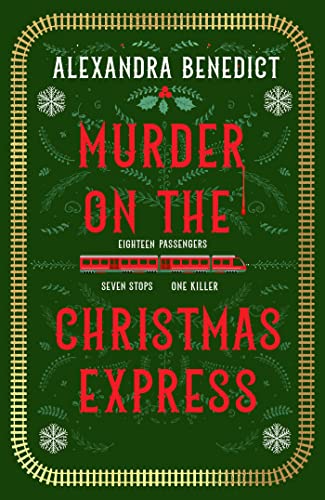
2022/139: Murder on the Christmas Express — Alexandra Benedict

"It's about every person who has been made to feel like nothing. Violated mentally and physically. Extinguished. How many on this train have gone through an experience where ... the next day they have curled up into a ball, and screamed silently into a pillow?"
"It's probably easier to say who hasn't." Roz's voice was very quiet. Very small. [loc. 2654]

It's the night before Christmas Eve, and the sleeper train to Fort William leaves Euston with a number of passengers on board, including a killer, a stowaway, and former Met detective Roz Parker. Roz is heading north to be with her daughter, who's gone into labour prematurely. Social media influencer Meg intends to propose to her partner Grant. There are four students competing for a place in a quiz team; a couple travelling with their teenage children; a lawyer who seems familiar to Roz; an elderly woman and her son; and of course the train crew. Somewhere after Edinburgh, in heavy snow, the train is derailed by a tree on the line -- and shortly afterwards, one of the passengers is found dead. They won't be the last ...

A homage to Murder on the Orient Express, laced with cryptic clues and Kate Bush references, and featuring a competent and interesting female lead (who remembers being a Goth as a teenager: she's 49: suddenly I feel ancient), this was an entertaining whodunnit with some clever plotting, a lot of misdirection, and a truly unpredictable ending. The isolation of the passengers, the fear setting in as the bodies mount up, the intersection of Roz's personal and professional lives, the mysterious 'killer' who is sometimes the narrator, but is not identified until very late in the story, the diversity of the characters, the secrets each of them hide -- all make for a well-plotted and well-paced novel.

However, the plot does depend on a lot of physical and emotional abuse of women. Nearly all the female characters have been victims of sexual assault. (None of this is 'on screen', but some of the descriptions are very vivid.) 'Trauma sticks to trauma', and memories become tangled together: Roz's recollection of giving birth is inextricably linked with her recollection of a previous assault. She's not the only passenger haunted by her past.

Despite this theme, Murder on the Christmas Express manages a happy ending (at least for some) and an unexpected but apt resolution. Still, I think I preferred Benedict's previous Christmas crime novel, The Christmas Murder Game.

Thanks to the publisher and Netgalley for the advance review copy, in exchange for this full honest review. UK Publication Date is 10th November 2022.

It's time we stopped saying what we 'should' or 'shouldn't' do. They should stop raping us. [loc. 2841]

Monday, October 24, 2022

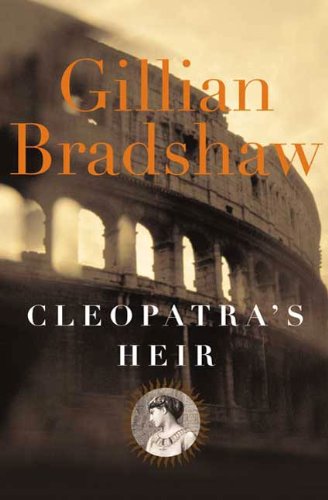
2022/138: Cleopatra's Heir — Gillian Bradshaw

“Where did you acquire a conscience?” asked Octavian. “It was bred out of your mother’s line long ago.” [p. 415]

I decided to read this whilst I was in Egyptian mode, following Cleopatra's Daughter: I was surprised to find that it also resonated strongly with A Confusion of Princes. Indeed, it has pretty much the same plot as the latter -- though a very different setting, and a different emotional landscape. (Both, it seems, owe a plot-debt to Kipling's Captains Courageous, which I haven't read.)

Caesarion, son of Cleopatra VII and Julius Caesar, wakes up on his own funeral pyre: he had a seizure when the camp was attacked by traitors, and has been left for dead. He eludes the half-hearted guards and makes his way to the caravan trail, where he's found and tended by an Egyptian trader named Ani. Caesarion, unaccustomed to dealing with the lower classes (he was a king!) tells Ani that his name is Arion, and proceeds to display all the arrogance, entitlement and prejudice with which he's been inculcated from birth. Ani is remarkably tolerant, and (very gradually) Arion becomes less arrogant. Once he's recovered from his wounds he's actually useful to Ani and Ani's family: literate, Latin-speaking, and well-informed, he can discuss poetry with a Roman general, write letters introducing Ani to trading partners, and entertain Ari's children with tales of Alexandria before the Roman conquest.

I didn't love this as much as Island of Ghosts (one of the most enjoyable historical novels I've read in years) but it was an engaging read. Though I disliked Caesarion in the initial chapters, I was drawn into his story as he began to adjust to his new, lowlier status, and the loss of all he'd known or anticipated. Though there is constant peril here, there's also humour and warmth. In Ani's family, Arion finds something he's been missing all his life. Perhaps that's what gives him the strength to face up to enemies, traitors and even his second cousin...

Bradshaw's Afterword explains her approach to the story: she 'came reluctantly to the conclusion that Cleopatra was a nasty piece of work, and that her son wouldn’t have been much better' (p. 444). Arion's epilepsy (the 'sacred disease' which Caesar also apparently suffered -- here an additional indication that Caesarion truly was Caesar's son) is depicted with sensitivity: be warned, though, that Arion's haunted by nightmarish visions of medical horrors, which he relives during his seizures.

Sunday, October 23, 2022

2022/137: Cleopatra's Daughter — Jane Draycott

Cleopatra Selene is an historical figure who should be much better known, particularly by young women of colour who look for someone they can personally identify and engage with in the historical record. [loc. 125]

I was only vaguely aware of the existence of Cleopatra Selene, daughter of Cleopatra and Mark Antony: I hadn't appreciated the arc of her life, from Egyptian princess to Roman prisoner to African queen. Draycott's biography, whilst admittedly a 'qualified reconstruction' rather than a rigorous examination of historical evidence, is an eminently readable account of the known facts, and the probable truths, of Cleopatra Selene's life. While there is little information about her childhood, there is ample information about aristocratic children in Rome around that time; though there are no records of her life in Alexandria, archaeological and historical evidence allows Draycott to describe city life in the first century BCE.

After the deaths of their parents, Cleopatra Selene and her brothers Alexander Helios and Ptolemy Philadelphos were taken to Rome to be raised in the household of Octavia, wife to Antony and sister to Octavian whose naval defeat of Antony and Cleopatra orphaned the three children. (Caesarion, Cleopatra's son by Julius Caesar, had already been killed: if he'd lived, and the war hadn't happened, he'd have ruled with Cleopatra Selene as his sister-wife.) The two boys vanished from the historical record shortly afterwards: in Draycott's view, it's at least as likely that they contracted some disease as that Octavian had them killed. Cleopatra Selene survived, though, and at age 15 was married to Juba II of Numidia, an African prince. The two became co-rulers of the Roman client kingdom of Mauretania -- co-rulers rather than a king and his consort, evidenced by coinage issued in both their names. Cleopatra Selene died relatively young, at 35, allegedly during a lunar eclipse. Her only son, Ptolemy, ruled Mauretania with his father and then alone until he was executed by Caligula.

Draycott is keen to draw parallels between Cleopatra Selene's time and the modern world. She's careful to stress that our concepts of 'race', 'nationality' and so on aren't applicable to the ancient world: however, prejudice, appropriation and misogyny are very much in evidence both then and now. Whilst prisoner, or adoptee, in Rome, Cleopatra Selene would have been exposed to 'Egyptomania, a process of cultural appropriation whereby Egyptian motifs were reworked for this newfound Roman audience and became extremely fashionable as a result' [loc. 1933]; I was reminded of the interest in ancient Egypt sparked by Napoleon's campaign in the early 19th century. Draycott's comparisons of ancient and modern life are usually apt: I was struck by her mention, during the passage discussing the triumphal procession in which the children were paraded through Rome, of Princes William and Harry walking behind their mother's coffin. There are also references to Meghan Markle's treatment by the British press, and to the surprising popularity of Cleopatra Selene (and her romance/political alliance with Juba) on social media. While occasionally the modern-day contextualisation jars ('Antony was keen on cosplay throughout his life') it's generally well-observed and will likely make the book more accessible to younger readers, and to those without a grounding in ancient history or the classics.

Fulfils the ‘Addresses a specific topic’ rubric of the 52 books in 2022 challenge.

Thanks to the publisher and Netgalley for the advance review copy, in exchange for this honest review. UK publication date is 10 November 2022.

Saturday, October 22, 2022

2022/136: Greywaren — Maggie Stiefvater

The world he had built with Ronan Lynch. A world of limitless emotions and limited power. A world of tilting green hillsides, purple mountains, agonizing crushes, euphoric grudges, gasoline nights, adventuring days, gravestones and ditches, kisses and orange juice, rain on skin, sun in eyes, easy pain, hard-won wonder. [loc. 3256]

Concluding the 'Dreamer' trilogy that began with Call Down the Hawk and continued in Mister Impossible. I am still assimilating, and will probably reread quite soon: in some ways Greywaren resolves or explains a great deal of what has gone before (not only in the Dreamer trilogy but in the Raven Cycle), but in others it left me vaguely unsatisfied.

At heart it's the story of the three Lynch brothers: Declan, who would like to be able to lead his own life; Ronan, who can manifest objects (and people) from dreams; and Matthew, who exists solely because of his brothers. It's also the story of their parents, Niall and Mór Ó Corra (nee Marie Curry); or possibly of the man calling himself 'the new Fenian' and the woman they all knew as Aurora. And it's the story of 'Jordan Hennessy', who is a dreamer and also a dream.

There are a lot of complex relationships in Greywaren, and a lot of transactional interactions. Adam gives Ronan back his watch (no, no, thinks Ronan, but is unable to speak); Liliana gives Carmen a revelation that explains the apocalyptic visions driving the Moderators; Bryde gives Declan's brothers back to him. Nobody comes out of this novel unchanged: everyone is transformed. And everyone, I think, loses something they thought was important.

I think I'll need to reread the trilogy as one long book -- which it surely is -- in order to understand all the nuances and twists. But I love Stiefvater's blend of profanity and profundity: I love the sense of a wider universe opening up, in the Forest and beyond: and I love the final scene, friends reunited, promises made, tranquility attainable.

Friday, October 21, 2022

2022/135: A Confusion of Princes — Garth Nix

All I had to do then was get along with a group of people who I still, at heart, thought were totally inferior and should do what I told them to do. Resisting this impulse took a lot of energy and thought, and one wearisome day a week later I told the two main shareholders in our little enterprise how I really regarded them. Five minutes later I had a very bruised face and was looking for another contract... [loc. 2071]

Khemri is special. Not because he's a Prince: one of ten million Princes who rule a wormhole-reliant galactic empire encompassing 'trillions of sentient subjects, most of them humans of old Earth stock'. Princes (the term is gender-neutral) are taken from their families as small children, if they have the requisite talents and abilities, and undergo a rigorous programme of physical and mental training and modification before they come of age and enter into competition with the other Princes. Khemri survives multiple assassination attempts within the first few hours of being a Prince. Luckily, he has an extraordinarily gifted Master of Assassins to protect him, and acquires more staff rapidly. This must, he reasons, be because he has been Chosen. Every twenty years the Emperor abdicates and a new Prince ascends the throne. It's nearly abdication time: can Khemri survive the training scenarios and the attentions of his fellow Princes for long enough to have a chance at supreme power?

The Empire, though, is not what it seems: Khemri slowly realises that a lot of what he's been taught is not wholly accurate. He encounters normal, unmodified humans who have little to do with Princes: he fights, and dissembles, and falls in love, and grows up into a rather more likeable person than he was at the outset.

This YA novel is good old-fashioned space opera, with some of the flaws of that genre. The romance, in particular, felt contrived, and though the scale was epic, the worldbuilding felt thin in places. There were plenty of indications that Khemri's understanding of the Empire was incomplete, but mostly this aspect of the story faded out without resolution. I'd have liked more about the Empire's enemies and the abandoned systems and the whole 'immortality' thing. That said, A Confusion of Princes was great fun, a solid YA narrative that focusses on the evolution of Khemri from arrogant Prince to relatable human being: it would make an excellent film. Plenty of scope for sequels, too.

Wednesday, October 19, 2022

2022/134: A Thief in the Night — K J Charles

I did think I might make you stand, and then deliver..."

Novella-length audiobook, narrated by James Joseph and Ryan Laughton.

Toby, the eponymous thief, encounters a gentleman named Miles Carteret in a rural inn. They like the look of one another, and repair to the shadowy alleyway behind the inn to act on that attraction. On parting, Toby helps himself to Miles' watch and pocketbook and congratulates himself on a very satisfactory evening. Sadly, whilst pretending to be a snooty valet some days later, he discovers -- a beat too late -- that his potential employer is none other than Miles, who turns out to be the impoverished Earl of Arvon. Miles is trying to clear out the family home after the death of his estranged father. It's possible that the key to the family fortune is hidden amid the hoarded bills and ephemera -- and that Miles' father had not, after all, given up on his son.

This was a pleasant romance with quite a slow burn, though the pace picked up massively in the last couple of chapters. Miles and Toby were both likeable, both flawed, both haunted: daddy issues, Toby's lost siblings (who are the protagonists of The Gentle Art of Fortune Hunting), Miles' triumph over his gambling addiction. I'd have liked a bit more backstory for them both (more about Miles' time as Captain Carteret in the Peninsula, and Toby's previous escapades) but the story, and the romance, worked well without this.

I don't think audiobooks suit me at all well, though. I managed to finish this whilst recovering from my covid booster jab, when I felt too rough to read print, but kept losing track and restarting. I confess the dual narration didn't really work for me, either. Partly this was due to mispronunciations ('Miss Earliness' for miserliness; 'stifled' with a short 'i'; different pronunciations -- neither of which quite worked for me -- of 'Little Gilling', a fictional village), which jolted my attention and distracted me from the story. Partly, too, I didn't find the 'Toby' narrator's voice quite fitted the character: too young and submissive. I suspect I will have a different experience when I read the ebook, due in 2023.