Proto-Anatolian and Proto-Indo-European split from an older language spoken by people who did not know the wheel and so had no word for it. Each of the two daughter branches acquired their wheel words later, after they had separated. Logically, then, those words bore no relation to each other. [loc. 1492]
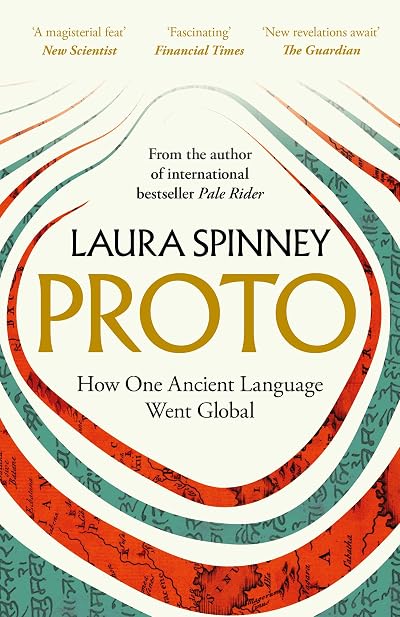
Proto-Indo-European (PIE) is the reconstructed common ancestor of all Indo-European languages -- a group of languages spoken by almost half of the global population. Spinney traces its roots to the Yamnaya, steppe nomads who spread across Eurasia about five thousand years ago. She discusses the archaeogenetics of the Yamnaya and the likelihood that the language they spoke -- or at least spread -- was a trade-oriented lingua franca. There's also fascinating discussion of the linguistic elements of PIE, and how and when other languages developed or split from it. And the newer languages also acquired loan-words from local, now-lost languages as the migrations spread.
There is a great deal of interesting material here: on how long a language takes to evolve into a new one (likely less in preliterate cultures); how echoes of lost languages survive in modern ones (for instance 'the French way of writing ‘eighty’ as ‘four-twenties’ (quatre-vingts), is a relic of Gaulish vigesimal counting in the otherwise decimal Roman system' [loc. 2341]); that Scythians travelled in carts with their cats (I must know more!); that there's a replica of the Nebra sky disc on the International Space Station; that all languages have 'prohibited' consonant pairings (such as 'dv' in English) and 'people don’t even hear the combinations that are forbidden in their native language' [loc. 2969].
In the final chapter Spinney discusses the war in Ukraine -- 'in part, a war over language – over where the russophone sphere begins and ends' -- and its impact on the archaeology of the region. The site where the oldest Yamnaya remains were found was flooded by the Kakhovka Dam in 1956, but the dam was destroyed in 2023 and the site may be accessible again, one day.
Spinney writes about how language, technology (such as farming and smithing) and genes are interconnected. Throughout the book, she doesn't lose sight of the people who spoke the languages she discusses: their stories, their preoccupations, their beliefs.
We know that ancient people looked at themselves in mirrors. We don’t know what they saw. [loc. 3492]
Read because: I, a monoglot with a tin ear for spoken language, am fascinated by linguistics and by prehistory.
No comments:
Post a Comment