Wednesday, July 29, 2026

2026/110: As We Fall Through Time — Claire North

Every time traveller who has ever trodden on a butterfly has created a ripple through time. These ripples make more ripples which make more travellers, the snake swallows its tail... [loc. 694]

Cal is a time-traveller, and something of a paradox: sometimes male, sometimes female. He encounters Olivier, a French soldier, in 1789, and falls in love. Which seems to be somehow connected to the temporal paradox sparked by fellow time-traveller Fadimatu encountering her own corpse in The Museum of the Unmasked Conspiracy...

This is a love story, a story of climate activism, and a murder mystery. It's narrated in first person by a mysterious observer. Time is infested with ghosts and witches, 'fathomless creatures of unlived realities': paradoxes can be healed, or at least ameliorated, by paradoxical objects ('amaranthines') such as a ceramic flower that did and did not crack in the kiln.

I am already looking forward to rereading this next month for the full review...

Read because: Claire North has become one of my favourite authors -- from the 'Songs of Penelope' trilogy to the awesome Slow Gods. Obviously I read this as soon as it landed on my Kindle... Thanks to the publisher and Netgalley for the advance review copy, in exchange for the full honest review I'll write nearer UK Publication Date -- 10th October 2026.

Friday, July 24, 2026

2026/109: Apollo 13 — James Lovell / Jeffrey Kruger

I’m afraid this is going to be the last moon mission for a long time.

Initially published as Lost Moon and retitled to tie in with the movie Apollo 13, this is Jim Lovell's account -- with Jeffrey Kruger's wealth of background research and synthesis -- of the NASA mission that would have been the third Moon landing. It's not just a minute-by-minute account of the accident and the return, both on board the spacecraft and back at Mission Control, but also a biography of Lovell: there are vignettes featuring other people impacted by the events (such as the spacecraft recovery specialist aboard the USS Iwo Jima), and a detailed account of Marilyn Lovell waiting at home with their children, supported by friends and neighbours.

I found this compelling listening: it's extremely well paced. The technical details of the damage to the Service Module, and the ingenious workarounds developed by crew and Control, are explained clearly for a non-technical audience. The constant stress of the four days after the explosion (which vented most of the oxygen to space, and forced the three-man crew to take refuge in the Lunar Module which had been designed to support two men for two days on the surface of the Moon) is clear, but there's never false drama.

The crew's levelheadedness did occasionally falter, but only in throwaway comments. (I suspect Kruger relied heavily on the log transcripts.) And I found the dogged perseverance of Mission Control uplifting and inspirational. It's also amazing to me that the mission was completed -- not only on the ground, but in the spacecraft -- with less processing power than my smartwatch. (See Reddit for discussion).

Narrated very well by Fred Sanders, whose voice I found pleasant and who injected humour into the lighter interludes, and didn't speed up when things became tense.

Read because: I don't quite remember this happening (unlike some of my friends), but it's been part of my cultural background for most of my life. I realised I knew very little about the disaster, though I did know it hadn't ended in tragedy. And the NASA space program, at its height in the '60s and '70s, is exciting.

Thursday, July 23, 2026

2026/108: Dragon's Fin Soup — S P Somtow

...in this town, there’s no distinction between the real world and the world of illusion. It’s the only place in the world where all truths are true at the same time. [p. 264]

Subtitled 'Eight Modern Siamese Fables', these stories are set in Thailand -- mostly Bangkok -- at various points in the late twentieth century, and typically deal with the culture clash between Thai and Western culture, with flourishes of the fantastic. I especially liked 'The Steel American', about a knight seeking the Grail in a small village, and 'Fiddling for Water Buffaloes', a cheery tale of an American anthropologist, the trade in fake antiquities, and possible alien invasion. 

Some of the other stories felt dated: sexist, cyberpunk-inflected, plain body-horror. And the text is not formatted well in this edition.  In some of the stories it looks as though a draft version, complete with markup and comments, has been used.

But when it's good, it's very good: the little details of domestic life, the prevalence of belief in spiritual entities (good and otherwise), the juxtaposition of ancient and modern. I intend to read more of Somtow's work, having (I think) bounced off some of his horror fiction in the 1990s.

Read because: Many of S P Somtow's books are available on Kindle Unlimited, and I wanted to fill a challenge prompt -- 'by a Thai author or about Thailand'. This one looked interesting and accessible, and fulfilled both aspects of the prompt.

Tuesday, July 21, 2026

2026/107: The Georgian Star — Michael Lemonick

Herschel... followed his own ambition, which was nothing less than to understand the universe, to figure out its overall structure and composition. [loc. 180]

A comprehensive overview of the lives and work of William and Caroline Herschel, covering not only their astronomical accomplishments (which are many) but their previous careers in music -- William was a professional musician and composer, and Caroline a soprano who performed some of his works. 

Born in Germany, William emigrated to England in 1757, and Caroline joined him in 1772. At this point Herschel had already become interested in astronomy, and roped in his sister as assistant. They built telescopes (Caroline grinding the lenses and polishing the mirrors) and recorded their observations, which were considerably more meticulous, detailed and accurate than those of their peers. 

William discovered Uranus, though he thought at first it was a comet: on realising it was a planet he proposed the name Georgium Sidus, hoping this would attract royal favour and the post of Astronomer Royal. Caroline, meanwhile, discovered multiple comets and some Messier objects that Messier had missed.

Lemonick doesn't assume too much in the way of scientific knowledge or understanding: I was grateful for the clear explanations of theories and methods, though more astronomically-minded readers may feel these are overly basic. The Georgian Star succeeds in presenting a rounded picture of the Herschels as scientists and as human beings, and setting out the importance of their work in modern astronomy. I liked the argument that Herschel's approach was radical: that he was more a cosmologist than an astronomer, and realised that his desire to understand the universe could only be achieved by close observation. I was also amused to read that (like many of his contemporaries) he believed the planets, and the Sun, were inhabited. 

The audiobook was read by Paul Boehmer: somewhat monotone, but no weird pronunciations or false amusement!

Read because: I'm interested in astronomy, and in Caroline Herschel, and this was on offer on Libro.fm.

Monday, July 20, 2026

2026/106: The House That Eats the Dead — Max Doty

I curled up in a chair with ... a copy of a book on tidying by Marie Kondo. ... it would be good to get rid of some things. Maybe the house would help me.
I went to put down my book and found my hand empty. Marie Kondo was gone, tidied into oblivion. [loc. 623]

Claire and Tom Morgan, with their delightful children Grace (6) and Derek (15), and their dog King, move from the urban frenzy of San Francisco to a leafy suburb. Their new home seems perfect, though food seems to rot quickly and flowers wilt in hours. Gradually, Claire realises that the house devours anything organic -- but only if it's dead. She and her children are safe, and nosebleeds get cleaned up instantly. And only the owners of the house remember anything that has been eaten.

At first this seems convenient, even benevolent. The house has eaten Grace's favourite soft toy, but she doesn't remember loving it, and a tearful crisis is averted. Later, Claire and Tom decide that the children would be better off not remembering that they'd ever owned a dog...

Claire is the protagonist, a stay-at-home mother (formerly an artist) experimenting with the house's powers, and treating it as an individual. She brings it cow hearts to stop it eating the food in the fridge: she paints with organic paints, and the house finds a way to tell its story. Claire has a traumatic past, and so does the house -- which is very much a character in the novel, though it never speaks ... at least not to Claire. It affects each of the Morgans in different ways: Grace likes the stories it tells, Tom finds it helpful in climbing the corporate ladder, Derek's self-confidence grows, and Claire is painting again...

I was reminded of Stephen King's Pet Sematary, which also features a family discovering a supernatural phenomenon and being altered by their use of it. But this is a more mundane narrative: a family drama with horror elements, rather than a story of demons and tragedies. Which isn't to say that there aren't deaths, and bad decisions -- but the impulse behind both is human rather than occult.

It took me a few chapters to get into this novel, because Claire is not immediately likeable: but once the plot started escalating I was gripped. I liked the morally grey characters, the vaguely-sketched backstory, and the family dynamics, and I found Claire's ethical dilemmas fascinating. Would I have done the same?

Thanks to the publisher and Netgalley for the advance review copy, in exchange for this full honest review. UK Publication Date is 13th August 2026.

Read because: The publisher invited me to read this, on the basis of my having enjoyed other Tor Nightfire titles.

Thursday, July 16, 2026

2026/105: My Best Friend's Exorcism — Grady Hendrix

For the Langs, Madonna was totally and completely out of the question. But when Gretchen's dad was at work and her mom was taking one of her nine billion classes (Jazzercise, power walking, book club, wine club, sewing circle, women's prayer circle), Gretchen and Abby would dress up like the Material Girl and sing into the mirror. Gretchen's mom had a jewelry box devoted entirely to crosses, so it was basically like she was inviting them to do it.

Set in Charleston in the 1980s, this is the story of two best friends -- Gretchen, from a well-off, conservative, religious family, and Abby, whose background is lower-income and rather liberal -- from elementary school to adulthood. It's full of 80s culture: big hair, Benetton perfume, fad diets, Madonna, personality quizzes, Halley's Comet ... and the Satanic Panic, which in this instance turns out to be justified. It's also packed with period-typical attitudes and behaviour (racism, sexism, homophobia, corporal punishment) which I remember being 'normal' back then, and find horrific now.

Abby and Gretchen are best friends. They attend the same school, and are friends (but not best friends) with constantly-dieting Margaret and class swot Glee. One night at Margaret's riverside home they take LSD, and Gretchen declares that she's going skinny-dipping. She vanishes, and the other three search for her all night, eventually finding her naked in the woods, saying she can't remember what happened. After that, Gretchen becomes a lot meaner, and Abby starts to wonder if her friend has been the victim of sexual assault. Then the Lemon brothers, charismatic preacher-types, do a show at the school, and Christian Lemon says he can see that Gretchen has a demon...

Issues of race, class, wealth are explored in the manner of a high school comedy-drama, but the story gets increasingly dark. Abby, though, is a resourceful and courageous protagonist, and the actual exorcism is a virtuoso blend of character, setting and cultural references. (It made me laugh, but it's also very emotional.) Yes, it's a horror novel, and there are some terrible scenes: but there is so much humour and ridiculousness that I could tolerate the nastier elements.

Interestingly, the novel doesn't stop with the exorcism. We see Abby and Gretchen growing up, changing, staying more or less friends for decades. I really liked that Hendrix showed us how their friendship changed and evolved as they grew older.

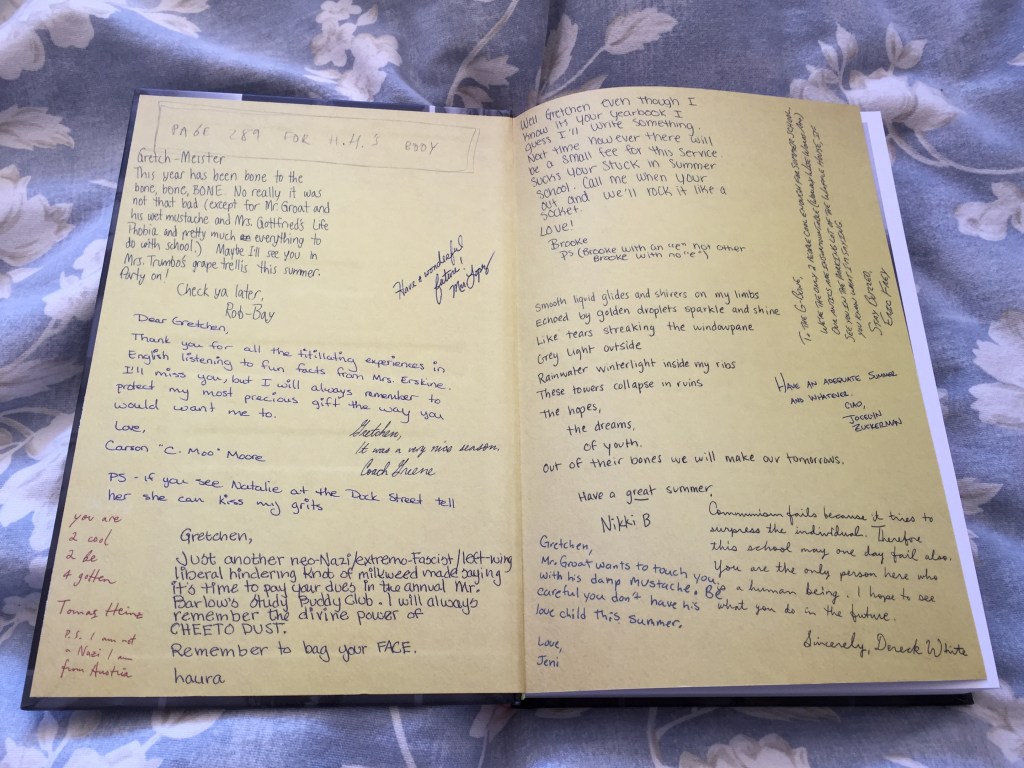
I listened to the audiobook, read by Emily Woo Zeller, whose narration was very engaging and emotional, to the extent that I sometimes had to pause the shriekier bits! Some aspects, however -- like the yearbook messages and newspaper clippings -- didn't translate well to audio format.

Read because: The book appeared in the Libro.fm sale a while ago, and having enjoyed The Southern Book Club's Guide to Slaying Vampires I snapped it up. I was in the mood for something very different from Neumeier's trilogy, and this certainly delivered.

Tuesday, July 14, 2026

2026/104: Tasmakat — Rachel Neumeier

When we ask the gods to be merciful, we have no idea what we’re asking. [p. 469]

After the events of Tarashana, Aras and Ryo travel back to the summer lands -- via a wedding -- and to the king's judgment. Aras seems sanguine on the long journey from the winter lands (a journey which I now realise comprises more than half of the novel) but there's a strong possibility that the king will have him executed.

Instead, he sends Aras and Ryo to the Land of Two Suns, ruled by the Ro-Antalet (sphinxes), where the envoy Tasmakat (a jackal-headed woman) has suggested there might be an adept who can lighten the sorcerous madness that is beginning to afflict Aras, and break the bond -- the 'leash', as the Ugaro call it -- between Aras and Ryo.

Of course it is not that simple.

This novel is packed with thorny issues of loyalty, honour and mercy. Ryo is strong and stubborn, but can he prevail against madness? He has to contend with false memories and guard his mind (though he's already proved he can mask his thoughts): he's sorcerously altered to withstand the tremendous heat of the Two Suns ... and all the while he worries about what's happening in the winter lands, what's happening with his wife and her other husband.

Intensely emotional, sometimes very dark, sometimes unevenly paced: the climax of this novel is a triumph, and the finale hopeful. I enjoyed it very much despite sometimes wearying of the interminable journeying. And I'm keen to read more of the novels set in this world -- though perhaps not quite yet.

Read because: This concludes the Ryo-centric trilogy that started with Tuyo and continued with Tarashana -- I wanted to follow that story to its conclusion, especially while the events of the previous two books were still fresh in my mind.

Sunday, July 12, 2026

2026/103: Why We Swim — Bonnie Tsui

For many swimmers, the act of swimming is a tonic, in that old-fashioned sense of the word: it is a restorative, a stimulant, undertaken for a feeling of vigor and well-being. The word tonic comes from the Greek tonikos, “of or for stretching".

Read by Angie Kane. I spotted this in the Libro.fm audiobook sale and thought it looked intriguing: I didn't expect such a comprehensive survey of the history of swimming, from prehistoric times (I was especially fascinated by the chapter on the likelihood that the humans at Gobera swam in their lake) to modern competitive swimming.

Tsui covers five major reasons to swim -- survival, well-being, community, competition and flow. She discusses how various communities throughout history have adapted to swimming -- for instance, free-diving fishers in south-east Asia and Japan, or 'human seal' Guðlaugur Friðþórsson who survived six hours in 5o water -- and the ways in which swimming has been used and recommended as a therapy for centuries. She describes the creep of racial segregation in twentieth-century America, reducing access to swimming for non-white Americans. It's not just a leisure issue, but a question of being able to swim -- being able to avoid death by drowning.

I learnt about samurai swimming, and was inspired by the accounts of people who've overcome major physical challenges via the 'salt water cure' -- sea-swimming. "Being in the ocean, you can become part of the food chain at any moment," writes Tsui. (In 21st-century Britain you are, sadly, more likely to encounter the end product of the food chain if you swim in the sea.) And Tsui's mention of Lewis Pugh, who swam across the North Pole to highlight the climate catastrophe, led me to some videos that I swear will cool you down on the hottest of days.

Reading this book made me want to swim more often, especially in rivers and the sea. I already know it improves my health, mentally and creatively as well as physically. 

Read because: I am a keen swimmer and was intrigued by this history of swimming.

Thursday, July 09, 2026

2026/102: Tarashana — Rachel Neumeier

I think everyone behaved courageously and honorably, until courage and honor were not enough. [p. 328]

Second in the 'Tuyo' arc, despite it being book number 3... A year and a half after the events of Tuyo, Lord Aras is encountering some political issues in the summer lands, where Ryo still serves him. A reprieve of sorts is offered when a message comes from the winter country, asking for Aras' help. Apparently a Tarashana woman (from another cosmological realm, beyond the winter lands, lit only by starlight) has approached the Ugaro: she seems to be mute but clearly needs help of some kind. Can Aras (and Ryo) assist?

Cue an expedition through the winter lands -- with various Lau allies, including the excellent Lalani -- and a chance to see Ryo in his homeland, with his people. After they leave the Ugaro and cross the steppe, the world becomes very much stranger: ghost tigers, paths that don't lead where they appear to, and the horrors that the Tarashana woman has fled from. Some appalling things happen, especially at the book's climax. Honour, respect, trust and kindness prevail, eventually. And Aras and Ryo have some difficult conversations.

Also, Ryo wants to get married, but there's competition...

This is a vast book, 700-odd pages in print, and I did occasionally feel that some passages weren't essential to the plot. But every action, every reaction, every line of dialogue matters... And when the bad things happened I could not stop reading, because Neumeier knows how to play arpeggios on my heartstrings. The plot here -- and the worldbuilding -- feel more complex than in Tuyo, and as soon as I'd finished this I went on to the third of the Ryo-centric novels...

Read because: Having finished Tuyo, I wanted to see what happened next: I like the characters and am intrigued by the worldbuilding.

Tuesday, July 07, 2026

2026/101: Tuyo — Rachel Neumeier

Every man is glad to stop looking for the truth when he’s handed a lie he likes better. Sorcerers are no different in that. [p. 129]

Ryo InGara is nineteen years old, a warrior of a nomadic tribe that dwells in the winter country. At the beginning of Tuyo, he's been left as a kind of sacrifice to the opposing army -- the Lau -- in a minor skirmish: he expects to be killed slowly and painfully, and it is a matter of honour that he meets his death bravely.

Instead, he finds himself given guest-right by his captor, Lord Aras Eren Samaura, who says that Ryo is more useful alive than dead. Aras is trying to determine the cause of the recent unrest between the Ugaro (Ryo's people) and the Lau (Aras' people). He suspects sorcery is involved -- and Ryo comes from a culture where sorcery is punished by death. Ryo does indeed encounter sorcerers, plural: his memories are changed without his consent, and only his own strength of will -- and his trust in Aras' essential good nature -- saves him.

What I liked most in this novel was Ryo's narrative, and the close examination of the changing relationship between Ryo and Aras. (NB This is not a romance.) Neumeier depicts the minutae of Ryo's emotional landscape, and the evolution of his understanding of Aras, credibly and without sentiment.

The worldbuilding is fascinating, too: it's clear almost from the start that this is a radically different cosmology. A river separates the winter lands of the Ugaro from the summer lands of the Lau. In the winter lands, the moon is always full, but in the summer lands it ('she', the goddess) has phases. There are stories of another land beyond the winter land, lit by starlight, and a sunless sea; and Aras has travelled beyond the summer land, where jackal-headed sorcerers dwell. 

One brief complaint: there is a great deal of story-telling in this novel, but we don't get the stories themselves.

Ryo and his culture reminded me of Ariantes, the Sarmatian narrator of Island of Ghosts, one of my favourite novels: I was pleased to read Neumeier's post on that novel, which acknowledges it as an influence.

Read because: I'd read a sample after seeing it recommended (and I'd already enjoyed The Year's Midnight by the same author). Amazon stealthily offered me a month of free Kindle Unlimited, and I bit.

Sunday, July 05, 2026

2026/100: The Killing Time — Elly Griffiths

It’s hard enough being a woman in 2024, what must it be like when you’ve almost no agency and are imprisoned by your clothes? [loc. 3368]

In this, the second of the Ali Dawson time-travel thrillers, Ali is confounded by bureaucracy. After the problems of her previous expedition to 1851 -- and the disappearance of star physicist Jones, presumed lost in the nineteenth century -- the Cold Cases Unit is banned from further excursions. 

Ali distracts herself by investigating the contemporary case of a young man who fell to his death after being told by a charismatic psychic that he could fly. Prepared to find a fraud, Ali is unnerved when the psychic, Barry Power, seems to convey a message from Jones. And Ali already knows that she'll return to the 1850s... though she doesn't expect it to happen when she's trying to go back just a few minutes to close the cat flap and prevent her beloved kitty from escaping. 

This excursion was less harrowing than the first, although I was anxious about Terry the cat. (Naturally he has landed on his feet.) And there are hints of the directions the series might go: the connections between the members of the Cold Case Unit, Ali's romantic entanglement, the collective unconsciousness, Jones' new life. I remain intrigued. 

Read because: I enjoyed The Frozen People, and was eager to discover what happened next...

Saturday, July 04, 2026

2026/099: Around the World in 72 Days — Nellie Bly

"It is impossible for you to do it... In the first place you are a woman and would need a protector, and even if it were possible for you to travel alone you would need to carry so much baggage that it would detain you in making rapid changes. Besides you speak nothing but English, so there is no use talking about it; no one but a man can do this."
"Very well," I said angrily, "Start the man, and I'll start the same day for some other newspaper and beat him." [chapter 1]

Inspired by Jules Verne's novel (and desperate to write about something interesting), New York World reporter Nellie Bly suggested to her editor in 1888 that she might attempt to recreate the fictional journey of Phineas Fogg. (Her editor's initial reaction is quoted at the top of this review.)

Bly's only luggage was a single bag: she'd commissioned a lightweight dress, but refused several society invitations on her travels due to lack of the proper attire. She sailed to England, then took the boat train to France, where she met Jules Verne himself; then another train to Brindisi, a ship through the Suez Canal, a stay in Ceylon: then Singapore, Hong Kong, China, Japan, a Pacific crossing, and a breakneck railway journey on a specially-commissioned train -- greeted everywhere by cheering crowds -- from San Francisco to New York. 

Her account is generally witty and gossipy, poking mostly-gentle fun at fellow travellers. Obviously, it's also packed with period-typical racism and some old-fashioned attitudes. Occasionally she encounters an importunate gentleman, who she dismisses with charm. She's quite rude about British trains, but who isn't? And she does go into a little too much detail about Japanese executions.

And she leaves a lot out. In Hong Kong she's told of a contender in the 'race', another reporter who has set out to beat Bly's time. "I will not race. If someone else wants to do the trip in less time, that is their concern," she declares. And we never hear anything more about the competition -- or Elizabeth Bisland, who travelled in the opposite direction (setting out across the Pacific, returning across the Atlantic) and made the trip in 78 days. 

I would have liked more about the mundane problems -- did she wish she'd packed more clothes? what were the sanitary facilities like? did she like any of those importunate men? -- but nevertheless this was a fascinating account of travel and travellers in the 1880s.

The Librivox audiobook, which is in the public domain, was excellently narrated by Mary Reagan, whose voice suited Bly's light tone very nicely. There's a good summary here, which also includes context lacking from Bly's sometimes-breathless account.

Elizabeth Bisland's memoir of her trip is also available as a public-domain audiobook.

Read because: it fills two challenge prompts -- non-fiction published before I was born, and a work written in the nineteenth century. Bly's journey took place in 1889, and her account of it was published in 1890.

2026/098: The Frozen People — Elly Griffiths

‘Whatever you do, don’t trust Dickens.’ [loc. 696]

Ali Dawson is fifty years old, with fire-engine red hair and a son who's working as a special advisor to Isaac Templeton, a Tory MP. Ali herself works for the Cold Case Unit -- 'so cold they're frozen' -- which uses a top-secret time-travel device to investigate crimes.

Ali's first experience of time travel, in the first weeks of Covid lockdowns, went smoothly: she and her companion travelled back a single week, weren't visible to those around them, and returned to their present once they'd worked out that they had to stand exactly in the spot they'd arrived. Sent back to 1850s London to clear the name of Isaac Templeton's ancestor, things fall out rather differently.

There was a lot to like here: Ali's discoveries about Cain Templeton, presumed murderer, and the Collectors' Club of which he's a member; Jones (a.k.a Serafina Pellegrini), the brilliant Italian physicist who developed the time travel device; the subplot involving Finn; Ali's Siamese cat Terry (even though I hope the description of him as 'sleek teal' is a misprint). As long as I didn't think too hard about the time travel -- and the likelihood of it being used to solve crimes, rather than for military or criminal purposes -- my disbelief stayed manageable. And there's enough of a cliffhanger that I went straight on to the second in the series...

Read because: I'm a big fan of Griffiths' Ruth Galloway mysteries, and had bought this some time ago... then the second in the series showed up as a Daily Deal, and friends waxed enthusiastic about this first volume. After reading, it fitted nicely into a challenge prompt -- 'suspension of disbelief'!