Sunday, March 29, 2026

2026/052: The Sapling Cage — Margaret Killjoy

“Regardless of how we're born, we get to decide who we are and who we want to be.”

Lorel has always wanted to be a witch. Growing up in her small village, and helping her mother run the stables, is not the life she wants. But there's one problem: she was born in a male body, and there are stories of what the witches do to men who try to infiltrate their ranks.

Luckily her friend Lane, promised to the witches from birth, is determined to be a knight instead -- so Lorel takes Lane's place, while Lane heads off to the city. Loren, meanwhile, has to contend with being called a 'whelp' (the witches' term for apprentices) and walking all day. And of course she can't bathe with the other girls, despite making tentative friendships with some of them. Meanwhile, a magical blight is killing trees in the forest and disrupting the natural order. [NB: As a British reader, I found the term 'blighters' insufficiently villainous. This is a term for a nuisance, not an existential threat.] And the country as a whole is being threatened by an ambitious duchess, who's moving in on the vacant throne -- much to the disapproval of the witches (who are pretty anarchic) and the Ilthurian Knights (who are, delightfully, even more so).

The novel is presented as Lorel's first-person viewpoint, which does mean that some of the other characters are a little two-dimensional. I found the pacing uneven, and I would have liked a little more detail on the world in which Lorel and the witches are adventuring. Instead, there was more telling than showing.

But there's a lot to like. I enjoyed Killjoy's subversion of common fantasy tropes -- the knights, the nobility, the patriarchy (there was little sense of this being a patriarchal society: women seemed as empowered, or disempowered, as men of the same class.) Lorel is a seething mass of resentment, romance, ambition and hubris (100% accurate teenage mindset) which was sometimes a little wearing, but she is also brave, loyal and determined. It's a queernorm world, more or less, and Lorel is attracted to both male and female characters: she's not the only queer character, either, and learning about the different issues which others have faced is part of her growth.

Good narration by Jackie Meloche, who was great with character voices and pronunciation -- though I'm not sure why 'Dame' was pronounced 'Dam', and I spent much of the book wondering if one character was really called 'RNA' (no, it's 'Araneigh').

Saturday, March 28, 2026

2026/051: The Library at Mount Char — Scott Hawkins

“You shall be the thing [X] fears above all others, and conquers... Your way shall be very hard, very cruel. I must do terrible things to you, that you may become a monster." [p. 355]

On Labor Day, 1977, in the sleepy American suburb of Garrison Oaks, Carolyn's life changed. She and a dozen other children were orphaned, their homes obliterated, and they were adopted by 'Father'. Father, who seems very powerful, tells the children that they are Pelapi -- an old word that means 'librarian, but also apprentice, or perhaps student' -- and assigns each of them a Catalogue. Carolyn's Catalogue is language: all languages, human and otherwise. ("What if I don't want to?" she asks Father. "It won't matter," he replies. "I'll make you do it anyway.") 

And so Carolyn grows up in the Library, studying and learning to live with the other Pelapi. Nobody is allowed knowledge of anyone else's Catalogue: this is a crime with appalling punishments. Time passes, but perhaps not chronologically. And then Father vanishes, and David (whose Catalogue is war) convenes the Pelapi to try to discover whether Father is dead. And if he is, which of the other powers -- eldritch beings whose ascendance would mean the end of complex life, and possibly also the sun -- will take his place?

This is not a novel for the faint-hearted: there are some truly harrowing scenes. And it's not a novel for the easily distracted, as it's fast-paced, told out of sequence and includes a labyrinthine plot that even the plotter can't think about (due to some of the others being mind-readers). The story is peppered with foreshadowings, and with asides that indicate a very different, and decidedly more horrific, history than the one we think we know. Luckily there are a couple of Everyman characters -- wanna-be Buddhist plumber Steve, and career soldier turned special agent Erwin -- to temper the extreme weirdness and growing inhumanity of Carolyn and her siblings. 

For they are, in their various ways, losing whatever human emotions they possessed when Father brought them to the Library. Carolyn knows all languages but is laughably bad at actual communication. David is certain that violence solves every problem, and enjoys killing. Jennifer, the healer, uses drugs to soften her world. And Margaret hangs out with the dead...

The horror elements are extremely horrific: The Library at Mount Char is told, though, with black humour and a strong sense of the ridiculous. The characters are fascinating, though seldom likeable. Only near the end of the novel do we find out what really happened on Labor Day 1977: only after calamities have been averted and retribution awarded does Hawkins reveal, and conclude, the overall arc of the narrative.

Despite some pacing issues, and the ubiquitous sexual violence against strong female characters, it's a massively impressive debut novel (published in 2014: Hawkins' second novel is due in September 2026) and I would like to reread it at some stage. At least I'll be able to skip braced against some of the nastier scenes: and I'd like to see just how the overall plot is constructed, and appreciate the worldbuilding, without being distracted by atrocities.

Thursday, March 26, 2026

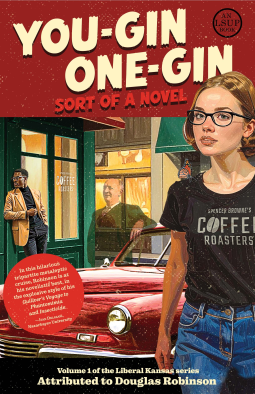
2026/050: You-Gin One-Gin — Douglas Robinson

"I met her on the alien spaceship."
"Oh really."
"Don't take that arch tone with me, Volodya. You're dead, remember? You don't get to be arch."
"What, there's a rule? You die, you forfeit your right to rise above a situation?"
..."Hell, I don't know. Be arch. You're Vladimir Nabokov. If you're not arch you're, I don't know, Raymond Carver."
"Anything but that," I say with a histrionic shudder. I've read his work. It feels as if he wrote it with a hammer. [loc. 3018]

A riotous, fast-paced, exuberant metafiction -- or 'sort of a novel', per the subtitle -- set at a (fictional) university in Liberal, Kansas. The story starts with a stage production of Pushkin's Eugene Onegin which not only breaks the fourth wall, but features Pushkin himself as a character. Theatre professor Kip Knurl is playing Pushkin, and his immersion in the role threatens his marriage. 

Then Kip is apparently shot -- though the x-ray shows no bullet -- and the action switches to hapless playwright Douglas Robinson, along with alien-abductee barista Sherry and the ghost of Vladimir Nabokov, as they try to discover why the play (or the character) has been targetted, and whether the chair of the theatre department has really been possessed by the spirit of a medieval poet. It's at the local lingerie league football game, though, that things get really weird...

This was great fun, witty and playful. I liked the framing narrative in which the manager of the Liberal State University Press disclaims any knowledge of or responsibility for the events portrayed within: and I really enjoyed the beats of the playscript which forms the first third of the novel. Nabokov's exchanges with the character Douglas Robinson (surely not to be confused with the author Douglas Robinson) are a delight: it's Nabokov's 'joke' pronounciation of the play's title that becomes the novel's title. And I appreciated the ways in which the novel interrogated Eugene Onegin, and how that work has been reduced from Pushkin's own metafiction to just another failed romance. (See Tchaikovsky's opera for details.) 

I would have liked the female characters to be a little more independent, instead of being defined by their relationships to men, and I'm still not wholly sure about what happened at the end of the story. But a fun, clever read which blends ghosts, literary theory, alien abduction and campus life.

Thanks to the publisher and Netgalley for the advance review copy, in exchange for this full honest review. Already published!

2026/049: The Southern Book Club's Guide to Slaying Vampires — Grady Hendrix

"He thinks we’re what we look like on the outside: nice Southern ladies. Let me tell you something…there’s nothing nice about Southern ladies.”[quote]

This does exactly what it says on the cover, and it is a delight. Patricia Campbell is a stay-at-home mother, married to Carter, who is a patronising git who cheats far from the ideal husband, though he does earn enough to keep Patricia and the kids -- Korey and Blue -- in the style to which they are accustomed. Patricia quits one book club because she'd bounced off Cry the Beloved Country and was encouraged to leave by Grace, the woman who ran the book club: instead, she joins a newly-formed book club that mostly seems to read true crime.

Which is probably why, when the charismatic James moves in next door, her initial liking quickly warps into suspicion. Kids -- Black kids -- are going missing, Patricia has been attacked by an elderly neighbour, and her mother-in-law Miss Mary is savaged by a horde of rats. ("She knew what to do if too many people showed up for supper, or if someone arrived early for a party, but what did you do when rats attacked your mother-in-law? Who told you how to cope with that?") James, though, seems so pleasant, even if Miss Mary did take an instant dislike to him. And the book club's menfolk think he's great, and that he'll bring them fortune and prosperity with the investments he encourages them to make.

When Patricia voices her concerns to Carter, his response is to prescribe her antidepressants.

The book club ladies aren't heroic, or super-powered, or even especially confident: they're also somewhat racist (though of course they'd deny that), in that it's a Black woman who has to push the plot along. There is also a great deal of misogyny in this novel, larded with religion, strict etiquette and 1990s politics: enough to make it a horror novel in a subtler key even without the revelation of James' nature.

I really enjoyed this audiobook. Bahni Turpin's narration is smooth, and the story flowed slowly but inexorably. Very impressed, too, by the characterisation of the various women, each of them an individual with a background and a life. And by the fact that their success was rooted in their domestic skills, rather than anything magical or superpowered.

Warnings for violence both mundane and vampiric; for racism (and white saviour-ism); for misogyny; for (off-page) rape and sexual assault.

Think of us what you will, she thought, we made mistakes and probably scarred our children for life, and we froze sandwiches, and forgot carpool, and got divorced. But when the time came, we went the distance.

Tuesday, March 24, 2026

2026/048: A History of the World in Six Glasses — Tom Standage

Understanding the ramifications of who drank what, and why, and where they got it from, requires the traversal of many disparate and otherwise unrelated fields: the histories of agriculture, philosophy, religion, medicine, technology, and commerce.

Standage explores the histories of six 'period-defining' drinks, from beer in the Neolithic to cola (Coca-Cola vs Pepsi) in the modern era, and explains how each beverage has shaped history.

The drinks in question are beer, wine, spirits, coffee, tea and Cola: there's an epilogue focussing on water, contrasting the lack of safe drinking water in parts of the developing world to the modern Western fad for bottled water -- often pretty much the same stuff as comes out of the tap.

There were some really fascinating connections and remarks in this book. I learnt that the Coca-Cola Company supplies 3% of humanity's total liquid intake; that Caligula drank century-old Falernian wine; about the role of rum in the slave trade and in the European colonisation of America; about the all-male coffee houses that spawned the Stock Exchange and Lloyds of London; that tea was initially vastly more expensive than coffee, and how it sparked the Opium Wars; about anti-Coca Cola sentiment in the Communist Bloc, and how Coke came to represent America while Pepsi cornered the Soviet market. (Krushchev was a fan.) There's also a fascinating appendix on how to taste ancient drinks, from King Cnut's Ale (St Peter's Brewery) through retsina to Fentiman's Curiosity Cola.

Again, this audiobook wasn't a wholly great experience. I missed being able to highlight interesting sentences, and I found the narrator's voice rather bland. But this was an interesting book and I'd recommend it as an accessible -- albeit Western-biased -- guide to the history of popular drinks.

2026/047: The Blue, Beautiful World — Karen Lord

The entire planet was at a tipping point, ripe for salvation or destruction, angels of deliverance or barbarians. And, in the meantime, bread and circuses made life bearable and occasionally diverting. [loc. 354]

Earth is struggling with the effects of climate change. A disparate group of people -- rock star Owen, VR pioneer Peter Hendrix, Kanoa and his friends in a World Council Global Government workgroup, the mysterious Tariq -- are trying to prepare the world for first contact with various alien factions, some of whom are already present on Earth.

Listening to this novel did not work well for me: I lost track of who was who, and didn't appreciate the abrupt changes of focus (from Owen's gigs to Kanoa's studies to Peter's discussions of identity). The narrator's various accents jarred, and for much of the time I had no idea what was going on. 

This is a problem with me, rather than with the book: but I suspect it didn't help that this is actually the third in a trilogy, a fact I wasn't aware of from the book's page on Libro.fm. I didn't engage with most of the characters (though I did like Kanoa, and what little we saw of Owen's sister) and I kept wanting more detail, more background.

I'll definitely read another novel by Karen Lord, but I will read it in (e)print, rather than listen to an audiobook.

Monday, March 23, 2026

2026/046: Night Life — John Lewis-Stempel

I keep looking around the dark corridor for secret drinkers, then understand that the beeriness is the fermenting combination of all the midsummer scents, and it is old and original. A Neanderthal standing on the bank of the river, spear in hand, would have known it. [p.108]

Subtitled 'Walking Britain's Wild Landscapes After Dark', this is a short collection of pieces about Lewis-Stempel's thoughts and experiences of walking at night -- on the Welsh coast, in the Lake District, and on the Thames Path at Hammersmith (adjacent to the London Wetland Centre). He's a farmer, and in some of the essays there is a lovely sense of comfortable familiarity with his land. I realise that I miss having 'my' land, the places I'd walk every day, the places so familiar that I notice any change and every seasonal recurrence.

Lots of fascinating facts and observations here: I learnt that birds flying in a V formation can fly almost twice as far as one bird flying alone; that the word 'delirium' is rooted in the notion of going off track when ploughing; that brent geese are named for their dark colour, 'brent' being a corruption of the old Norse 'brantr', burnt.

I appreciated his unease when in London ('I'm fritted by the city at night') but could not help thinking that I would not be keen on walking alone, at night, along the darkest part of the Thames Path. (Men's fears are different from women's.) Overall, though, I really appreciated his observations and his sheer joy in existing as part of the natural world.

2026/045: The Casefile of Jay Moriarty — Kit Walker

"...since when do children’s authors incite hate crimes?”
“In this case, just within the last few years,” Jay said. “If Clay was a bigot before that, she at least kept it to herself.” [p. 139]

Collects the first five instalments of the 'Jay Moriarty and Sebastian Moran' series, in which Moriarty is a brilliant hacker (and trans man) and Moran is ex-SAS. Together, they fight crime... The setting is contemporary London: the crimes they fight range from a cover-up of lethally-faulty aviation software to -- as per quotation -- a transphobic children's author, Anya Clay, revealed to be appropriating money from her own charity.

I read the first of these novellas, which is available for free at Amazon, and promptly purchased the collection, because I like Moriarty (and his evolving relationship with Moran) so much. Fun, pacy, violent and cunning: highly enjoyable, though animal lovers may wish to skip 'Sebastian Moran Gets Mauled by a Tiger'.

Friday, March 20, 2026

2026/044: Tuesday Mooney Wore Black — Kate Racculia

Dex believed in coincidences, and fate, and signs and wonders, and the great interlocking gears of the universe telling him to do things, and though he’d gotten pretty good at ignoring what the universe was telling him to do (most recently: quit your soul-sucking job and open a karaoke bar!), it didn’t mean he couldn’t still hear it screaming. [loc. 2810]

Tuesday Mooney has a comfortable life: she lives alone, except for her cat Gunnar: she tutors Dorry, her teenage neighbour who's still mourning her mother, and excels at her job as a prospect researcher for a hospital fundraising team. Her best friend is Dex (short for Poindexter), who works in finance but craves a career in showbiz. Her best friend was Abby Hobbes, but Abby vanished one night when they were both fifteen. (Tuesday tried to contact her via Abby's Ouija board, but nobody ever answered.)

Then, one night at a charity event -- where Tuesday encounters local tycoon Nathaniel Arches, and maybe flirts a little -- a flamboyant old man named Vincent Pryce drops dead in front of Boston's finest. And somehow Tuesday, Dex, Nathaniel and Dorry wind up playing Pryce's post-mortem game ('an adventure of intellect, intuition and imagination that begins now and will culminate on the night of my funeral'), with a prize that might be a share in Pryce's vast wealth ... or an item from his collection of haunted artifacts.

This is a multi-layered novel: the puzzles of the quest itself; a murder mystery; Tuesday's growing, and reluctant, attraction to 'Archie'; ghosts, Edgar Allan Poe, Goth culture, karaoke bars and urban exploration. I loved how centred Tuesday was, and related to her liking for solitude. I liked the ways in which the protagonists each had something haunting them (not literally) and how each of them confronted their past and their future. The descriptions of Boston made me want to go back. (It's been decades.) And the supernatural (or magic realist?) elements -- Amelia Earhart's goggles! -- were a delight. Plenty of humour, and a compassionate and hopeful vibe.

I've owned this for years, and only got around to it because it fitted one of the reading challenge prompts ('day of the week in the title'): I loved the novel, and I'm so grateful for that prompt! Looking forward to reading Racculia's other novels...

... when you gender-flip Indiana Jones, you don’t come up with Lara Croft—the last thing Lara Croft is is a fallible everywoman—but instead an independent, knowledgeable, determined…spinster. Indiana Jones is a spinster: self-supporting and self-contained, unmarried and unlikely to pair with any one partner.... Indy’s singleness, however—if it’s remarkable at all—is aspirational, not pejorative. So Tuesday Mooney was also inspired by an attempt to play with that double standard, to investigate ideas about independence and partnership, family and friendship, and all the other forms of love and human connection that make a life full. [Excellent interview with the author (which also explains why the title is Tuesday Mooney Talks to Ghosts in the US]

Thursday, March 19, 2026

2026/043: Rupert Wong, Cannibal Chef — Cassandra Khaw

Human is very similar to pork, after all. (I know, I know. Religious pundits say that cannibalism is forbidden in the Quran anyway. The ghouls say that this isn’t quite the same.) [loc. 61]

Despite the title, there's very little (if any) actual cannibalism in this novella. True, Rupert Wong (ex-mobster with a murky and karmically unpromising past) works as a chef for a wealthy ghoul family, serving up gourmet meals concocted from the bodies of hapless tourists: but that's only one of his jobs. He's also working off that karmic debt through community management: listening to baby ghosts who want to unionise, doing the accounts for the Hungry Ghost festivals, and -- the focus of this tale -- investigating the death of the Dragon King's daughter, slain by Furies. Yes, the Erinyes. Yes, they are Greek, but apparently there is a visa waiver scheme in place...

This is a fast-moving, vivid caper set in Kuala Lumpur and in the Ten Hells. Rupert is not a wholly sympathetic character (to put it mildly) but he has a degree of power (magical and mundane), and his role as seneschal gives him access to the most powerful players in the supernatural realm. I especially liked the God of Missing Persons. Khaw's scene-setting is packed with sensory detail, sometimes gruesome and sometimes revolting (nobody changes a corpse's underwear) and peppered with unfamiliar terms: I learnt kwee kia, bomoh, ang moh. There's plenty of dark humour and some tantalising hints about the wider supernatural world. And it's the first in a series, of which I own at least one more volume. 

Tuesday, March 17, 2026

2026/042: The Keeper — Tana French

Ardnakelty has no time for Guards. The townland will run its own investigation, spreading unseen beneath the official enquiry like ancient trailways underlie the brash modern roads; it'll reach its own conclusions, and deal out its own justice. [loc. 1069]

Third in the trilogy that began with The Searcher and continued with The Hunter. Cal Hooper's life in the small village of Ardnakelty seems settled: he's more or less engaged to Lena, and Trey is finding friends and possibly even romance. Then a young woman -- Rachel, fiancee of local big-shot Tommy Moynihan's son Eugene -- is found dead in the river. Obviously suicide, is the consensus: but there's some doubt, because the coroner's report indicates that she drank antifreeze. And Lena may have been the last person to see Rachel alive...

The dark underside of Ardnakelty reveals itself, with its 'strange intricate weavings invisible or meaningless to any outsider', the 'webs that bind people to one another, to their land, and to their past'. There are old stories here: about the ownership and inheritance of land, about the power of rumour, about dirty deals and corruption, about loyalties, memories, and fiercely-held beliefs. Cal, Lena and Trey, all outsiders in some sense, find ways of belonging (and ways in which they can never belong) to Ardnakelty. 'This place is fucking lethal,' says Trey, who may have a chance to leave.

I still don't find this series as fascinating as the Dublin Murder Squad novels, with their hints of the supernatural and their close focus on a single character: but I am impressed by French's gift of dialogue -- the rhythm of it, the idioms and the Irish -- and by her ability to make the village as much a character as Mrs Duggan, or Mart, or Bobby who used to hunt UFOs but now has a girlfriend. And her writing has immense emotional weight. Sometimes I had to pause and reread a paragraph to appreciate the nuance and the layers.

Thanks to the publisher and Netgalley for the advance review copy, in exchange for this full honest review. UK Publication Date is 2nd April 2026.

Rumour is one of Ardnakelty's primary weapons, the glinting flipside of its dark silences. [loc. 3618]

2026/041: Temeraire — Naomi Novik

You may value their lives above your own; I cannot do so, for to me you are worth far more than all of them. I will not obey you in such a case, and as for duty, I do not care for the notion a great deal, the more I see of it. [p. 196]

Audiobook reread: I first read this as an arc in 2005, and reread in 2019. I still love this book a great deal, and had a better sense of the pacing when I listened to the familiar procession of events. Splendidly read by Simon Vance, who gives Temeraire a very slight 'foreign' accent, perhaps hinting at his mysterious origins. I'm so tempted to buy the audiobooks of the whole series...

Sunday, March 15, 2026

2026/040: Enshittification — Cory Doctorow

Compared with the climate emergency, genocide, inequality, corruption, democratic backsliding, authoritarianism and sustained racist, homophobic, misogynist and transphobic attacks, the internet is just a sideshow. But the internet ...is the communications medium we will use to organise to save our species and planet from their imminent eradication. We can’t win these fights without a free, fair and open internet. [introduction]

Audiobook, read (with vigour and enthusiasm) by the author. Doctorow's foundational argument is something most internet users will agree with: that big internet sites, such as Facebook, Amazon, and the-site-formerly-known-as-Twitter, have become much less usable and user-friendly over recent years. (I would add Del.icio.us, Vinted, Goodreads, LiveJournal...)

Doctorow tracks the process of 'enshittificaton' through case studies of Facebook, Twitter, Amazon and Apple. He describes it as a process in three stages. First, the platform is good to its users; then it's good to its business partners; and finally it's good to the company itself, clawing back all profits. Some really eye-opening examples, clarifying the trend towards charging for 'premium' features that used to be standard.

Back in the days of the 'good internet', there were various factors reining in the bad behaviour of big companies: competition, regulation, self-help (a.k.a. the right to repair, or at least fix issues, and to use non-approved components), and the ethical stance of the workforce. All broken now -- Doctorow mentions at one point that this book was still being written when Trump's second term began, tolling the requiem bell for regulation and anti-trust. I wish he had come up with better solutions than 'unionisation, activism, opt out'. Oh, and stop using Amazon. (Readers may note my recent book links now point elsewhere.)

Sometimes repetitive, often very funny, a horrible catalogue of appalling behaviour on the part of big business. I'm appalled, but (mostly) not surprised, though the cradle company that charges a monthly 'subscription' for formerly-standard features was a new low.

Wednesday, March 11, 2026

2026/039: Piper at the Gates of Dusk — Patrick Ness

The god comes screaming through the trees, shoving them to each side like matchsticks, breaking and burning them as it thrashes its way out of the woods... [opening paragraph]

In the original Chaos Walking trilogy (The Knife of Never Letting Go, The Ask and the Answer and Monsters of Men) Todd was thirteen, dealing with life on an alien planet and the constant phenomenon of Noise -- the constant thoughts and feelings of the men (all the women are dead) in the colony -- and the threat of the alien Spackle. Piper at the Gates of Dusk starts a generation later, and focuses on Max and Ben, the two sons raised by Viola and Todd. Their world is very different to that in the first trilogy: Noise has been 'cured', the Spackle are now known as 'the Land' (except by rude racists), the colony is thriving. But then a burning god comes out of the woods, and the children of the colony start having nightmares, and there's something in the sky which might be an alien spaceship.

Ness explores gender with considerably more nuance than before: there's a trans character, and a range of reactions to that character from 'are you sure? is it just a phase?' to all-out transphobia with a religious flavour. There's also more about the natives, the Land: and, this being Ness who does not pull his punches, there are some truly harrowing scenes. Ness riffs on the legend of the Pied Piper -- who stole all the children save one from Hamelin, leaving one boy behind -- and the ways in which stories shape, and are shaped by, the societies in which they evolve.

I really liked Ben and Max, and wanted to howl at the cliffhanger ending. The political elements (a mayor elected by dubious means, who lies and scapegoats and distracts people from the truth) were a little too relevant to be comfortable. And grown-up Todd and Viola are flawed and human, but devoted to their family. I'm very much looking forward to the next in this new trilogy.

Thanks to the publisher and Netgalley for the advance review copy, in exchange for this full honest review. UK Publication Date is 7th April 2026.

Tuesday, March 10, 2026

2026/038: Broken April — Ismail Kadare (translator: John Hodgson)

The guest, the bessa, and vengeance are like the machinery of classical tragedy, and once you are caught up in the mechanism, you must face the possibility of tragedy. [Chapter 3]

A tragedy set in Albania. Gjorg Berisha is compelled by the Kanun, the ancient laws of the mountain country, to kill the man who killed his brother. The murder cements his own fate: he'll be killed in turn by one of the men of the Kryeqyqe family, in thirty days' time. (Women are generally excluded from the messy cycle of vengeance.) The feud which Gjorg is part of has been running for seventy years, since a guest -- sacrosant according to the Kanun -- was murdered. Since that murder, hundreds more men have been killed. It's unclear whether there's even a possibility of the feud ending before every adult male in both families has paid the blood-debt.

There's a dark, timeless air to the first chapter, so much so that I was shocked when Gjorg paused to watch an aeroplane fly over! Soon, though, the focus switches to more modern-minded characters: the writer Bessian Vorpsi and his bride Diana, spending their honeymoon in the mountains. Bessian spends hours explaining the Kanun and the blood feud ('at once terrible, absurd, and fatal, like all the really important things') to Diana, who is horrified. She glimpses Gjorg, on his way to pay the blood-tax, and becomes fascinated by him and his fate. Gjorg, too, is enchanted by this beautiful 'foreign' woman from the lowlands, and spends much of his remaining life-span searching the country for another glimpse of her. And Diana breaks custom and does an unspeakable thing in search of Gjorg.

Kadare recounts the story simply and powerfully, without any authorial discussion of the morality of the characters' actions. Bessian and Diana provide a twentieth-century perspective, but Bessian's at pains to insist that this is a legal code that probably predates Christianity. And he does provide an overview of the Kanun's political, agricultural, social and cultural effects. The long history and the persistence of the Kanun is fascinating -- though I was perturbed to learn that blood feuds have become common again since the end of communism. (An Albanian Boy's Life Ruined by Blood Feuds [2014].)

This was a compelling read, though not a cheerful one. I pitied Gjorg but did not especially warm to him. And the sense of each individual's helplessness in the face of tradition, Kanun and honour was deeply depressing.

Each man chose between corn and vengeance. Some, to their shame, chose corn... [chapter 4]

Sunday, March 08, 2026

2026/037: Star Shipped — Cat Sebastian

Simon’s been trying to keep things friendly, neutral, light, to act like they didn’t spend two days presenting one another with secrets like outdoor cats gently placing mangled rodents at one another’s feet. [p. 205]

Simon Devereaux is thirty-four, prone to migraines and anxiety attacks, and for seven years one of the two stars of Out There, a sci-fi show described as 'Twin Peaks in space, leaning hard into the camp'. Simon's antisocial tendencies are acknowledged and accepted by the rest of the cast, and he has a comfortable enmity going with his co-star Charlie Blake, who's improbably good-looking and highly gregarious. Now Simon's thinking of leaving the show. Things hit crisis point when his ex, Jamie, moves back into his house and disrupts all of Simon's careful rituals. An opportunity for escape is provided by Charlie, who's worried about his step-dad and invites Simon to accompany him on a road trip to Arizona.

This is a delightful warm bath of a book, a slow-burn romance between two charismatic and likeable characters. Along the way, Simon -- the viewpoint character throughout -- learns to accept his mental health issues and his migraines as a form of disability (and his dachshund Edie as an emotional support animal); reassesses his relationships with co-workers, family and Charlie himself; and develops a taste for romantasy novels with dragons in them. (His favourite book as a kid was Patricia Wrede's Dealing with Dragons.) And sniping at Charlie, of course.

Star Shipped is also a love letter to fandom, from the dedication ("For the people who write the world’s most gorgeous stories about television shows I might have seen one episode of twenty years ago. You’re lifesavers.") to Simon's own background as a fanfic author (LOTR, Sherlock), and his pleasure that fans write fic about his character, and about him. There are snapshots of exchanges on an Out There fandom Discord, where the fans enthuse about public evidence of Simon and Charlie's relationship, and these are affectionate and spot-on, with a sense of the real people behind the pseuds.

I loved this: it was exactly what I needed, cheerful and funny and never demeaning or mocking Simon's mental health issues. And I loved the fandom-friendly energy, and the references to sci-fi tropes such as 'the body-swap episode', the hiding behind ruined alien temples, the interstellar bounty hunters... This felt like reading really good fanfic!

I also decided that it works for the 'a character who does Pilates' challenge prompt (at least unless something more apt comes along), solely on the basis of Simon's complaint that  'Sometimes Jamie makes me do Pilates'.

Friday, March 06, 2026

2026/036: A Great Reckoning — Louise Penny

“Not every mystery is a crime,” said the Commander. “But every crime starts as a mystery." [p. 76]

Gamache has come out of retirement to take the role of Commander at the Sûreté Academy, which has lately been turning out new police officers who are aggressive, brutal and not up to Gamache's standards. He has to root out the source of the corruption, which -- in typical Gamache style -- he does by keeping on some known troublemakers on the staff, and recruiting his old friend-turned-nemesis Michel Brébeuf as another teacher. Of course everything goes swimmingly, until one member of staff is murdered.

The focus shifts to a group of four young cadets, who have been previously tasked to work together on solving the mystery of a century-old map found in the wall of the Three Pines bistro. The map shows Three Pines, but also includes a snowman and a pyramid: and it also appears on a stained-glass window at the chapel, tucked into the rucksack of a young soldier heading off to fight in the Great War. Curiously, one of the cadets has lost her copy of the map ... which turned up in the murder victim's room. And the cadet sans map is Amanda, to whom Gamache seems to have some mysterious connection...

I mostly read these for the characters, and the vignettes of life in Three Pines, and Gamache's essential goodness and gnomic utterances (not to mention his habit of concealing his plans until they come to fruition). There were some lovely scenes in this novel, and some excellent clues, including a reference to a scene in The Deer Hunter. A pleasing, calming, engrossing read that felt like a brief holiday from reality.

Wednesday, March 04, 2026

2026/035: Cuckoo Song — Frances Hardinge

Trying to cling to the past, to the way things were, pretending nothing has changed. Everything changes and breaks and stops fitting – and we know that, even with our stopped clock. The world is breaking, and changing, and dancing. Always on the move. That’s how it is. That’s how it has to be. [p. 409]

Reread for book club: first read in 2014. I remembered very little except Triss' true nature and the scissors. That said, I find that my Kindle highlights match quotes from that earlier review... And I'm not sure I have much more to say about it, other than that this time around I really sympathised with Violet, who carries the winter with her, and who is definitely kicking against society's decrees about what nice girls do.

The parents' behaviour towards their remaining children -- who they only want to keep safe -- is borderline abusive. Pen is the scapegoat, Triss is the delicate flower, and nobody must ever mention Sebastian or talk about any of the problems within the family. (Sebastian's fate is cruel: I wish we'd had more of his letters. )

Hardinge's prose is deliciously visual, vivid and arresting: a cry 'sounded the way a scar looks'; 'so dark that she seemed to hear the hiss as it sucked light out of the air'; and, when they're pursued, the pursuers are 'cold on their heels'. 

We spent quite a while wondering where Ellchester was. I thought it had a northern feel but the consensus, eventually, was that it might be Bristol-adjacent.

Sunday, March 01, 2026

2026/034: The Invention of Essex — Tim Burrows

I started to recognise an intrinsic feeling of accentuation when it came to Essex, between sparseness and density, bucolic abandonment and oncoming modernity, realism and poetry, country and city, rich and poor – buzzing dichotomies that meant that, as hard as I tried to pin Essex’s story down, it always somehow slipped away. [loc. 1151]

Burrows was born in Essex*, and moved back there from London when he and his wife started a family. He has real affection for the county, but a solid grasp of its socioeconomics, and of the TOWIE-fuelled perception of Essex as 'a land of crass consumerism, populated by perma-tanned chancers and loose women with more front than Clacton-on-Sea'. 

Essex has long been viewed as a classless, uncultured wilderness -- apart, of course, from 'Constable Country', which Burrows describes as 'a shambling pastoral scene assiduously cultivated since the days of [the painter] Constable', and which attracts the kind of tourists who would flinch at the raucous glories of Southend seafront. Dismissed as 'the rubbish dump of London', Essex is the site of multiple, often toxic landfill sites where the majority of London's actual rubbish ended up. It's also where working-class Londoners moved in the hope of a better quality of life. And Essex has long been a hotbed of dissent, individualism (utopians, occultists, political and religious extremists), experiments in new ways of living (from communes to worker-oriented 'new towns) and, of course, crime.

Burrows often writes for the Guardian, and his piece on the Broomway and the stranded Amazon van prompted me to buy this long-wishlisted book. I learnt about plotlands, which I'd somehow been unaware of despite growing up with people who lived in them! And about the ecological impact of the London Gateway megaport, dredging for which has destroyed much of the local fishing industry. Burrows is also good at putting stereotypes such as 'Essex Man' and 'Essex Girl' into context, and he's quietly scathing about the superficial glamour, and the underlying classism and misogyny that informs those stereotypes.

Some weird hyphenation throughout -- Basil-don, South-end, Med-way -- but otherwise immensely readable, informative and well-researched.

*I was also born in Essex, but nearer the edge of the map: Burrows barely mentions the area where I grew up, though it's less than ten miles from his current home in Southchurch.