Tuesday, October 13, 2026

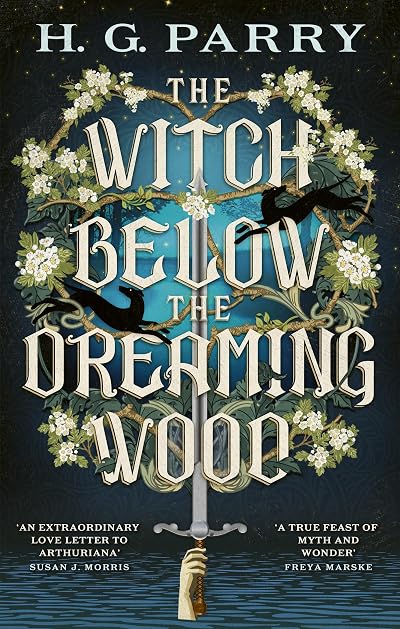
2026/143: The Witch Below the Dreaming Wood — H G Parry

A house named for Arthur’s last battle, passing down from guardian to guardian across centuries. A housekeeper whose appearance changed in different lights, and whose name echoed that of Arthur’s great enemy. A professor who neither she nor Tom had ever seen, whose name echoed Merlin. And all the while, the world at war, and the dreams coming faster and brighter and increasingly slipping through to the waking world. [loc. 3474]

Second Arthurian novel in a row, (though that was unintentional!), which like The Everlasting explores whether myths can be challenged or changed: "As long as the right stories were told afterwards, perhaps the truth could be whatever we were able to bring about."

Ellie Ambrose, a librarian at the British Museum Library, saw a quarter of a million books destroyed in the Blitz. Her superior, perhaps taking pity on Ellie's distress, sends her away from London to catalogue a private library in Wales. The only people at Camlann House are the housekeeper, Mrs Leaf, and the groundsman, Tom Wilder: the latter was a pilot, but was badly injured in a crash. People all over Britain are dreaming about King Arthur, but once Ellie's at Camlann House she starts dreaming instead about Nimue, Merlin's nemesis.

The second narrative voice is Nimue's own -- first-person, rather than Ellie's third person -- beginning with her childhood under the Lake, on the borders of the Otherworld. She, along with Lancelot du Lac and Mordred, was adopted by Morgan Le Fay, who tells the children bedtime stories about the people they will doom: Merlin, Guinevere and Arthur himself. But when Nimue (calling herself Viviane) arrives at Camelot and meets Merlin, he seems unwilling to fall in love with her...

The Witch Below the Dreaming Wood has a twisty plot, intrusions of myth and legend, a questing beast far from home, and a centuries-long plan. The dual narratives have different ambiences, with Nimue's evoking a post-Roman past populated by flawed heroes and very human myths, while Ellie's is peppered with the practicalities and horrors of a world at war. Ellie herself is pragmatic and unmystical, but has a mysterious past. Tom, the former pilot, was especially interesting as an exemplar of cowardice and courage. (I half-expected a romance between Ellie and Tom and was pleased not to encounter one.) I'd have liked more of wartorn Britain, but I think the two narratives were nicely balanced -- though I'm still not quite sure why more recent myths entered the story.

Read because: I've enjoyed other novels by Parry (A Declaration of the Rights of Magicians, A Radical Act of Free Magic, The Scholar and the Last Faerie Door.
Wednesday, October 07, 2026

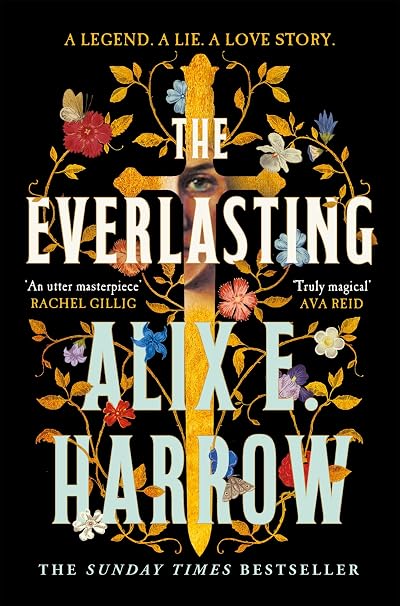
2026/142: The Everlasting — Alix E Harrow

... you had already strayed far from the path of your story; if I told you how it ended, you would never return to it. You would never slay the dragon or fetch the grail. [p. 59]

The nation of Dominion has recently emerged from a terrible war. Historian Owen Mallory, certified coward and former Corporal, is relieved to be back at the Cantford College Department of History, working on his book about the legendary hero Sir Una Everlasting. One day a long-lost manuscript arrives in the mail, purporting to be an early account of the Everlasting's life and death, and leads Owen to an interview with Minister of War Vivian Rolfe. And thence to a time a thousand years before his birth, where a legend is waiting to be recorded.

Of course it is not quite that simple. Owen meets Una, who is huge and fearsome and unaware of her fate: he also meets the queen she serves, Yvanne, who has an eye for dramatic presentation and is using Una to forge a national myth. “In order to have a future worth fighting for, you must have a past worth remembering.” But the story is never that simple, and Owen and Una are tools as well as protagonists.

This is a story about courage and cowardice, about how legends are shaped and about two people (and a foul-tempered warhorse) trying to seize control of their own stories. It's also about PTSD and heroism, love and grief, violence and kindness -- and about trying to build a better world out of violence and betrayal. There are distinct Arthurian echoes, but the legends differ sufficiently -- not least in the gender-switching of the king and the knight -- to minimise expectations. And it's a very twisty time-travel story with a unique and unexpected mechanism. I also found Harrow's technique of repeating passages, with variations, immensely effective as a way of showing the circularity of the story.

The novel is mostly told in alternating second person singular: Owen to Una, Una to Owen. This was also effective, though I note that while I did feel compassion for the characters I did not always like them, certainly not as much as they liked each other.

Read because: it won the Hugo Award for Best Novel, 2026. For what it's worth, I have read four of the other five shortlisted titles: A Drop of Corruption, Death of the Author, The Incandescent, The Raven Scholar. I did not vote.

Saturday, October 03, 2026

2026/140,141: The Clocktaur War — T Kingfisher

“What? If I wanted a lot of corpses nobody’d miss, I’d start a plague too.”
“Such a crime would be considered monstrous by all known authorities,” said Caliban.
“Yeah, the people generating unstoppable giant killing machines are probably real concerned about that.” [The Wonder Engine, p. 118]

'The Clocktaur War' is a duology -- The Clockwork Boys and The Wonder Engine) about a terrible mechanical army, and the attempts of a ragtag band of anitheroes to combat it. I read The Clocktaur Boys back in, er, 2017, and liked it, but also noted a lot of unanswered questions. (My original review of The Clockwork Boys.) "I'll definitely read the second half of the story," I vowed. But someone spoilt me for an event in the second book, The Wonder Engine, and I never got around to it. Until now... Turns out those unanswered questions are (mostly) answered, though I'd have liked more about Caliban's history. And the event for which I heard unwanted spoilers didn't turn out at all as I'd expected, which was a pleasant surprise.

More about gnole pronouns than I remembered, and a convincing romance between world-weary adults. Kingfisher's fiction is always cheering and I think she's improving as she goes -- or maybe just as she fleshes out the world of the White Rat.

Read because: When I read Daggerbound recently, the author's afterword indicated that one of the protagonists, Edmund, also appears in the Clocktaur War books. I decided it was about time I got around to the second volume of that duology ... and a reread of the first. And yes, a callow Learned Edmund is a major character -- and Learns a lot.

Thursday, October 01, 2026

2026/139: International Relations — Zac Hammett

There are going to be lies one way or another, so I might as well go all in with the big one. Difficult as it may be, it’s better than telling people the truth. [loc. 1131]

Max works for the British government in international diplomacy: he has his eye on a position at the British Embassy in Athens, but his boss advises that being single is hurting his chances. Look at Quentin, his rival, and Quentin's sleek, Greek-speaking girlfriend Flora... Max, an inveterate liar, refuses to confess that his maybe-a-date stood him up for a reception at Buckingham Palace: instead, he hires an out-of-work actor to play his boyfriend.

The out-of-work actor -- recruited via the truly delightful Doily, a name-dropping theatrical agent who knows everyone in the business -- is Hunter, a gorgeous American whose visa is due to run out. (And who starred in a gender-switched production of Grease, hence Doily's suggesting him for the role...) Can he persuade Max to marry him? And can the two keep up the pretence for long enough that Max gets the job of his dreams? Or will their very different personalities, goals and approaches to life invite disaster?

Great fun once it got going, though Max's constant lies bothered me. I liked Hunter a great deal, and really appreciated the ways in which each of the protagonists resolved one another's issues without belittling them, or compromising their own goals. Sometimes laugh-out-loud funny, sometimes really poignant (especially Max's relationship with his dad), and with an unexpected but pleasing resolution.

Read because: recommended by a friend, and I fancied a light frothy romcom.