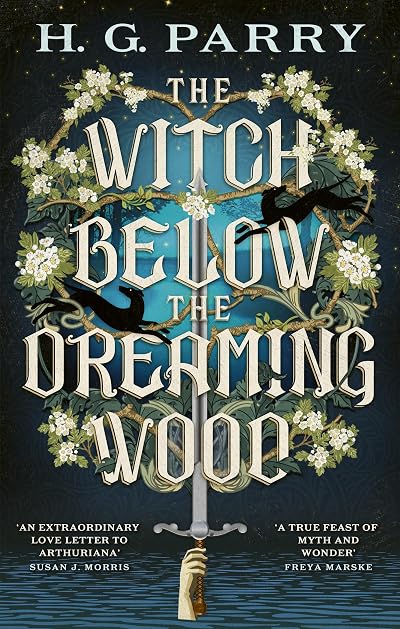
A house named for Arthur’s last battle, passing down from guardian to guardian across centuries. A housekeeper whose appearance changed in different lights, and whose name echoed that of Arthur’s great enemy. A professor who neither she nor Tom had ever seen, whose name echoed Merlin. And all the while, the world at war, and the dreams coming faster and brighter and increasingly slipping through to the waking world. [loc. 3474]
Second Arthurian novel in a row, (though that was unintentional!), which like The Everlasting explores whether myths can be challenged or changed: "As long as the right stories were told afterwards, perhaps the truth could be whatever we were able to bring about."
Ellie Ambrose, a librarian at the British Museum Library, saw a quarter of a million books destroyed in the Blitz. Her superior, perhaps taking pity on Ellie's distress, sends her away from London to catalogue a private library in Wales. The only people at Camlann House are the housekeeper, Mrs Leaf, and the groundsman, Tom Wilder: the latter was a pilot, but was badly injured in a crash. People all over Britain are dreaming about King Arthur, but once Ellie's at Camlann House she starts dreaming instead about Nimue, Merlin's nemesis.
The second narrative voice is Nimue's own -- first-person, rather than Ellie's third person -- beginning with her childhood under the Lake, on the borders of the Otherworld. She, along with Lancelot du Lac and Mordred, was adopted by Morgan Le Fay, who tells the children bedtime stories about the people they will doom: Merlin, Guinevere and Arthur himself. But when Nimue (calling herself Viviane) arrives at Camelot and meets Merlin, he seems unwilling to fall in love with her...
The Witch Below the Dreaming Wood has a twisty plot, intrusions of myth and legend, a questing beast far from home, and a centuries-long plan. The dual narratives have different ambiences, with Nimue's evoking a post-Roman past populated by flawed heroes and very human myths, while Ellie's is peppered with the practicalities and horrors of a world at war. Ellie herself is pragmatic and unmystical, but has a mysterious past. Tom, the former pilot, was especially interesting as an exemplar of cowardice and courage. (I half-expected a romance between Ellie and Tom and was pleased not to encounter one.) I'd have liked more of wartorn Britain, but I think the two narratives were nicely balanced -- though I'm still not quite sure why more recent myths entered the story.
Read because: I've enjoyed other novels by Parry (A Declaration of the Rights of Magicians, A Radical Act of Free Magic, The Scholar and the Last Faerie Door.
No comments:
Post a Comment