I was familiar with his key hypothesis: that natural disasters — floods, storms, earthquakes, and the like — generated magic. Henry argued that it was the lingering magic from these violent phenomena — catastrophes — that we accessed with reliqs. That intriguing blasphemy made up the first half of his book... [he] further argued that these catastrophes, and the enormous release of magic, caused animal species to change. [loc. 1879]
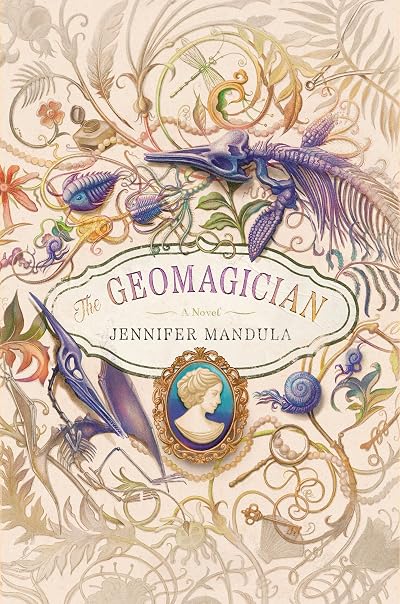
A fantasy in which Mary Anning is a geomagician who finds a baby pterodactyl named Ajax -- disrupting the scientific community, and forcing her mentor William Buckland to come up with theories about Noah's Flood that Mary knows to be false, but that will assuage the anxieties of the religious world. Darwin's theory of evolution has not yet been published, and geomagic treads a careful path between science and creationism.
And fossils, typically, are used as reliqs -- stores of magical power, charged by the individual wearing the reliq. Mary has been driven by poverty, more than once, to sell her magic to the 'slickers' who trade in reliqs. Mary's friend Lucy is determined to reform the reliq industry, and her brother Edgar, in the House of Lords, is due to give a speech urging that reform. But Henry Stanton, high-profile geomagician and Mary's ex-fiance, has developed a new method for creating 'manifold reliqs', hundreds of times more powerful than the run-of-the-mill reliqs that everyone uses. And he believes that somehow Mary used magic to bring Ajax to life, and persuades her to continue her experiments ...
There was a lot going on in this novel. Paleontology, obviously, but also politics and riots; the refusal of the Geomagical Society to admit women; Mary's lingering attraction to Henry, and her fondness for Buckland despite his creationist theories; Lucy's activism (and ill-advised romance); Mary's bond with Ajax, which I felt was rather underplayed. Mary herself is not wholly likeable: poverty and solitude have made her quite selfish, and she isn't especially adept at the social games she's forced to play in London. I wasn't entirely convinced by her reconciliation with Henry, either.
On the whole, though, an enjoyable novel set in a fascinating variant of the nineteenth century: it's the first volume of a duology, and the second part (The Paleomancer) is due out in spring 2027. I've already wishlisted it...
Read because: Mary Anning! A pterodactyl! Magic!
No comments:
Post a Comment