He dropped into the wild current of the Cwill, let it whirl him, now as a fish, now a dead branch, through deep, churning waters, down rapids and thundering falls until he lost all sense of time, direction, light. The current jarred him over endless rapids before it loosed him finally in a slow, green pool. He spun awhile, a piece of water-soaked wood, aware of nothing but a fibrous darkness. The gentle current edged him toward the shore into a snarl of dead leaves and branches. He pulled himself onto the snag finally, a wet, bedraggled muskrat, and picked his way across the branches onto the shore. (Harpist in the Wind, p.133)
I discovered McKillip's Riddlemaster trilogy in my teens -- I have a vivid memory of reading the books instead of studying for 'O' levels -- and have reread the books several times over the intervening ~30 years. Remembering the intensity with which I used to immerse myself in favourite books, I'm not really surprised that I can remember whole paragraphs almost word for word. These were a quick reread, because so much of the text is set in memory!
I love the rich tapestry colours and the vivid visual descriptions; the blend of Celtic and Scandinavian myth; the elements of archetype, legend, emblem (I hadn't read Campbell's The Hero's Journey when I first read McKillip). The whole 'riddle' framework -- where history and a kind of spirituality are conveyed within fables that remind me of Sufi parables as much as of the Mabinogion -- appeals intellectually. I'm fascinated by the openness of the characters: even when they have hidden secrets, there's a level of emotional honesty (and complexity) that's (or that was) rare in genre fantasy. And I like the characters -- though now they mostly seem very young to me.
I admire McKillip's other novels, though increasingly I've found them subtle, multi-layered, allusive and elusive: by comparison, the Riddlemaster trilogy reads like -- and is now, I believe, published as -- young adult fiction. It's a more straightforward tale, a hero's coming-of-age, not quite a quest fantasy but with a great deal of travelling as the protagonists learn the Realm.
And I'm starting to wonder, half-frivolously, if it could be read as science fantasy, comparable to McCaffrey's Pern books: those are 'obviously' fantasy at first, what with the dragons and Holds and feudal society, but increasingly sfnal with allusions to colonisation, genetic engineering and the like. McKillip's Realm, ruled by a High One, formerly the domain of the Earth-Masters, riddled with wizards and ghosts and shapechangers: clearly a fantasy world, and yet there's talk of the years of Settlement (that is, the current occupants arrived there from elsewhere). And if one's going to seize on tiny details*, how about 'the old moon with a lost star drifting between its horns'? (Heir of Sea and Fire, p.158) That, to me, implies something shiny between moon and viewpoint: too close to be a star or a planet, but just right for an artificial satellite ...
Anyway: always worth a reread for me, always comforting, always something new: the best kind of favourite book!
*as elsewhere, for example, a capital 'c' on the word 'culture', or a reference to a 'falling star', might serve as key to unlock a novel by Banks or Fowler ... just sayin'.
Showing posts sorted by relevance for query mckillip. Sort by date Show all posts
Showing posts sorted by relevance for query mckillip. Sort by date Show all posts
Saturday, December 13, 2008
Monday, June 20, 2022
2022/084: Song for the Basilisk -- Patricia McKillip

She could not talk to birds, or summon monsters; she had no defenses against history. [loc. 3843]
A twisting, dreamlike tale told in McKillip's typically stained-glass, luminous prose, this novel from 1998 has been on my shelves, on and off, for a couple of decades: now, in memoriam, it's a book club read. McKillip's 'Riddlemaster' trilogy was a salvation to me as a teenager, and I read and reread those novels so often that even now I find fragments of McKillip's sentences glimmering in my own writing. For some reason, though, I didn't form similar attachments to any of McKillip's other novels, though in general I've enjoyed them. (Checking my reviews of her work, I see I have read at least one of them twice, with no recognition of the second time being a reread ...)
Song for the Basilisk opens with a massacre, and the sole survivor -- a young boy -- hiding in the ashes. He's taken north to the bards of remote, rocky Luly, and given the name Caladrius 'after the bird whose song means death'. Caladrius, who mostly goes by 'Rook', grows to manhood, sires a son, journeys into the hinterlands ... and eventually, accepting his true name and his fate, to the city of Berylon, where Prince Arioso Pellior, the Basilisk, rules. An opera is planned for the prince's birthday; a hoard of musical scores is discovered, and must be catalogued; a gang of revolutionaries realise there is more to fighting than just waving a sword around; and the Prince's younger daughter falls in love with the new librarian.
Song for the Basilisk features many of my favourite fantasy tropes: blurred identity, music both high (opera!) and low (tavern), revolution, hints of something 'older than human language', vengeance, a mature protagonist ... Yet it didn't quite click and I'm not sure why. Perhaps there were too many intriguing characters -- Caladrius himself, Giulia the musician, Luna Pellior, Hollis, Hexel -- for me to engage fully with any of them. Perhaps some aspects of the story were too oblique, or I missed or skimmed over important elements. (I do think this novel would reward a second reading.) Perhaps the beautiful prose lulled me into a dream-state and I simply accepted each plot development, each change of scene, without considering how it fit into the arc of the novel.
That said, I found the ending very satisfactory, and did not predict the various resolutions: admirable convergence of characters and plot-threads and themes, and much more positivity than expected.
Friday, October 07, 2016
2016/53: Kingfisher -- Patricia A. McKillip
Rituals with letters, rituals with cauldrons, a bloody gaff, a missing knife, everyone in a time warp, looking back at the past, wishing for the good old days, hinting of portents, speaking in riddles, knowing things but never saying, never explaining — [loc. 760]
Pierce Oliver is sorting crabs on the pier, for his mother's restaurant Haricot. Along come three knights in a black limo. Their shadows reveal their ancestry, though they seem surprised that he can see those shadows. They're somewhat bemused, too, about where it is they've ended up. Cape Mistbegotten, says Pierce. If it's not on the map it's because my mother hid it.
This encounter, and the knights' invitation -- "Look for us if you come to Severluna. You might find a place for yourself in King Arden's court" -- prompts Pierce to go home and announce to his mother, the sorceress Heloise, that he is leaving home to seek his fortune. Heloise is not happy, but tells him enough about his father (also a knight at King Arden's court) to whet his appetite. Pierce charges his phone, gets in his car and drives south.
On the way to Severluna he stays the night at the Kingfisher Inn, whose owner is crippled and estranged from his wife, but who hosts the famous Friday Nite All-U-Can-Eat Fish Fry. There is something very odd about the Kingfisher Inn, its staff and its clientele. And something odd about the kitchen knife that Pierce feels compelled to steal as he leaves.
Pan out to Severluna, a cosmopolitan city where the younger royals are frequently in the headlines, and the king's bastard son is enamoured of a mysterious young woman who may have a hidden agenda. Skim sideways to the quest announced by King Arden (which pretty much boils down to 'go and look for something special -- you'll know it when you see it') and the ensuing adventures of the motorcycle-riding Knights of the Rising God.
Kingfisher has a large cast and a complex plot -- or, rather, a complex layering of plots plural, from Pierce's search for his father to the knights' quest for a bowl which may belong to their god or to a goddess; from the legendary Friday Nite Fish Fry to Stillwater's legendary restaurant where exquisite morsels leave the customers as hungry as before; from Dame Scotia Malory, intellectual and warrior, to Carrie Teague, exasperated daughter of the rather shamanic Merle; from plush limos to ancient shrines ...
It's easy to tease out threads of Arthurian and Greek myth, but the blend of Americana and arcane, all laced with McKillip's rich prose (not quite a lush as in some of her work, but though the lyricism may be sparser it still glows) and some images that reminded me of her earlier works, especially the Riddlemaster books. I liked the ways in which the characters accepted and worked around the occasional incursions of the magical, the mythic and / or the antique into their lives: the ways in which the material and spiritual worlds interwove. At times the novel feels overfull, with too many strands and characters and levels: at others, I'm delighted by that same complexity. I don't think I've enjoyed one of McKillip's novels this much since Fool's Run.
Sunday, November 07, 2021
2021/133: The Book of Atrix Wolfe -- Patricia McKillip
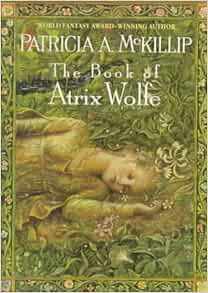
...the Hunter lifted a fistful of torn pages to his teeth, bit into them. Blood ran down his mouth, as if words bled. Talis swallowed, his throat paper-dry. [loc. 1400]
Twenty years ago, the mage Atrix Wolfe created a monster to stop a war. Peace came at a terrible cost: death, infertility, a mute child scrubbing pots in the castle kitchen. Atrix Wolfe eschewed magic and shapechanging, and turned away from humanity, working as a healer of animals in an isolated mountain village. But then Talis, heir to one of the kingdoms saved and doomed by Atrix Wolfe, discovers an ancient spell book, where the words on the page don't mean what they say.
I am not generally an afficionado of high fantasy, but I've loved McKillip's prose since I discovered the Riddle-Master trilogy at an impressionable age. This is very much in the same style -- lush, rich, allusive, mythic -- and though I didn't especially empathise with any of the characters (except possibly the mute, amnesiac Saro, staring into the cauldron as she washes saucepans) I enjoyed the sensory richness of the world in which the story plays out. The tangle of stories -- Atrix Wolfe, Talis, his brother Burne, Saro, the Hinter -- resolves in a satisfactory way. Justice is achieved; there is a brighter future for the kingdoms of Pelucir and Chaumenard; Saro remembers herself; the Hunter, who is truly terrifying and who echoes many forest-myths, finds mercy.
An intriguing allegory for weapons of mass destruction, and a moral story about the power of words and the need for precision: I don't think it will end up as one of my favourite of McKillip's novels, but in several ways it feels more mature, and more grounded in the 'real' world, than her earlier work.
A note for non-American readers: pronounced with an American accent, 'Saro' and 'sorrow' are homonyms. I was confused by the characters' confusion until I realised this!
Tuesday, November 15, 2016
2016/58: Fool's Run -- Patricia A. McKillip
"I learned something strange. When you run, you run backwards, you never reach the future. The past runs faster than you and waits for you to reach it. You have to walk out of danger, out of the past. Because you look back when you run, but you look to the future when you walk."[loc. 1737]
Reread: I absolutely adored this novel when I first read it, but haven't revisited it for years. Having recently read Kingfisher -- which reminded me of Fool's Run in its mythic resonance and its relatively sparse imagery -- I wanted to reread this and see if my memory had become rose-tinted.
As usual with rereads, it was interesting to see what I remembered and what I didn't. Last time around, I think I was more focussed on the band and the romance: this time, I found the story of Jase -- unwilling King of an Underworld which is actually an orbitting penal colony -- fascinating. The echoes and distortions of the Orpheus myth are still impressively intricate, and critical of the source: the future, with its First World Government and its Sectors and music from all eras, seems much further away than it did in the Eighties.
Irritatingly, this ebook publication has a problem with typos: specifically, the word 'colour'. We have 'the brilliant colourcoloured lights'[loc. 807], 'a pair of colourrose-coloured cube-sticks' [loc. 1316], the 'colourcolourless or of all colours' [loc. 2198]. And this is, as usual with McKillip, a book full of colour: gold, rose, amethyst ... even Viridian, the surname of the woman whose quest for more light affected so many of the characters.
I wish McKillip wrote SF more often.
Saturday, October 01, 2011
2011/55: Ombria in Shadow -- Patricia McKillip
Mag never told Faey that she knew she was other than made. Human being what it was -- raging, messy, cruel, drunken and stupid -- she decided to remain wax. If, she reasoned, she did not say the word, no one would ever know. Saying 'human' would make her so. (p.20)
Ombria is a bright city sparkling with the decadent seeds of its own downfall. Its Prince is dying and Domina Pearl, the malevolent Regent, sets courtier against courtier and banishes the Prince's mistress Lydea to the streets from whence she came. Beneath those streets lies the city's own shadow, a maze of forgotten alleyways, disused cellars, sunken houses and gardens buried beneath dead leaves. The undercity is the realm of Faey the sorceress, who has a thousand faces and sells her magic to whoever might buy. Her waxling, Mag -- who Faey makes out to be a made thing, a magical construct, but a spell goes astray and Mag discovers the truth -- runs Faey's errands, slipping through Ombria's streets, watching and reporting and helping those who Faey makes her business. Among those she watches are Ducon Greve, the dead Prince's bastard nephew; Kyel, the young heir, who misses his friend Lydea; and Kyel's tutor Camas Erl, who's fascinated by the legends of a catastrophe that will transform Ombria from a city of despair and fear into something light and full of hope.
McKillip's prose often feels, to me, like a medieval tapestry, rich with colour and detail and odd, precise glimpses of magic. (The mirrors in Faey's sanctum are old, 'overused, shadowy with images'. Outside the palace gates, a garden of sunflowers stands guard.) Ombria in Shadow is beautifully written, and the protagonists rounded and realistic, heartsore with grief but not incapable of action. Despite the urban setting and the convolutions of shadow and light, the ambience of this novel brings to mind McKillip's Riddlemaster trilogy in ways that some of her more recent fantasy novels don't: perhaps it's the comfortable and credible quasi-medieval setting, without much overt magic, where characters are as likely to do laundry or visit a brothel as they are to cast spells or fight enemies.
The ending, which I shan't spoil here, felt sudden and hollow on first reading, but on reflection I find it wholly satisfactory. I'd love to encounter these characters again.
Wednesday, December 31, 2008
#48: The Book of Atrix Wolfe -- Patricia McKillip
He saw the wood again in two worlds: one lifeless, dark, blanched with winter, the other drenched with light, green leaves trembling in a sweet soundless wind, and both on the edge of Hunter's Field. (p.132)
McKillip blends myth, fairytale and history in a tale of the aftermath of magical war: the eponymous mage Wolfe, under pressure from a king, uses magic to end war in Pelucir, but conjures a Hunter darker and more terrifying -- and more persistent -- than anything he could have imagined. From the wood on the hill, the Queen of the Wood watches with her consort and their child: Atrix Wolfe's magic whirls wide to include them too.
Fast-forward twenty years. The King is dead, killed on Hunter's Field, and his son Burne rules in Pelucir: Burne's younger brother, bespectacled Talis, is studying magic in Chaumenard when -- during a game of magical hide-and-seek -- he discovers a spellbook in a broom-cupboard. Returning to Pelucir, his forays into the book wreak domestic havoc, as when a spell to extinguish candles breaks all the mirrors in the castle: 'Words don't seem to mean themselves ... the spell in the book dealt with mirrors. But it said candles. And fire. So I was confused.'.
Then Talis falls from his horse, meets a woman in the wood on the hill:
"... she let me see her face. She was very -- she was more beautiful than --"
[Burne] grunted. "They always are." (p89)
And within days, Talis has disappeared in a sliver of moonlight, and Burne turns to the mages while Talis tries to reach back through to his own green world.
Meanwhile, in the kitchens, a mute girl scrubs pots and watches passively as creative, indulgent and mouth-watering feasts -- very much in the medieval style, pastry in bird-shapes, birds stuffed with other birds, mulled wine and cold meats -- are prepared for King and Court. When the black cauldron is empty of pots, she sees visions in the water ...
I'd reread the Riddlemaster trilogy (my very favourite novels when I was about 15: they've stood the test of time pretty well) and started wondering why I hadn't really connected with McKillip's later works. The Book of Atrix Wolfe is beautifully-written, and I love the central conceit that if one's writing of one thing but thinking of another, that other will flavour the writing; it doesn't move me as the Riddlemaster books did, and yet I admire the construction of the plot, shiver at the Hunter with the black moon between his antlers, am caught up in the poetry of the wood: and, yes, had to eat, and eat, while I read the kitchen scenes.
McKillip blends myth, fairytale and history in a tale of the aftermath of magical war: the eponymous mage Wolfe, under pressure from a king, uses magic to end war in Pelucir, but conjures a Hunter darker and more terrifying -- and more persistent -- than anything he could have imagined. From the wood on the hill, the Queen of the Wood watches with her consort and their child: Atrix Wolfe's magic whirls wide to include them too.
Fast-forward twenty years. The King is dead, killed on Hunter's Field, and his son Burne rules in Pelucir: Burne's younger brother, bespectacled Talis, is studying magic in Chaumenard when -- during a game of magical hide-and-seek -- he discovers a spellbook in a broom-cupboard. Returning to Pelucir, his forays into the book wreak domestic havoc, as when a spell to extinguish candles breaks all the mirrors in the castle: 'Words don't seem to mean themselves ... the spell in the book dealt with mirrors. But it said candles. And fire. So I was confused.'.
Then Talis falls from his horse, meets a woman in the wood on the hill:
"... she let me see her face. She was very -- she was more beautiful than --"
[Burne] grunted. "They always are." (p89)
And within days, Talis has disappeared in a sliver of moonlight, and Burne turns to the mages while Talis tries to reach back through to his own green world.
Meanwhile, in the kitchens, a mute girl scrubs pots and watches passively as creative, indulgent and mouth-watering feasts -- very much in the medieval style, pastry in bird-shapes, birds stuffed with other birds, mulled wine and cold meats -- are prepared for King and Court. When the black cauldron is empty of pots, she sees visions in the water ...
I'd reread the Riddlemaster trilogy (my very favourite novels when I was about 15: they've stood the test of time pretty well) and started wondering why I hadn't really connected with McKillip's later works. The Book of Atrix Wolfe is beautifully-written, and I love the central conceit that if one's writing of one thing but thinking of another, that other will flavour the writing; it doesn't move me as the Riddlemaster books did, and yet I admire the construction of the plot, shiver at the Hunter with the black moon between his antlers, am caught up in the poetry of the wood: and, yes, had to eat, and eat, while I read the kitchen scenes.
Sunday, July 25, 2021
2021/088: Magician -- K L Noone

Magic shivered and scurried and sang along all the strings of his being: little swinging swaying bolts of light reached out to other lights, caught the threads of the universe, wanted to play. [loc. 315]
This was just what I needed on a muggy summer Sunday: a sweet, comfortable, low-conflict romance between a powerful but reclusive wizard and the young prince who's come in search of magical help.
Lorre has exiled himself from human society and lives on a tropical island, changing shape as the whim takes him and enjoying his separation from the human race. Here, he can't shift the balance of power, or harm anyone, or disturb the world. Sometimes people come looking for him, but he never lets them find him. Until Prince Gareth shows up, talking to thin air (of course Lorre is listening) and reading a novel and generally being optimistic, pleasant and charming. Also very handsome, which does not harm his chances of persuading Lorre to help him against the magical coldness afflicting his homeland.
Lorre's magic, his integration with the world around him, reminded me somewhat of Patricia McKillip's wizards. He's centuries older than Gareth (and possibly functionally immortal) but, frankly, does not act his age: the difference in their life experiences is written as a fascination with each other's histories, rather than a cause for incompatibility. Lorre has acquired a fearsome reputation, but he's always tried to do the right thing, though sometimes his temper has got the better of him: Gareth has read all the stories, and there's an element of hero-worship (in both directions -- Gareth is the archetypal hero) which is leavened with plenty of humour and common sense.
I especially liked how comfortable this novel felt: the stakes are moderately high but there's little peril, few confrontations and no major miscommunications. Lorre and Gareth are both likeable characters, and their growing attachment to one another is thoroughly believable and very sweet.
I hadn't read the prequel story, Sorceress, in which Lorre's history (as a dragon, and a somewhat inadequate father) is seen through the eyes of his former lover, but I didn't feel that my experience of Magician was lessened by this omission: I did buy and read it immediately after finishing the novel, though. Review soon!
Monday, August 16, 2010
2010/64: The Girl with Glass Feet -- Ali Shaw
”Maybe you noticed something different. When you returned to St Hauda’s Land. A taste on the air. A mannerism the birds have. A peculiar snowfall, making almost mathematical patterns. A white animal that’s not an albino... for the most part, people are either born here and are used to these things, or they move away. There aren’t many people who come here.” (p. 108)Midas Crook lives on the remote northern archipelago of St Hauda’s Land, perfectly accustomed to the almost incestuous tangle of island life, and the strangeness all around him. His father committed suicide in a grandiose Viking-style burning boat; his mother lives, lamed and maimed by a luminous jellyfish, in the tantalisingly-named hamlet of Martyr’s Leap. Somewhere in the woods is an animal of pure white (except the blue patch on the back of its neck): every living being that sees this unnamed beast becomes bleached, colourless, white as snow. (This is a very wintry novel.) When Midas makes the acquaintance of Ida Maclaird -- who first visited the islands the previous summer, as a tourist -- and discovers that she is slowly, feet-first, turning to glass, it surprises him but does not shake his world view.
This is a beautiful book -- beautifully written, and a beautiful physical object. (the hardcover has mirror-bright page edges). Shaw’s prose sings; the island’s stark monochromatic landscapes made me shiver on a hot summer’s day; there’s a sense of interconnectedness, of hidden meaning, from the glass body in the bog to the possible use of the local jellyfish as a cure for vitrification. (I loathe jellyfish, am quite phobic about them: but the jellyfish in this novel are marvellous, lovely, alive.)
Unfortunately too much of that meaning remains hidden. I found myself hoping for revelation if not resolution: instead, I came away with a sense of having forgotten the salient details of a beautiful but disturbing dream. The key to this novel is transformation, but by the last page only Midas really seems likely to metamorphose into something better -- and that’s by no means certain. Other characters seem trapped, literally or figuratively: frozen, drowned, imprisoned.
St Hauda’s Land reminds me of Margaret Elphinstone’s islands: Hy Brasil, Ellan Vannin. The strangeness, the little mysteries presented as mundane, remind me more of Patricia McKillip. I’ll look forward to more of Shaw’s fiction.
Subscribe to:
Posts (Atom)