Saturday, February 13, 2021

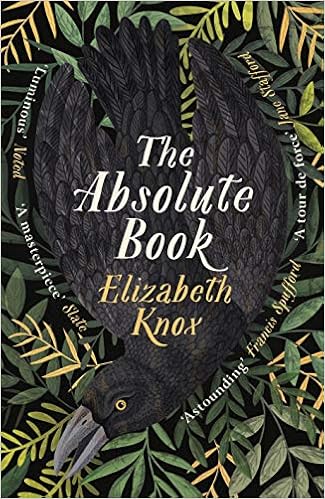
2021/020: The Absolute Book -- Elizabeth Knox [reread]

"I wasn't born when you found yourself having to pay for your stolen land. Which, being thieves, you chose to pay for with stolen human souls."[loc. 6070]

Reread, for the 'reread a favourite' part of the Reading Women Challenge 2021, and because I was reminded of its awesomeness by various promotional events in advance of the UK/US publication (UK Publication 18th March 2021). Here's Elizabeth Knox being interviewed by Dan Kois...

My original review is here.

This time around I found myself noticing more resonances with Knox's other work, in particular Black Oxen -- possibly because that's a fairly recent reread -- and perhaps The Vintner's Luck. I suspect there are many more echoes: this is a book of love, an author's attempt to write her way into happiness, a carefully-crafted salvation (and how I wish, especially now, that it could come true), and I think that conscious decision to write a route to happiness must revisit other mapped moments of joy, other characteristic elements of the author's interior world(s).

I believe Knox has made some minor changes in the UK/US edition: I would love to know what those are. New-come readers won't read the book I read and loved ...

Tuesday, February 09, 2021

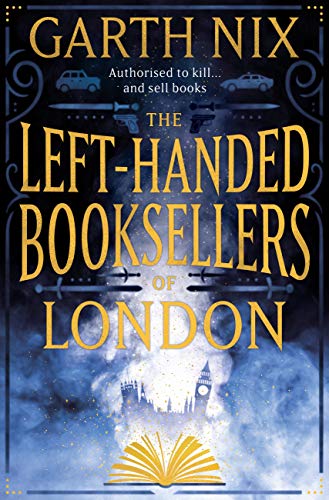
2021/019: The Left-Handed Booksellers of London -- Garth Nix

“Children’s writers,” said Merlin. “Dangerous bunch. They cause us a lot of trouble.”
“How?” asked Susan.
“They don’t do it on purpose,” said Merlin. He opened the door. “But quite often they discover the key to raise some ancient myth, or release something that should have stayed imprisoned, and they share that knowledge via their writing. Stories aren’t always merely stories, you know." [p. 76]

Susan Arkshaw's mother has always been rather vague about Susan's father: so Susan, who's won a place at the Slade to study art, decides to head up to London a few months before her course starts, in the hope of discovering the other half of her heritage.

It's 1983, but not quite as we know it: Margaret Thatcher is the second female PM, after Clementina Atlee, and prime-time TV show The Professionals features Raelene Doyle and Georgina Cowley. (I don't think we ever discover the alt-Bodie's first name.) In this London, booksellers -- like molecules -- come in two varieties. The right-handed ones are researchers; the left-handed ones are warriors, keeping at bay the various magical and supernatural entities that lurk just below the surface of reality. Susan, visiting her Uncle Frank, swiftly encounters a left-handed bookseller by the name of Merlin, who (a) is gender-queer (b) stabs Uncle Frank with a Georgian hatpin (c) really cares about clothes. Susan, tending towards the punk end of the spectrum, is fascinated by Merlin, and it's mutual: however, before she can ask him on a date, the two have to elude a variety of nasties, including Uncle Frank ("he's not your uncle"), the Shuck, a Fenris wolf, goblins, and some perfectly ordinary police constables.

This is an entertaining, breathless, headlong romp, with a sense of real danger and a thorough grounding in British folklore. Susan is preternaturally level-headed: sometimes, though she's the 'chosen one', she's less of a protagonist than a foil for fey, flighty, vain, brave Merlin, who is vexing and charming in equal parts. Susan does discover her heritage, and comes into her own at the climax of the novel: and she's practical enough to counterbalance Merlin's mercurial tendencies.

I enjoyed this a lot, and am hoping for a sequel: I'd like more of Merlin's 'shape-shiftery' nature, and his twin sister Vivien's story. While it definitely has the feel of a YA novel, it doesn't flinch from nastiness, and the underlying world-building has a great many unexplored possibilities.

Saturday, February 06, 2021

2021/018: A Civil Campaign -- Lois McMaster Bujold

"Biology isn't destiny?"
"Not any more, it's not." [loc. 2305]

In which Miles Vorkosigan attempts to court Ekaterin, except that instead of telling her he tells everyone else. There is also a thoroughly hellish dinner party, not helped by someone moving the place cards; the introduction of the delightful Byerly Vorrutyer; a trans character (of sorts); some typically Barrayaran skulduggery; and a hapless genetic engineer, plus his girls.

I did enjoy this reread, but again have little to say about the main plot. (I think that might be a function of my state of mind during this latest late-winter slump, rather than the books I reread: on the other hand I had rather more to say about Shards of Honor ...) Ekaterin rocks. Lord Dono is awesome, and makes some very interesting and pertinent observations about the sexism inherent in Barrayaran culture. (I do wonder if Lady Donna liked -- or was attracted to -- men very much, though.) Byerly, who I barely noticed on first reading lo these many years ago, is a splendid character. The dinner party is the stuff of nightmares and Miles does not acquit himself well.

And so concludes my recent dip into Bujold's Vorkosigan saga. I'm vaguely tempted to reread Barrayar, but don't have an e-copy and am attempting not to buy full-price books this month. I think, if I feel the need for more of these characters, I'll veer fanfic-wards or reread Gentleman Jole and the Red Queen.

Thursday, February 04, 2021

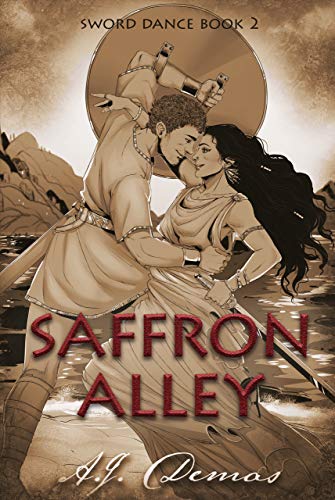
2021/017: Saffron Alley -- A J Demas

"Oh, Papa's a 'she' today," said Remi, as if that were a normal thing. [loc. 1535]

Sequel to Sword Dance, and also featuring characters from One Night in Boukos, this novel is set in Demas' alt-historical version of the ancient Mediterranean: for Zash read Persia, for Boukos read Athens.

In Sword Dance, ex-soldier Damiskos and eunuch dancer Varazda pretended to be having an affair in order to investigate a crime: as is so often the case, at least in fiction, the pretence became real. Now, it's a month since the end of Sword Dance and Damiskos is visiting Varazda at his home in Boukos. Varazda has told his family -- Yazata and Ariston, two eunuchs who were freed at the same time as Varazda, and Rish, a little girl whose provenance is unclear -- of Damiskos' arrival, and of what Damiskos means to him. Although it is possible that his family have not wholly understood him ... The day of Damiskos' arrival is a catalogue of domestic disasters, including a horrible goose and a deliberately over-spiced welcome meal: and things become ever more vexing from there on in.

This novel is told entirely from Varazda's point of view, and he is a fascinating narrator. He doesn't dwell on his past, but he is constantly aware of his difference, and often insecure about whether he can give Damiskos what he deserves, sexually or emotionally. Yet despite Varazda's self-doubt, it's clear that he is beloved by friends and family (except the horrible goose) and valued by the wider community of Zashians in Boukos.

Much of the humour in this novel comes from the way that Ariston's perception of his 'brother' is altered by events. Ariston (nee Tash: he's assumed a Pseuchian name) is a eunuch, like Varazda, but eager to be considered a Man (capital M), while Varazda accepts and sometimes foregrounds his feminine side, and identifies as gender-fluid. (He does tend to use male pronouns, except when he's explicitly being female: so I've used male pronouns in this review.) "My brother is so comfortable being himself," Ariston tells another character. "I wish I could be like that." His growing respect for, and acceptance of, Varazda's unique nature is one of the joys of Saffron Alley.

There is a strong theme of communication (and its lack) in this novel. Damiskos and Varazda are very good at asking one another what they want (though not always quite so good at hearing the meaning behind the answers); Varazda's family are less ready to accept that Varazda likes men and loves Damiskos, regardless of how often he tells (or shows) them. There are further mishearings and misunderstandings, some more momentous than others, that drive the broader political plot: Ariston eavesdropping, rumours being spread, truths being concealed.

My only criticism of Saffron Alley is that the ending is abrupt, and too much of a reversal of what's gone before. The tumultous political plot doesn't really get going until the last third of the novel, and then everything is suddenly wrapped up very quickly: I'd have liked an epilogue, or just another chapter of settling. But I understand there is another novel to come, and I look forward to it very much.

This novel fulfils the 'a queer love story' rubric of the Reading Women Challenge 2021. I received a free ARC from the author (thank you, A J Demas!) in exchange for this honest review.
Wednesday, February 03, 2021

2021/016: Shards of Honor -- Lois McMaster Bujold

About three meters away, he is now. An uncrossable gulf. So in the physics of the heart, distance is relative: it's time that's absolute. The seconds spun like spiders down her spine. [loc. 1508]

Cordelia Naismith (captain of a Betan Astronomical Survey ship) and Aral Vorkosigan (Barrayaran admiral, colloquially known as the 'Butcher of Komarr') meet when Aral's landing party attack Cordelia's base camp. Cordelia finds herself stranded with a wounded colleague and an 'enemy' who has been left for dead by treacherous subordinates. She and Aral get to know one another as they travel cross-country, on an uncolonised and distinctly alien planet, to rendezvous with another Barrayan contingent, some of whom are loyal to their commander. Aral then proposes marriage, what with Cordelia being competent and independent: but suddenly she is rescued by her fellow Betans, and when they meet again they're on opposite sides of a planned invasion -- which is also an assassination plot. By the time Cordelia gets back to Beta Colony, where she is feted as a heroine and encouraged to seek therapy, she finds that it's no longer the safe, liberal home she once thought it was.

Reader, she married him ... I remember first reading Shards of Honor, the opening volume of the Vorkosigan saga, and being underwhelmed. Then I reread it a few years later (after becoming more familiar with the series) and loved it. Right book, wrong time. Or vice versa? Reading it now, I'm still impressed by the characterisation of Cordelia and Aral. Cordelia thinks, with some justification, that Barrayarans are bellicose and feudal, but that Aral is an honourable man despite his cultural background; Aral thinks, also with justification, that Cordelia is much more interesting than Barrayaran women, and that her military experience and general common sense might suit him very well. The novel is told from Cordelia's point of view, so there's more of her interior life than of Aral's: we see him through the filter of her changing emotions and her own cultural context, and it becomes clear that he is a decent man in a corrupt and violent situation.

I did find some aspects of the novel dated, especially Cordelia's experience at the hands of the sadistic Ges Vorrutyer. Does it need to be a sexual assault, as opposed to a non-sexual physical assault? In one sense yes, as it sets up the backstory of several other characters, as well as indicating that -- even for a Barrayaran -- Vorrutyer is vile, and his colleagues know it. But: ugh. Yes, sexual violence exists: no, I do not want it to be a plot device.

Overall, though, I do still like Shards of Honor, and I still prefer Cordelia and Aral to their offspring.

Tuesday, February 02, 2021

2021/015: Komarr -- Lois McMaster Bujold

If a person lived in hurt like a mermaid in water, till hurt became as invisible as breath, its sudden removal -- however artificial -- must come as a stunning event. [loc. 3443]]

A whodunnit and a romance, with plenty of plot concerning making an uninhabitable planet into somewhere where humans can live. There's a solar reflector, life in atmosphere-controlled domes, and environmental crime. Komarr also features an unhappily-married woman who snags Miles' attention, a strong sub-plot about hereditary illnesses, and a dastardly terrorist plot.

Bujold's portrayal of an emotionally-abusive relationship is understated but effective; the whodunnit / mystery elements are nicely laid out, and signalled without fanfare; and she managed to make me sad about a plant falling off a balcony. Otherwise, though, I find I don't have much to say about my recent reread of this novel, which I first read (and enjoyed) around the time of its first publication in 1998.

Monday, February 01, 2021

2021/014: Memory -- Lois McMaster Bujold

“Some prices are just too high, no matter how much you may want the prize. The one thing you can’t trade for your heart’s desire is your heart.” [p. 415]

It's a very long time since I first read this -- which I suspect was just after Komarr was published -- and I had, as usual, forgotten nearly everything about it. Reread because I realised it was something of a boundary between the early, more militaristic novels in the Vorkosigan saga and the later, more comic / romantic / sociological works. Also I wanted to remind myself of what happened to Simon Illyan.

What happens to Simon Illyan is nasty: he has a cybernetic memory chip in his brain, and it starts to degrade, and a traitor within the organisation seizes the chance to overthrow him. Miles, who has well and truly messed up and is sulking at home, investigates, and justice is served. Several romances begin.

What really struck me about this novel was how dated the technology felt! Example: Simon is used to being able to remember absolutely everything, and he's literally as well as figuratively lost when the memory chip is no longer functional. Alys gives him a holocube map, a portable device to help him find his way around the city. No option of having that function made available on a wearable communications device (which, actually, also doesn't seem to appear here, though later books have 'wrist coms'). There are e-readers, but reading matter comes on disks, as do messages from remote locations. And yet: implanted memory chips -- and later, an implant that regulates seizures.

It's quite a thrilling whodunnit, in part: it's also a novel about personal and professional failure, and about honour. Miles (a character I don't especially like, though he's complex and interesting and intelligent) has to make some tough choices about what matters, and the lengths he'll go to in order to keep hold of the things most important to him. His prevarications, and his decisions, are fascinating, and very credible.