Sunday, October 22, 2023

2023/153: Prophet — Helen McDonald and Sin Blaché

...just like fluoride in water protects a nation’s teeth, Prophet in water protects a nation’s idea of itself... [loc. 6139]

An American diner has appeared in a Suffolk field. It's a pitch-perfect rendition, with the neon and the jukebox: but it's not connected to any electricity supply. It's something like a memory, but not quite. To investigate this, the US military brings in an odd couple: Sunil Rao, British-Asian, ex-MI6, ex-Sothebys, who has an inexplicable sense of truth so strong and so infallible that he can zero in on a fact by asking himself questions about it; and Lt-Col Adam Rubenstein, impassive and unscrutable, the only person whose lies Rao can't detect. The two have worked together before, but there are elements to their collaboration that Rao, at least, isn't aware of. And between them they begin to discover the nature of the substance called Prophet, manufactured by an American pharma company, which -- at least initially -- allows those who are dosed with it to reify their fondest memories: for instance, that diner, created by a local fellow who's into Americana.

Nostalgia, which was regarded as a psychological disorder when it was first identified and named, is now generally thought of as a twee but harmless affection for the past: here, though, it's weaponised, and Prophet, the means by which memories become objects, is poorly understood by its creators. It's up to Rao and Rubenstein to make sense of the drug and the implications of its existence, even as its nature changes and changes again. Add to this an apparently one-sided attraction between them (Rao is a promiscuous, manic bisexual, and he hypothesises that 'whatever sexuality Adam possesses has been entirely sublimated into government-sponsored violence') and the two men's personalities and histories weave into an ever more complex web of meaning, emotion and deception.

I liked this a great deal, though I think I had been expecting something ... other, given Macdonald's solitary, rural, grief-laden H is for Hawk. I was aware, going in, that the two authors had co-written Prophet during the pandemic, and that some reviewers were comparing it to fanfiction. As someone who has co-written before, and misses it, I was especially intrigued by the collaborative aspect of the novel: as with all good collaboration, the joins are imperceptible. If there are issues, it's the uneven pacing and perhaps the skewed imbalance between backstories: we get a lot about Adam's past, but rather less about Sunil's. On the other hand, most of the narrative focusses on Sunil Rao: he is the agent of change.

The romance works; the techno-thriller more or less works; I like the protagonists (and their banter, and their very distinct voices) a great deal; I found some of the Prophet-objects, such as the dog, truly horrific; and I hope that Blaché and Macdonald collaborate again.

'Our subject, in Prophet, is the literal weaponisation of nostalgia.' -- great article by the authors on how and why this is 'Barbie meets Oppenheimer'.

Friday, October 20, 2023

2023/152: The Lighthouse Witches — C L Cooke

We are not just made of blood and bone – we are made of stories. Some of us have our stories told for us, others write their own – you wrote yours. [loc. 4542]

The story begins in 1998, when artist Olivia Stay arrives on the Scottish island of Lòn Haven, where she's been commissioned to paint a mural in a disused lighthouse. With Olivia are her three daughters: Sapphire, aged fifteen; Luna, aged nine; and Clover, aged seven. Sapphire -- Saffy -- is not best pleased to have been uprooted from her life and her friends: searching for distraction, she finds an old book and begins to read about witches and changelings and missing children. All the locals seem to be highly superstitious, and Saffy is scornful of their fears -- though it's true that a lot of children go missing from Lòn Haven. And then Clover disappears...

The second main narrative of the novel begins in 2021 (sans Covid), with Luna expecting her first child. Since she was abandoned in the forest by her mother as a child, she's grown up in a series of foster homes, which have left her with some deep-seated psychological issues and a reluctance to commit to Ethan, the father of her unborn child. Luna is very much alone in the world, and is constantly searching for clues about what happened to her mother and sisters. Then she receives a call from a police station in Scotland. Clover has been found: and, inexplicably, she's still seven years old.

The premise of this novel is intriguing, but I was unable to suspend my disbelief at certain points. Why would the police just hand over a seven-year-old child -- who's apparently the subject of a missing person report from over twenty years ago -- to a woman claiming to be her sister? Why would that seven-year-old child start behaving in deeply spooky ways, which constitute an excellent red herring but have no other explanation? Why would the 'diary' excerpts from a book supposedly written in the seventeenth century have such a modern style? And what's the mechanism by which numbers appear, cut into the skin of returned children?

The atmosphere was great, but I didn't feel the story really hung together: too much of it relied on characters being purposely opaque or deliberately dishonest. There's a subplot about cancer which I could have done without, especially as it had little relation to the main story about witches' curses and missing children. And I didn't warm to any of the characters.

Wednesday, October 18, 2023

2023/151: Venomous Lumpsucker — Ned Beauman

The diversity of life on earth was (as far as anyone knew) the most majestic thing in the universe, and human beings were (as far as anyone knew) the only living things with the capacity to appreciate that majesty, and yet human beings were also the ones who were stamping that majesty out, not deliberately but carelessly, incidentally, leaving nothing behind but a few scans and samples that nobody would ever look at. [p. 119]

Hilarious, mournful and eminently quotable, Venomous Lumpsucker is a technothriller with strong ecological and climate-crisis themes, focussing initially on the plight of the (fictional) eponymous fish -- possibly the most intelligent fish on earth, assuming its last remaining breeding ground in the Baltic hasn't been destroyed by a misdirected mining operation.

Our protagonists are Mark Halyard, an Australian environmental impact coordinator working for the Brahmasamudram Mining Company (and surreptitiously engaging in a little short-selling of 'extinction credits') and Karin Resaint, a Swiss-German biologist contracted by Brahmasamudram to assess the intelligence of the venomous lumpsuckers. If the fish aren't intelligent, it will cost fewer extinction credits if they're wiped off the face of the earth. Halyard argues that it won't matter: their DNA is backed up in biobanks. But then the biobanks are destroyed ...

I don't propose to recount the twists and turns of this engaging, headlong novel (though I will say how pleased I was that Beauman eschewed any cheap romantic element). Instead, I'll observe that the tone -- and the frequent asides providing context on some especially improbable invention, such as the Hermit Kingdom -- reminds me strongly of Neal Stephenson. (The Hermit Kingdom features chalk cliffs that are 'just a doomy frontage for sunlit uplands'; 'that government, like an empty restaurant who won’t give you a table, was still very much wedded to the idea that their borders were under siege, even though it was probably a decade since anybody had felt any desire at all to sneak into the country'; one of the novel's more delightful characters is the maverick Secretary of State for DEFRA, first encountered in a powered wetsuit; and the South-West Peninsula is a macabre wildlife preserve, run by tech billionaire Ferenc Barca. But I digress.)

Venomous Lumpsucker is, on one level, a profoundly depressing vision of an imminent future where failing agriculture means awful food, extinction is subject to market forces, uncontrolled spindrifters (reminiscent of Theo Jansen's creations) roam the seas whipping up random storms, insects -- 'yayflies' -- are genetically engineered to maximise the amount of joy in the universe, and everyone is embarrassed at mention of the United States. It's easy (as I've done here) to applaud the inventive details: but there is also a solid, and often poignant, plot, though it does sometimes get obscured by the sheer exuberance of Beauman's writing. Immense fun, and a worthy (and accessible) winner of the Arthur C Clarke Award.

After reading Beauman's first novel, Boxer, Beetle, I wrote "I'd like to read his other work to see if the promise of this book is fulfilled." My conclusion is a resounding 'yes, yes it is'.

'...We’re losing the spiny shore beetle and at least another ten thousand like it every year. You say you’d rather die than lose dogs, but to lose those ten thousand a year doesn’t trouble you at all.’
‘Christ, you people never stop talking about your ten thousand a year, it’s like being in fucking Jane Austen.'[p. 184]

Tuesday, October 17, 2023

2023/150: For Thy Great Pain Have Mercy on My Little Pain — Victoria MacKenzie

I wanted my mind to be driven deep into God like a nail. [loc. 787]

This short novel examines the lives of the two great medieval female mystics from Norfolk, Julian of Norwich and Margery Kempe. The two met at least once, around 1413, when Margery visited Julian in her anchoress' cell at St Julian's Church in Norwich. Victoria MacKenzie posits that, on this occasion, Julian handed the manuscript of her Revelations of Divine Love to Margery for safekeeping.

Most of this short novel is composed of alternating scenes from the two women's viewpoints: Julian looking back on the life she left behind to become an anchoress, and the ritual 'death' by which she withdrew from the world to be immured in her tiny cell; Margery complaining of being misunderstood, harassed and hounded by the townsfolk of what was then just plain Lynn. They are very different people. Julian's intensity, her almost obsessive pacing and prayer, contrasts strongly with Margery's performative faith, her public conversations with Jesus, and her frequent clashes with the religious establishment. Julian sees the world, and God, in the song of the blackbird in the hazel tree outside her cell; in a snowflake melting in the palm of her hand; in the company of her cat. Margery weeps for Christ in church, and is unable to get enough of being shriven for her sins. She's called a heretic, but she has experienced visions of Christ, and she's sure that some day she will be in heaven with Mary and Jesus and the apostles. And when they meet, there is an instant connection, a shared understanding that each has experienced revelation.

This would make an excellent play: the voices are so strong and distinctive. (The quotation at the top of this review is from Julian's narrative: Margery says, quite early on, 'as I began to tell of this sin, my confessor was sharp with me, telling me not to take all day, and then I could not get the sin out' [loc. 185].) And it's refreshing to read historical fiction which focuses tightly on the characters, rather than exploring the world around them. There are just enough hints of life in medieval Norfolk (the wandering musicians who Margery hears at the inn, the whispers of plague that reach Julian in her cell) to remind us that this is not our time.

Monday, October 16, 2023

2023/149: Daughters of the Labyrinth — Ruth Padel

One of Cézanne’s friends said the master always began a painting with shadow. He laid down a patch of shadow, overlapped it with another, then another, till all the shadows hinged to each other like screens. That’s what Mama has been doing for me. Connecting the dark bits to make a picture of her life. [loc 2898]

Daughters of the Labyrinth is the story of Ri Gold, a British artist in her sixties. Ri (short for Arianna) was born in Crete and has recently been widowed: her husband was Jewish. She's finding London, in the run-up to Brexit, increasingly unwelcoming, and when her friend Nashita visits from Mumbai for Ri's gallery opening, she points out that there's something 'withheld' in Ri's work. But then Ri's mother is admitted to hospital in Crete, and Ri flies home to see her -- and is shocked when her Catholic mother, half-conscious, begs her 'say kaddish for me'. But there are no Jews in Crete ...

Ri's mother Sophia (nee Sara) was Jewish, and during the Second World War, when the Germans invaded and the Jews were driven out of Chania -- one of the oldest Jewish settlements in the world -- she fled to the mountains, helped by Andonis, a Cretan boy who was falling in love with her. Andonis was also active, as a teenager, in the Cretan resistance, and worked with an English archaeologist who later sponsored Ri's education, as well as her brothers' livelihoods.

Ri's growing understanding of her family's history is beautifully told: her painterly eye, and especially her observations about light and shadow ('every ripple has a grin of dark') add an intriguing layer to the story. Her anger at her parents for their silence transmutes into acceptance and even pleasure at her newfound heritage, and even in the final pages, when the spectre of Covid ('koronia') looms, there's a sense of hope and inspiration. The stories of Andonis and Sara, full of long-held secrets, are grimmer and more poignant: but they survived the war, and became the loving parents of Ri and her brothers.

I read this novel about Crete whilst holidaying there: I hadn't expected to be so moved by it, and it offers a perspective on Cretan life not readily accessible to the tourist. It did make me look afresh at everything around me: at the shadows, and at the light.

The author's afterword reveals the historical inspiration for the novel: it's based on real events during the war, and Padel draws on the work of modern Jews rededicating the ancient synagogue in Chania. I do wonder if her 1940s character Tinu, formerly a Turkish slave -- the Turks only left Crete in 1900 and he's in his sixties when Sara meets him -- is also based on a real person...

Sunday, October 15, 2023

2023/148: The Last of the Wine — Mary Renault

It was not that we were in love with the past. We were of an age to feel the present our own, and to suppose it would never outstrip us. [loc. 4289]

Read for book club: technically a reread, but it's at least twenty years (and probably more than thirty) since I first read this novel. Curiously, the one image that I remembered from that earlier reread is the narrator's father, Myron, turning a wine bowl in his hands: 'inscribed on the one side MYRON and on the other ALKIBIADES'. For The Last of the Wine is about (among other things) the Peloponnesian War, and Alkibiades' chequered career, and the Tyranny of the Thirty. The focus, though, is on the narrator Alexias: his adolescence, his many admirers, his education at the feet of Socrates, his love affair with Lysis, his difficult relationship with his father, and his experience of war.

This novel caused quite a storm in 1956: it's not sexually explicit, but it does deal with a homosexual relationship between a youth and an older man, and the way that relationship evolves when Lysis -- not only Alexias' lover but his mentor and role model -- marries a woman named Thalia. (After Lysis' death, Alexias, who has already saved Thalia from dishonour for Lysis' sake, marries her himself.) Renault's depiction of their relationship is understated but powerful, not least because in a hundred little details she shows us that this is wholly normal and expected in that place and time. Though a man must marry and father children, his first love affair as a youth will be with a man a few years older than himself: and, as with Myron and his long-past relationship with Alkibiades, that first love can influence and shape a man's whole life. Alexias doesn't always understand what he's seeing (for instance his father buying at auction one of Alkibiades' old mantles: 'I daresay my father thought it a bad bargain, for he never wore it') but the shadow of Alkibiades looms large in Myron's household.

Where this novel really hit home for me was the depiction of Athens' defeat by Sparta: widespread starvation and infanticide, surrender, and then the almost Orwellian Tyranny of the Thirty, which lasted mere months but saw 'the killing of 5% of the Athenian population, the confiscation of citizens' property and the exile of other democratic supporters... Many wealthy citizens were executed simply so the oligarchs could confiscate their assets, which were then distributed among the Thirty and their supporters.' (source. Renault doesn't pull her punches: Alexias suffers loss after loss, and it is he who kills the leader of the tyrants, avenging his father.

Ancient Greece is so vividly evoked: I felt as though every stele Alexias saw, every temple he prayed at, was real -- and likely many of them were, for Renault had an excellent and comprehensive knowledge of the archaeology and history of classical Greece. There are references, too, to the Athenians' own sense of history: one man has pierced ears and Alexias deduces that 'he came from one of the very old noble families, some of whom at that time still wore the ancient adornments handed down since the Wars of Troy'. (Lysis, at his wedding, wears 'a great brooch of antique goldwork from Mycenae, a gift to some ancestor from Agamemnon'.) That's a primarily oral history stretching back nearly a thousand years... There are some less pleasant, but wholly accurate, elements: the treatment of women, the custom of exposing female newborns, the enslavement of defeated soldiers, the slaughter of domestic animals in times of famine. It is a very different world: but the people in it are not that different from ourselves.

I've read another very good historical novel dealing with the rise and fall of Alkibiades: The Flowers of Adonis, by Rosemary Sutcliff. (And I note from that review that I had just completed an online course in Ancient Greek history, of which I now remember nothing. But perhaps the basics are still with me, even though I'd forgotten about the course.)

Saturday, October 14, 2023

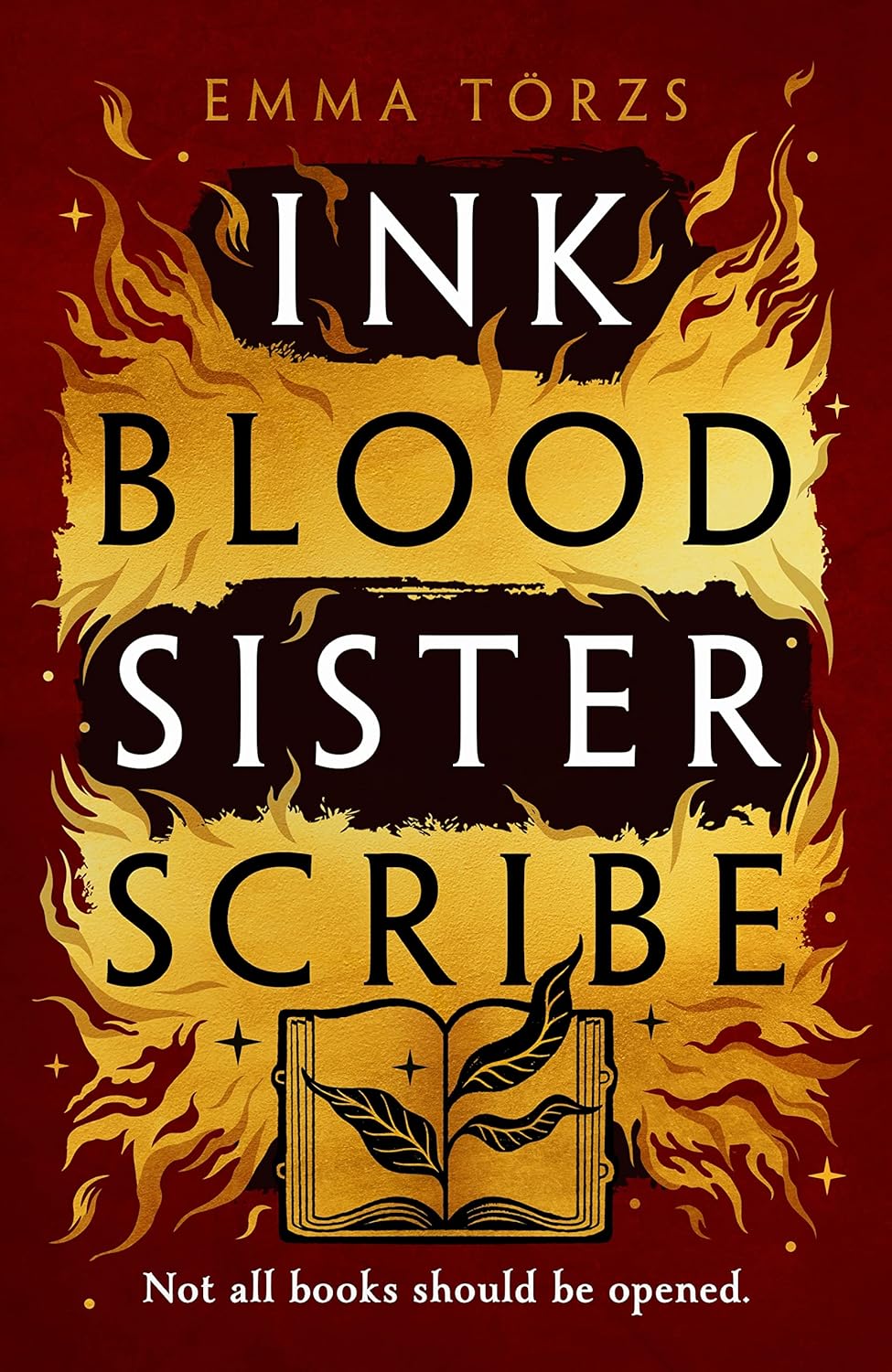
2023/147: Ink Blood Sister Scribe — Emma Torzs

At first each bookstore felt magical. Not the kind of magic Esther had grown up with but the kind she’d read about in novels, the kind that was all possibility, the chance that with one right turn in the forest or one fateful conversation with an old woman a person’s life might change forever. [loc. 3614]

The Kalotay sisters haven't seen one another for years. Esther is working in the Antarctic as a electrician, while her half-sister Joanna lives in a hidden house in Vermont, alone since the death of their father, who was killed by a book.

This is a world where magic is a closely-guarded secret, and spells are inscribed in books using ink made of blood and herbs. The talent for magic runs in families -- Joanna can sense it in the books she guards, though Esther is curiously immune -- and can be detected by other magic users. Esther was told never to stay in the same place for more than a year: 'you must leave on November 2 and keep moving for twenty-four hours, or the people who killed your mother will come for you'. But she's in love with a girl named Pearl, and doesn't want to go. Joanna, meanwhile, lives a solitary life, reading historical romances: there's a stray cat that comes looking for food, and she visits her mother in town, but she's achingly lonely.

As is Nicholas, the third of the viewpoint narrators, despite the near-constant presence of his bodyguard Collins, and the company of his uncle Richard, and of Maram, Richard's partner and Nicholas' former tutor. Nicholas is heir to the Library, a secret thaumocracy of magic-users: he's also a powerful Scribe, writing spells to order with his own blood. He lives a life of immense privilege but very little freedom. It's for his own protection, says Uncle Richard: wasn't Nicholas kidnapped as an adolescent, and didn't he lose an eye?

The three protagonists' stories converge, but the paths are twisty and the intersections unpredictable: the denouement, despite a slowing of the plot as all the convolutions are exposed, is highly satisfying, and open enough to admit a sequel. Ink Blood Sister Scribe is a pleasure to read, full of inventive turns of phrase ('He’d never felt so passionately all-caps about another person') and vivid descriptions -- of a dark garden in Vermont, of a drive through London at night, of Antarctic skies. It reminded me, in atmosphere, of The Atlas Six by Olivie Blake, but the tone is less cynical and the characters less antagonistic, less competitive. An intriguing debut.