Wednesday, August 10, 2022

2022/102: The Black Witch — Laurie Forest

“Real education doesn’t make your life easy. It complicates things and makes everything messy and disturbing. But the alternative, Elloren Gardner, is to live your life based on injustice and lies.” [loc. 5397]

Elloren Gardner has been brought up in seclusion by her beloved uncle. She's the spitting image of her dead grandmother, a national hero, and although she has shown no signs of magical ability, her relatives seem sure that it's only a matter of time. Then her Aunt Vyvian arrives unexpectedly, and whisks her off to the city and thence to Verpax University. Aunt Vyvian has an agenda: she wants Elloren to 'wand-fast' to attractive and powerful Lukas May -- and she's not afraid to fight dirty when Elloren protests that she barely knows the man. Elloren ends up in squalid university residences, sharing with winged Icarals ('demonic, monstrous, winged'), studying with Lupines ("savage" and lewd) and working in the kitchens with Kelts ('accepting of intermarriage ... mixed'). She is bullied mercilessly, both by members of the 'impure' races (everyone who isn't Gardnerian: selkies, werewolves, elves, Fae) and by fellow Gardnerians, such as her aunt. She's grown up believing that the Gardnerians have been oppressed for centuries, until the time of her grandmother: brought up to regard herself as a deserving member of a pure-blooded elite, and to require ritual cleansing after meeting the eyes of an Icaral. But gradually Elloren begins to question her perspective and her culture...

I was discussing various fantasy-academia novels with a friend, and she mentioned The Black Witch, which it turned out I'd purchased a while back. I decided it was time to read it -- and after a few chapters I remembered / realised why I'd bought it: because it was targetted as toxic, racist, homophobic and elitist on Twitter a few years back. In general, I prefer to make up my own mind about such accusations, and my conclusion is that this is indeed a novel about toxic, homophobic, elitist, misogynist racists, at least one of whom -- Elloren, our viewpoint narrator -- is capable of overcoming her prejudice. This level of cultural baggage isn't easily or quickly overcome, but Elloren and her brothers are on the path to redemption by the end of this novel, first in a series. The Black Witch depicts bigotted behaviour: it does not endorse it.

Controversy aside, this is a very readable YA novel that reminded me in places of L J Smith's great unfinished Night World series: the pairing-up of unlikely couples, the diversity, the sense of world-views being adjusted to fit a wider reality. I didn't find Elloren very relatable, and for at least a third of the book she was really quite whiny (as well as racist, elitist, ignorant et cetera). But she changed: people do.

On Disagreement
Tuesday, August 09, 2022

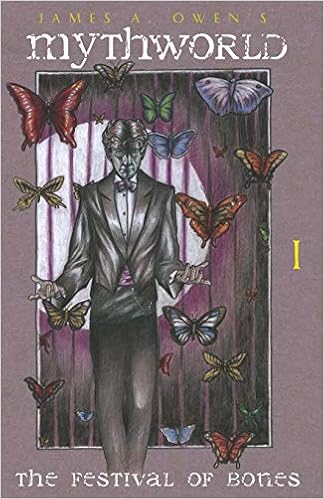
2022/101: MythWorld Book One: The Festival of Bones — James A Owen

“This, as far as I can tell, is the Prime Edda — a completely unknown work of Snorri Sturluson’s. What’s more, this manuscript apparently belonged at one time to Franz Liszt, who worked on the translation before giving it to a young companion of his whom he referred to as ‘Dearest Friend’.
..."Wagner," breathed Galen. "It's Wagner." [loc. 875]

Alexandra David-Neel! Trepanning! Wagner and Liszt! A lost Edda! Absinthe! A magician going by the stage name of 'Obscuro', whose name is actually Jude!

All so promising. But also: very few female characters, none of them with any significance to the plot; not much in the way of characterisation (our three protagonists are all white male academics); a sprawling, convoluted and sometimes repetitive plot full of conspiracies and ancient wisdom; some clunky writing... Despite being published in 2002, I suspect this was written a lot earlier ('Yugoslavian Airlines'?). And despite my acquiring it in 2012 (!) it's taken me a decade to get around to reading it. (Or so I thought: see below.) Luckily I wasn't hooked -- 'luckily' because the rest of the series seems to be currently unavailable, and has possibly never been published in English.

Come for the Norse myth, stay for the trepanned zombie students roaming the streets of Vienna, but don't expect resolution.

...Oh, for heaven's sake: turns out this was another accidental reread. My original review from 2012/13.

Tuesday, August 02, 2022

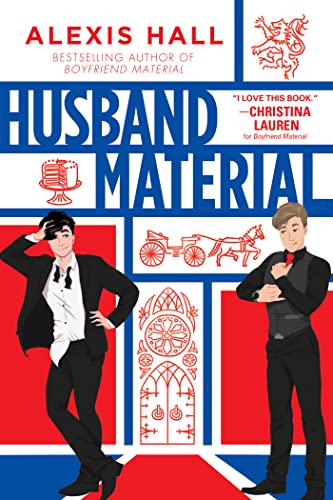
2022/100: Husband Material — Alexis Hall

...the reason I'd needed to date someone like him to begin with was that I’d needed to distance myself from the parts of queer culture that looked bad to a certain kind of rich straight person. And while I’d come to realise that Oliver was more than a respectable job and a wholesome jumper, it still weirded me out that he found so little value in what I’d always instinctively thought was our community. [p. 140]

This is a surprisingly difficult book for me to review: I enjoyed it a great deal, but discovered something about myself while reading, which is that I don't especially like 'staying together' romance. Or, perhaps, that I don't find it as relatable as 'getting together' romance. This tells you more about me than about Husband Material, though: the latter is a sequel to the adorable Boyfriend Material (in which embittered Luc finds true love with straightlaced Oliver), and begins two years later. Alexis Hall has echoed the structure of a well-known romantic comedy (can you guess which one?) in this tale of multiple weddings -- some heterosexual, some not -- and an unexpected death. Luc is nearly (gasp) thirty years old, and all his friends are settling down, with more or less drama. (Bridget, naturally, experiences more drama than anyone. But she works in publishing -- we get more fleetingly-mentioned anecdotes, each of which'd make a splendid story in its own right -- and should be accustomed to improbable coincidences by now.) Luc is blissfully happy with Oliver, and he thinks it's mutual: but the two are very different, with Luc embracing queer culture and Oliver preferring podcasts and straight friends, alienated by flamboyance and rainbow balloon arches. They're both gay men, and they've both grown up in the UK, with marriage (not to mention giving blood) having been an impossible dream for most of their lives: but do they have enough in common to make a commitment?

This was such an entertaining read, with very much the same cast as the first novel (plus the intriguing Tyler, who's apparently going to get a novel of their own) and entirely credible developments in the lives of each. There are also new characters, and new locations (outside London, OMG), and very definitely new developments. The final chapters put a big smile on my face (as did the scene where Luc, about to give a speech, realises that fountain-pen ink and sweat don't mix too well. I feel your pain, Luc).

Frivolous and funny but also insightful, this novel doesn't flinch from the difficult moments -- a couple of which brought tears to my eyes -- and is very much in favour of emotional honesty, as well as surprising sweetness. My sourness is my own!

Monday, August 01, 2022

2022/099: Notorious Sorcerer — Davinia Evans

”All any of us can do is make the best of the cards we are dealt.”
Why? Why can’t we —“ Zagiri waved her free hand wildly. “Draw blade on the dealer, seize the deck. Make the best better. For everyone, not just us.” [loc. 3220]

Siyon Velo comes from the wrong side of town, Dockside, but he's built a successful business retrieving alchemical supplies from the other planes -- the Empyreal, the Abyssal, and the Aethereal -- and selling them to various alchemical practitioners. His clients are mostly azatani, or aristocrats: Siyon is well aware that they have privilege he can't even imagine. But when he commits an impossible act in a crowded square, he finds himself attracting the attention of several well-connected individuals. And maybe, just maybe, he can pull off another impossible feat...

Notorious Sorcerer contains an abundance of my favourite things: opera, alchemy, queer romance, card games, mannerpunk, swordfighting, women chafing at social mores, friendships between men and women. The worldbuilding is intriguing, though lightly drawn: hints of the lands beyond the city of Bezim, which is the only place in the world where the planes can be accessed, and characters from those other lands with their distinct customs and culture. There are a lot of likeable characters here, too: the azatani sisters Anahid and Zagiri Savani, who want very different things from life; Siyon, who’s reinvented himself but is still a product of his experiences; Izmirlian, who’s voyaged extensively but yearns for further horizons; even Anahid’s husband Nihath, stubbornly adhering to the classical methodology of alchemy as laid out centuries before. Alchemy colours every aspect of life in Bezim, from the suits of cards (each with their Power) to the plots of popular operas, from the concordances of emotions to the City itself, divided by the geological consequences of an alchemical endeavour. That it's technically illegal is just one more way in which social class manifests: the alchemists of the Summer Club (to which Siyon yearns to be admitted) can get away with rather more than a street-wise supplier of infernal kelp and phoenix feathers.

This is a novel about alchemy, about balance, about draconian policing and social negotiation: but at heart it’s a story about finding one’s place in the world, and the importance of living in one’s own life. I liked it immensely — perhaps even more on second reading, when I could see how cleverly the plot had been constructed. [Disclaimer: I should confess that I've known the author (mostly online) for lo these many years. Nevertheless, I was fully prepared to nitpick like mad: but I didn't need to, because this is a brilliant, engaging, emotional whirlwind of a novel, which made me laugh out loud and also reduced me to tears.

Thanks to the publisher and Netgalley for the advance review copy, in exchange for this honest review. UK publication date is 13 September 2022.

Sunday, July 31, 2022

2022/098: Dweller on the Threshold — Skyla Dawn Cameron

Now I was a pink-haired girl living in a giant haunted house, scheduled to play Dungeons and Dragons with my realtor’s son, like some kind of Manic Pixie Dream Girl out of a shitty novel about a middle-aged man finding the will to live after his divorce. [p. 117]

I was hooked by the sample chapter and read this novel in a single afternoon. It's narrated by Norah, who's been living with her ex during the pandemic but is summarily told to move out. Luckily, she's just discovered that she's inherited the family house from her long-estranged, recently-deceased father. Norah takes the bedspread, her two cats, and all the toilet paper, and drives to the little town of Hope Falls, Ontario, where she discovers that the house is ... not exactly vacant. Haunted house? Weird neighbours? Repressed childhood memories? Bring it on.

The pacing is sometimes uneven, the final chapters are frantic, and a few plot points could have done with more resolution: but I liked Norah's narrative voice, and her determination to protect her cats, and I certainly empathise with her approach to social interaction: "...a lot of the pandemic protocols were things I could get used to one day when we were all vaccinated and no longer dealing with it. I dug masks. I really dug social distancing. I loved not shaking people’s hands. I loved people not getting in my space when I was shopping or on the sidewalk. I liked this new trend of minimizing the time someone was in my home. And not a single dude had randomly stopped me on the street to tell me to smile. If we could have all that without the death and suffering, I’d be happy." [p. 90]. An engaging read, with some interesting observations about the long-term effects of trauma ('reframing how we look at what we've become to cope' says the author in her afterword), and plenty of humour to leaven the darker scenes.

The cats, by the way, are absolutely fine.

Saturday, July 30, 2022

2022/097: Ithaca — Claire North

Listen to my voice: I who have been stripped of honour, of power and of that fire which should be mine, I who have nothing to lose that the poets have not already taken from me, only I will tell you the truth. I, who part the veil of time, will tell those stories that only the women tell. [loc. 149]

I was thrilled to discover that Claire North -- whose previous novels (The First 15 Lives of Harry August, Touch, The Sudden Appearance of Hope) I've enjoyed immensely -- was publishing a novel based on Greek mythology. Ithaca, first in a new trilogy, focusses on the women of the island, abandoned these past eighteen years by their king (Odysseus) and by the adult men, all fed to the war in Troy. Now pirates menace Ithaca, and the island has few men to defend it. Penelope, guarding the throne for her husband (of course a woman cannot rule in her own right, unless she is a monster like Penelope's husband-slaying cousin Clytemnestra) is besieged and patronised by suitors, but she has her clever and (mostly) trustworthy maids to help her manage the household, the palace, the unwelcome guests and the economy of the island. And then more guests arrive: Orestes and Elektra, children of murdered Agamemnon, in search of their mother...

I was amused by the homogeneity of the suitors — with the notable exception of Kenamon the Egyptian — and the sheer inability of the island’s elders (male, of course) to accept that their wives, daughters, maids and female slaves are actually pretty competent at keeping the economy going, and even at defending against external threats. The relationships between the women (forceful Elektra, the hateful Trojan captive, the village huntress Teodora, Penelope herself) are, in general, richer and more balanced than those between women and men. Telemachus has an increasingly tempestuous and abrasive relationship with his mother: Orestes, in contrast, is almost catatonic with … something. (Elektra does all the heavy lifting, emotionally, with a belated ‘my brother will issue his orders later’.)

North depicts the culture with a light touch: the guest-laws and the obligations of the hostess, the practicalities of slavery, the little details of domestic life in the palace of Ithaca, the tensions between a goddess and her stepdaughters… What makes this novel so refreshing is the choice of narrator: Hera, who takes queens under her protection, who loves Helen and Penelope and Clytemnestra (but the latter best of all), who snarks and scorns her stepdaughters and her husband, who mocks the men who discount women so utterly that they don't see what's in front of them. Hera sees the wider world as well as the goat-tracks and sea-caves of Ithaca, and her broad perspective and smouldering rage make for a unique voice and an engaging read.

Thanks to the publisher and Netgalley for the advance review copy, in exchange for this honest review. UK publication date is 6th September 2022.

Tuesday, July 26, 2022

2022/096: A Taste of Gold and Iron — Alexandra Rowland

Just as someone's palate changed over time, so too might their sense of a metal change. ...Remarkable, and ominous, was the fact that it had happened now. Remarkable was what it had changed to.
He was never again going to be able to touch iron without remembering this: the wine cellar. The door. Kissing Evemer. It was imprinted on him permanently, written into his fingerprints. [loc. 5248]

The sultan of Araşht, Zeliha, has just given birth, and her brother Kadou is torn between relief that he's lower in the succession and anxiety that the baby's father, Siranos, is untrustworthy. His anxiety has frightful consequences, and he's assigned a new bodyguard, the upright and stoic Evemer. Evemer judges the prince to be careless, flighty and negligent ... until he comes to know him better. And when the two become involved in political and financial skulduggery, there is plenty of opportunity for both to show their mettle.

This is a romance in a fantasy setting, rather than a fantasy novel with romantic elements: the emphasis is very firmly on Kadou and Evemer's evolving relationship, and their interactions with those around them. The worldbuilding is tantalising (sea serpents!) and there's little more than a glimmer of magic: Kadouhas the rare ability to sense the purity of any metal, and this manifests as a kind of synaesthesia. There are gods, but they remain firmly in the realm of the hypothetical.

One aspect of A Taste of Gold and Iron that I very much admired was its handling of mental health issues. Kadou is plagued by anxiety, panic attacks and overthinking: Evemer in particular -- but also Zeliha, Tadek and others -- are supportive and compassionate, and recognise the value of Kadou's various coping mechanisms. I also applaud the notion of the temple aunts, who are more therapist than priestess.

Araşhti society is refreshingly free of prejudice: women, or oryasilar (third-gender persons) are at least as likely as men to be in positions of power, and same-sex relationships are unremarkable. (At one point Zeliha is trying to broker a marriage between Kadou and a fine-looking nobleman from a neighbouring country.) There are three categories of fatherhood, none of which Siranos seems to understand at all; there are the kahya, who are not mere guards or servants but the future political elite; there is weaponised etiquette. And there are many very likeable secondary characters, especially Tadek (Kadou's ex-kahya and ex-lover, who has wit and heart) and Tenzin, a satyota (truth witch) who has some of the best lines in the novel.

There were some aspects of the novel that jarred. Kadou is named after the word for 'gift' in Vintish -- which, yes, is actually, literally French. ('all the Vintish servants kept coming in to stand around my crib and coo, cadeau, un cadeau, un tel cadeau' [loc. 1275]). Everything else is secondary-world: why not invent the Vintish language too? There are also some moments where the protagonists make poor decisions, which seem out of character: even when exhausted / imprisoned / panicking, both Kadou and Evemer are (almost always) fearsomely competent. And the pacing sometimes feels uneven.

But still, I loved it. The slow-burn romance; the plethora of romance tropes (only one bed! kissing to allay suspicion!); the emphasis on respect and reciprocity in what could have been a tragically unequal partnership; the ways in which Kadou and Evemer initially underestimate one another, and the openheartedness with which they negotiate their evolving relationship.

Thanks to the publisher and Netgalley for the advance review copy, in exchange for this honest review. UK publication date 01 September 2022.