Tuesday, July 19, 2022

2022/095: On Wilder Seas -- Nikki Marmery

They think I am a thing they have stolen. Like the silver and the grain and the charts, and the roteiro guides, and everything else they take from the Spaniards. Rather have I stolen myself. [loc. 383]

This fictionalised account of 'Maria', the only woman known to have sailed on Drake's Golden Hind, was inspired by a single line in an anonymous account of Drake's circumnavigation, 1577-80. Maria has been a slave of one sort or another for eleven years when the novel opens, traded from one man to another, learning to read and acquiring some education before that particular owner fell prey to the Spanish Inquisition. Now she is eager to escape her Spanish protector, the vile Don Francisco, and she dares to ask Drake -- known only as 'the General' -- if she can accompany him. Unaccountably, he says yes: and Maria finds herself the only woman on what's effectively a pirate ship.

She makes allies amongst the crew, notably Diego, an African who is also a free man, and Thomas, a cabin boy who shows her where to hide from the crew and their indiscriminate lusts. But in the end, the only real sanctuary is in the General's bed, and thus under his protection. Little does he know that Maria is already pregnant when she boards the ship ...

Maria's presence is sometimes beneficial to Drake: she's better at communicating with the indigenous people they encounter when the Golden Hind drops anchor. Maria herself welcomes these trips ashore, the only times when she is not the sole woman in a performatively masculine environment: the claustrophobic danger of the ship is strongly contrasted with the days she spends with Native American women. Yet in the end, she cannot trust Drake, and he cannot trust her.

As in many historical novels, the language of Maria's first-person narrative feels rather stiff, lacking contractions and colloquialisms -- though she does occasionally use a Spanish word. Perhaps not a wholly likeable character, but a person who is determined to survive, pragmatic about how she minimises her risks, and fortunate not to fall prey to worse treatment than she does. On Wilder Seas is an impressive first novel, and that cover is beautiful!

A piece by Nikki Marmery on the historical inspiration for her protagonist, 'Maria: the African woman who sailed with Drake on the Golden Hind', suggests that she might have been the inspiration for Sycorax in Shakespeare's The Tempest: there are also some research-related posts at Marmery's blog.

Monday, July 18, 2022

2022/094: Termination Shock -- Neal Stephenson

... apparently in Texas you could just crash jet airplanes, shoot it out with giant predators on the tarmac, set fire to the wreckage, and flee, and no one would get particularly excited about it. [loc. 5526]

Just over a decade ago, I wrote a review beginning thus: "Neal Stephenson's latest novel is a vast, sprawling contemporary techno-thriller. It's very readable: I devoured it, on my Kindle (not sure my wrists are up to coping with the physical dead-tree book) in a couple of days. But it wasn't as satisfying as Stephenson's previous novels. All his flaws (including implausible female characters, lack of editing, frustratingly inconclusive endings) are here..." So: ten years after Reamde, more or less, comes Termination Shock, a vast sprawling techno-thriller, very readable, et cetera. I did enjoy it a lot while I was reading it, and I am happy to report that I was much more satisfied with the female characters and with the ending. But gosh, there is a lot here. Feral hogs, a pair of football hooligans from Leeds, a Venetian movement in favour of seceding from Italy, eagles versus drones, the Comanche mindset, Herman Melville's Moby Dick ... They do all connect, eventually, in this thriller about climate change, one man's radical approach to reversing it, and the competing factions who would like things to be done differently.

One of the protagonists is Saskia, Queen of the Netherlands; another is Rufus, a nomadic veteran with a complex racial heritage and a great many practical skills; and the third is Laks, known as Big Fish, a Canadian Sikh who goes to the Himalayas to fight the Chinese on the Line of Actual Control, disputed territory where any weapon developed later than the Paleolithic is forbidden. It's not immediately obvious how Laks' story intersects with the others, but I trusted Stephenson enough to go with the flow.

Things I especially liked included Rufus' close reading of Moby Dick and the parallels he draws to his own life; Cornelia, a Venetian aristocrat who can trace her ancestry back to the Roman Empire; Stephenson's clear, layman-accessible descriptions of the scientific principles, inventions and techniques involved; Saskia's relationship with her daughter. Things I wasn't so keen on: repeated references to news items of the present day, since this is set, I'd say, a decade or two in the future. Are we really still going to be talking about January 6th, about Khashoggi, about the Talking Heads? ... Also worth mentioning that this is a world in which 'living with Covid' is a thing: better track'n'trace, children growing up learning how to have facial expressions that are effective fro behind a mask, social bubbles ...

Termination Shock was a good read, and a surprisingly optimistic one: as usual, it could have been a lot shorter without any impact on the plot, but I did enjoy the frequent, lengthy digressions.

A long, spoilery, intelligent piece about the science and the themes of the novel..

Saturday, July 16, 2022

2022/093: A Restless Truth -- Freya Marske

Women in modern evening gowns exposed more skin than this in public. Even so: the scandalous and experienced Violet Debenham had stopped talking at the sight of her. A thrill of triumph washed over Maud. [loc. 1781]

Second in the trilogy that began with A Marvellous Light, this novel has a very different setting -- the Lyric, a luxury liner sailing from New York to Portsmouth -- but shares some characters, and has the same balance of romance and magical whodunnit. I was very happy to renew my acquaintance with Maud Blyth, sister of the previous novel's protagonist Robin, and Lord Hawthorne, rude and arrogant ex-lover of A Marvellous Light's other protagonist, Edwin. There are new and fascinating characters, too, most notably theatrical performer Violet Davenport, 'a sophisticated scandal-trap of a girl', and Alan Ross, allegedly a journalist or perhaps a writer of advertising copy, who has a hidden agenda, an unexpected talent, and a chip on his shoulder.

The emotional timbre is quite different to A Marvellous Light, and not only because the focus is on a sapphic relationship rather than a relationship between two men. Maud (who refuses to lie) and Violet (who is always performing) have a spikier relationship than Robin and Edwin, and the dynamic is … not what one might expect. Maud may be naive, but she exhibits considerable backbone, and sophisticated Violet (ruthlessly suppressing her own mistakes) has a lot to learn from her.

There are a number of excellent older women with agency, though poor Mrs Navenby gets a rather raw deal: the same might be said for her parrot, Dorian, who is an African Grey. (I'm ashamed to say it took me a while to spot the literary reference). I’m intrigued by Alan Ross, not least because he’s one of several non-WASP characters who confront the unthinking privilege of Maud, Hawthorne et al: and I’m very much looking forward to discovering more about Lord Hawthorne, who’s much more likeable here than in A Marvellous Light, and who I believe will be one of the protagonists of the trilogy’s conclusion.

Plenty of (sometimes literally) steamy sex scenes, charming descriptions of Edwardian fashion, pornography readings, advancement of the ‘Last Contract’ series arc, and some genuine peril complete the package. Eager to see how this will all be resolved in Marske’s next book!

Thanks to Netgalley and the publisher for the advance review copy, in exchange for this full honest review. UK Publication Date is 10th November.

Fulfils the 'featuring a club' rubric of the 52 books in 2022 challenge, thanks to the Forsythia Club (female magicians).

Friday, July 15, 2022

2022/092: Razor Girl -- Carl Hiaasen

“A carrot cake is neighborly,” Burton said. “A blowjob is a plan.” [p. 76]

Florida health inspector (formerly police officer) Andrew Yancy is still visiting local restaurants ('more like a petri dish with menus') to investigate hygiene failures, such as giant Gambian pouched rats, something wriggling in the hummus, and hair clippings in the quinoa. The hair clippings come from Buck, a reality TV star who's fled a bar after his racist and homophobic jokes were poorly received. Normally his manager / agent, Lane, would have been a mitigating influence, but he's been kidnapped with the aid of the eponymous Razor Girl, an insurance fraudster who goes by the name of Merry Mansfield and whose speciality is faking traffic collisions whilst pretending to shave her bikini area. The guy Merry was supposed to, literally, bump into is Martin, the owner of a company called Sedimental Journeys, which provides high-quality sand ('like cocaine for your toes!') to replenish eroded beaches on the Eastern Seaboard. Martin falls foul of a New York mobster, who owes Andrew Yancy a canine-related favour, or possibly a diamond ring... Confused? You will be: but you'll enjoy it.

There are some serious elements to this headlong farce. Yancy's girlfriend Rosa, a coroner, heads off to Oslo, 'where children never, ever die from gunfire', and seems unlikely to return. Buck, the reality TV star, realises that he's inspired some batshit white supremacists. Yancy is keen to discourage the latest potential buyers of the empty lot next to his own: he suspects them (rightly) of wanting to build a McMansion and obscure his view of the sunset, not to mention the environmental impact. And Merry is an all-American con artist, let down by the system, independent and self-made, exploiting anyone who's sucker enough to believe her, but doing so without malice.

I think of Hiaasen's novels as beach reads (which is not a quality assessment, more an ambience thing) and purchased Razor Girl (a loose sequel to Bad Monkey) for a recent beach trip. It was a good choice. The tangle of connections resolves nicely, the characters are sufficiently well-written to engage, and Hiaasen's humour, while perhaps not as dark as in some of his earlier novels, still hits the spot.

Fulfils the 'household object on the cover' rubric of the 52 books in 2022 challenge. (There's a razor on the cover of my edition.)

Thursday, July 14, 2022

2022/091: False Colors -- Alex Beecroft

The naval routine around him was familiar as the rhythm of his breathing. But he began to dimly discern another world within it; jealousies too sharp for friendship, smiles too radiant. [loc. 1987]

1762: Lieutenant John Cavendish is awarded his first command, the Meteor (née Météore) and sent off, with an untried crew, to harry the Barbary slavers of Algiers. He hopes that his new lieutenant, Alfie Donwell, will be a reliable right-hand man.

Alfie likes the look of his new captain, and hopes that John is amenable to seduction.

All goes well (for values of ‘well’ including captivity, torture and hurt/comfort) until John realises what Alfie wants from him and storms off in a welter of moral indignation. Alfie returns to his old ship, the Britannia, and his old captain, the charismatic and thoroughly amenable Charles Farrant, Lord Lisburn. Meanwhile John agonises over Alfie’s horrific revelations. John, product of a religious upbringing, has never had any problem being chaste. He doesn’t find himself overwhelmed in ... feminine ... company ...You can see where this is going: but John’s crisis of sexuality -- his internalised homophobia, and his gradual realisation that perhaps he is not immune to Alfie’s charms -- is slow, painful and thoroughly credible for the period.

I think I was expecting something light and frothy, but this is a well-researched novel, with excellent detail on the nautical side as well as a sympathetic, but depressing, depiction of queer life around the edges of polite society. I was struck by two plot elements that one doesn't always find in m/m romance: firstly, that Alfie spends a lot of time, and experiences a fair amount of happiness, with Farrant rather than with John; and secondly, that Farrant's wife (of whom Farrant is fond and protective: 'he had been faithful in his way — taking no man to his bed for whom he cared more than he cared for Isabella') is a rounded character with agency, who interacts with the three male protagonists and affects their lives.

The author, in her afterword, says 'I owe an enormous amount of inspiration, entertainment and information to Patrick O’Brian' -- a debt I think I'd already recognised in her detailed and accurate depictions of naval battles and naval life. False Colors ranges from the Mediterranean to the Arctic via the Caribbean: it's a more serious novel than I'd expected, and less focussed on the romance between John and Alfie, but I found it an enjoyable (if not always cheerful) read.

Fulfils the 'title beginning with 'F'' rubric of the 52 books in 2022 challenge.

Monday, July 11, 2022

2022/090: Dawn Wind -- Rosemary Sutcliff

'...British gone wild, like dogs that run away to hunt in the woods.’
Owain felt clammily sick. To be here in the dark hiding from Saxon raiders was no more than physical danger; to be here hiding from one’s own kind, broken men turned wolf pack, was a hideous thing, an uncleanness like leprosy. [p. 77]

Reread after finishing Dark Earth, which also depicts life in the ruins of a Roman city after the Romans have left. I hadn't read Dawn Wind since at least 2005, and had forgotten much of the plot: the scenes in the crumbling remains of Viroconium are actually only a small part of the story.

Owain is fourteen when he wakes on a battlefield surrounded by the dead: he's survived the battle, but the British lost and his father and brother are both amongst the corpses. Accompanied by a war-hound whom he names 'Dog', Owain heads north with some thought of returning to the lands he knew. He falls sick on the road, and is cared for by a retired potter and his wife: but, unwilling to stay with them, he continues his journey and ends up in abandoned Viroconium, where he meets Regina, a louse-ridden and emaciated girl who begs for a share of his dinner.

The two eventually decide to head south, hoping to reach Gaul, but Regina contracts a fever and Owain trades his freedom so that she can be cared for by a Saxon family. He accompanies his new master, Beornwulf, to a farm on the south coast, and finds himself making a life there: the children like him, he still has Dog, and he's bonded with the magnificent white stallion that will likely be tribute to the King. And he fights alongside the Saxons, and they accept him as one of the war-band...

An understandably bleak book, with Owain convinced that Britain is finished and the lights have gone out, that the Saxons have won and that, when he fights as one of them, he is fighting not for anything, but only against. Owain is not free, but he has a better life than many thralls: Beornwulf likes and trusts him, he is treated well, and he finds some inspiration in the words of the Welsh envoy, Einon Hên, who speaks of a glowing future for Britain: 'not the dawn as yet, but I feel the dawn wind stirring'.

Owain's emerald ring, which becomes a plot point in itself, shows that he is a descendant of Marcus Flavius Aquila (from The Eagle of the Ninth) and more recently Aquila who was Artos's advisor in The Lantern Bearers: but this novel is set a century after Artos' victories, and the memory of Rome is faint. Still, Owain is heartened in a very dark moment by the discovery of a mosaic in an old shrine:

...he scraped and scrabbled on, the loose black soil formed by the drifted leaves of a hundred summers crumbling easily away under his fingers. In a little, he had cleared a medallion surrounded by a delicate border of ivy leaves and berries, and was looking at the half-length figure of a girl with a bird in one hand and a blossoming branch in the other. Part of the border had been destroyed by the roots of something that had grown through it, but the little figure was perfect, delicately charming and full of joy.[p. 165]

More comfort there than in his notional Christian faith, though the latter does bring him face to face with Augustine, not yet sainted and eager to raise his church in Saxon lands.

As in Dark Earth, there's a post-apocalyptic feel to this story: the lights have gone out, outlaws roam the land, all that was civilised and beautiful lies in ruins. And yet there is hope, and love, and found family. I found Owain's story rather darker than Isla's narrative, perhaps because he is so alone, or perhaps because the stories and roles available to him, as a man, are very different.

Fulfils the 'involves a second chance' rubric of the 52 books in 2022 challenge.

Sunday, July 10, 2022

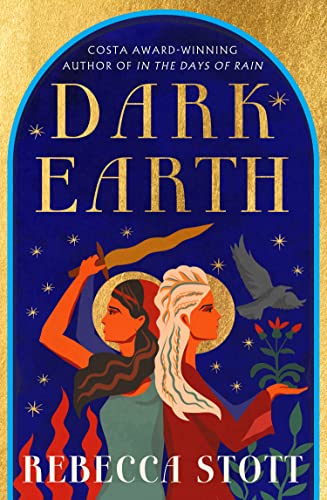
2022/089: Dark Earth -- Rebecca Stott

There is one last nightingale... the very last bird left on that wall. The rest of the plaster has cracked and fallen away... It is all going down into the dark earth, Isla thinks, remembering what Crowther had said about the marsh rising and the cities falling. It's going to take them all with it. But it hasn't taken the nightingale. Not yet. [loc. 3249]

Isla and Blue live on a nameless island in the Thames. The year is AD500 or thereabouts; the Romans ('Sun Kings') have abandoned Britain, and the ruins of their city are rumoured to be haunted. The Saxons ('Seax'), ruled by Osric, live across the river. After the death of the girls' mother, Osric exiled Isla and Blue along with their father, a Great Smith. Ostensibly this was because the smith had brought bad spirits to the camp, but clearly the reason was that he was the only man in the south of England who could make 'firetongued' (pattern-welded) swords, and Osric wanted those for himself.

But now their father is dead; Isla is terrified that Osric's soldiers will discover that she's been working in the forge, an activity prohibited to women; and without the protection of Osric and his sons, the sisters will have no home and no kin. Blue's tales of witchcraft, however, don't endear them to the superstitious Seax, and it doesn't help that the sisters are half-Iceni (through their dead mother) and wholly 'other': Blue's pet crow, Isla's mismatched eyes ...

The characters of the novel inhabit a world infested with ghosts, spirits and deities (Blue occasionally slips off to the mudflats to commune with the staked skeleton of a woman) but Dark Earth is emphatically not a fantasy novel. Every event is explicable, actual, real: it's the overlay of the characters' beliefs and perceptions (and sometimes a deliberate desire to mystify) that adds the sheen of the fantastic. Dark Earth -- the name refers to the layer of dark soil marking the years of Londinium's abandonment -- is firmly rooted in the archaeology of post-Roman London, and especially the Billingsgate Bathhouse, where the sisters encounter a predominantly female community of outcasts, scavengers and mystics. There are some beautifully evocative depictions of life in the ruins, and the need to reuse and repurpose everything that's been left behind by the vanished Sun Kings. Cremation urns become cook-pots; nails are salvaged for metalwork, now that the Roman mines have fallen into disuse; overgrown gardens still harbour medicinal herbs.

The narrative voice is Isla's, and it's clear that she doesn't understand everything she sees. She is oblivious to the growing attraction between Blue and dark-skinned Caius; uncertain about her own feelings for Senna, who rescues them from the splintering Roman bridge; convinced that she has brought a curse upon the people who have helped her. But her emotions are vivid and compehensible, despite the strangeness of the post-apocalyptic world through which she moves.

I'm a Londoner, a medievalist and a feminist, and I enjoyed this novel a great deal. It's a tale of contrasts: Romans and Saxons, men ('all swords and certainties') and women, stone and wood, ghosts and the living, pagan gods and Christianity. There were, however, two scenes which jolted me out of the story -- an account of folk banding together to save a stranded whale (what, and lose out on all that meat?!) and a passage referencing Macbeth, in which the author would have done better to paraphrase more. Nevertheless, an engaging read, with credible diversity, and a fascinating and credible depiction of a distant, poorly-documented time.

Stott's website has a page linking to some fascinating posts about her research rabbitholes.

Thanks to NetGalley for a free copy of this novel, in exchange for this honest review.

Fulfils the 'featuring an author's note' rubric of the 52 books in 2022 challenge.