Sunday, October 07, 2018

2018/67: Killing Gravity -- Corey White

"MEPHISTO,” I say. “Stands for Military Experimental Post-Human Specialist Training Organization, and I only found that out after years of sniffing around.”
“And they’re the ones that ... made you?” [loc. 540]
Space-opera novella that reminded me strongly of Andre Norton, right down to the presence of a feline companion. Mars Xi is a living weapon with mystical, highly-destructive powers. She's on the run, from bounty hunters as well as the dastardly corporation that created her: rescued by the space tug Nova, she finds it hard to trust her new companions with the truth about herself -- or her fears about someone who was once her friend and might now be an implacable enemy.

The violence (and, to be honest, quite a bit of the characterisation) has a comic-book feel, and there are considerable holes into which the plot would stumble if it weren't moving so quickly. Good fun, with some nice ideas (and a space-kitty!), but somewhat two-dimensional.

Saturday, October 06, 2018

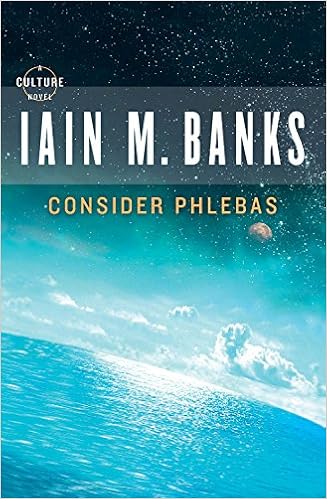
2018/66: Consider Phlebas -- Iain M. Banks

I don't care how self-righteous the Culture feels, or how many people the Idirans kill. [The Idirans are] on the side of life—boring, old-fashioned, biological life; smelly, fallible and short-sighted, God knows, but real life. You're ruled by your machines. You're an evolutionary dead end. [p. 26]
This was likely the first of Banks' SF novels that I read, back in the last millennium, and I don't think I've ever reread it. What did I remember? The finger scene: ugh.

The protagonist of Consider Phlebas is Bora Horza Gobuchul, a Changer (i.e. a shapeshifter, though taking on another's appearance is slow and effortful) who has been recruited by the effectively-immortal Idirans in their war against the Culture. Horza is sent by the Idirans to retrieve a Culture 'Mind', which he persists in thinking of as a machine although it's actually a sentient entity with free will. Cue an interstellar chase, with space pirates. weird cults, ancient temples, treachery, swashbuckling, comedy aliens (along with many that are not at all comic), romantic complications, and an enemy agent -- the magnificent Balveda -- who is more than a match for Horza.

I like Horza, though suspect I should not, as he is not actually a very nice person. His singlemindedness and courage, and his competence, make up for a lack of interpersonal warmth and a certain hollowness. (And it is not his fault that his girlfriend is fridged.)

I do vaguely recall reading the novel, being shocked by the abrupt ending, and shocked all over again that, according to the appendices, the events of the novel happen centuries in our past. So, a bit like Star Wars, I suppose: long ago, in a galaxy far away ... I've been thinking about why this was a shock, and I suspect it's because I unconsciously expected this to be our future, the future of Earth-origin humans -- not of human-type aliens who have nothing to do with me, us, Earth.

I note that I don't tend to reread Banks' novels (not sure why, though it may simply be bad timing on my part: I didn't enjoy The Algebraist as a holiday read) and I'd somehow forgotten just how entertaining, witty and inventive a writer he was. Reading Consider Phlebas felt like a headlong rush through a plethora of big-screen space-opera settings, but there was also plenty of character interaction, philosophy (Horza is highly critical of the Culture, though I think his views are founded at least partly on misconceptions) and conflict. I think it could make great TV, and a series is in production: I might even get around to watching it.

Friday, October 05, 2018

2018/64: Nine Coaches Waiting -- Mary Stewart

The castle in the air, the Cinderella-dream – nonsense for a night. Banquets abroad by torchlight, music, sports, nine coaches waiting! Not for you, Linda my girl. You get yourself back to Camden Town. [p. 325]

Orphan Linda Martin, aged 23, quits her 'dogsbody' job at a boys' school to travel to France (where she lived as a child) and become governess to Philippe, Comte de Valmy, who is nine years old. The boy's Aunt Héloïse, who meets Linda in Paris and accompanies her to Chateau Valmy in the Savoy region, is keen that the job goes to someone with little or no French: so Linda, of course, lies about her fluency.
Philippe's Uncle Leon is confined to a wheelchair, but that doesn't impact his charisma, or his temper. Philippe is afraid of his uncle, and Linda learns to respect him. She's befriended by the housekeeper, Mrs Seddon, who tells Linda about Leon and Héloïse's wild and adventurous son Raoul -- who Linda first encounters when he almost runs her over one dark night.

Then the 'accidents' begin. Someone shoots at Philippe in the woods; a balcony almost collapses ... If Philippe dies, his aunt and uncle will inherit the Valmy fortune. Can they -- and perhaps even the seductive Raoul -- be plotting a murder?

Linda sees herself in a Cinderella role -- the poor, isolated girl who wins the heart of the prince -- but she's realistic: if Philippe is under threat, her priority is to protect him, no matter that she's falling in love with a man who might be the villain of the story.

This is an emotional and suspenseful novel, with some glorious writing -- I was especially taken by Stewart's descriptions of Paris on a rainy night -- and a satisfying romantic arc that complements, but doesn't overshadow, the rather Gothic thriller that constitutes the central plot. It is also set in, and strongly evocative of, spring, to the extent that it felt jarring to read it on a hot sunny beach.

I didn't really warm to Linda, but she did not irritate me (except by her dismissal of loyal and helpful English botanist William Blake, without whom all might have been lost). And the growing affection between Linda and her charge Philippe is rather sweet.

Raoul has considerable charm, though his values are those of his time (probably the 1950s) and his class. He's an excellent Gothic hero, reminiscent of Rochester (to Linda's Jane Eyre, of course: they even meet in a similar way!) and remains a mystery right up to the climax of the novel. An engaging read.

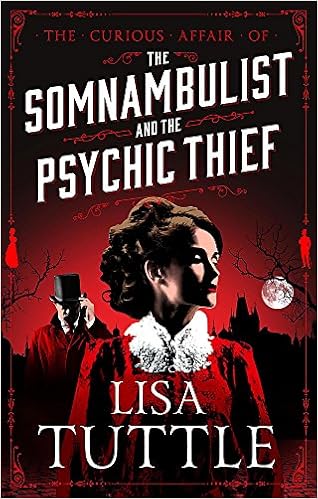
2018/65: The Somnambulist and the Psychic Thief -- Lisa Tuttle

...something sparked between us. It was not that romantic passion that poets and sentimental novelists consider the only connection worth writing about between a man and a woman. But there was curiosity in that look, on both sides, and a tentative recognition – or at least the hope – that here there might be a congeniality of mind and spirit. [loc. 121]
1893: Miss Lane has been involved with the Society of Psychical Research for years, but flees her latest assignment after discovering that her 'closest companion', friend and employer Gabrielle Fox, has been using the same fraudulent tricks as the false mediums they've investigated.

Arriving in London with little luggage and less money, Miss Lane notices an advertisement in a shop window for a 'literate, brave and congenial' assistant to a consulting detective. Not Holmes, though one could be forgiven for confusing the two at first: Jasper Jesperson is brilliant but naive, a crack shot and a master of the deductive method who is oblivious to the financial hardships afflicting the household.

This is a world in which both our protagonists are familiar with the works of Arthur Conan Doyle -- indeed, this short novel could be read as a fond critique of some of the Holmes stories -- but it is a world in which some aspects of the supernatural, at least, are real. The duo's first two cases involve a wife worried about her husband's somnambulism, and the disappearance of a number of noted psychics. (For added frisson, the latter case is brought to the attention of Jesperson and Lane by the perfidious Miss Fox herself.) Further investigations, combining Miss Lane's rationalism and Mr Jesperson's immense self-confidence, reveal connections between the two cases -- and a previously-unsuspected talent of Miss Lane.

I liked the relationship between the two protagonists, and the profound good sense and stoicism of Miss Lane. I was also pleased that Tuttle didn't feel it necessary to explore or explain Miss Lane's relationship with Gabrielle Fox: in fact, neither protagonist has any romantic or sexual relationship, which suits the social restraint of the period and with the rationality so valued by the pair. And how refreshing to read a book about a partnership between a man and a woman where neither sexual attraction or romantic wishes are an issue! Instead, they bring out the best in one another: Miss Lane becomes less mistrustful, Mr Jesperson less swashbuckling. I look forward to further cases.

Thursday, October 04, 2018

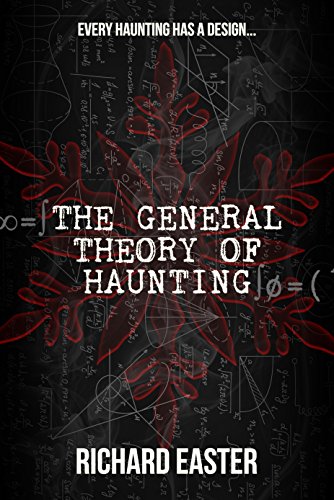
2018/63: The General Theory of Haunting -- Richard Easter

... once a door is opened, guests may arrive, invited or not. [p. 20]
Six people converge on isolated, little-known Marryman Hall for a New Year's party. Along with the butler, Boulder, they are snowed in. Strange things start to happen as they uncover the history of the Hall, a great white round edifice designed and built by Francis Marryman in the early nineteenth century. Why do all the visits recorded in the Visitors' Book happen in winter? Was that a face at the upstairs window? Why is there a portrait of Francis Marryman's dead wife Patience, but no portrait of the man himself?

Meanwhile, the guests' party spirit (not strong even at the beginning of the book) wears thin, and secrets seep through. Anne and Dan are mourning the death of their infant son, and barely speak; Paula refuses to acknowledge that her husband Ian has been changed by events earlier in the year; publisher and host Greg finds new ways of laughing off his sister Lucy's increasingly problematic alcoholism. As for Boulder ... well, Boulder has his own problems, but he doesn't feel the need to share them with the paying guests.

Another Kindle Unlimited whim, and a very readable novel, despite some proof-reading issues ('pouring over the plans'; 'Verve Clicquot'; the use of 'the Lord' throughout, rather than 'his Lordship' or 'Lord Marryman'). This is a character-driven story, and I'd have liked more dimension to all of the main characters, especially Greg. I very much liked the nineteenth-century parts of A General Theory of Haunting: Francis Marryman, in my opinion, has more personality and courage than any of the modern-day protagonists. And Francis, at least, is not affected by the wrecking-ball events of the novel's conclusion.

This is the first in a loose trilogy: I'll keep an eye out for the others, because I like the author's inventiveness.

Tuesday, October 02, 2018

2018/62: The Space Between -- Dete Meserve

With each passing day, I’d become invisible to him. Like the Trojan asteroid, I was dancing in his orbit day after day, but was completely unnoticed by him. [loc. 416]
Astronomer Sarah Mayfield is devoted to her work: she's just given a presentation on the discovery of a Trojan asteroid, 'hiding undetected in Earth's orbit for thousands [sic] of years'. But when she returns to the family home, her husband Ben is missing, there's a Glock in the bedside table, and her account has just been credited with a million dollars. Their son Zack has been behaving badly, hence the installation of a video home-security system (which has been wiped clean), but he doesn't seem to know anything about his father's absence.

It's beginning to look as though Ben had a secret life. But Sarah is not wholly above-board either: with each new clue about Ben, she reveals one of her own secrets, such as the attraction she feels for co-worker Aaron, or the ultimatum she gave Ben before departing for the presentation. And when the clues seem to indicate that Ben's secrets are dangerous ones, Sarah lies to everyone in order to ensure that, whatever the truth, she'll be the first to know. Has she been wrong about Ben all these years?

This was a Kindle Unlimited book that I picked on a whim, because of the astronomical angle. Pleasingly, Sarah's career does play a part in the plot, and is also an excellent source of metaphors: "some things hide in plain sight ... We often can’t see or observe them because we’re blinded by the light of other objects." [loc. 1263] Searching for the truth in 'the space in between', Sarah ends up piecing together an unexpected and suspenseful story. There's a mention of A Wrinkle in Time (I think), considerable resistance to hackneyed assumptions about career women, and some splendid scenery. A well-paced novel, though I didn't engage with the characters.

Monday, October 01, 2018

2018/61: Untouchable -- Thalia Hibbert

... self-doubt, pale and pink and private like the inside of a stranger’s mouth. You shouldn’t have said anything. There’s a difference between refusing to feel shame and setting yourself up for a fall. She was used to ignoring self-doubt. It was rather prejudiced, and a bit of a bore. If she held an emotional tea party, self-doubt would eat all the scones and call Hannah fat if she complained. [loc. 674]
Nate Davis was one of the bad kids, growing up: full of rage that expressed itself in violence. Now he's back in the small town of Ravenswood, mourning his dead wife and rearing their two 'adorable' children, Josh and Beth. It'd be hard work even if his mother wasn't battling cancer: as it is, he needs help.

Enter Hannah Kabbah, a girl he went to school with. Hannah has just lost her job (or possibly been sacked: hard to tell, as her boss was suffering a marshmallow-related speech impediment when she last saw him). She'd love to work with children, but unfortunately is no longer allowed to do so due to a conviction for criminal damage.

Nate thinks she's the perfect person to look after the children. And possibly to look after him -- though of course he would never abuse his position of power, as her employer, in such a way.

The course of true love never does run smooth: Hannah is prone to depression, and outbursts of rage, has a history of self-harm, and eyes up women as well as men. (Though she's had a crush on Nate since her teens.) And Nate is finding it difficult to adjust to a new life in which he is materially comfortable, but losing everything that matters.

The ways in which they open up to one another -- and the honesty of both lead characters -- is charming. How nice to see a romantic couple discussing their various sexual problems! And there's plenty about the tangles of family -- Hannah and her sense of obligation to her sister Ruth and her mother Patience; Nate over-protective of his children because they're the only ones he can protect, and terrified that his mother is dying. Kudos to Talia Hibbert for unfolding a happy ending for all. (It turns out that communication is the key: who knew?)

But the winner, for me, was the depiction of Hannah's depression, anger and self-doubt: how she's constantly trying to second-guess the voice that tells her that her hopes and wishes are unreasonable; how she (usually) squashes down the urge to say exactly what she thinks. An utterly realistic portrayal of mental health issues, without being doom-laden or over-serious.