Saturday, April 15, 2017

2017/38: The Curse of the Pharaohs -- Elizabeth Peters

I was flattered that the cat stayed with me; always before she had seemed to prefer Emerson. No doubt her keen intelligence told her that the truest friend is not always the one who offers chicken.[loc. 9086]

Amelia Peabody Emerson and her redoubtable husband are off to Egypt again, after five years in England. They leave their little son Ramses in the tender care of Emerson's brother Walter and his lovely wife Evelyn. Both leap at the opportunity to excavate what might be an undisturbed royal tomb -- and given Amelia's predilection for crime-solving, it probably doesn't hurt that the discoverer of the tomb, Sir Henry Baskerville, died in mysterious circumstances.

Egypt is certainly a contrast to their sedate life in Kent. There is a vexing reporter, an American Egyptologist, the bereaved Lady Baskerville, a young man who spends most of the novel in a coma, and Madame Berengeria, who drinks a lot to assuage the Eternal Pain stemming from being the reincarnation of an ancient Egyptian Queen. (Emerson is apparently her long-lost love.) There is a great deal of skulduggery, a romance that seems to be doomed, and a number of superstitious individuals --
Egyptian and otherwise -- who would rather Emerson and Amelia did not excavate the tomb, which is (of course) cursed.

Amelia is as delightfully cynical as ever ('the fact that she had not yet exterminated her mother proved that she was incapable of violence') and manages to retain her air of competence by never quite admitting when she's wrong.

I have to say I didn't enjoy this as much as Crocodile on the Sandbank: but I had already committed myself, via the four-book omnibus edition, to the series. Curse of the Pharaohs is entertaining, fast-paced and often very funny: it introduces characters who will be significant later in the series: but Amelia did not charm me quite as much as on first acquaintance.

Also, I note that in Elizabeth Peters' books, overweight individuals are seldom on the side of good -- whether neutral or actively villainous.
Thursday, April 13, 2017

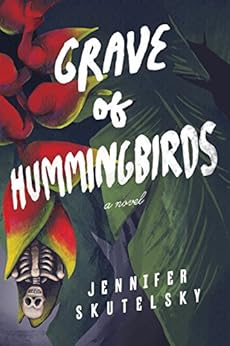
2017/37: Grave of Hummingbirds -- Jennifer Skutelsky

Gregory stood still, aware of circumstances closing over his head in a flood, images pouring in: the body in the highlands, laid out on his table under a scalpel; the tattoos and their scabs; Alberto’s beatings at the hands of the police; the woman at the café, who resembled Nita too closely, who seemed an afterthought of Nita or a memory made whole in flesh and bone.[loc. 1552]

Grave of Hummingbirds begins with a mysterious murder and mutilation in Colibrí, a remote Andean town. The local doctor, Gregory Moreno, notes the victim's resemblance to Nita, the dead wife he's still mourning. (Several other men in Colibrí seem to have been in love with Nita too.) Then two American tourists arrive in town: forensic anthropologist Sophie -- who also bears a remarkable resemblance to Nita -- and her teenaged son Finn. They have come to witness an ancient, savage ritual that involves tying a condor (symbolising the native population) to a bull (symbolising the Spanish invaders). Gregory, who loves animals, is against this. So is his young protégé Alberto, though not for the same reasons.

There are some beautiful phrases in this novel, but on the whole it felt unfinished, in need of a further edit. Sophie and Finn have an air of the white saviour about them. Their arrival in Colibrí precipitates major changes. They are the only ones who can see or hear the ghosts of Colibrí's disappeared. Both are the focus of desire and fascination from the townsfolk. And only with their appearance can the poor folk of Colibrí find justice, understanding and closure.

I'm unhappy about the characterisation, too. Sophie, who is a single mother and has visited many of the world's most troubled locations as a forensic anthropologist, crumbles into near-hysteria under pressure. Finn's great dream is to be a ballet dancer, but he decides to postpone his ambitions at the drop of a hat. And Nita turns out to have been harbouring a tragic secret -- a concealment that, given other characters' perception of her, seems improbable.

The novel's ending seems hurried, abrupt: everything (well, most things) wrapped up neatly, regardless of whether it makes narrative or logical sense. Skutelsky has a gift for lyrical writing, but it doesn't show to best advantage in this, her first novel.

Wednesday, April 12, 2017

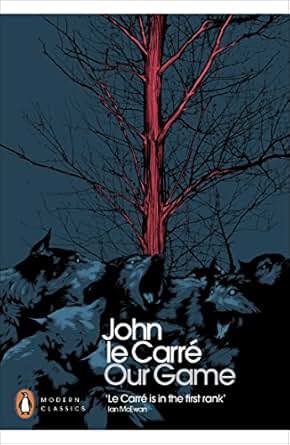
2017/36: Our Game -- John le Carré

‘Such an inconsistent man you are. One minute you are looking for Emma, the next you are looking for your friend. You know what? I don’t think you wish to find your friend, only to become him. ’[loc. 4325]
Tim Cranmer, retired 'civil servant', receives a visit late one Sunday night: his friend -- or associate -- Dr Lawrence Pettifer has gone missing, and the police wonder if Cranmer can help with their enquiries.

Cranmer, of course, is not the middle-aged Treasury economist turned winemaker that he seems. And Larry is not simply an eccentric lecturer in Global Security. They are former intelligence operatives, bound closer than friendship by secrets and loyalties -- and by their shared regard for Emma, Cranmer's girlfriend, who is a composer.

Panicked, Cranmer heads to London to meet with his former employers, and learns that Larry has been up to no good. But is he still alive? And where is Emma? Cranmer, finding himself as suspect as Larry, sets out to discover what Larry has really been up to.

Cranmer does not seem to be wholly sure of his own emotions; or perhaps the habit of secrecy is so engrained that even in this first-person, non-sequential narrative, he won't admit to them. I'm not sure I'd call him a likeable character, but his competence -- wonderfully contrasted with his mental turmoil, which sometimes seems tinged with hysteria -- is fascinating.

On first reading, I thought this was Larry's story: but I wonder now if it's the story of Tim Cranmer finding new purpose after being severed from the career that gave him meaning. Not at all the ending I expected, but a very satisfactory conclusion.

Sunday, April 09, 2017

2017/35: Paradise Lost: The Destruction of Islam's City of Tolerance -- Giles Milton

When the screams from the distant quayside grew too loud to be ignored, the captain ordered the ship’s band to strike up tunes.

This is not a cheerful book: but it is fascinating, brilliantly written, cautionary and informative. Giles Milton examines life in Smyrna before and during The Great Fire of Smyrna in 1922. Milton's especially good at picking out individuals who illustrate aspects of life in his chosen milieu: the first part of Paradise Lost focusses on the (mostly American) Levantines who made their homes in Smyrna because of the cosmopolitan, tolerant, mercantile nature of the city. Many of them seem to have been unusually benevolent employers: when the inhabitants of one village fled, fearing invasion, Edmund Giraud watered, harvested and sold their crops, and sent the proceeds to the displaced farmers.

The city -- populated by almost as many Greeks as Turks, together with Armenians, Jews, and Europeans -- remained relatively unscathed by World War One. Smyrna's Ottoman governor, Rahmi Bey, seems to have been instrumental in fending off the more bellicose initiatives of the Ottoman Empire: he even attempted to strike 'a private truce between Smyrna and the British government, offering to withdraw his city from the war in order to safeguard its numerous different minorities'. Sadly, the British were vehemently opposed to the Ottoman Empire -- who were allies of Germany -- and refused.

After the end of the First World War, Greece invaded: and three years later, the Greco-Turkish War was effectively ended by the Turkish army regaining control of Smyrna. Subsequently -- according to Milton's book -- the Turks set fire to much of the city, driving Greeks and Armenians to the quayside, where they remained trapped for three weeks; many were murdered, many more died, and most of the men were marched away to the interior. Although there were many Allied battleships in the harbour, all seem to have been under orders not to intervene (though, unsurprisingly, the wealthy Levantines were able to seek sanctuary on one ship or another). Hero of the hour: Asa Jennings, an unprepossessing American missionary, who commandeered a flotilla of (mostly Greek) ships and oversaw the evacuation of hundreds of thousands from the quayside. '‘All ships in the Aegean placed under your command to remove refugees from Smyrna.’ Asa Jennings had been appointed an admiral of the Greek navy. '

After reading Paradise Lost, I realised that I'd read fictionalised accounts of -- or at least references to -- the fall of Smyrna in various novels, for example Middlesex (Eugenides) and Birds Without Wings (de Bernieres). None of those moved me, or engaged me, or enraged me to the extent that Milton's book did. Part of the success of this book, for me, was that Milton focussed on a relatively neutral group rather than either Greek or Turkish factions; part is his excellent pacing, alternating charming, and often quite gossipy, vignettes with examinations of the political situation. Milton is good at fleshing out historical characters, and merciless when describing the failings of politicians.

A note of caution: I read Paradise Lost on Kindle, and then went hunting on the Internet for illustrations and maps. It took me a couple of days to realise that the paperback is lavishly illustrated with photos, maps etc: I swiftly returned my Kindle book for refund, and bought a dead-tree version.

Saturday, April 08, 2017

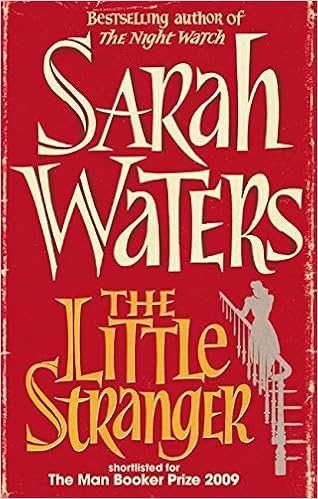
2017/34: The Little Stranger -- Sarah Waters

Arriving at that crumbling red house, I’d have the sense, every time, that ordinary life had fractionally tilted, and that I had slipped into some other, odder, rather rarer realm. [loc. 1151]
Set in post-war rural Warwickshire, The Little Stranger is a Gothic novel that echoes with inequality: sexism, social class, family secrets and a creeping sense of horror. Everyone in this novel is scared of something, but most of them won't (or can't) put a name to their fear. For Dr Faraday -- I don't believe his forename is ever revealed -- it's the imminent National Health Service, which he fears will destroy his practice. For the once-wealthy Ayres family -- Mrs Ayres and her two grown children, who live at isolated Hundreds Hall with their few remaining servants -- it's the Labour government that's taxing rural landowners into penury. But those are fears that can be spoken of, and laughed about. There are others.

Dr Faraday is a working-class lad made good, though he has a chip on his shoulder and a constant sense of not quite belonging. His friendship with the Ayres family -- and especially with Caroline -- give him glimpses of a different world, and the reclusive family who inhabit the crumbling ruins of a bygone age. He's keen to suggest experimental treatments for Roderick Ayres, who is scarred, physically and mentally, by his wartime experiences. Rod is an amiable sort, joking about the servants getting better treatment than the family -- though he seems to be struggling with the management of the estate. Rod's sister Caroline seems cheerful and competent, devoted to her elderly Labrador Gyp: she and Faraday become good friends.

But Rod himself is becoming increasingly distressed -- he talks of keeping something at bay, and recounts an outlandish tale of an evil presence -- so Dr Faraday, diagnosing nervous illness, arranges for his removal to a nursing home. Once Rod is out of the picture, the Ayres women turn to Faraday for help and support -- and, on Caroline's part, perhaps more.

There is a delicious creeping sense of horror here: nothing quite glimpsed or explained. Faraday's first-person narrative reveals more than he knows: his insistence on rational explanations and psychoanalytic theory blinds him to much of what is happening. Waters' descriptions are precise, as though she's viewing each scene through a magnifying-glass and picking out the details one might not notice: the dirt on each hair on the bare leg of a young woman, a drop of blood on a silk blouse. Throughout the novel there's a sense of disrepair, decay, things that are stained or marked or charred.

I should read more Waters ...

Sunday, April 02, 2017

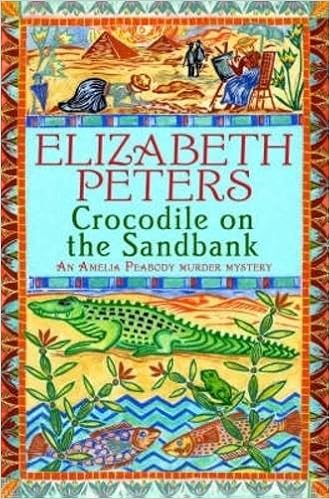
2017/33: Crocodile on the Sandbank -- Elizabeth Peters

Men are frail creatures, of course; one does not expect them to exhibit the steadfastness of women. [loc. 2586]

Amelia Peabody, brought up in a house full of books and antiquities, has come into a substantial inheritance and decides to use it to fund her travels. Her chosen travelling companion falls ill, but fortuitously she encounters distressed gentlewoman Evelyn Barton-Forbes, abandoned and destitute in Rome, and the two quickly become friends. They journey to Egypt, where Amelia develops a passion for pyramids and encounters irascible archaeologist Radcliffe Emerson and his rather more amiable brother Walter. The Emersons are determined to uncover the secrets of Amarna, Akhenaten's capital, and Amelia and Evelyn become involved in the excavation.

All would be idyllic were it not for the sudden appearance of Evelyn's cousin Lucas (who wants to marry Evelyn) and an apparition of a mummy (which may also be interested in Evelyn). Fearing for her friend -- and exasperated by, well, pretty much everything -- Amelia sets out to solve the mystery of the mummy, and get to the bottom of Lucas's story.

This was great fun: it's always nice to discover a likeable series, and know that there are plenty of further adventures awaiting the characters. (I believe the Amelia Peabody series is now up to twenty volumes.) Amelia is a rational and somewhat domineering female, and Emerson an excellent foil for her. The setting -- Victorian Egypt, without the racism of Victorian novels set there -- is intriguing. I did find the plot predictable in places, and I'd like to read the alternate history in which Amelia and Evelyn 'could have lived like sisters, enjoying the domestic comforts of England, and travelling whenever we got bored with domesticity'. But overall, most enjoyable.

Saturday, April 01, 2017

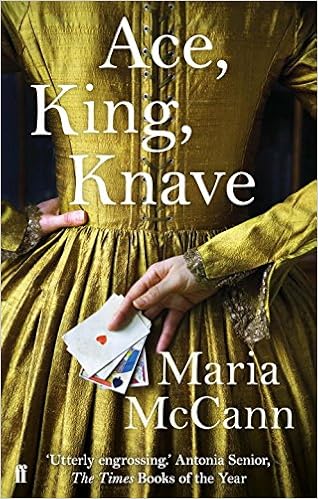
2017/32: Ace, King, Knave -- Maria McCann

She begins to comprehend the mentality of such people. One need not be especially clever, and certainly not well educated. The essential thing is to conduct one’s life as war: everything is permitted except compassion. [loc. 5102]

London in the 1760s: or 'Romeville', to the 99% who don't inhabit the clean well-lit civilised world of the gentry. Betsy-Ann Blore is living with a man she despises, having been won by him in a card game with her former lover, the charmingly rakish Ned Hartry. She was once a common prostitute (ensnared by Ned's mother Kitty), but now scrapes a living by thieving and card-sharping. Her brother (the brutish Harry) is a resurrectionist, digging up fresh corpses to sell to anatomists. Betsy-Ann worries that her current fellow, Sam Shiner, will join Harry in his nocturnal adventures.

Sophia Buller, only child of wealthy parents, is newly married to Edmund Zedland, whose business affairs are opaque to Sophia but clearly very lucrative. Why won't he trust her with any of his secrets? And why does his servant, the black boy Titus, seem to hate her? And why do her parents reply so vaguely to her letters?

Sophia's life is lonely, and genteel. Betsy-Ann's quite the opposite, a narrative replete with slang and double-dealing. In Betsy-Ann's world, cruelty is a constant, especially cruelty to -- and by -- women. (The men, in this novel, seem almost peripheral: on the whole they are either well-meaning but ineffectual, or dishonest and violent.)

Sophia and Betsy -- and Titus, whose name is actually Fortunate and who was brought from (or bought in) Annapolis to serve Mr Zedland -- discover how their fates are entwined, and how each of them is the victim of deception. Which leads, in due course, to each of them practicing their own deceptions, with greater or lesser success. This is a novel in which the reader becomes aware of the great central lie before any of the characters realise how they've been duped.

I confess I found Betsy-Ann's narrative richer than Sophia's, but it was also quite breathtakingly unpleasant at times. McCann does an excellent job of comparing and contrasting her two protagonists: her depiction of 'Titus', who can barely speak English but whose interior life is sketched through memory, fancy and despair, is marvellous. And though the novel ends on what, in music, would be called an 'imperfect cadence' (there is no grand resolution) I liked that ending: it works, because it opens up possibilities.