Saturday, October 13, 2007

#64: Fludd -- Hilary Mantel

From the doorsteps the women stared at passers-by, and laughed. They knew a joke, when it was pointed out to them, but for the most part their entertainment lay in the discernment of physical peculiarities in those around them ... They did not think it was cruel to mock the afflicted, they thought it was perfectly natural; they were sentimental but pitiless, very scathing and unforgiving about any abberation, deviation, eccentricity or piece of originality. There was a spirit abroad in the village that discriminated so thoroughly against pretension that it also discriminated against ambition, even against literacy. (p.14)
Fludd is set in a fictitious village in the north of England, in the 1950s. Hilary Mantel's portrait of village life, blackly comic and quietly mocking, would have hooked me even if the novel had had no plot at all. And it does have plot: I'm still thinking it through.
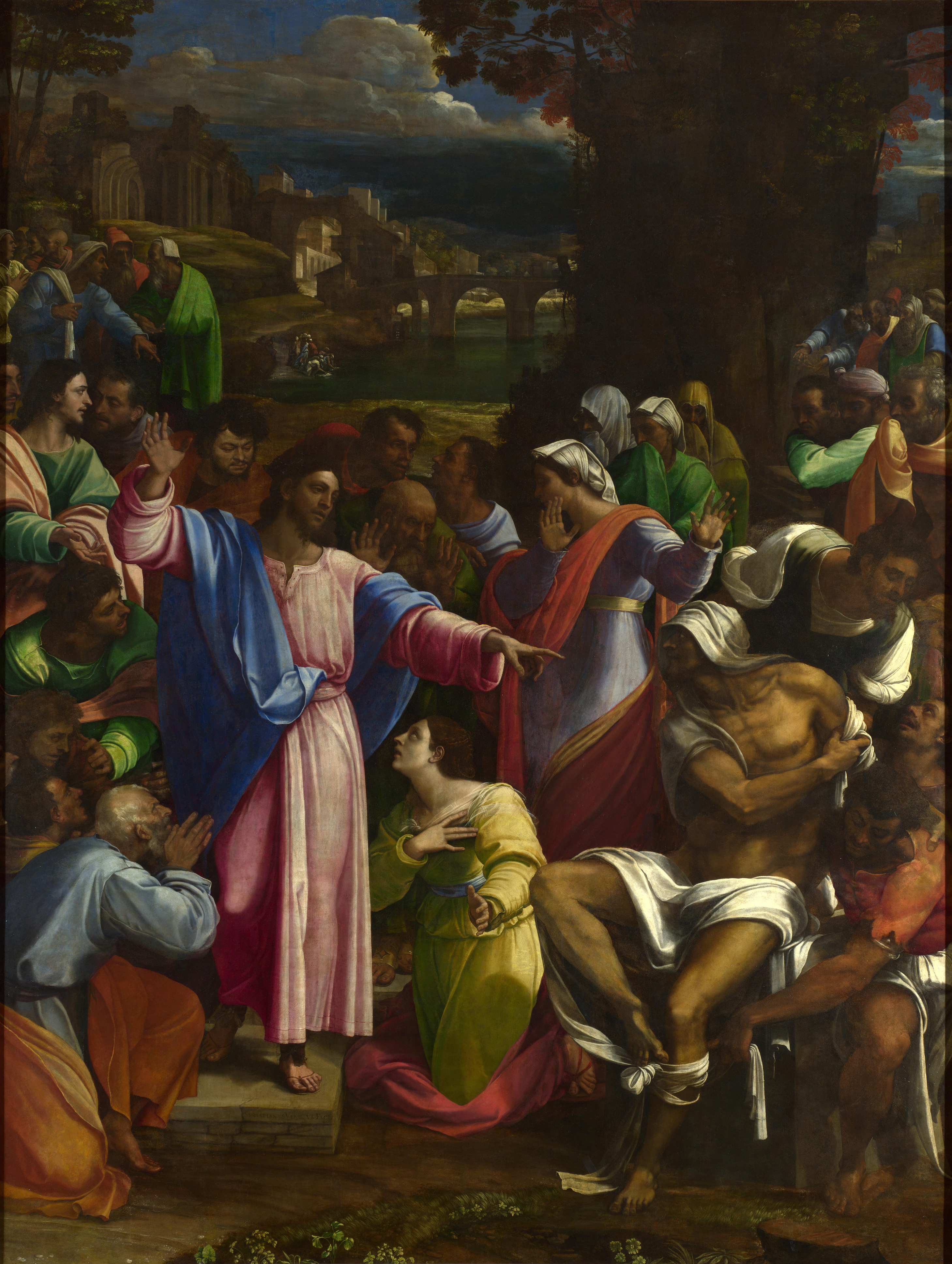
Sebastiano del Piombo's 'The Raising of Lazarus'
The novel opens with a description of Sebastiano del Piombo's 'The Raising of Lazarus' (left), which doesn't seem especially relevant. Then the story itself begins, with the Bishop's visit to Father Angwin, bidding him to remove the saints' statues from the church. (I fear that the priest's household, with the eternally curious housekeeper Agnes Dempsey, reminded me irresistably of Father Ted. But not in a bad way.) Father Angwin is prone to muttering insults under his breath, but gets away with it: still, the saints have to be removed, and he enlists the help of the villagers to bury them in the churchyard. Then a visitor arrives: Fludd, a curate whom Father Angwin takes to be the bishop's man. Nevertheless he warms to his visitor, confessing his crisis of faith -- and his belief that McEvoy, the tobacconist in Netherhoughton (the hamlet up the road, where the people have some very odd habits), is the Devil incarnate.
'How did you know him?' 'It was his smile ... his horrible jauntiness ... the little tune he whistled.' 'Anything else?' 'Perhaps the smell of sulphur. It stank out the afternoon.' 'Sulphur,' said Fludd, 'may be taken as definitive.
Quietly and smoothly, without any fuss, things begin to change. (There's a whisper in the back of Agnes' mind, 'and only he could have put it there. I have come to transform you. Transformation is my business.') Even when we're granted Fludd's point of view, we know little more about him or his mission. There are, it must be said, several oddities about Fludd. Father Angwin's whisky bottle never empties when he's drinking with the curate; Fludd, refusing to read Sister Philomena's hand, nevertheless knows a great deal about palmistry; visiting Netherhoughton, he instantly recognises 'the lively signs of alchemy: the black hens scratching in the small back-plots, and the nine-runged ladder, the scala philosophorum, leaning casually against a wall'; and some of the changes he effects don't seem at all Christian.
Borgognone's 'Virgin and Child'
The book ends with a description of another painting, Borgognone's 'Virgin and Child': Mantel draws our attention to the 'near-smirk on her dimpled mouth'. And I think that near-smirk stands for the most significant of Fludd's changes; but I am still thinking through the implications and consequences of his time in the village, and his departure. And of the final appearance of McEvoy, the tobacconist ... I enjoyed this ever so much, though it's really quite a bleak novel: hope and love and rescue, all right, but so little can be saved.

#63: Spanish Steps -- Tim Moore

In which Tim Moore, author of Do Not Pass Go, does the Camino de Santiago -- a pilgrimage from St Jean Pied-de-Port (on the French side of the Pyrenees) west to Santiago de Compostela -- in the company of Shinto, a donkey. Neither is driven by any religious fervour. Moore seems to be having a very mild and wholesome mid-life crisis (hitting forty, wife and three children, a while since the last bestseller) and Shinto is the beast of burden, acquired when Moore decides that lugging his own luggage is a mug's game.

The fine art of the pilgrimage having declined somewhat since its medieval heyday (explored in well-researched, pertinent and entertaining asides that never overwhelm the basic narrative), you might think that Moore was basically in for a solitary trip. Far from it. He meets pilgrims from all over the world, with varying degrees of faith, dedication and stamina -- not to mention eccentricity. "One thing was certain. Doing this walk never made anyone less weird."

Moore has an excellent ear for accents (for instance, the woman who's wandering around aimlessly after having encountered a fellow traveller with a huge joy, which she has smocked) and is not afraid to reinforce national stereotypes. But he's also ready to mock himself, and to own up to the unsentimental feelings inspired by Shinto, who has a horror of crossing wooden bridges and an apparent determination to make life as difficult as possible. But as the journey progresses (more than 500 miles; more or less a million steps) Moore becomes fonder of Shinto, and their final parting is remarkably, understatedly, affecting.

Which all sounds serious, and it's a book that made me laugh out loud.

And did the pilgrimage have any effect?
I had learnt to be more patient and less fastidious, to cope when many of the basic decencies of modern life were absent, to relish them when they weren't. I had made sense of a complex world by appreciating the humble solidarities of the past; learnt the true value of water; acquired a Dark Ages lexicon of livestock feed and disease. I had learnt to accept, even befriend people I'd previously have dismissed with a cheap and ugly laugh: brittle-spirited mystics, policewomen, Austrians.

Friday, October 12, 2007

#62: The Ninth Life of Louis Drax -- Liz Jensen

I'm not most kids. I'm Louis Drax. Stuff happens to me that shouldn't happen, like going on a picnic where you drown. Just ask my maman ...
Louis Drax is French, accident-prone, fond of reading, very intelligent, and in therapy for some behavourial problems. On his ninth birthday, his parents take him on a picnic. By nightfall, his father is missing, his mother is hysterical and Louis himself has been pronounced dead.

Which makes his narration of half of this novel slightly spooky.

Louis (unaccountably still alive, or alive again, though it's impossible to rouse him from his coma) starts off with a potted history of his short but fraight life. Falling in front of the metro, cot death, salmonella and tetanus and botulism, a dynasty of hamsters all named Mohammed ... There's a hint that not all Mohammeds have died a natural death: "you can drop something heavy on him, like volume three of the encyclopédie medicale or Harry Potter et l'Ordre du Phénix. Just as long as you don't make a mess". As his mother Nathalie says, "If you were a cat, Louis, you'd have used up eight of your lives by now. One for each year. We can't go on like this."

She's probably crying. Boys shouldn't make their mamans cry, repeats Louis.

Hence Fat Perez, the psychiatrist, who has his hands full with Louis, who is an exceptionally convincing eight-year-old boy, with a voracious enthusiasm for weird facts, spit, blood, rude names for people and complete contempt for stupid adults. Fat Perez doesn't seem to make much progress, but then Louis is a difficult child.

Cue the second narrator, Dr Dannachet, who takes over Louis' case at his clinic in Provence. A married man, he nevertheless finds himself attracted to Natalie, Louis' mother, and when it seems as though Louis' father -- still apparently on the run -- is a threat to Natalie, Dr Dannachet promises to protect her.

Only gradually (and extremely unwillingly) does he begin to question her account of events at the picnic.

Louis is in the dark, but he's not alone. The ghoulish figure of Gustave -- whose head is wrapped in bloody bandages -- addresses him as 'Young Sir' and shows more interest and understanding of Louis and his predicament than anyone else ... well, anyone outside Louis's head. And Gustave, in the end, makes the difference to Louis.

Some parts of the novel (Dannachet's home life, Perez' reaction to Louis' 'accident', Natalie's past) seem almost too lightly sketched, but there's enough solid meat there to support the story. It's a story of many layers: an attempted-murder mystery; a child's interpretation of overheard, half-understood accusations; a doctor's willingness to take a chance that could ruin him professionally; a ghoulish tale of life inside Louis' head. And it's a difficult novel to write about because unpicking even one of those layers would reveal too much about the rest. I did feel, though, that it was a more tightly-plotted, less rambling novel than the more recent My Dirty Little Book of Stolen Time.

"If you make a choice, and it's wrong," says Nathalie, "you have to live with it. Everyone has to live with the consequences."

Apparently the film rights have already been snapped up, and it's to be directed by Anthony Minghella (The English Patient I wonder if it'll get a UK release?

#61: To All Appearances a Lady -- Marilyn Bowering

Bowering's first novel, To All Appearances a Lady, is set on the west coast of Canada in 1957 -- though many of the key events occur in the late 19th century, recounted to protagonist Robert Lam by the ghost of Lam Fan, his recently-deceased Chinese stepmother.
I think about what Lam Fan has said about how we came here -- by following the whaling ships. As if their well-worn routes from the open sea through the islands were like a path through the woods: trodden down and flattened, worn to bedrock ... Have both sea and land a record to keep? Do ship lanes and whale migrations and the blood trails left by the sea ravages of men -- just like roadways and railways -- tie strings of traffic round Mother Earth herself? ... It makes a sort of sense, I suppose, at least to a ghost. Who need not concern herself with what is now and what is past. It is all one line she treads.

Lam (half-Chinese, he goes by the name 'Lamb' to ease his way as a pilot in the close-knit and occasionally xenophobic maritime community) is a complex character. The novel is the story of his last voyage in the Rose: a trip up the coast to where the whales are, a trip which becomes a voyage of self-discovery, fuelled by Lam Fan's slow revelations about his parents, and his step-parents. Fan's ghost, a tiny frail Chinese lady deprived of her habitual opium (not to mention her life) and spiky and restless as a result, tells a richly-detailed story: should Lam doubt her tale, the briefcase of family documents which he discovered after her death is more concrete evidence.

Robert Lam's mother, India Thackery, was an idealistic reformer who emigrated from Hong Kong after her father's death, accompanied only by Lam Fan -- the abandoned daughter of the baker who, in 1857, tried to poison the white community with arsenic. Arriving in Vancouver Island, the two women found a community bubbling with unrest and conflict: a melting-pot of cultures and races where India's good works were drops in the ocean. She persevered, and found employment as a bookkeeper ... in an opium factory. (I hadn't realised that opium, or at least its production, was legal in Canada until 1908. The economy of the Chinese community seems dependent upon it, as employment and solace.)

Whilst doing good deeds, India became acquainted with a drifter, Robert Louis Haack, who carried as talisman a letter from the author Robert Louis Stevenson, whom he'd met in California before coming north. Falling in love with India, Haack developed ambitions to better himself: but his schemes went awry and he ended up imprisoned, unable to rescue India when the opium factory was robbed and she was abducted. Considering how many toes India'd stepped on, and how little protection she had, the thieves were pretty merciful: they marooned her on an island off the coast -- D'Arcy Island, home to a community of Chinese lepers.

And there she stayed 'til Haack, released from gaol, came for her, married her, and abandoned her after a single day.

The title is taken from a report into India's death: she drowned, and Robert Lam has never been quite sure of the circumstances. Fan, used to keeping her secrets close, reveals them only slowly: reveals the truth about Lam's parents, and her own involvement in their lives, last of all. But by then there are other proofs to convince Lam of what really happened on D'Arcy Island at the turn of the century. Proofs that, despite his unwillingness to accept them (unlike the ghost of Fan, whose company he welcomes but never questions), are inescapable.

It seems that everyone in this novel is displaced. Lam never quite fits with British Columbia, never marrying or, apparently, feeling much for anyone save his stepparents (perhaps because of the secret shame that he keeps close); Lam Fan, addicted to opium til the day of her death, trying to keep the memory of her guilt at bay; the lepers on the island, cast out from a world that is already far from their war-torn, famine-stricken home; India Thackery, alone in the world and abandoned by the man she loved.

To All Appearances a Lady opened up a period of history, and of migration, about which I knew almost nothing. Few of the characters were likeable (India, perhaps; Lam Fan, until near the end; Ng Chung, the most personable of the lepers on D'Arcy Island) but they felt real. And Lam, alone (but for a ghost) in the fog-bound inlets and deserted islands of the coast, is the product, the end, of all the stories, quietly bleak, embracing his fate.

Beautifully written and well-researched, not a cheerful book but a compelling story.
Thursday, October 11, 2007

#60: A Woman Unknown: Voices from a Spanish Life -- Lucia Graves

...my story is partly the story of Spain; .. all these ends and changes in Spanish life reflected ends and changes that also occurred in me.
Lucia Graves (daughter of the poet Robert Graves) writes of life between cultures -- Spanish, Catalan and English -- and the life of women in twentieth-century Spain: the village midwife in Majorca, her marriage declared unlawful after the Spanish Civil War; Lucia's own education in a convent in Palma, chanting Fascist slogans and being gently pressured to convert to Catholicism; the village girls watching silently as their fiances flirted with the first wave of English and Scandinavian tourists ...

I read this whilst on holiday in Barcelona, and it did give me new insight into the oppression of the Franco years (suspicion of the authorities, endless bureaucracy, everything -- in Lucia's memories, at least -- grey) and into some hitherto unfamiliar aspects of Spanish, and especially Catalan, life, past and present: the Sephardic Jews, the folklore of the land, women in Catalan history ... But I found myself more fascinated by glimpses of Robert Graves the family man. I read Graves' poetry avidly in my teens and twenties, but I don't think I even realised that he was still alive (he died in 1985) much less that he'd raised a family, that he used to comfort his little daughter by picking the nightmares from her scalp and flushing them down the toilet, that he'd run on stage after the annual ballet show with bouquets for everyone, that he was simply Senor Graves in the Majorcan village where the family made their home.

From the sound of it, Lucia didn't at first know just how famous her father was in the English-speaking world. At school in Geneva, her English teacher made her feel inadequate for her failure to write English as fluently as her father. Later, she was an undergraduate at Oxford when he was Professor of Poetry there; by which time, she says, she'd 'largely overcome the feelings of inadequacy'. But it wasn't until I, Claudius was shown on Spanish television that Graves' adopted homeland began to take an interest in him. By that time he was already too ill to deal with this late fame, and Lucia became her father's representative on lecture tours and in interviews.

This is not only a book about being the daughter of a famous man. Lucia Graves' account of herself as a woman divided between cultures, caught in the gap between languages, is honest and direct. "To say that the man was dead was simply not the same as saying he was mort, even if both words have the same meaning. ...'dead' was like a dull pain, like the quiet end of a smile ... mort was the sudden tolling of bells, deep mourning, a gloom beyond words." Like Persephone (her father's metaphor) she learns to love both her lives, English and Spanish.

#59: The Nautical Chart -- Arturo Perez-Reverte

... real freedom, the only possible freedom, the true peace of God, began five miles from the nearest coast.
Took this with me to read in Barcelona, since that's where the novel starts: with Manuel Coy, a sailor stranded on shore after running a ship onto uncharted rocks, attending a maritime auction. At the auction he notices a beautiful woman (Tanger Soto) bidding -- against fierce and apparently hostile competition from a menacing pony-tailed man and a malicious dwarf -- for a 17th-century nautical atlas. She wins, but Coy has to intervene in a potentially nasty situation outside. Buys her a drink, or two. Falls in love. Sells his one valuable and treasured possession, his sextant, to buy a train ticket to Madrid, where he tracks down Tanger at work in the Museo Maritime and finds out why she really wants the chart -- to help her find the wreck of the Dei Gloria, a Jesuit ship sunk by pirates off the coast of Spain in 1767.

Unsurprisingly there is treasure aboard.

And Coy, not only a sailor but an experienced diver who knows that part of the coast well, is just the man to help Tanger with her quest. The fact that he's given to solving problems with violence, and has what one might term poor impulse control, probably doesn't hurt.

The Nautical Chart is peppered with references to nautical classics: Coy thinks of himself as being in the Conrad phase of his life ("all heroes authorised to move through that terrain were weary heroes, more or less lucid, aware of the danger of dreaming when at the helm"), having previously lived a Stevenson period and a Melville period. I warmed to him as soon as he showed evidence of being an O'Brian fan. Plenty of nautical metaphors, too, and an interesting backstory for the Dei Gloria's last fateful voyage -- just before the expulsion of the Jesuits from Spain ...

I wasn't entirely satisfied with this book: the action seemed to be propelled artificially, with Coy threatening to walk away every time the action slowed, and Tanger drip-feeding some more information. And the ending seemed flat and abrupt, though I do wonder if it's meant to illustrate just how blinkered Coy can be and has been, just how unwilling to face the facts. Just how blinded by love (for Tanger, and more convincingly for the sea) he has been.

Apparently the plot echoes The Maltese Falcon, but it's a long long time since I saw the film ... so that's a layer of significance (and possibly an extra dimension of emotional depth, of twisting and transforming the characters and themes) that I missed.

Occasionally I found myself noticing the translation, as though the translator was struggling to put into English a phrase that flowed in the original Spanish. And when the actual narrator, the first-person voice who claims to be telling this story, finally made an appearance (".. the story of the lost ship, and of Coy, the sailor banished from the sea, and of Tanger, the woman who returned him to it, seduced me from the start ...") I found him irritating and sly.

Packed with action and with plot -- and some excellent nautical detail, like the storm at sea, and going overboard, and the perils of night-sailing in busy waters -- but curiously empty.

#58: The Electric Michelangelo -- Sarah Hall

Like Water for Elephants (with which it shares at least one real-life scene), this novel focusses on the American circus/carnival milieu in the Thirties. But The Electric Michelangelo is darker and grittier.

The novel opens with Cy (Cyril) Parks' boyhood in Morecambe. His father died days before he was born: his mother, Reeda, pursues two complementary trades -- running a boarding-house for tuberculosis patients during the summer, and providing illegal abortions in the off-season -- to make ends meet. Cy grows up familiar with blood and suffering (there's a surprisingly beautiful scene where he tries to read his fortune in the swirls of blood in a patient's basin) and accustomed to showmanship, the lifeblood of the resort.

His artistic ability is spotted by Eliot Riley, an alcoholic tattoo artist with a reputation as one of the best who takes Cy on as apprentice. It's not an easy ride. Eliot is a slave to the bottle, prone to black moods and violent behaviour. But he has a lot to teach, and Cy is eager to learn.

Reeda and Riley dead, Cy turns his back on Morecambe: he emigrates to America, and sets up a booth in the heart of the circus -- Coney Island, a carnival underworld populated with immigrants and the displaced, with misfits and freaks and outcasts. Cy -- now The Electric Michelangelo -- fits right in. Confident in his art (and it's clear, both from the technical detail of his work and from the way he's driven by, transformed by, a channel for it) he finds others who share, or at least comprehend, his vocation. Something of a loner by nature (we get the feeling that he doesn't give his heart lightly, and both Reeda and Riley have left him walking-wounded) he finds friends and colleagues.

And then there's Grace.
There was something unholy about her from the beginning, that guile, the heretical bile that lifted in her mouth when she spoke, the gall in the gut of her words, the retch of her dark hair, the very peccancy of her sex, that thousand-fanged stare, and she might have been his, once, but for herself, but for her cloven-kolo self in the centre of her being.

Grace is probably not her name, but it's the name she's chosen. (Significantly, she always refers to Cy by his tradename). She's a European woman of indeterminate origin, a bareback rider (her horse sometimes shares her Brooklyn apartment, in the same block as Cy) who comes to Cy with one clear and specific request: she wants to be made into the Lady of Eyes, to be tattooed with the image of an eye (green, edged in black) repeated over and over on every inch of her skin.

Cy obliges, and almost incidentally falls in love. It's not as though there haven't been women before, plenty of 'em, aroused by endorphins and acutely aware of their newly-tattooed bodies. Grace is different. They aren't lovers in the physical sense, but there is far more sense of Cy's engagement with her than with anyone since Riley's death. And although he doesn't make love to her in any of the usual ways, perhaps the physical act of transforming her body, the intimate engagement of pain, is another form of eroticism.

Grace, complete, is a work of art. And art can be destroyed. Riley's death follows vengeful violence: Grace survives the attack on her, but it transforms her as much as or more than Cy's art -- and against her will. Her return to Cy is the pivot-point of the novel, the moment at which everything that's made him the man he is (Reena, Riley, the consumptives, the tattooing) comes together in a single night. The events of that night occur offstage: we have only Cy's memories, later, to show us what happened. It's enough.

As coda, the novel shows us Cy's return to Morecambe, years later. He's served in the war, and walks with a limp: he is alone: he's coming back to Riley's empty house. Yet it's not an ending, and not a decline: 'his heart was densely occupied and his soul was lying fallow', and if beneath it all he's waiting, still he's out in the changing world.