Tuesday, August 25, 2026

2026/123: The Edge of Memory — Patrick Nunn

Literacy is tyrannical, for it encourages us to undervalue our pasts –- the knowledge amassed by those countless ancestors of ours who could neither read nor write.

Subtitled 'Ancient Stories, Oral Tradition and the Post-Glacial World', Nunn's thesis is that preliterate societies encoded and passed down observations of natural disasters in folk tales. He opens with a discussion of Klamath stories about Crater Lake in Oregon. According to the stories, there was a demon who dwelt in a mountain and terrorised the local people with earthquakes and falls of hot rock. The demon was defeated by a spirit who pulled the mountain down and made a lake instead. This is, according to Nunn, a fair fictionalisation of what actually happened when the caldera was formed ... 7,700 years ago. If the story is an account of actual events, it's been passed down for 300 generations.

The bulk of the book deals with Aboriginal myths that include information about sea level rise and coastal drowning. Nunn recounts more than twenty of these, which began to feel a bit repetitive: but he believes each story explains a local phenomenon, such as the disappearance of an island or the flooding of a bay. He also discusses similar stories from India, and from north-west Europe: Doggerland, and especially the Scillies, which were once rather higher above water (and thus had fewer distinct islands). There's also an intriguing mention of a folktale from Italy which seems to record a meteorite impact in the 4th or 5th century, which disrupted a pagan ritual and convinced the locals to convert to Christianity. (I am unable to access the article on which this is based, but there's more about the theory on wikipedia.)

I wasn't wholly convinced by some of the interpretations, but I do accept the core tenet that folk tales can be fictionalised accounts of actual events, and can be passed on for many generations. And it's certainly true that 'our ancestors', as in 'prehistoric humans', lived through some drastic geological, astronomical and meteorological events. I'd like to read more on this topic.

Excellent narration by Peter Silverleaf, who sounded engaged and enthusiastic throughout.

Read because: I'm fascinated by the notion of stories being passed down, specifically from prehistoric/preliterate times, as a way of remembering important events.

Monday, August 24, 2026

2026/122: The Smart Neanderthal — Clive Finlayson

[the] sweeping statements made by some archaeologists, such as birds are fast-moving prey or hard to catch, are gross overgeneralizations which reveal an absence of natural history understanding, an understanding that intelligent Neanderthals would have had. [loc. 1382]

Finlayson is a keen ornithologist and archaeologist who lives in Gibraltar: much of this book is devoted to his excavations at the Gorham's Cave system, and to his ornithological expeditions in Gibraltar and southern Spain. His aim in this short book is to prove that Neanderthals were cognitive equals to modern humans: 'they made blades; they made complex tools; they had personal ornaments in the form of eagle feathers; they used ochre either to paint themselves or to make paintings, or both; they made engravings in cave walls; and they had sophisticated economic and social organization that included detailed planning of hunting activities at specific times of the year for particular prey. The prey often included birds.' [loc. 2678].

Though his prose is occasionally lacklustre, the sense of scientific excitement comes across strongly -- as does the grind of archaeological excavation, the care which must be taken with each specimen. His descriptions of observing eagles, vultures and corvids in the wild, acquiring an understanding of their habits and behaviour in the same way as Neanderthals may have done, are compelling. And I gained a better understanding of how climate change (the Ice Age and its aftermath) would have affected Neanderthal populations, fragmenting their territory and isolating communities.

Read because: I've been fascinated by Neanderthals, and by their differences to modern humans, since I first read The Clan of the Cave Bear (which was impeccably researched, though some of the data is dated now).

Thursday, August 20, 2026

2026/121: The Salt King — Natasha Pulley

Avelyn thought of saints in paintings again. There were often other paintings hidden underneath that final layer of colour. You could see them under the right kind of light, those deeper iterations where the saint was not smiling, or where instead of cotton, they wore armour. The more time he spent with Jericho, the more he saw flashes of armour. [loc. 4493]

Avelyn Brocken is a Jesuit priest, 'sent from the Vatican to investigate something that was either miraculous or requiring an exorcist'. He is the only person in the Vatican who speaks Hreod -- the language of Hreodwater, a remote and inaccessible place somewhere in East Anglia that does not appear on any maps, contains the most valuable salt mine in Europe, is a place of pilgrimage, and seems to have been the site of a miracle. An American priest walked again after two years in a wheelchair ... and then, on camera, turned to a pillar of salt.

Avelyn very much does not want to return to Hreodwater. He left after his entire family were killed, and has spent the intervening decade or so lasering off his tattoos, studying, and aware that (unlike his mentor, Father Li) he feels nothing during worship, except cold. He has come to understand, over the last decade, that he was raised in a cult: but he still believes that there is something beneath Hreodwater: something called the Salt King, that has protected the community for centuries. He does not believe it is good.

Meanwhile, in Jordan, nuclear safety inspector Dr Tallis Osho is investigating a mysterious structure in the desert, which may be emitting radiation. Her colleague Dr Saloman Akhbar identifies the black metal spikes protecting the structure as silver. There are other anomalies from around the world: coins always landing heads-up, electronic equipment failing and emitting spikes of salt, random number generators no longer being random (with calamitous consequences for capitalism), fortune tellers finding clear images in coffee grounds and sand... 

But the focus is on Avelyn, and his uncomfortable friendship with / attraction to Jericho (the doctor at Hreodwater), and the gradual revelations of the events leading up to his departure from Hreodwater. It's a strange place, with a subterranean abbey, an ancient language -- and a strange 'salt light', that only Hreoda can see, which illuminates wonders and horrors.

I loved this, despite some flaws -- Tallis's story felt distinctly secondary to Avelyn's -- and some disappointments. Avelyn is very much a product of his training, and he holds some views that I found unpleasant. Pulley doesn't gloss over the scandals of the Church, either: Father Li is viewed with suspicion in some quarters for having 'abducted' Avelyn and taken him to Rome. God, apparently, told him to do it.  

As usual in Pulley's novels, there is plenty of humour, often in footnotes, to lighten the darker aspects of the novel. And there are mammoths, cephalopods, Dionysus, shield walls, and linguistic oddities. It's not a wholly happy ending for all concerned, but I found it very satisfying.

Read because: Natasha Pulley is my favourite author (and I had to wait until publication day because Netgalley don't give me her books in advance).

“Are you, like, neurodiverse?”
“No, I’m a Jesuit.” [loc. 1656]

Wednesday, August 19, 2026

2026/120: Our Noble Selves — Kate Atkinson

He wasn't whole, he would never be whole, but, like the hundreds of thousands, perhaps millions, of men before him who had returned from a war, he was getting on with his life by treating the past as if it barely existed. [loc. 217]

Before the war, Harry Flynn was a reporter; then, very briefly, a war reporter; and finally a POW working on the Burma Railway. In post-war London he drifts miserably, only vaguely aware of the planned Festival of Britain. One day he encounters his old boss in St James's Park, and is offered a job in the Festival Office, 'sopping up all the bits and pieces of Festival business that no else else cared to'. He shares his office with 'Badger', a.k.a. Mr Badgley, who doesn't talk about his war work; Evans, who survived shipwreck in the Arctic; and 'the Boy', who is 14, illiterate, working class, and a delight. 

One night Flynn goes for a drink with a rather obnoxious Frenchwoman named Delphine Dubois. He wakes up the next morning with a black eye and a gap in his memory -- and Delphine has disappeared. Naturally, suspicion falls on Flynn. Even under suspicion of murder, though, he still has a job to do -- dealing with a celebrity cook and her nefarious husband, a stepdaughter and a dog, a Festival anthology of appalling poetry, and a plethora of plaster doves...

There is a lot of detail about the Festival here, but it's woven around a thriller about spies, double agents and fascists. As usual with Kate Atkinson, it's easy to get sidetracked by the asides, the characters, the setting: London in 1951 is a city still emerging from the horrors of war, and though the Festival is intended as a boost to morale and a taste of a peacetime future, there are plenty (including the Daily Express) who fulminate about the cost, the inherent classism, the London-centric nature of the main event. Plus ça change.

Flynn is somewhat naive but generally a good man: the novel is told, third-person, from his perspective, and the attentive reader will find significance where Flynn does not. This is a hopeful novel, despite its gentle mockery of British art and attitudes.  I found Atkinson's afterword -- where, as well as describing her research, she sets out her reasons for not writing about Flynn's war -- interesting, too. 

Read because: spotted it on Netgalley and was intrigued by the premise and setting: I generally enjoy Atkinson's novels, and this was no exception.

Thanks to the publisher and Netgalley for the advance review copy, in exchange for this full honest review. UK Publication Date is 10th September 2026.

Tuesday, August 18, 2026

2026/119: The Moor's Account — Laila Lalami

How strange, I remember thinking, how utterly strange were the ways of the Castilians—just by saying that something was so, they believed that it was. I know now that these conquerors, like many others before them, and no doubt like others after, gave speeches not to voice the truth, but to create it. [chapter 1]

The Moor's Account tells the story of 'Estebanico', a Moroccan slave who was among the four survivors of the 600-strong Narváez expedition, an expedition to the so-called New World in 1527. 'Estebanico' is the name forced, by the Spanish, upon a trader from Azemmour, Mustafa ibn Muhommad ibn Abdussalam al-Zamori, after he sells himself into slavery to save his family from poverty and starvation. And the 'New World' is neither unknown nor uninhabited.

Within a year of the expedition landing in what's now Florida, there are only four survivors: three Castilian gentlemen -- among them Mustafa's owner, Andrés de Dorantes -- and Mustafa himself. Sometimes together, sometimes not, they travel westward, living among indigenous tribes (some more welcoming than others) and becoming healers, using a combination of folk medicine, storytelling and prayer. But the Castilians never lose sight of their primary purpose -- to find gold, more gold, all the gold -- while Mustafa's experience as a trader and then as trade goods has taught him that not everything has, or should have, a price. 

Eventually, they are found by a group of Spanish slavers and taken to Tenochtitlan (Mexico City), where arrangements are slowly made for them to return to Spain. The three Castilians are asked for their accounts of the expedition: Mustafa, mentioned only once in the Castilian reports ('The fourth [survivor] is Estebanico, an Arab Negro from Azamor') and is not asked to contribute his own version of events.

Mustafa observes that the Castilians' accounts of the years in the wilderness, they omit a great deal: cannibalism, theft, rape, murder, and their Native American wives. (Not real wives, Dorantes assures him: they weren't married in church.)  Mustafa has sustained himself by dreams of returning to Azemmour: but he too has married a Native American woman, now pregnant, and is increasingly disturbed by the invaders' attitude to the indigenous peoples. Dorantes' reluctance to free Mustafa, despite all they've endured together, crystallises his determination to free himself. 

This felt long, perhaps because it was repetitive: tribe after tribe, misfortune after misfortune: it's under 400 pages in print. I listened to the audiobook, read by Neil Shah, and found the exaggerated Spanish accents rather grating. But it is a fascinating story, and Mustafa's perspective is quite unlike that of the Spaniards. The style is that of an Arabic travel text: dates are given according to the Islamic calendar, and places in the Old World are referred to by their Arabic names. The narrative switches between Mustafa's early life in Azemmour and his adventures as part of the expedition, each chapter entitled 'The Story of...': the parallel narratives show how Mustafa's response to the New World is shaped by his own past, and that of his people.

Two interesting resources I found when I was reading about the historical background: an analysis of the 'official' accounts with reference to the tribes they may have encountered, and Lalami's own set of resources.

Read because:I enjoyed The Dream Hotel, and when contemplating the 'Storygraph Reads the World: Morocco' prompt this drew my attention.

Monday, August 17, 2026

2026/118: The Magician of Tiger Castle — Louis Sachar

By the way, when the princess said the king called me Esquaveta's Leonardo, he was referring to Leonardo da Vinci. Just thought I ought to point that out in case it slipped past you. [p. 127]

We first meet Anatole -- overweight, short and hairless -- in a coffee bar in what used to be a country called Esquaveta. He's musing on the tigers that roam the castle moat, and on the history of the castle itself: then, abruptly, he's reminiscing about the arrival of the very first tiger in 1523, when he was the court magician, working on turning black sand into gold, and performing a series of proto-scientific experiments. ('In the 1500s, science and magic were virtually indistinguishable.') Gradually, he tells the story of how, tasked with ensuring that Princess Tullia of Esquaveta married Prince Dalrympl of Oxatania, he had to contend with Tullia falling in love with penniless scribe Pito. His solution? Create a potion that makes each of them forget the other.

Needless to say, it is not that simple. Oh, the potions work: they didn't have ethics in 1523, apparently, so it's fine not to tell either of his subjects what the potion does, and anyway that would negate its effects. But the potion he uses to postpone the wedding is not the lethal poison expected, and he's forced to flee, with two cantankerous lovers in tow. Can Anatole reach freedom? Can Tullia and Pito survive long enough to marry? And why is Anatole so attached to one of his laboratory animals?

This was announced as Sachar's first novel for adults, though it felt quite YA to me: the plethora of historical factoids ('In 1523 fire was started by striking flint against a piece of iron'; a description of how a hurdy-gurdy works; why ale is was healthier than water) was occasionally intrusive, and the overall tone reminded me of The Princess Bride, though rather more cynical. I didn't really warm to the characters, except Luigi the mouse. A pleasant enough read but not one I'll revisit.

Read because: it was on offer as a Kindle Daily Deal, and I was intrigued by the idea of an adult fantasy novel from the author of Holes.

Sunday, August 16, 2026

2026/117: Daggerbound — T Kingfisher

"... I thought you'd be on the side of law and order."
"No, young man," said Bishop Beartongue, despite being several centuries his junior. "I am on the side of justice. If we're lucky, the two run in parallel. If they don't, we bend the law to attain justice, not the other way around." [loc. 4092]

Edmund leaves the Temple of the Many-Armed God with a mule named Sweetheart, a selection of rare books and an ancient artifact that he's been tasked with transporting to an academic in Archen's Glory. He has no intention of returning to the temple, with its misogynist priests and antiquated ways. But before he has time to make plans, bandits happen -- and he accidentally unsheathes the artifact (a sword) and releases a silver-eyed angel.

The angel is ... no angel. His name is the Dervish, and he's been imprisoned in the sword for many years: his last wielder was a sadistic priest, and consequently he has no time for religion, or indeed wielders. He is a walking mass of trauma, but (in his opinion) 'very pretty trauma'. And he helps Edmund survive the journey -- via more outlaws, an excellent gnole, a cobbled-together dragon, and a diplomat from another species -- though what the pair find when they reach the city is not what either of them expected.

This was an absolute delight: a romance, yes, but also a story about healing, and about loyalty, and about scholarship. (There is some steam. They are in a sauna.) I am happy to report that Zale features in Daggerbound, as do other characters from Kingfisher's previous explorations in the World of the White Rat. 

Daggerbound has heroism, emotional inarticulacy, gnole pronouns, the importance of books, and an exciting new use for bacon. The characters -- human and otherwise, good and bad -- have personality and motivation, and the worldbuilding is thorough without being forced.

I requested this from NetGalley despite having the Kindle version pre-ordered, which should give you some idea of my enthusiasm for this series. Already looking forward to Shieldborn...

Read because: It showed up on Netgalley, and even though I have the Kindle edition preordered I couldn't resist.

Saturday, August 15, 2026

2026/116: Parallel Lives — Iain Pears

... it is difficult to believe that life during the siege of Leningrad was quite as jolly as the tone of [Larissa's] recollections sometimes suggested. [Introduction]

Larissa Salmina was born in northern Russia in 1931, daughter of an army officer: she survived the siege of Leningrad (and does indeed make it sound quite jolly, though there are horrors too: they ate the neighbour's cat, who was starving anyway) and later became a curator at the Hermitage Museum. She was appointed Commissar for the Venice Biennale -- she lost some of the artworks en route -- and met an English art historian Francis Haskell.

Francis was brought up in England, grandson of an Iraqi Jew, and seems to have had a very miserable youth, struggling with repressed (and not so repressed) homosexual urges, antisemitism, and loneliness. He was smitten by Larissa, more of a free spirit than himself: she, already married, blithely embarked on their affair, and broke the terms of her visa to travel with him -- which could have ruined her own career in the USSR.

Larissa seems to have had the gift of landing on her feet: Francis revealed unsuspected backbone in his determination to marry her, despite the bureaucratic hoops this entailed in the mid-1960s. And Iain Pears, who was taught by Haskell and befriended Larissa after Haskell's death, weaves their story together -- from conversations with Larissa, and from the diaries Francis kept from childhood until his marriage -- to depict 'a tale of a Europe that is lost. 'Not the Europe of geographical and ideological divisions, but of a certain mentality, which was common to a very few on both sides of the Iron Curtain'. He emphasises the importance of art to both, and their sense of a shared cultural inheritance: and he balances Larissa's oral history (noting that it's full of gaps and deliberate omissions) with Francis' dogged self-analysis.

I confess I was much more interested in Larissa, especially her experiences during the siege. I learnt a lot about post-war Soviet society, including the fact that Russians were legally obliged to look after ageing parents: Larissa's mother had to waive her right to this before the marriage could go ahead. I would have liked more discussion of Francis' homosexual affairs (there are delicate allusions, no more) and perhaps of their married life: but the book effectively concludes with their marriage, and I respect Pears' decision to stop there.

Read by Richard Attlee: his voice suited the narrative, and Pears' measured style, really well.

Read because: It was on offer at Libro.fm, and Larissa's story in particular sounded fascinating. Also, this is the Europe which my father's family knew.

Friday, August 14, 2026

2026/115: Under Story — Chloe Benjamin

In our world, matter that was living decomposes -- but not always. If decomposition was interrupted, a fossil forms instead... Here, a fossil is like a seed. [loc. 2988]

It's 2018, and Laurel is working as a dishwasher in Antarctica, mourning the death of her son, separated from her husband Eli -- and drawn to the Arc, an anomalous phenomenon a few miles from McMurdo Base, that manifests as an arch of light. Laurel was formerly a mycologist, and she has a scientific outlook: but when she dreams about the Arc, she can't help feeling that her dream has given her an insight. And then Eli, a renowned physicist, shows up at McMurdo. He believes that the Arc might help him prove his theory of the universe, a theory that proposes an 'antiuniverse' where 'entropy reverses on a massive scale' and time itself moves in the opposite direction.

This is a fascinating thought experiment of a novel, with elements of romance and mysticism as well as the hard (if theoretical) science underpinning it. There are octopodes! There is Antarctic life! I loved the secondary characters, especially Gloria and Louis, and I was intrigued by Laurel's experiments in mycology.

I'm not sure I fully understood some elements of the novel, and I almost gave up on the story when it seemed likely to explain some aspects solely through a mystical experience: and I am not wholly satisfied by the ending. But it was a fascinating read, with moments of beauty (both scientific and personal) that balance the occasional horrors.

Read because: I spotted it on Netgalley, where an early review described it as 'The Overstory meets Interstellar': I was intrigued.

Thanks to the publisher and Netgalley for the advance review copy, in exchange for this full honest review. UK Publication Date is 1st September 2026.

Sunday, August 09, 2026

2026/114: After Hours at Dooryard Books — Cat Sebastian

Outside these doors is chaos. Appalling men are elected president. Every day's headlines are worse than the last. All year, it's been like that, and it isn't getting better. But it will. 

The setting is New York in 1968. Patrick is the manager of Dooryard Books, a secondhand bookstore owned by the philanthropic Mrs Kaplan. One night, Mrs Kaplan turns up with a stranger, who she introduces as 'Nathaniel Smith': a man several years older than Patrick, with a haunted look and no possessions to speak of. Patrick can relate: he was one of Mrs K's 'projects' too, years ago.

Nathaniel (who's agoraphobic) clearly has guilty secrets, but Patrick is happy to let him take his time revealing them. And he has plenty else to distract him: soon after Nathaniel's arrival, Susan -- Patrick's sister-in-law and childhood friend, a well-known singer-songwriter -- shows up, distraught, with a suitcase, a baby, and a telegram from the Department of Defence. Susan's husband (Patrick's brother) Michael has been killed in Vietnam.

How the three of them (plus baby Eleanor) create a kind of family, and how Nathaniel comes to terms with his own sexuality, is the heart of the novel: it also features delightfully spiky Puerto Rican twins, a lot of discussion of Walt Whitman's poetry (Patrick is a huge fan), plenty of gay and trans secondary characters, anti-war protestors and political radicals and folk musicians, and a dog. The revelation of Nathaniel's secret past was a big surprise and definitely something to feel bad about, but he does his best to make things right, not only with Susan and Nathaniel but with the wider world.

Great depictions of male-female friendship, alternative culture, and the second-hand book trade. I listened to the audiobook, read by JJ Hawkins (who read Patrick's chapters) and Joel Leslie (who read Nathaniel's). I felt a bit uncomfortable while listening to Leslie, who sounded as though he was choking at the end of each sentence, but both narrators brought warmth, emotion and humour to their performances.

Read because: it was in the Libro.fm sale, and I have enjoyed other novels by Cat Sebastian.

Wednesday, August 05, 2026

2026/113: The Sentence — Louise Erdrich

Think how white people believe their houses or yards or scenic overlooks are haunted by Indians, when it’s really the opposite. We’re haunted by settlers and their descendants. [p. 91]

Reread for book club: I had forgotten just how much it's about the pandemic. I also noticed many aspects of motherhood here, from Hetta with her new baby to Tookie bearing the name of the woman who helped her mother. Book club response was positive: we talked about the sense of community in the novel, and the low-key horror of the ghost.

My original review is here.

Read because: bookclub choice, and I was happy to reread this!

Sunday, August 02, 2026

2026/112: Never After — Alexis Hall

“Say something.” His voice rang harshly, even in his own ears. “Call me unnatural. Scorn me. Turn away in revulsion. Tell the village.”
“Oh, Michael, I’m an old woman, my back would play up something chronic. I can’t turn away in revulsion like I used to.” [loc. 3759]

This is described as 'a melancholic tale of queer romance': it's set in the 1860s in London and, later, a country town, and it's the story of two men (an opium-addicted male prostitute named Micha, and the Reverend Thomas Mandeville) who love one another. But I'm not sure it's a romance per se.

It has many of the tropes of romance: Micha is very ill when Thomas finds him collapsed on the street and takes him home; Micha is prickly and dishonest, but gradually becomes more likeable under Thomas' gentle ministrations; Micha's secrets gradually come to light, and Thomas's unpleasant family history likewise; Thomas finds a better family because of Micha. And it does seem that they might achieve a HEA. But no.

Devastatingly emotional, with lots of rich textured descriptions that reminded me of nineteenth-century novels. Hall treats Thomas' faith, and the moral quandaries his desire for Micha sparks in him, with respect and honesty. And Micha's addiction is also portrayed realistically and without modern sensibilities. I especially liked the female characters, none of whom behave as Micha expects: Thomas' housekeeper Mrs Clark, who could reveal Micha's past; the ladies of Nettlefield, especially Esther (whose response to Micha's confession of homosexuality heads this review); and, at the end, Hope.

Pleasantly read by Steve West, who managed to infuse Micha's sometimes-limited vocabulary ('Oh, fuck. Oh, fuck.') with emotions appropriate to the setting.

from the author's webpage, discussing ending and epilogue...

Read because: I've enjoyed many of Hall's other novels and spotted this as audio and ebook on Kindle Unlimited, my 'free trial' of which runs out very soon. A pleasant audiobook to listen to in the garden!

Friday, July 31, 2026

2026/111: A Trade of Blood — Robert Jackson Bennett

My augmentations had permanently altered my very biologies. Had I been made a beast, to be sacrificed for my family and the Empire? Or was I now a shepherd, and the common folk of the cantons my flock? [loc. 3578]

My initial gleeful review is here: I liked this novel just as much on rereading.

Two households, both alike in dignity... The Armentas are a wealthy aristocratic family, raising monstrous cows to feed the Empire: the Buravs are a neighbouring family who provide the beans that feed the cows. The two families have been feuding for years: despite this, Castus Armenta and Zanzay Burav were planning to run away together. Now Zanzay lies horribly dead and Castus is in the local jail, unable to explain the events of the previous night. 

Just another case for Immunis Ana Dolabra and her trusty assistant, Signum Dinios Kol! Together, the two uncover a history of misfortune (or perhaps a family curse) plaguing the Armentas, and an ancient forest which may harbour gods from before the Empire. And they learn about farming. This is not Romeo and Juliet: it's certainly not a romance. It is, instead, a novel about the grotesque excesses of agriculture. It highlights the routine slaughter and the wastefulness, the ecological impact, and the use of enslaved creatures* as field workers.

And it's also about Ana and about Din -- the former coming a little closer to revealing the secrets of her alterations, the latter wholly unprepared to encounter someone from his past. There is body horror, there are unsettling mental changes, and there is more, much more, about the Empire itself. (I note that Ana and Din are moving towards the heart of the Empire -- the first book was set on the coast, the second in the independent kingdom of Yarrowdale, and this novel within the Third Ring.)

Very much looking forward to the next book -- this is clearly not a trilogy! -- and to learning even more about the Empire, and about the eccentric Ana. (A taste of Ana: "I'd normally be given to suspect his enemies, the Armentas --except they've nearly been eliminated... Or so we think! I can't confirm, because people keep goddamn interrupting me with their dying!" [loc. 2597])

*Small creatures known as cats, though they are more like squirrels or weasels: I suspect the author of devising a way to refer to characters as 'cat-herders'.

Read because: I enjoyed the first two books so much, and leapt at the chance to get an ARC. Thanks to the publisher and Netgalley for the advance review copy, in exchange for this full honest review. UK publication date is 4th August 2026.

Wednesday, July 29, 2026

2026/110: As We Fall Through Time — Claire North

Every time traveller who has ever trodden on a butterfly has created a ripple through time. These ripples make more ripples which make more travellers, the snake swallows its tail... [loc. 694]

Cal is a time-traveller, and something of a paradox: sometimes male, sometimes female. He encounters Olivier, a French soldier, in 1789, and falls in love. Which seems to be somehow connected to the temporal paradox sparked by fellow time-traveller Fadimatu encountering her own corpse in The Museum of the Unmasked Conspiracy...

This is a love story, a story of climate activism, and a murder mystery. It's narrated in first person by a mysterious observer. Time is infested with ghosts and witches, 'fathomless creatures of unlived realities': paradoxes can be healed, or at least ameliorated, by paradoxical objects ('amaranthines') such as a ceramic flower that did and did not crack in the kiln.

I am already looking forward to rereading this next month for the full review...

Read because: Claire North has become one of my favourite authors -- from the 'Songs of Penelope' trilogy to the awesome Slow Gods. Obviously I read this as soon as it landed on my Kindle... Thanks to the publisher and Netgalley for the advance review copy, in exchange for the full honest review I'll write nearer UK Publication Date -- 10th October 2026.

Friday, July 24, 2026

2026/109: Apollo 13 — James Lovell / Jeffrey Kruger

I’m afraid this is going to be the last moon mission for a long time.

Initially published as Lost Moon and retitled to tie in with the movie Apollo 13, this is Jim Lovell's account -- with Jeffrey Kruger's wealth of background research and synthesis -- of the NASA mission that would have been the third Moon landing. It's not just a minute-by-minute account of the accident and the return, both on board the spacecraft and back at Mission Control, but also a biography of Lovell: there are vignettes featuring other people impacted by the events (such as the spacecraft recovery specialist aboard the USS Iwo Jima), and a detailed account of Marilyn Lovell waiting at home with their children, supported by friends and neighbours.

I found this compelling listening: it's extremely well paced. The technical details of the damage to the Service Module, and the ingenious workarounds developed by crew and Control, are explained clearly for a non-technical audience. The constant stress of the four days after the explosion (which vented most of the oxygen to space, and forced the three-man crew to take refuge in the Lunar Module which had been designed to support two men for two days on the surface of the Moon) is clear, but there's never false drama.

The crew's levelheadedness did occasionally falter, but only in throwaway comments. (I suspect Kruger relied heavily on the log transcripts.) And I found the dogged perseverance of Mission Control uplifting and inspirational. It's also amazing to me that the mission was completed -- not only on the ground, but in the spacecraft -- with less processing power than my smartwatch. (See Reddit for discussion).

Narrated very well by Fred Sanders, whose voice I found pleasant and who injected humour into the lighter interludes, and didn't speed up when things became tense.

Read because: I don't quite remember this happening (unlike some of my friends), but it's been part of my cultural background for most of my life. I realised I knew very little about the disaster, though I did know it hadn't ended in tragedy. And the NASA space program, at its height in the '60s and '70s, is exciting.

Thursday, July 23, 2026

2026/108: Dragon's Fin Soup — S P Somtow

...in this town, there’s no distinction between the real world and the world of illusion. It’s the only place in the world where all truths are true at the same time. [p. 264]

Subtitled 'Eight Modern Siamese Fables', these stories are set in Thailand -- mostly Bangkok -- at various points in the late twentieth century, and typically deal with the culture clash between Thai and Western culture, with flourishes of the fantastic. I especially liked 'The Steel American', about a knight seeking the Grail in a small village, and 'Fiddling for Water Buffaloes', a cheery tale of an American anthropologist, the trade in fake antiquities, and possible alien invasion. 

Some of the other stories felt dated: sexist, cyberpunk-inflected, plain body-horror. And the text is not formatted well in this edition.  In some of the stories it looks as though a draft version, complete with markup and comments, has been used.

But when it's good, it's very good: the little details of domestic life, the prevalence of belief in spiritual entities (good and otherwise), the juxtaposition of ancient and modern. I intend to read more of Somtow's work, having (I think) bounced off some of his horror fiction in the 1990s.

Read because: Many of S P Somtow's books are available on Kindle Unlimited, and I wanted to fill a challenge prompt -- 'by a Thai author or about Thailand'. This one looked interesting and accessible, and fulfilled both aspects of the prompt.

Tuesday, July 21, 2026

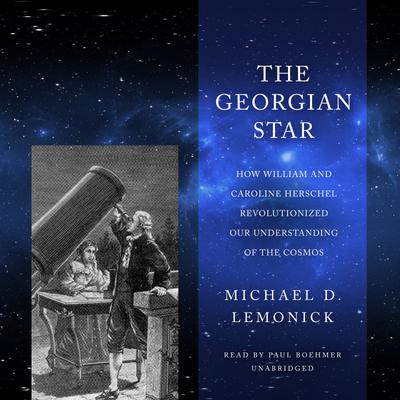
2026/107: The Georgian Star — Michael Lemonick

Herschel... followed his own ambition, which was nothing less than to understand the universe, to figure out its overall structure and composition. [loc. 180]

A comprehensive overview of the lives and work of William and Caroline Herschel, covering not only their astronomical accomplishments (which are many) but their previous careers in music -- William was a professional musician and composer, and Caroline a soprano who performed some of his works. 

Born in Germany, William emigrated to England in 1757, and Caroline joined him in 1772. At this point Herschel had already become interested in astronomy, and roped in his sister as assistant. They built telescopes (Caroline grinding the lenses and polishing the mirrors) and recorded their observations, which were considerably more meticulous, detailed and accurate than those of their peers. 

William discovered Uranus, though he thought at first it was a comet: on realising it was a planet he proposed the name Georgium Sidus, hoping this would attract royal favour and the post of Astronomer Royal. Caroline, meanwhile, discovered multiple comets and some Messier objects that Messier had missed.

Lemonick doesn't assume too much in the way of scientific knowledge or understanding: I was grateful for the clear explanations of theories and methods, though more astronomically-minded readers may feel these are overly basic. The Georgian Star succeeds in presenting a rounded picture of the Herschels as scientists and as human beings, and setting out the importance of their work in modern astronomy. I liked the argument that Herschel's approach was radical: that he was more a cosmologist than an astronomer, and realised that his desire to understand the universe could only be achieved by close observation. I was also amused to read that (like many of his contemporaries) he believed the planets, and the Sun, were inhabited. 

The audiobook was read by Paul Boehmer: somewhat monotone, but no weird pronunciations or false amusement!

Read because: I'm interested in astronomy, and in Caroline Herschel, and this was on offer on Libro.fm.

Monday, July 20, 2026

2026/106: The House That Eats the Dead — Max Doty

I curled up in a chair with ... a copy of a book on tidying by Marie Kondo. ... it would be good to get rid of some things. Maybe the house would help me.
I went to put down my book and found my hand empty. Marie Kondo was gone, tidied into oblivion. [loc. 623]

Claire and Tom Morgan, with their delightful children Grace (6) and Derek (15), and their dog King, move from the urban frenzy of San Francisco to a leafy suburb. Their new home seems perfect, though food seems to rot quickly and flowers wilt in hours. Gradually, Claire realises that the house devours anything organic -- but only if it's dead. She and her children are safe, and nosebleeds get cleaned up instantly. And only the owners of the house remember anything that has been eaten.

At first this seems convenient, even benevolent. The house has eaten Grace's favourite soft toy, but she doesn't remember loving it, and a tearful crisis is averted. Later, Claire and Tom decide that the children would be better off not remembering that they'd ever owned a dog...

Claire is the protagonist, a stay-at-home mother (formerly an artist) experimenting with the house's powers, and treating it as an individual. She brings it cow hearts to stop it eating the food in the fridge: she paints with organic paints, and the house finds a way to tell its story. Claire has a traumatic past, and so does the house -- which is very much a character in the novel, though it never speaks ... at least not to Claire. It affects each of the Morgans in different ways: Grace likes the stories it tells, Tom finds it helpful in climbing the corporate ladder, Derek's self-confidence grows, and Claire is painting again...

I was reminded of Stephen King's Pet Sematary, which also features a family discovering a supernatural phenomenon and being altered by their use of it. But this is a more mundane narrative: a family drama with horror elements, rather than a story of demons and tragedies. Which isn't to say that there aren't deaths, and bad decisions -- but the impulse behind both is human rather than occult.

It took me a few chapters to get into this novel, because Claire is not immediately likeable: but once the plot started escalating I was gripped. I liked the morally grey characters, the vaguely-sketched backstory, and the family dynamics, and I found Claire's ethical dilemmas fascinating. Would I have done the same?

Thanks to the publisher and Netgalley for the advance review copy, in exchange for this full honest review. UK Publication Date is 13th August 2026.

Read because: The publisher invited me to read this, on the basis of my having enjoyed other Tor Nightfire titles.

Thursday, July 16, 2026

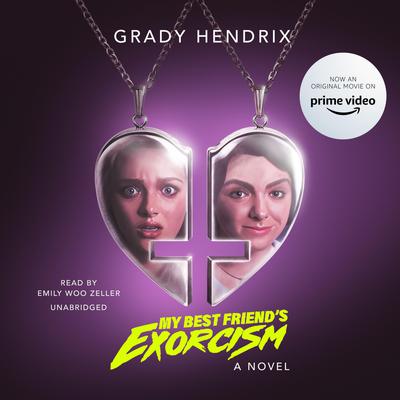
2026/105: My Best Friend's Exorcism — Grady Hendrix

For the Langs, Madonna was totally and completely out of the question. But when Gretchen's dad was at work and her mom was taking one of her nine billion classes (Jazzercise, power walking, book club, wine club, sewing circle, women's prayer circle), Gretchen and Abby would dress up like the Material Girl and sing into the mirror. Gretchen's mom had a jewelry box devoted entirely to crosses, so it was basically like she was inviting them to do it.

Set in Charleston in the 1980s, this is the story of two best friends -- Gretchen, from a well-off, conservative, religious family, and Abby, whose background is lower-income and rather liberal -- from elementary school to adulthood. It's full of 80s culture: big hair, Benetton perfume, fad diets, Madonna, personality quizzes, Halley's Comet ... and the Satanic Panic, which in this instance turns out to be justified. It's also packed with period-typical attitudes and behaviour (racism, sexism, homophobia, corporal punishment) which I remember being 'normal' back then, and find horrific now.

Abby and Gretchen are best friends. They attend the same school, and are friends (but not best friends) with constantly-dieting Margaret and class swot Glee. One night at Margaret's riverside home they take LSD, and Gretchen declares that she's going skinny-dipping. She vanishes, and the other three search for her all night, eventually finding her naked in the woods, saying she can't remember what happened. After that, Gretchen becomes a lot meaner, and Abby starts to wonder if her friend has been the victim of sexual assault. Then the Lemon brothers, charismatic preacher-types, do a show at the school, and Christian Lemon says he can see that Gretchen has a demon...

Issues of race, class, wealth are explored in the manner of a high school comedy-drama, but the story gets increasingly dark. Abby, though, is a resourceful and courageous protagonist, and the actual exorcism is a virtuoso blend of character, setting and cultural references. (It made me laugh, but it's also very emotional.) Yes, it's a horror novel, and there are some terrible scenes: but there is so much humour and ridiculousness that I could tolerate the nastier elements.

Interestingly, the novel doesn't stop with the exorcism. We see Abby and Gretchen growing up, changing, staying more or less friends for decades. I really liked that Hendrix showed us how their friendship changed and evolved as they grew older.

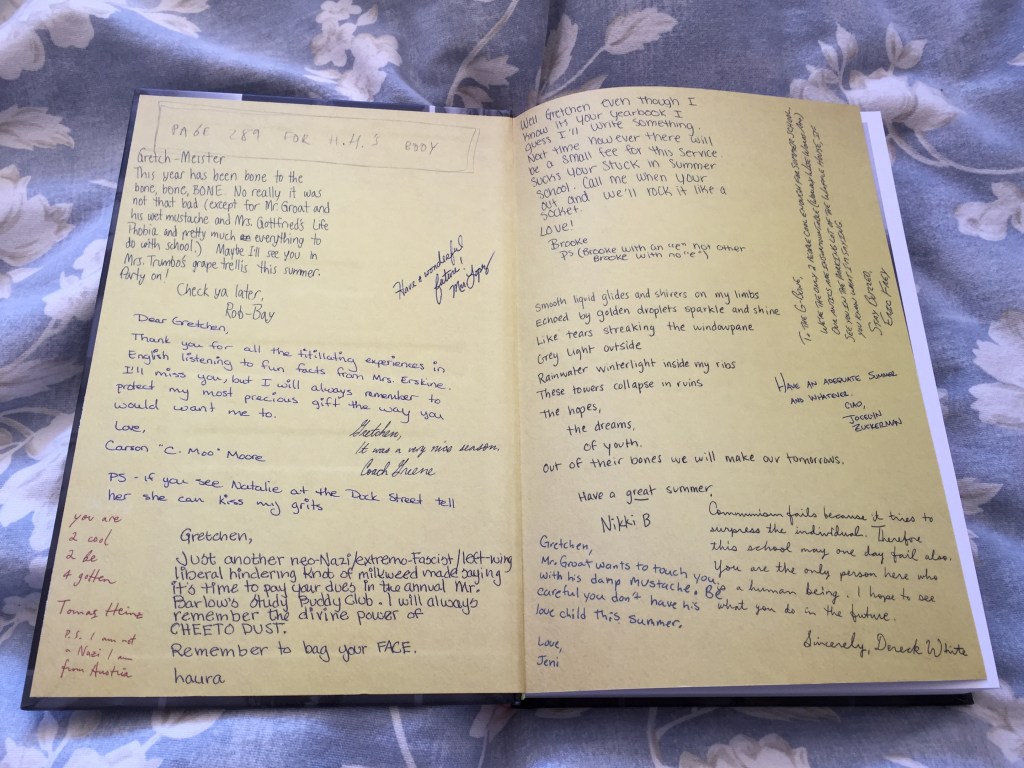
I listened to the audiobook, read by Emily Woo Zeller, whose narration was very engaging and emotional, to the extent that I sometimes had to pause the shriekier bits! Some aspects, however -- like the yearbook messages and newspaper clippings -- didn't translate well to audio format.

Read because: The book appeared in the Libro.fm sale a while ago, and having enjoyed The Southern Book Club's Guide to Slaying Vampires I snapped it up. I was in the mood for something very different from Neumeier's trilogy, and this certainly delivered.

Tuesday, July 14, 2026

2026/104: Tasmakat — Rachel Neumeier

When we ask the gods to be merciful, we have no idea what we’re asking. [p. 469]

After the events of Tarashana, Aras and Ryo travel back to the summer lands -- via a wedding -- and to the king's judgment. Aras seems sanguine on the long journey from the winter lands (a journey which I now realise comprises more than half of the novel) but there's a strong possibility that the king will have him executed.

Instead, he sends Aras and Ryo to the Land of Two Suns, ruled by the Ro-Antalet (sphinxes), where the envoy Tasmakat (a jackal-headed woman) has suggested there might be an adept who can lighten the sorcerous madness that is beginning to afflict Aras, and break the bond -- the 'leash', as the Ugaro call it -- between Aras and Ryo.

Of course it is not that simple.

This novel is packed with thorny issues of loyalty, honour and mercy. Ryo is strong and stubborn, but can he prevail against madness? He has to contend with false memories and guard his mind (though he's already proved he can mask his thoughts): he's sorcerously altered to withstand the tremendous heat of the Two Suns ... and all the while he worries about what's happening in the winter lands, what's happening with his wife and her other husband.

Intensely emotional, sometimes very dark, sometimes unevenly paced: the climax of this novel is a triumph, and the finale hopeful. I enjoyed it very much despite sometimes wearying of the interminable journeying. And I'm keen to read more of the novels set in this world -- though perhaps not quite yet.

Read because: This concludes the Ryo-centric trilogy that started with Tuyo and continued with Tarashana -- I wanted to follow that story to its conclusion, especially while the events of the previous two books were still fresh in my mind.