Showing posts sorted by relevance for query demas. Sort by date Show all posts

Thursday, February 04, 2021

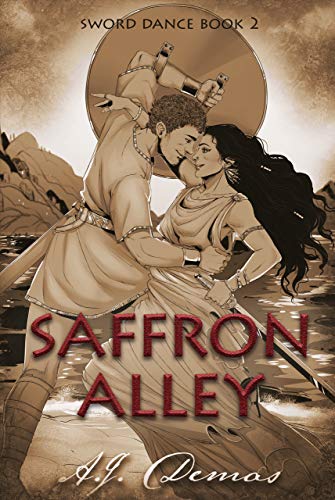
2021/017: Saffron Alley -- A J Demas

"Oh, Papa's a 'she' today," said Remi, as if that were a normal thing. [loc. 1535]

Sequel to Sword Dance, and also featuring characters from One Night in Boukos, this novel is set in Demas' alt-historical version of the ancient Mediterranean: for Zash read Persia, for Boukos read Athens.

In Sword Dance, ex-soldier Damiskos and eunuch dancer Varazda pretended to be having an affair in order to investigate a crime: as is so often the case, at least in fiction, the pretence became real. Now, it's a month since the end of Sword Dance and Damiskos is visiting Varazda at his home in Boukos. Varazda has told his family -- Yazata and Ariston, two eunuchs who were freed at the same time as Varazda, and Rish, a little girl whose provenance is unclear -- of Damiskos' arrival, and of what Damiskos means to him. Although it is possible that his family have not wholly understood him ... The day of Damiskos' arrival is a catalogue of domestic disasters, including a horrible goose and a deliberately over-spiced welcome meal: and things become ever more vexing from there on in.

This novel is told entirely from Varazda's point of view, and he is a fascinating narrator. He doesn't dwell on his past, but he is constantly aware of his difference, and often insecure about whether he can give Damiskos what he deserves, sexually or emotionally. Yet despite Varazda's self-doubt, it's clear that he is beloved by friends and family (except the horrible goose) and valued by the wider community of Zashians in Boukos.

Much of the humour in this novel comes from the way that Ariston's perception of his 'brother' is altered by events. Ariston (nee Tash: he's assumed a Pseuchian name) is a eunuch, like Varazda, but eager to be considered a Man (capital M), while Varazda accepts and sometimes foregrounds his feminine side, and identifies as gender-fluid. (He does tend to use male pronouns, except when he's explicitly being female: so I've used male pronouns in this review.) "My brother is so comfortable being himself," Ariston tells another character. "I wish I could be like that." His growing respect for, and acceptance of, Varazda's unique nature is one of the joys of Saffron Alley.

There is a strong theme of communication (and its lack) in this novel. Damiskos and Varazda are very good at asking one another what they want (though not always quite so good at hearing the meaning behind the answers); Varazda's family are less ready to accept that Varazda likes men and loves Damiskos, regardless of how often he tells (or shows) them. There are further mishearings and misunderstandings, some more momentous than others, that drive the broader political plot: Ariston eavesdropping, rumours being spread, truths being concealed.

My only criticism of Saffron Alley is that the ending is abrupt, and too much of a reversal of what's gone before. The tumultous political plot doesn't really get going until the last third of the novel, and then everything is suddenly wrapped up very quickly: I'd have liked an epilogue, or just another chapter of settling. But I understand there is another novel to come, and I look forward to it very much.

This novel fulfils the 'a queer love story' rubric of the Reading Women Challenge 2021. I received a free ARC from the author (thank you, A J Demas!) in exchange for this honest review.

Monday, January 27, 2020

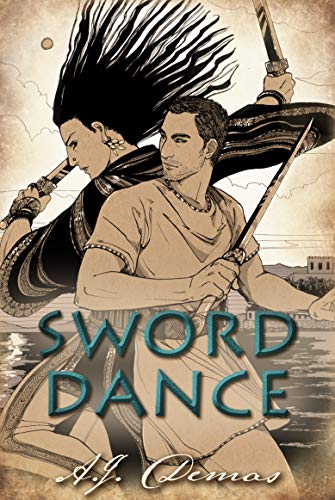
2020/010: Sword Dance -- A J Demas

"You literally said you were expecting more than a kiss. We'd better do something out of the Garden of Jasmine, at least."
“The garden of what? Why can’t you say ‘fuck’ like a normal person?”
“Oh, I can say it, but I’m not going to let you do it—and much as I’d love to do it to you, it’s not really in my repertoire.” [loc. 1344]

A delightful pseudohistorical country-house murder mystery foregrounding a romance between an invalided soldier and an elegant eunuch who is not what he seems. Also featuring wastrel philosophy students, fake relationship, a fish sauce factory, and some really unpleasant backstory (torture, slavery, mutilation, non-consensual sex) for both protagonists -- though they are both good at acknowledging their own traumas and accommodating the other's. The romance evolves gradually, and is built on a foundation of mutual respect and equality.

I enjoyed the classical-flavoured, pseudo-Mediterranean world depicted here. There are elements of Persia and Greece, and with the fish sauce it's hard not to think of Rome ... Using a semi-historical setting with the serial numbers filed off means that Demas doesn't have to adhere to strict detail, either in terms of the society she depicts or in the wider political milieu.

Things I especially liked here include the wealth of strong female characters; Varazda's non-binary nature; the way that he and Damiskos work together as soldiers / warriors. It's told throughout from Damiskos' viewpoint, and he is not always the most perceptive of individuals: the reader understands how his feelings are changing towards Varazda before Damiskos recognises it himself.

And it's not all sweetness and light. Characters have decided views on manliness, racial purity, slavery and the decadence of Zash. There are unwanted suitors, blithering philosophers and feisty servants. And some intriguing hints about religious practices ...

So of course I went and bought the other two books by Demas. Yay!

Thursday, January 30, 2020

2020/013: Something Human -- A J Demas

They had fallen into an easy friendliness, as if they had known each other for years. It would have been something remarkable if they had been soldiers serving together or two people introduced by a mutual acquaintance at a party. But they had been on opposing sides of a battle a few hours earlier. This felt far more natural than that. [loc. 257]

Rus is a tattooed priest, born into a nomadic tribe; Adares is a civil servant, trapped under a wrecked wagon after his first battle. They should be enemies, but they are drawn to one another. Rus saves Adares, and Adares returns the favour by finding shelter for them both in a nearby temple. He tends Rus' near-fatal wound, and the two young men quickly become friends. Adares would like more, but Rus is, after all, a priest. And there can be no future for any relationship between them, because they're on opposite sides of a war.

This is an utterly delightful romantic novel, set in the same pseudo-historical period as Demas' Sword Dance and One Night in Boukos. I was reminded strongly of Rosemary Sutcliff's work, both in the depiction of male friendship and in the little details that bring the setting to life. Rus and Adares are both keeping secrets about themselves, but that doesn't prevent them being honest and open with one another. They are both competent, strong characters, whose personalities and abilities complement one another. And their conversations made me laugh out loud more than once.

Something Human is a straightforward but engaging story, with some intriguing worldbuilding. I'm hoping Demas will publish more fiction set in this world.

Saturday, March 19, 2022

2022/37: Honey and Pepper -- A J Demas

"Nothing we did in bed together changed the truth of who we were to each other -- you know, 'owner' and 'property'." [loc. 1866]

The first in a new series ('When in Pheme'), Honey and Pepper is the story of two former slaves, both trying to adjust to life as free men. Nikias has come to the city after the death of his beloved master, a country landowner who lived quietly in the mountains, and is now working as a short-order cook at a snack stand: Kallion was freed when his not-at-all-beloved master disappeared, believed murdered, and is making a career for himself as a law clerk. Each likes the look of the other, but both are dealing not only with the novelty of freedom, but with the lingering mental damage of having recently been regarded as property.

Like Demas' other pseudohistorical romances, this is set in a milieu that resembles, but isn't, the ancient Mediterranean. She has an eye for the little details that bring an antique setting to life: Nikias' octopus fritters, Kallion's unused kitchen, bags of hazelnuts at the races, a high-born lady wiping her fingers on her mantle after eating a snack 'in the street, like a dockworker'. (Food is an important element in this novel, not least because Nikias enjoys cooking so much. I want the recipes!) There are some familiar names from the other novels: Eurydemos, Nione, Lysandros ... And, though this is a romance between two men, there are several excellent women, including Nikias' employer the widow Pyke, his new patron Satteia, and -- glimpsed only briefly -- an inspirational lady pirate. There are also tantalising hints of potential future protagonists: ex-archon Polydoros, in particular, intrigues me greatly.

The plot's driven by a villainous scheme which affects Kallion closely, but that isn't the focus of the novel. Instead, Honey and Pepper tells the story of two young men (and their growing circle of friends) coming to terms with, and overcoming, the after-effects of slavery: the acts for which they weren't truly responsible, the power imbalances, their different ways of learning to own their selves, their lives.

I liked this very much indeed: Nikias and Kallion are delightful, the secondary characters all felt rounded and realistic, and the setting -- Pheme, a cosmopolitan city with an ambience that reminds me of classical Rome as depicted by Lindsey Davis -- is fascinating. After I'd finished this, I went back and reread most of Demas' previous novels, and I'm already eager for the next 'When in Pheme' novel.

Thanks to the lovely author for an advance review copy!

Thursday, June 13, 2024

2024/085: The House of the Red Balconies — A J Demas

"Men like you and Loukianos are a great boon to women like me, you know."
"W-we are?" He'd have thought it was the opposite.
"Oh, yes. One can't do all one's politicking in bed. It's handy to have men to deal with who don't expect it." [p. 98]

Hylas Mnemotios has come to the island of Tykanos to build a much-needed aqueduct. He's something of an innocent, in more ways than one, and is dismayed to find that he's been assigned a lodging in a tea-house, the eponymous House of the Red Balconies. Tykanos' tea-houses are its pride and joy: places where one can enjoy good food and drink, conversation and music -- and, for a consideration, the charms of the companions. Hylas finds himself sharing a garden with the companion Zo, the most beautiful person he's ever met. And Zo, with his mysterious past and his chronic illness, finds that Hylas is kind, unassuming, and willing to bring him his breakfast every day.

Hylas quickly becomes known in the house as Aqueduct Man, but his professional endeavours are frustrated by the unpredictable customs of Tykanos: the fact that he has to seek out the quartermaster's mistress to assemble a team of workers, the drunken outings to other tea-houses with his employer Loukianos, the gorgeous map of the island's water sources and piping which is wholly inaccurate. He begins to feel more comfortable in the House of the Red Balconies, despite its impoverishment, and despite its bad-tempered Mistress Aula. And he is enraptured by Zo's music: by Zo. But Mistress Aula demands that Zo find a wealthy patron, and Hylas doesn't even know when he's next getting paid ...

The House of the Red Balconies is a novel about kindness, friendship, secrets and mutual support; a slow-burning, sweet romance; and a cheering vision of a society in which same-sex love is regarded as natural and normal, and in which women, though precluded from formal power, find plenty of ways to exert influence. Demas' alt-Classical world, based on but not identical to the ancient Mediterranean, is full of the minutae that bring the best historical fiction to life: the romance novel that everyone's eager to read, lent to Hylas by Mutari (the quartermaster's mistress), the adjustments Zo's made to his room so that he can manage better on bad pain days, the gossip in the kitchen. I'm reminded of the little details in Rosemary Sutcliff's books that bring a lost world to life.

And I loved the alternation of Zo's and Hylas's narratives, and their complementary strengths and weaknesses. Hylas comes from Sparta-flavoured Ariata and has a lot to unlearn about toxic masculinity: Zo is from Persia-styled Zash, and left his identity, as well as his family, behind. Each man, at the beginning of the story, Is adrift, without connections or any sense of home: by the end of the novel they (and others) have found stability, security and love. The House of the Red Balconies is an absolute delight, highly recommended. The sign of a good novel, for me, is that on finishing it I immediately want to reread the author's other works: I've already reread most of Sword Dance, and I'm looking forward to rereading more by Demas this weekend.

Many thanks to the author for the review copy! UK publication date is 24th June 2024.

Tuesday, January 28, 2020

2020/011: One Night in Boukos -- A J Demas

"He did it for a lark. He thought it would be fun... The night before, he was really having a good time. He’d got to do all sorts of things a respectable man can’t do in Zash, and he thought it was spectacular. He liked mingling with the locals—he thought everyone in Boukos was just wildly quaint and fabulous in a sort of barbarian way." [loc. 2756]

The Ambassador from Zash has gone missing in Boukos after a night of debauchery cementing diplomatic ties. So far, the only two people who know he didn't come home are the captain of his guard, Marzana, and his eunuch secretary Bedar. Can they find the Ambassador in time for the trade deals to be concluded? And will the fact that it's the night of the Psobion, a religious festival dedicated to sex and decadence, interfere with their investigations?

Another cheerful secondary-world pseudohistorical from A J Demas. I didn't adore this quite as much as Sword Dance, but that might be because it's as much a crime novel as a romance: also, there are two romances, one heterosexual and one not, but neither is a case of wild passion. The Zashians apparently say that one 'catches' love, like an illness: the infections depicted here seem mild and gentle, head colds rather than high fever, though no less sincere and cheering.

A lot of the charm of this novel is in Marzana's and Bedar's experiences of culture shock, as they come to terms with the sheer foreignness of Boukos. (Horned Beasts everywhere! Megaphallic marionettes! Unwatered wine!) The secondary characters, the widow Chereia and the prostitute Pheres, are also thoroughly delightful -- we come to know them as our protagonists do, gradually but intimately and with a real appreciation of their characters, strengths, and vulnerabilities.

And happy endings for nearly everyone involved. Win!

Friday, October 08, 2021

2021/120: Strong Wine -- A J Demas

"If it would help," said Varazda, deadpan, "I'd be happy to pose as a bizarre girlfriend. I didn't bring any of my gowns with me, but I can always get something ready-made in the market." [loc. 1453]

Third in the series that started with Sword Dance and continued with Saffron Alley: the setting is reminiscent of the classical Mediterranean, though with the names changed, and the protagonists are Damiskos (military veteran) and Varazda (eunuch dancer and spy).

I think I enjoyed Strong Wine even more than the previous two instalments. Damiskos, who has been living with Varazda for a month and rather hoping that he can stay forever (but is it too early to ask?) is summoned 'home' to Pheme to encounter old enemies, his ex-fiancee, and -- worst of all -- his feckless parents. He despairs: but he should have more faith in Varazda, who is not prepared to simply let his beloved be drawn back into a life he no longer wants.

Hilarious, poignant, and triumphant, Strong Wine features a murder mystery, some splendid women (including Aradne and Nione, first encountered in Sword Dance, as well as Ino the silversmith and Dami's mother Myrto, who refuses to misgender Varazda), just deserts for the malfeasant and happy endings for the (mostly) deserving, including Dami's horse Xanthe. I was especially cheered by the ways in which the characters look after one another, and by Varazda's sheer competence: he's not just a pretty face. (I was also, perversely, cheered that neither Varazda nor Dami were prepared to tolerate misgendering, homophobia or generic insults. It's one thing to know that they originate from prejudice and ignorance, quite another to endure the constant grind.)

I received a review copy from the lovely author, in exchange for this honest review, which I'm publishing out of sequence in honour of Publication Day!