Friday, September 29, 2023

2023/141: The Mars House — Natasha Pulley

January had a bizarre out-of-body moment where a detached part of his brain said: You’re very cold, it’s Monday, and a senator is arguing about you with a mammoth. On Mars. [loc. 4929]

I loved The Mars House instantly and unreasonably: but's far too soon for a proper review, so I'll just say that the footnotes feature Farringdon dock, formerly Farringdon Station; varying pronunciations of 'Mx'; Mori and Daughter, a shop on Filigree Street; bathroom terminology in Mandarin; The Clangers; mammoth jokes; and Shuppiluliuma, a cat named after a Hittite king who coincidentally appeared in my recent read 1177BC: the Year Civilisation Collapsed.

Thanks to the publisher and Netgalley for the advance review copy, in exchange for the full honest review which'll be appearing nearer UK publication date (19th March 2024).

Monday, September 25, 2023

2023/140: The Winter Spirits: Ghostly Tales for Frosty Nights — various authors

My bells tinkled and rang. The pine needles pattered across the floor. If I squinted, I could just see the blue edge of her, dancing in a fury, whirling with her hands out, breathing her spite against the walls. The plaster bubbled and split. ['Banished', Elizabeth Macneal: loc. 1925]

A follow-up to last year's The Haunting Season, this collection features twelve stories by contemporary authors working in the Gothic / historical / fantastical / weird milieu: the settings are historical and mostly British, though Catriona Ward's 'Jenkin' is set in Maine, and Laura Shepherd-Robinson's 'Inferno' takes place in late eighteenth-century Italy. Despite the subtitle, not all of the stories feature ghosts. Andrew Michael Hurley's 'The Old Play' centres on a drama that is traditionally performed on New Year's Eve: this year Committee have made some improvements, which they don't explain to the actor playing the role of the Beggar. He's haunted, true, but it's by the memory of war, of Dresden and Hamburg burning. 'Widow's Walk', by Susan Stokes-Chapman, is a slowly-clarifying story about vengeance -- as, in a very different key, is 'A Double Thread' by Imogen Hermes Gowar. And Natasha Pulley's thoroughly unnerving 'The Salt Miracles', set on a remote Scottish island where pilgrims can be cured (if they don't simply vanish) centres on an angel rather than a ghost, though perhaps not the sort of angel one might expect in a winter-themed anthology.

No two stories are alike, even when they share a theme or a setting (such as Victorian spiritualism, which is the focus of both 'Host' by Kiran Millwood Hargrave and Jess Kid's 'Ada Lark': two very different perspectives). Some feel very much in the classic understated mode; others are nightmarish Gothic horrors. And the authors' voices are distinctive, each with its own flavour. 'Host' has tempted me to read Hargrave's longer fiction; 'The Salt Miracles' confirms my crush on Pulley's prose; 'Jenkin', by Catriona Ward, is as chilling as any of her novels. Those are probably my favourites right now, but there isn't a weak story in the collection.

Thanks to the publisher and Netgalley for the advance review copy, in exchange for this honest review. UK publication date is 19th October 2023.

Sunday, September 24, 2023

2023/139: Companion Piece — Ali Smith

... no government was ever going to give a fuck about and no history was ever going to think it worth recording never mind bowing its head even momentarily to the deaths and fragilities of any of the millions and millions and millions of individual people, with their detailed generic joyful elegiac fruitful wasted nourishing undernourished common individual lives, who were suffering or dying right now or had died over the past year and a half in what was after all just the latest plague and whose gone souls swirled invisible in shifting murmurations above every everyday day that we wandered around in, below these figurations, full of what we imagined was purpose.[p. 32]

The majority of Companion Piece takes place in 2021, at the height of the pandemic. Sandy Gray is a middle-aged female artist who works by layering painted words, one atop the other. Her father is in hospital and she can't visit as much as she'd like, due to Covid restrictions. Instead she looks after his dog and his house, and waits for the phone to ring with news. The call that kicks off the story, though, is not from the hospital but from a university classmate who Sandy once helped analyse a poem. The classmate, Martina Pelf (nee Inglis), has had a strange experience when returning to the UK with a medieval artifact: "The passports. The blank officials. The inexplicable and uncalled-for detainment. The revelation of the artisan beauty. The disembodied voice in the locked room." The voice said 'curlew or curfew, you choose'.

This sparks a series of recollections: Sandy's time at university, episodes with her father, the moment at which she lost hope. People start to arrive at her house, despite the risk of Covid: first it's Martina's acronym-spouting twin children Lea and Eden, accusing Sandy of having an affair with their mother and somehow changing her; then it's a mysterious young woman with a long-beaked bird on her shoulder, who seems to have been branded with a V for Vagabond. Martina, on a Zoom call, is convinced that this is the maker of the Boothby Lock, the beautiful piece of metalwork which was the cause of her delay at passport control.

And the final quarter of the novel -- shifting abruptly from Sandy and her unwelcome guests -- is the story of a female smith who is raped, at curfew, to prevent her completing her apprenticeship. (Fornication is forbidden, whether or not it is by choice.) The girl, who's never named, wakes in a ditch, and makes up her mind to die: but lives, because she's adopted by a baby bird, a curlew.

I think the cover, a Hockney print of a path through woodland ('we're not out of the woods yet', says the nurse about Sandy's father), inclined me to expect a connection with the Seasonal Quartet. If there is one -- apart from the contemporary setting, apart from the emphasis on art, apart from the solitude of the protagonist(s) -- it's subtle. And how much is real? Is the story of the medieval girl as real as Sandy's life in lockdown, or is she a story told to explain that cryptic 'curlew or curfew' mutter? And given the title, is the novel about how we reach for companionship (her father's dog; a long-beaked bird; a classmate from university; a book) even while thinking we're fine alone?

Beautiful, subtle, thought-provoking -- and vividly evoking a time that is still too close for comfort.

Saturday, September 23, 2023

2023/138: The Mermaid of Black Conch — Monique Roffey

Her hair was the worst part, a mess of fire and ropes of this and that. Jellyfish had come up with her, clusters of long blue veins. Sea moss trailed from her shoulders like slithers of beard. Barnacles speckled the swell of her hips. Her torso was sturdy and muscular, finely scaled over, as if she wore a tunic of sharkskin. She was crawling with sea-lice. [p. 29]

A thousand years before the story opens, long before the arrival of the 'Castilian admiral', a young woman named Aycayia lived on a fish-shaped island in the Caribbean. She refused to marry, though the men of the village pursued her relentlessly: eventually, the women cursed her to become a mermaid.

The narrator of The Mermaid of Black Conch is David, an old man, recounting the story of when he was a young fisherman in 1976. One day he was fishing alone from his boat and met a mermaid who liked his bad guitar playing. Their mutual fascination could have led to more: but Aycayia, lulled into trust, is hooked and caught (in a harrowing scene with strong undertones of sexual violence) by an American sports fisherman and his son, and dragged back to the harbour at St Constance. There's talk of an exhibit in the Smithsonian, a photo on the cover of Time magazine. What can David do? Obviously, he has to rescue her. She ends up in his bathtub; her mermaid tail rots away; she learns to speak English, and to wear clothes, and to walk in David's green suede Adidas trainers.

Of course it's not that simple. The Americans, Thomas and his son Hank, want the mermaid back; David's neighbour, the rapacious Priscilla, is curious about his guest; Miss Rain, the white woman who owns much of the land, accepts Aycayia into her home, where she listens to bass-heavy reggae with Miss Rain's Deaf son Reggie and learns to read and speak English. David, who fell in love with her when he first saw her, imagines how they might build a life together. But the mermaid's arrival has exposed tensions old and new: Miss Rain and her slave-owning ancestors, the lack of opportunities for young black men, the different ways in which men and women are oppressed, the ecological damage caused by humans.

Roffey mixes idiomatic Caribbean English ('picong', 'steupse', 'tabanca') into David's narrative -- it's interesting to compare the prose in his 1970s journal and the narrative of forty years later -- and lyrical oral story-telling in the rhythmic blank verse of Aycayia's voice. Her outsider perspective on the people and the culture of Black Conch, as well as her sheer messy physicality, lift this lyrical novel above more typical mermaid stories. The ending is not wholly happy, but nobody is unchanged by Aycayia's time on land.

Fulfils the ‘By a Caribbean Author’ rubric of the 52 books in 2023 challenge.

Friday, September 22, 2023

2023/137: Catfishing on Catnet — Naomi Kritzer

Having all my friends on the internet is a little weird; every now and then, it turns out someone isn’t at all the person you thought they were... [loc. 1177]

Steph and her mother move house frequently, which plays havoc with Steph's schooling and social life. Their itinerant lifestyle is because of Steph's father, who is apparently very dangerous. Steph doesn't understand why they can't just stay put and talk to the police. There's a lot that her mother hasn't told her. Possibly the only thing that keeps Steph sane is CatNet, a social media site that reminded me of the early days of LiveJournal. The currency is cat pictures, the moderator goes by the handle CheshireCat, and Steph (LittleBrownBat) has a supportive group -- a clowder -- of friends, none of whom she has ever met.

Steph and her mother wind up in New Coburg, a small town somewhere in Wisconsin. Steph enrolls in school, discovers she'll have to read The Scarlet Letter for the third time, and befriends (or is befriended by) an artistic girl called Rachel. But her mother falls ill, and Steph needs to run -- and she begins to find out about her mother's past and a very real and present threat. Luckily, CheshireCat and the Clowder are very much on Steph's side ... and CheshireCat is not a human being.

Catfishing on Catnet is sweet and funny, with solid SFnal elements (robo teachers, ubiquitous delivery drones), villainous plots, online friendships (and what happens when you meet in real life), and what defines a person. It's based on Kritzer's Hugo-winning short story 'Cat Pictures Please', which also features an AI trying to help humans while being keenly aware of Asimov's Laws of Robotics. I think I enjoyed the novel more, though: the narration is split between CheshireCat (introduced on the first page as 'AI'), Steph, and the Clowder. While Steph's mostly concerned with the exigencies of her situation, the wider picture -- her mother's past as a hotshot developer, her associates, her ex-husband -- is also fascinating.

I have a couple of criticisms (who feeds the actual cat while Steph's on the road? Maybe the never-seen landlady who lives in the same house?) but they're minor flaws: and I look forward to reading the sequel, Chaos on CatNet, in which I hope to see more of the Clowder and of CheshireCat.

Thursday, September 21, 2023

2023/136: Slow Horses — Mick Herron

If Moscow rules meant watch your back, London rules meant cover your arse. Moscow rules had been written on the streets, but London rules were devised in the corridors of Westminster, and the short version read: someone always pays. [p. 254]

Someone described this as 'Generation X slacker spies' and that's an apt summary. Slough House (hence 'slow horses') is where MI5's rejects -- the ones who've left classified info in a public place, the ones who've screwed up a training exercise, the ones who make bad calls or are implicated in bad ops -- end up. It's easier than firing them and there's always a chance that Jackson Lamb, the unlikeable, uncharismatic and flatulent head of Slough House, will inspire them to leave of their own accord.

But most of the slow horses still want to matter, and when a high-profile terrorism threat (a Pakistani youth. live on camera, due to be beheaded) goes wrong, Slough House's bunch of losers get a chance to be ... well, not exactly heroes, but certainly significant players. Unfortunately the enemies are rather closer to home than Le Carre's Russians or Fleming's supervillains.

There's a bleakness to Slow Horses that didn't appeal to me, though I did recognise the London in which I live: no exclusive gentlemen's clubs or quiet suburban mansions, just a run-down office block near the Barbican, and the recent memory (this was first published in 2010) of the bombs in July 2005.

Occasionally patchy writing ('They crossed the black river in a blue car, red memories staining their minds') but on the whole very readable, with an engagingly twisty plot. I'll probably read more in the series, now up to eight books and a TV series.

Monday, September 18, 2023

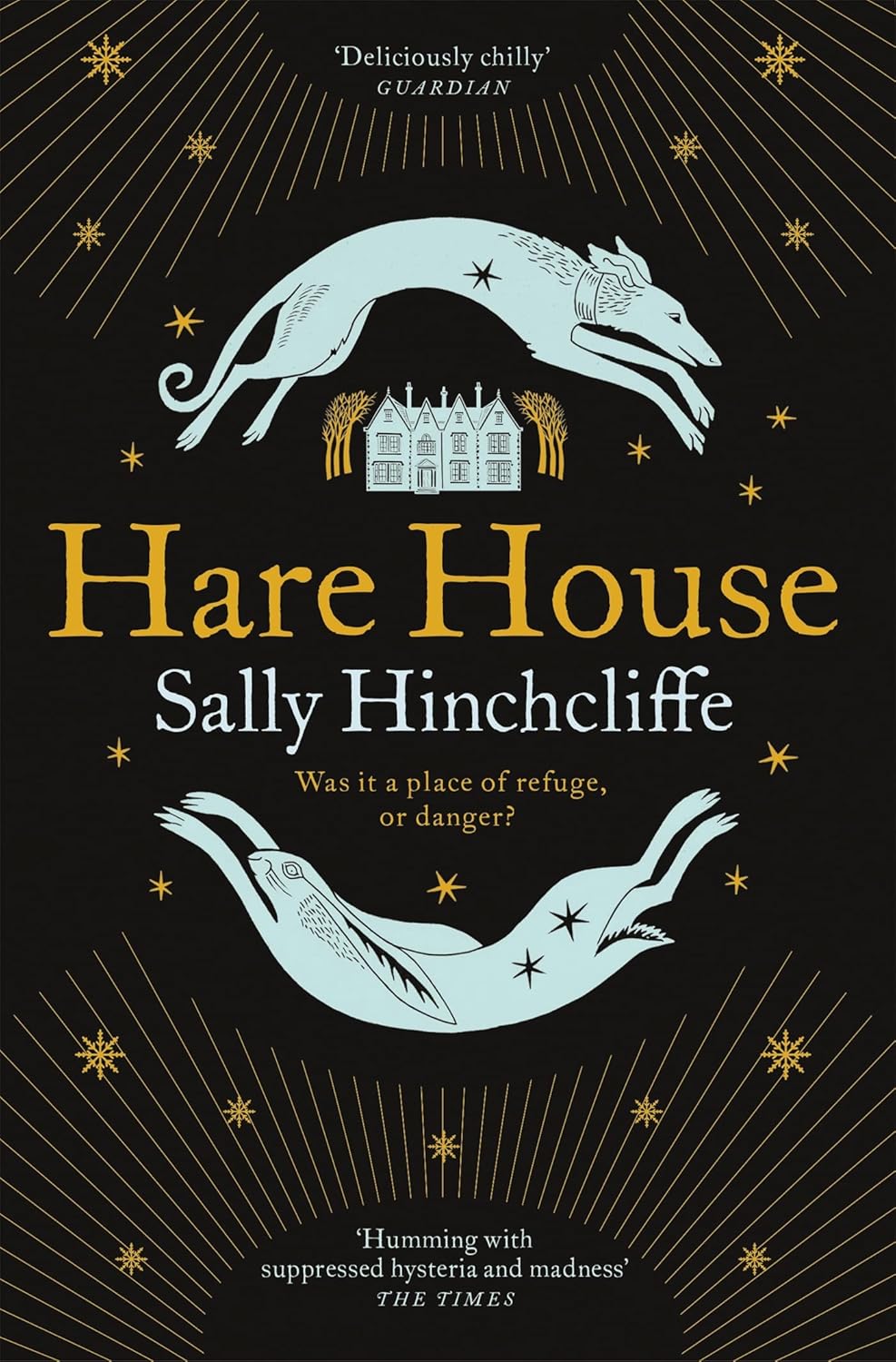
2023/135: Hare House — Sally Hinchcliffe

‘It’s not a simple matter. You can drain the water or grit the ice, or move the wall. It makes no difference in the end. It’s just a bad spot here, and always has been. A crossroads. The place where they buried folk like suicides and murderers. Witches. Bury them at the crossroads so their spirits get confused and can’t find their way home.’ [loc. 2112]

The never-named narrator of Hare House has been forced to give up teaching: on a holiday to Scotland, she impulsively decides to move to a cottage adjoining Hare House. She achieves a painful facsimile of friendship with Janet, who lives in the other cottage, and befriends the Hendersons, who live in Hare House: Cass (seventeen and beautiful) and her older brother Grant. (Their brother Rory died 'a hero', quite recently.) The house is ... eccentrically decorated, with Victorian taxidermy tableaux featuring stuffed hares in a variety of improbable poses. And hares, of course, feature in the local folklore: there's a story of a witch, killed while in the shape of a hare, only regaining her human form after death. The narrator is reminded of the hare she encountered on first arrival, mortally wounded by a collision with traffic, dying slowly in front of her because she didn't have the courage to kill it. And she thinks of Janet, her uncharitable neighbour, of whom Cass warns 'well, you know she's a witch, of course'. But can Cass be trusted to tell the truth? Her stories about her dead brother may not be strictly true, and she claims that the whole family is under a curse.

Entwined with this story, and perhaps underlying the Hendersons' changing attitudes to our protagonist, is the backstory of just why she was 'forced to give up teaching', and the modern witch-hunt that drove her out of her profession. In a reversal of the more usual trope, the narrator becomes rather less likeable as the novel progresses. She's a lonely middle-aged woman, embittered by 'the months and years of a life deferred': it's never entirely clear whether the Hendersons come to know of the scandal in her past, or whether they have drawn conclusions (accurate or not) about her culpability for some of the less pleasant events of a cold, isolating rural winter.

Hare House was tremendously atmospheric, Gothic in its sensibilities and to some extent its characters: but it never really resolved the issue of whether supernatural or 'merely' psychological forces were at work, and the finale was less dramatic than the rest of the novel had suggested.