Monday, May 18, 2026

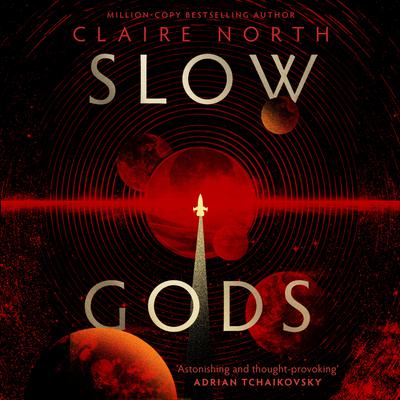
2026/078: Slow Gods — Claire North

It is not that I am not moral, in my own way.
It is simply that sometimes, rather like the rules of physics that should contain me, I forget. [loc. 1814]

Reread for book club: my initial review is here. This time round I listened to the audiobook, not least because I was intrigued by how the narrator (Peter Kenny) would handle the multiple pronouns... extremely well, as it turned out.

Unusually for the Lockdown Bookclub, everyone liked the book! We discussed the supernova as a metaphor for climate change (everyone knows it's happening but some people refuse to believe it can be that bad); what constitutes a god (the title has plural gods: is Maw one? is the Consensus?); why a couple of us initially read Maw as female; whether North's space opera is comparable in scale and scope to the works of Iain M Banks (I think we agreed it was, though more humane and compassionate, and without awkward / improbable sex scenes: also, first-person narrative).

Read because: bookclub pick.

2026/077: The Palace Beneath the Sea — Lauren Wiesebron

"I am the korrigez who founded Ys, both above and below the waves... and now I am here to take back what's mine and lay waste to what never should have been built!" [loc. 4508]

Nolwenn and her family are lighthouse keepers, defending the city of Ys. They use lenses to focus the moon's rays, to kill teuthes -- great monsters from the deep -- that threaten the sea-defences. She's been lucky, finding seasilk (a rare and precious commodity that can protect against the black tide) and is summoned by the queen, who flirts with Nolwenn and tells her to fetch enough seasilk to provide shield-nets for the lighthouses as well as the city.

Nolwenn recklessly rows out one night and is attacked: but she's rescued by a merperson, a korrigez who she names Morvan after the chieftain in a popular serial. Morvan takes Nolwenn to Ys-below, a coral palace deep in the ocean: she learns a lot (some of it rather uncomfortable) and falls in love, but yearns for her family, for sunlight, for air.

The worldbuilding is a delight: I loved the reimagining of the Breton folk tale about a city drowned by the sea. The half-humanoid, half-fish korrigez (Breton for 'mermaid') are fascinating, as are the ecology and economy of Ys-below. Coral for communication! Wiesebron is a marine ecologist and admits in her afterword that 'the fantasy of suddenly sprouting fins is one that I enjoyed, albeit from the safe and dry distance of my pen and paper' [loc. 4923] And I loved the resonances with the in-universe fiction 'Leylou Among the Korrigez'.

But I do think this novel could have done with another edit. There are pacing issues: the first third of the book is really slow, and the last third feels rushed. There are typos and infelicities: 'discretely' instead of 'discreetly', 'it's' instead of 'its', someone knowing something and a few pages later not knowing it. And Nolwenn, though she's twenty-three, sometimes behaves like a much younger girl: she's prone to impetuous behaviour, and doesn't always know the rationale behind her own decisions.

Really interesting setting, slightly disappointing prose -- but there's a fascinating romance, and a suitably epic finale.

Thanks to the publisher and Netgalley for the advance review copy, in exchange for this full honest review. UK Publication Date was 21st May 2026.

Sunday, May 17, 2026

2026/076: A Fair Maiden — Joyce Carol Oates

Just a roll of the dice. She was risking nothing. No danger in upscale Bayhead Harbor, which was very different from Atlantic City, fifty miles to the south, where Katya Spivak would never have been so naive as to go to a man’s house, no matter how harmless he appeared, how gentlemanly or how rich. [p.13]

Katya Spivak is sixteen years old, working as a nanny for a rich family in the upmarket coastal town of Bay Harbor -- a far cry from her working-class origins in New Jersey. One day, while admiring lingerie in a shop window, an elderly man asks her what she would choose. He is Marcus Kidder, nearly seventy but still elegantly dressed: a former author of childrens' books, a sophisticated artist. He befriends Katya -- is it friendship? -- and gives her not only money but attention (commodities lacking until now in Katya's life): and, chastely, beguiles her.

For three-quarters of the novel (which is only 166 pages in print) this seems like a routine seduction, with an older man preying on a very young woman -- albeit one who, because of past experiences, thinks she can handle whatever Kidder might do. Katya's independence and confidence, though, is at least partly a facade covering an absent father (who she misses a great deal), a neglectful mother who tries to borrow money from Katya to pay her gambling debts, and an emotionally distant employer. Kidder's attention seems harmless at first, and even when it becomes less so Katya is convinced that she can handle it. 

Then, when the ante is upped, a fairytale is told, the story of an old king and a Fair Maiden: and it is the pivot on which the whole story rests.

Oates manages a happy ending, of sorts, and presents a duo of fascinating character studies: of Katya herself, out of her depth for most of the book, and making some bad decisions; and (at one remove) of Marcus Kidder, who we only ever see through Katya's eyes. I cannot say that I liked either of them: both manipulative, both a little lost. But I did feel compassion for both.

Friday, May 15, 2026

2026/075: The Signature of All Things — Elizabeth Gilbert

Alma’s world and the moss world had been knitted together this whole time, lying on top of each other, crawling over each other. But one of these worlds was loud and large and fast, where the other was quiet and tiny and slow—and only one of these worlds seemed immeasurable. [p. 162]

Alma Whittaker, the focus of this novel, is born in 1800 and grows up in a wealthy household on the White Acre estate just outside Philadelphia. Her father Henry grew up in poverty, impressed Sir Joseph Banks with his initiative and his horticultural gifts, and made his money cultivating cinchona, a remedy for malaria. 

Alma is brought up to be fascinated with the natural world and to think for herself. At first, the only surviving child of Henry and his Dutch wife Beatrix, Alma is rather lonely: suddenly she acquires an adopted sister, Prudence, who is beautiful but reticent. She and Alma (who is plain) are never close.

The girls grow up. Alma develops a fascination with mosses, and conducts scientific correspondence with botanists all over the world. Prudence marries and becomes a committed abolitionist: Alma marries rather later, but her husband -- Ambrose, an artist -- is ... not what she had expected, wanted, craved. After her father's death she makes some momentous decisions, travels to Tahiti (where Ambrose had been exiled), and thence to Amsterdam.

I've done my best to avoid spoilers in that summary: I found the novel very slow, but a lot happens, actually as well as emotionally. I very much liked Gilbert's depiction of Alma as a sensual, as well as an intellectual, individual: I was fascinated by Alma's mosses, and her theories. I did not warm to any of the other characters -- perhaps because Alma, though she loves them, maintains some emotional distance.

This is also, in a way, a novel about early nineteenth-century science, and especially the theory of evolution. Alma considers the possibility: 'those who survived the world shaped it—even as the world, simultaneously, shaped them'. But there is no room in this world view for compassion, altruism, selflessness. Only on her return from Tahiti does she read of a new book by Charles Darwin...

Looking back on the experience of reading this novel, I find much to admire. Gilbert's prose has an Austenesque cadence that fits Alma very nicely ('her botanical drawings—which were never exactly beautiful, but always beautifully exact') and there are many vivid moments. But it felt so slow and claustrophobic while I was reading: and Alma's escape departure from White Acre, though an immense relief to me as well as her, did not immediately improve matters. And there's one scene, on Tahiti, that really bothered me: but ... spoilers.

...she knew that the world was plainly divided into those who fought an unrelenting battle to live, and those who surrendered and died. This was a simple fact. This fact was not merely true about the lives of human beings; it was also true of every living entity on the planet, from the largest creation down to the humblest. It was even true of mosses. This fact was the very mechanism of nature—the driving force behind all existence, behind all transmutation, behind all variation—and it was the explanation for the entire world. It was the explanation Alma had been seeking forever. [p. 434]

Monday, May 11, 2026

2026/074: Ring the Hill — Tom Cox

I didn’t see the Tor at its best that evening. Dusk was coming on but the weather was a little drappy — a Somerset word I’d recently learned, which means ‘starting to rain slightly’. Even without the benefit of one of its legendary sunsets, the view from the top pushed you back onto your heels, opening the world’s mouth and allowing you to see humblingly down its throat. [loc. 146]

Read by the author, so it felt almost like going for a long walk with Tom Cox and listening to him talk -- about moving house with plants and cats, about hares and the lack of them in the West Country as compared to Norfolk, about life on the Dartington estate in Devon, about his cats (I teared up hearing him talk about the deaths of two elderly felines).

The book is (notionally) based around hills: Glastonbury Tor, the hill in Derbyshire where he lived one winter, the hills of Dartmoor, et cetera. But Cox rambles in prose as well as in the countryside, so he might be walking up a hill and thinking about a pheasant named Clarence (though the pheasant does not know his name, of course). Ring the Hill -- the title is from a medieval text about nicknames for hares -- was gentle and funny, gorgeously written and endlessly intriguing. It made me want to get out in the countryside and walk for miles, preferably alone. And then go to the beach and swim in the sea*.

*Assuming no sewage alerts :(

Wednesday, May 06, 2026

2026/073: Platform Decay — Martha Wells

Mensah just looked at me and said, “SecUnit.” In that voice. The voice that’s the only reason I’m still here and alive and surrounded by … friends. (Emotion check: Good, actually. Really good.) (Emotion check: It is still hard to say the friends part.) [loc. 2474]

Murderbot is asked by Dr Mensah to help some family members escape from a space station run by evil corporation Barish-Estranza. Turns out the family members (including children, ugh) are being more or less held hostage and may be forced to work for B-E. There are also multiple SecUnits on the loose, running Murderbot's 'hack your own governor module' code. This includes Three, previously liberated by Murderbot and still looking to its liberator for guidance.

I liked the space station -- actually a torus surrounding a mined-out planet, with distinct zones -- and the exploration of forced labour, corporate abuse of power, and (maybe?) racism. And I loved Murderbot's self-help module, which pings every time Murderbot's neural chemistry goes weird, and asks for an emotion check. But there's more action here, and less reflection, than in the earlier instalments: I missed Murderbot's downtime. And there's no ART, and precious little Sanctuary Moon. An enjoyable read (and it's not a long novel) but I still prefer the novellas.

Zero. Mass. Transport. This is supposed to be a civilized space station, in space, why the fuck am I driving a ground vehicle to get to a fucking port on a fucking— (Emotion check: I am absolutely fine.) [loc. 2150]

Tuesday, May 05, 2026

2026/072: Disfigured — Amanda Leduc

Why, in all of these stories about someone who wants to be something or someone else, was it always the individual who needed to change, and never the world?

Subtitled 'On Fairy Tales, Disability, and Making Space', this is partly a memoir of the author's experience of cerebral palsy, and partly a survey of the ways in which fairytales 'other' people with disabilities, people who don't look right, people who are different. Sometimes fairytales depict outward disability / difference as a sign of inward wickedness, for example ugly stepsisters or a hunchbacked witch; in other stories, it's the result of a curse or a spell, and can be 'mended' by completion of a quest or a trial.

Leduc doesn't restrict her analysis to the tales popularised by the Brothers Grimm or Madame d'Aulnoy: she also examines the 'Disney princess' genre, and Marvel's superheroes -- for instance, Steve Rogers' disabilities pre-supersoldier serum. Blending her analysis with subjective personal experience and medical documentation sometimes sits oddly with the more scholarly discourse, but it also makes the book feel more personal.

This worked very well as an audiobook -- read by Amanda Barker -- though I kept wanting to highlight particular arguments or facts!

Monday, May 04, 2026

2026/071: Planesrunner — Ian McDonald

It was a deep, dark shock, a fist clenched around the heart, for Everett to realise that every decision he had made, every action he had taken, had caused someone to pay a high and terrible price. It was never like that in the action movies. There were never any consequences. [loc. 3205]

On a rainy December night in London, thirteen-year-old Everett is walking along the Mall to meet his father Dr Tajendra Singh: they're going to a lecture on nanotechnology at the ICA. Then Tajendra is abducted, leaving Everett with a few photos of the car in which he was taken away -- and, soon, an email that plunges Everett (named after Hugh Everett, who developed the Many Worlds theory) into a complex and perilous quest through multiple realities. Tajendra knows his son's aptitude for maths, pattern-spotting and connections. He's made plans to cover every contingency, and his priority has been to safeguard the infundibulum, a map of the multiverse which can lead the bearer -- via Heisenberg gates -- to trillions of other Earths.

I love the worldsbuilding: the world where Einstein was a quantum theorist, the world where the Moors invaded Britain after the Romans, the world where something mysterious has happened to the moon, even the world where, in 2010 or so, Michael Portillo is PM.  And of course E3, which is where Everett finds himself at the end of Planesrunner -- on an airship, in the company of multiple strong female characters. (E3's London is fascinating, not least for its variations on the inequalities of race, class and gender.) The YA label, and the sometimes-predictable plot beats, don't detract from Planesrunner's pleasures, and Everett is a likeable, relatable and interesting protagonist, solidly grounded in the mundane realities of teenage life despite being plunged into adventure.

This is Ian McDonald's first YA novel, which I purchased in 2013 and have unaccountably left in the TBR for all those years. I shall be reading the other two novels in the Everness trilogy soon, and not only for Everett's adventures and a conclusion to the story. 

Sunday, May 03, 2026

2026/070: The Paranormal Ranger — Stanley Milford Jr

Just because I cannot fully explain the event doesn't make me think it wasn't real... my experiences with the paranormal have taught me to coexist with mystery when I must.

Subtitled 'A Navajo Investigator’s Search for the Unexplained', this is Stanley Milford Jr's account of his life as a Navajo Ranger -- a law enforcement officer in the Navajo reservation, responsible for a vast area with a relatively low population. While much of his work was mundane, there were some cases that (at least in the eyes of those involved) had a paranormal aspect: skinwalkers, aliens, hauntings, Bigfoot. Always careful to ensure that the person reporting a crime or an issue felt heard, Milford was also intrigued by the unexplained.

Much of the book is narrated by Milford himself (he has a very restful voice), with Duane Milard voicing the chapters that recount Navajo myth. Milford's parents were Navajo and Cherokee, and he grew up hearing the legends and traditions of both tribes. His theories about the paranormal, unsurprisingly, draw heavily on these legends, especially the concept of parallel planes of existence. And he does present his views as theories, rather than certainties.

This book offers an insight into 21st-century indigenous attitudes towards the unexplained, and towards mainstream Western culture that dismisses 'superstition'. And it reminds us that 'urban myths' (here, of course, not exactly urban!) serve a social purpose -- warnings and checks on antisocial behaviour -- as well as, perhaps, documenting the incursions of the uncanny.

Saturday, May 02, 2026

2026/069: Floating Hotel — Grace Curtis

Media featuring extra-terrestrial intelligence (‘subversions of the supremacy of man’) had been banned Empire-wide for several generations. Even the word ‘alien’ made Uwade flinch with taboo. [p. 37]

It's the 29th century. Humanity has spread across the galaxy. The Empire -- and its 500-year-old Emperor -- governs many planets, quite a few of which are gutted for their resources before being abandoned, their populace sent to mine the next resource-rich world. 

But there is still luxury: the Grand Abeona Hotel (really more of an interstellar cruise liner) travels its leisurely circuit, offering an 'analogue paradise' that is screen-free, along with the luxuries and services of a lost golden age. The hotel's manager is Carl, who came aboard as a stowaway some decades before and became the protege of the then-manager, Nina Windrose. The crew members he's recruited are, like him, people with secrets in their pasts, people with something to run away from. But this circuit is different: the seditionist revolutionary known as the Lamplighter has been traced to the Abeona, and the Empire are keen to apprehend him.

Each chapter focuses on a different individual, from Carl himself to Daphne (brought aboard as the maid to a vapid socialite, abandoned by her and promptly offered a waitressing job) to Professor Azad (a delegate at the annual Problem Solvers’ Conference, held on board, who's paired with a young analyst who's her polar opposite), from Mr and Mrs Applegate (Imperial spies and torturers) to Angoulême the lounge pianist, from Rogan (the lifeguard who can't swim) to Uwade (the receptionist who believes someone is sending her love poems -- actually Shakespeare sonnets). Switching from character to character gives the novel a somewhat fragmented feel, but the plot ticks along in the background, sometimes very subtly.

Floating Hotel has been acclaimed as 'cosy found-family in space' -- though see above under 'torturers': there are some dark and nasty scenes). I'd disagree. There's an ambitious plot thread about what the Problem Solvers' Conference is actually solving, as well as the quest for the mysterious Lamplighter and the undercurrent of revolutionary sentiment. Though the denouement felt somewhat flat in contrast to the rest of the novel, I thoroughly enjoyed the entire experience.

I was reminded of  The Grand Budapest Hotel, and also of Claire North's excellent Slow Gods, perhaps because of the broad sweep of different cultures, perhaps because of the foregrounding of social class. Narratively speaking, they are very different -- tight first-person versus multiple vignettes -- but there's an innate optimism to both.

A couple of editing quibbles: a place where metal things are made is not a 'forgery', and if someone has omitted a pedicure they will not demonstrate unpainted nails by spreading their hands...

Friday, May 01, 2026

2026/068: She Made Herself a Monster — Anna Kovatchevka

"Humans have always needed people like me—as long as we’ve needed monsters.”
... “Do people need monsters?”
“A person can’t fight a plague, but they can fight the beast that cursed them with it. If not vampire or varkolak, it’s the Devil, or it’s witches. My way doesn’t end in witch burnings.” [loc. 1308]

Anka was orphaned on the night she was born: a house fire, a mother giving birth on bare earth lit by flames. The people of Koprivci, a small town in Bulgaria, believe Anka is the reason for the streak of stillbirths and fevers that has claimed nearly all of the children born in the last sixteen years.

Anka is miserable and lonely: her only close friend, Margarita, is to be married soon, to her childhood sweetheart. Her cousin Kiril (with whom she's had a love-hate relationship since they were little) is back from medical school, planning to rid the town of superstition and apply the techniques of modern medicine. And her uncle, known as the Captain, is determined to marry Anka herself as soon as she starts menstruating. Luckily the housekeeper, Yulia, is on her side, and helps her conceal her periods and consult with Minka, the village midwife.

Then a stranger comes to Koprivci: Yana, whose face looks shadowed even in bright light (I think she has vitiligo) and who is a self-proclaimed hunter of vampires and witches. There's certainly a witch in town, according to the townsfolk: Nina, a young widow, who's spent four months in the town jail. But when Yana arrives, occult signs multiply: dead hens, eggs full of blood... It's beginning to look as though there is a vampire in Koprivci: there is certainly a predator.

She Made Herself a Monster builds slowly, exploring ritual and story-telling: it's punctuated by Slavic folk tales, which cast the story's events in different lights. There's a deliciously Gothic ambience, but the rumours and stories of the supernatural are never precisely resolved. The focus is on Anka, and her relationships -- with Kiril, with Margarita, with the Captain, and especially with Yana. Anka is stronger than she seems at first, and she has agency: and in the febrile, superstitious atmosphere of Koprivci, the right words at the right time can spark a conflagration.

NB: The author was born in Bulgaria, but now lives in America: the novel was written in English.