Friday, April 24, 2026

2026/066: Beyond the Blue Horizon — Alexander Frater

[the] Imperial passengers... set off knowing they were flying the flag that held sovereignty over much of the territory through which they would pass. That, I thought, must have been immensely reassuring. All I had were a lot of last-minute worries, a closely typed seven-page itinerary and a booklet of tickets which, my exhausted travel agent said, was probably the largest ever issued on British Airways coupons. [p.40]

Frater, who was deputy editor and travel editor for the Observer, took a break from journalism to attempt a recreation of the Imperial Airways 'Eastbound Empire' service, inaugurated in 1936, which took nine days and stopped at 35 airports en route.

Frater is fascinated by the machinery of flight (he's keen on telling us about the engines of each plane he flies on) and, especially, by the travails of early air travel. Imperial Airways used 'flying boats' for much of the journey from London to Brisbane, which wasn't an option open to Frater: instead he zigzagged around the route, having to backtrack in order to visit every stopping-point. Desert forts in Saudi Arabia (where Imperial's aircraft used to fly in pairs), small towns on remote islands... 'It was thus essential to get to Calcutta in time for the Dhaka flight but, by the same token, I had to make my way there via Kanpur and Allahabad, both Imperial fuelling halts.' [p.212]. Some stops were more fraught than others: though he was welcomed everywhere, the welcome sometimes -- for instance, in Timor, mid-civil war -- firmly prevented him from exploring on his own.

Of course the world has changed since 1936... though it's also changed since this book was written in the early 1980s. ('I smoked a cigarette, recalling that I wouldn’t have been allowed to do so aboard an HP 42...' [p. 42]). Some of Frater's attitudes felt very dated to me: the way he sums up every woman he meets -- stewardesses, airport operatives, hotel staff -- by their size, eye colour and demeanour; his way of reporting the speech of those for whom English is a second language; his visit to a sex club in Bangkok. On the other hand, some things don't change: a security officer warns Frater that there are rumours of Iran closing the Straits of Hormuz...

I learnt a lot about early aviation, with particular reference to this most luxurious of routes: the steward's first duty in the morning, apparently, was to uncork the clarets and let them breathe in time for lunch. The technology in use was primitive in the extreme: 'Imperial’s engineers were asked urgently to devise equipment that would give a true indication of altitude. What they came up with were net containers secured to each wingtip and filled with pingpong balls. At the appropriate moment the nets were released and the balls bouncing across the limpid surface gave the pilot his crucial visual reference.' [p. 55]

A very enjoyable and informative read, despite my sense that I wouldn't have warmed to the author in person. That said, his enthusiasm, knowledge and gift for conversation -- he seems to have talked to everyone -- did a great deal to balance his flaws.

Apparently there's a film, The Last African Flying Boat, partly based on this book: it won a BAFTA for Best Documentary.

Thursday, April 23, 2026

2026/065: Renaissance — E H Lupton

“Ulysses?”
When he looked back, Eli said, carefully, “It’s pull the lever, not throw yourself in front of the trolley to save everyone.”
Ulysses exhaled. “It’s a thought experiment, Doc...” [loc. 3320]

Fifth in the 'Wisconsin Gothic' series which began with Dionysus in Wisconsin: in this instalment, Sam and Ulysses are planning a quiet summer, until Ekaterina (Ulysses' Russian grandmother) is hospitalised by a fall which she claims was due to a magical phenomenon. 

Sam, meanwhile, is sad that Ellen and Harry are moving to California -- and perturbed by the sense that there's something the library wants to tell him. While Ulysses is running himself ragged juggling hospital duty and mentoring a non-binary student, Sam wonders if last year's prophecy of 'something bad' might be coming true.  Is it coincidence that, Ekaterina incapacitated, an old enemy has resurfaced?

Oddly slow, despite the various menaces, though things speed up rapidly at the end. I'm intrigued by glimpses of Laz and Eli (the latter searching for premises in which he can set up his clinic for magic-users) and sad that, per the author, this is the last in the series to be focussed on Sam and Ulysses. I'll miss them -- but I am interested to see how things work out for Laz and Eli, and what becomes of Peregrine. And maybe one day we'll get more of Tim's story...

Coincidentally, I started reading this as I was finishing Silent Spring -- which is mentioned in the novel!

Monday, April 20, 2026

2026/064: Silent Spring — Rachel Carson

...genetic deterioration through man-made agents is the menace of our time, the last and greatest danger to our civilization. [ch 13]

Published in 1962, this book had a massive impact on the environmental movement -- indeed, may be said to have kickstarted it. Silent Spring inspired the creation of Greenpeace and Friends of the Earth, as well as influencing scientists, naturalists and politicians, from David Attenborough to Al Gore.

Carson relates, in horrific and exhaustive detail, the damages done to the natural world by pesticides such as DDT. She traces the roots of the widespread use of synthetic pesticides to the aftermath of WW2 -- not only were there chemical plants that had specialised in chemical warfare now lying idle, there was a surplus of newly-unemployed pilots to carry out crop spraying.

The sections detailing the death and destruction wreaked upon American farmland are appalling. And the effects are not limited to wildlife: Carson (herself suffering from cancer, diagnosed while she was writing Silent Spring) sets out evidence indicating that DDT, and similar compounds, are carcinogenic. Several researchers experimented on themselves to determine the effects of various pesticides on humans, with damaging and lingering results.

Carson argues that humanity is a part of the world: we live in it, and we depend on the ecosystems in which we live. Disturbing those ecosystems -- for example, by 'incidentally' killing earthworms, and thus affecting soil creation -- has widespread and often unforeseen effects. She also argues that, per Darwin, 'pests' will quickly develop an immunity to any given pesticide, so that repeated applications are less effective. instead, she champions biotic methods: biological solutions based on careful research and a holistic understanding of the ecological context. For example, introducing sterile males to a population of 'pests' can vastly reduce their numbers. Imported predators or parasites may also provide a solution, though their impact on the environment must be fully understood.

A groundbreaking work, and one that made me think about modern disease and the rise in cancers... Carson called for humanity to stop its war against nature -- it's an unwinnable conflict, and we are casualties.

Saturday, April 18, 2026

2026/063: Queen James — Gareth Russell

...given how obvious James’s affection was in public, nobody at court doubted what was happening in private. George [Villiers]’s contemporary Sir Henry Rich allegedly turned down an advantageous post in the King’s Household because he did not want anybody to assume he owed his position to his looks or an intimate relationship with the King. [loc. 5901]

A biography that doesn't shy away from James' homosexuality, but treats it as an integral part of his character. Becoming King of Scotland at the age of 13 months, his childhood was full of trauma: he was kidnapped several times, was served (or 'served') by four regents of varying calibres, beaten by his tutor, and endured the deaths of many close to him , including his mother, who he likely had no memory of: they'd been separated when he was a year old. The violence and death didn't stop when he was proclaimed ruler, at the age of 13: he was imprisoned by a faction who felt he was becoming too close to Esmé Stewart, a Catholic-turned-Protestant, who may have been the first man he fell in love with.

Russell documents James' life, with copious references and a sufficiency of political context: from reigning in Scotland, to becoming Queen Elizabeth's heir; marriage to Anna of Denmark, who sounds absolutely splendid; James' persecution of witches; the Gunpowder Plot; matters of religion (his Bible; the oppression of Catholics); his determination to avoid war -- with Spain, with the Hapsburg Empire... And woven through it all, his 'favourites', with whom (Russell argues) he was certainly having sexual relations of some kind -- though he wrote of sodomy as ‘a sin which ye are bound in conscience never to forgive’, so it's not clear what his own definition of sodomy might have been.

Russell is also at pains to show us the private man: the author of Daemonology, Basilikon Doron and A Counterblast to Tobacco, the avid hunter, the king who was happiest 'reading in his rooms, responding to letters, playing chess with Robert, taking care of his new pet armadillo'. I admired his wife immensely: well aware that he had male lovers, she supported George Villiers' ambition to become the next favourite. It was a political marriage but there is evidence of affection between James and Anna -- they produced seven children, though only three (Prince Henry, Elizabeth of Bohemia and Charles I) survived the first two years of life -- and she was also a noted patron of the arts, and a keen dancer.

A very readable biography of a complex man. I came away with a more nuanced impression of James than I'd had before reading: a man who was paranoid, but not without cause; bisexual, with a strong preference for men; a pacifist who smoothed over internal conflicts and balanced political factions; and, as Russell remarks, 'the first reign in centuries during which there had not been an invasion by, or of, England'.

Thursday, April 16, 2026

2026/062: My Beloved Brontosaurus — Brian Switek

'Going the way of the dinosaurs' should really mean becoming undeniably awesome, rather than sinking into inevitable extinction.

Subtitled 'On the Road with Old Bones, New Science and our Favourite Dinosaurs', this is Switek's* account of various dinosaur-related trips across the United States. Along the way, the author discusses the demise of Brontosaurus, deemed a misclassification of an Apatosaurus fossil (a decision that was reversed in 2015: My Beloved Brontosaurus was published in 2012); reveals their childhood fascination with dinosaurs; discusses dinosaur fighting, mating and parenting; dinosaur physiology, and why those old accounts of dull, slow-moving brutes is probably wrong; dinosaur vocalisation.

There's affection for the 'old' dinosaurs and for the joy that children -- especially this child -- found in them: but there's also great enthusiasm for the ways in which dinosaurs are being redefined, rediscovered, and reinterpreted. 

This is definitely the kind of book to be classed as Popular Science: it's aimed at a generalist, rather than specialist, audience. Which is not to say that it's lacking in theory, or that it fails to convey the wonder of science: question after question! I found it delightful: the author's passion for their subject, and their ability to explain scientific theories in simple terms, was refreshing.

*My audiobook edition was read by 'Brian Switek' who has since transitioned: the book is soon to be republished under Riley Black's name.

Sunday, April 12, 2026

2026/061: Eyeliner — Zahra Hankir

I found eyeliner in the Arab world’s deserts and in the savannas of Africa, in the hair salons of Iran, and in the alleyways of Kyoto. I found it on the faces of Indian storytellers, Latin American freedom fighters, and Palestinian activists.

A surprisingly wide-ranging and fascinating cultural history of eyeliner, from Queen Nefertiti (an influence on the author as a teenager) to New York drag queens. It begins with her own experiences as a British-Lebanese teenager, and covers the different types of eyeliner -- kohl, sormeh, kajal, and more, each with different origins and recipes -- and the manifold reasons for which people wear it. From ancient times, kohl was regarded as protective (studies have confirmed its antibacterial properties) as well as decorative: today, eyeliner is ubiquitous.

The book is organised geographically. Hankir starts with ancient Egypt and the bust of Nefertiti (with added Orientalism): then on, through the Wodaabe tribe of Chad (where it's the men who paint their eyes and flaunt their beauty); the use of sormeh as a political statement in Iran; use of kohl by both sexes in Jordanian Bedouin; Chola (Latinx) looks in California; kajal used on babies in India to ward off the evil eye, and in traditional theatre where it's used to blur gender roles as well as accentuate expressions; geisha traditions and colours, and more gender queering; drag queens in New York; Amy Winehouse and her legend; and the trend for ornate eyeliner 'graphics' on social media. 

There were a few points where connections were somewhat vague (commenting on Stevie Nicks and Patti Smith wearing eyeliner feels like commenting on random passers-by: it is, these days, more exceptional for a performer not to wear it!) but on the whole Hankir sticks to her thesis, which is that eyeliner is not only a cosmetic but a powerful connection to culture. She also interrogates the appropriation of Black and Asian trends by white influencers, the political and religious views on eyeliner in Islam (Muhammad is thought to have used kohl), and an expression of identity.

Written during the Covid years: Hankir thought it was a 'trivial' subject but her mother corrected her. 'A layered study of cultures of colour... that also brings delight to readers'. It delighted me.

Saturday, April 11, 2026

2026/060: Titanium Noir — Nick Harkaway

“You’re the shock absorber. From the Titans’ point of view, you stop the masses from realising the extent of their subjugation. You relieve them of the need to exercise raw financial and political power in the protection of their interests where those interests collide with the law. But ... you also protect ordinary humans from the consequences of that subjugation as best you can. Yours is an equivocal profession. But I hear you’re not entirely an asshole.” [loc. 2879]

Cal Sounder, consultant detective, is hired to investigate the murder of a reclusive scientist, Roddy Tebbit, who died in his own home and apparently by his own hand. Complicating the matter is the fact that Tebbit was a Titan -- a recipient of a genetic therapy called T7 (possibly something to do with telomeres) which reverses ageing, increases muscle and bone density, and incidentally makes Titans literally larger than life. On the downside, it's extremely expensive; it affects memory; and the process can be very painful.

Being at least in part a noir novel, the city features prominently in Titanium Noir. (It's unclear what the city is called, or where it's located. All we know is that it lies on the shore of Lake Othrys.) Cal knows everyone in the city's murky underworld: bar owners, weapons dealers, criminal masterminds. He also knows some of the Titans: his ex-girlfriend, Athena, is the daughter of Stefan Tonfamecasca, the man who discovered T7, and is a Titan herself. And as Cal's investigation develops more twists and complications, he needs to talk to Tonfamecasca himself.

I enjoyed this a lot, despite the genre-typical violence. There are satisfying twists and surprises, a good use of SFnal ideas, and some fascinating minor characters. (At one point Cal is lectured on the Titans by a Marxist bar owner -- see the quotation at the head of this review). I liked the blend of noir dialogue, near-future setting and elements of Greek mythology. 

I've owned this book for several years: now congratulating myself on buying the sequel, Sleeper Beach, when it was on offer.

Friday, April 10, 2026

2026/059: A Legacy of Spies — John Le Carré

...how much of our human feeling can we dispense with in the name of freedom, would you say, before we cease to feel either human or free? [loc. 3719]

Published in 2017, and very much a post-Brexit novel: at one point Smiley says to Peter Guillam "was it all for England, then? Of course it was... But whose England? Which England? England all alone, a citizen of nowhere? I'm a European."

Told from Peter Guillam's point of view: he's an old man now, retired to his family's farm in Brittany, but he's called back to London to explain his actions during Operation Windfall (as told in The Spy Who Came in from the Cold, which unaccountably I have not read in the last two decades) and refute the accusation that he's a 'professional Lothario hired by the British Secret Service, [who] roped in susceptible girls as unwitting accomplices in hare-brained operations that fell apart at the seams'. 

To some extent this is true (parallels can be drawn, as Le Carré reminds us, with the spy cops scandal) but Guillam nevertheless denies everything. He does not accept responsibility -- at least, not out loud -- for the deaths of other operatives or innocent dupes. His interrogators are dogged, but Guillam is still a professional, and still loyal to the mysteriously-absent George Smiley.

Le Carré's prose is in a class of its own: reading his work is a delight. He is the master of the balanced sentence, and his depiction here of an ageing intelligence operative, looking back on love and danger and subterfuge, is as compelling in its recreation of 1960s spycraft as in its exposition of Guillam's emotional landscape. I liked Guillam as a character, and found his inventive rebuttals of accusations very satisfactory. One interrogator tells him 'I'm trying to read your emotions. I can't. You either have none, or you have too many.' The latter, I think, is more accurate.

Thursday, April 09, 2026

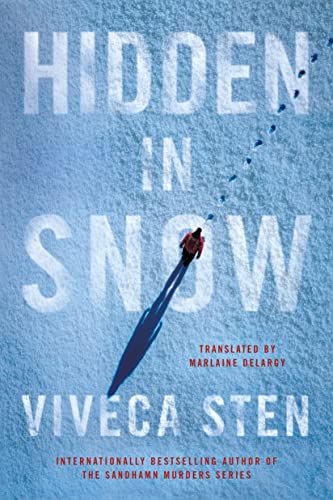
2026/058: Hidden in Snow — Viveca Sten (translated by Marlaine Delargy)

All these fucking men, exploiting vulnerable women. [p. 386]

First in a new series of crime novels set in the Swedish town of Åre, a quiet ski resort surrounded by mountains and forest. Hanna Ahlander's life has imploded, both professionally and personally: her boss has 'sent her home to think things over' and clearly wants her gone, and her boyfriend has broken up with her -- leaving her homeless. 

Salvation comes in the form of her sister Lydia, who suggests that Hanna spends some time at Lydia's lodge in Åre. Hanna finds herself helping the local police with a missing-person case, a young woman who disappeared on her way home from a party. She works with Detective Daniel Lindskog, who's recently become a father (though seems to prioritise his job over his family). Soon, she's asked if she'd consider transferring to Åre...

There were some interesting themes here -- the influx of migrants in Swedish society, the multiple ways in which men abuse and prey on women, the grandeur of nature -- but I disliked both Hanna (who takes a lot of risks, not all of them legal) and Daniel (who is prone to fits of rage, can't deal with the press, and keeps complaining of the effort of fatherhood while his girlfriend is left to do almost all the work). Sten's prose style (at least in translation) failed to engage me, and I wasn't a fan of the 100+ short chapters. I also felt that there wasn't enough foreshadowing of the villain: and I wasn't a fan of opening with the discovery of a body, in a flash-forward, before introducing the characters and the missing-person case. One last niggle: Hanna's ex is (justifiably) furious that she destroyed his clothes and shoes before leaving. He's threatening to report her to the police. But she has a minor car crash, and 'when he heard about the accident, all his anger melted away.' Yeah, right.

Oh, and the Kindle edition has some weird formatting -- place names in bold italic...

Lovely wintry atmosphere, great sense of the dangers of the natural world: but I would prefer it without these people in it.

Wednesday, April 08, 2026

2026/057: You Dreamed of Empires — Álvaro Enrigue (translated by Natasha Wimmer)

It never occurred to them, of course, that half the sauces of the dishes they had just eaten were moderately hallucinogenic, and thus their delectable sense of relaxation was in truth a welcome to the esoteric between-place where the Colhua permanently resided. [loc. 278]

I had been expecting a fictionalised account of Hernán Cortés' 'conquest' of Tenochtitlán, the capital of the so-called Aztec empire. (Enrigue points out that the inhabitants 'identified as Tenochca, the descendents of Tenoch': 'Aztec' is lazy shorthand by 19th century historians.) My expectations were subverted, exceeded and left by the wayside, for this is a manic and unpredictable novel: set on a single day (9th November 1519) when Cortés and his soldiers enter Tenochtitlán and meet Moctezuma.

Cortés, here, is less a conquistador than a slaver and pirate. His intentions have been overtaken by ambition, and by the support and influence of the local tribes. He has no idea whether they will be allowed to leave the city (which is a Borgesian labyrinth of corridors and rooms), and he doesn't realise that Moctezuma is less interested in the Spanish than in the cabuayos they rode in on. Moctezuma, meanwhile, is permanently high -- his shaman somewhat exasperated by his craving for more hallucinogens -- but sharp enough to deal conclusively with vexing family matters as well as with his barbaric guests.

Enrigue has immense fun with the scenario. He switches tenses, shifts focus, editorialises from his twenty-first century perspective, and has Moctezuma hearing T Rex's 'Monolith' -- perhaps what Enrigue was listening to himself, when he wrote.

I love this room, said Moctezuma, you can’t imagine how I miss being a priest. Where there were splotches of blood, he saw sprays of flowers. The withered fingers of the hands of great warriors sacrificed during the year’s festivals swayed pleasingly like the branches of a small tree to the beat of some music he couldn’t place, though in a possible future we would have recognised it. It was T. Rex’s ‘Monolith’. [loc. 1886]

(The lack of quotation marks, indeed of any conventional marking of speech, is a quirk of style that made me pay more attention to who was speaking, rather than on the rhythms of dialogue.)

You Dreamed of Empires strays far from the usual remit of historical fiction, but it's gloriously counterfactual and immense fun, vividly described (for instance, the reek of dried blood from the priests who sit near Captain Jazmin Caldera at dinner; the difficulty of cutting one's toenails with a dagger; the shadows cast by floating flowers in a pool) and exuberantly revolutionary.

Tuesday, April 07, 2026

2026/056: The Luminous Dead — Caitlin Starling

“That was the look of somebody resigned to being the monster they knew they were.”

Gyre lives on Cassandra-5, a planet with immense mineral wealth but little else to commend it. She takes a contract to explore a particular cave system -- dangerous, because the caves are often collapsed by native beasts called Tunnellers -- which will pay enough money for her to get off-world and search for her mother. She's been surgically fitted into a life-support suit, and she expects to find a full team supporting her by comms. Instead, she gets a single person: a woman named Em.

Neither Gyre nor Em has been wholly honest. Gyre's lied about her experience: Em hasn't revealed the true purpose of the mission, or the number of failed (and fatal) attempts already made. But it's Em who's in the position of power. She can order Gyre's suit to dispense drugs, sedating her: she can even manipulate the suit remotely, dragging Gyre along.

In the darkness of the caves, Gyre keeps feeling that she's not alone. That she's being watched. And she catches glimpses of things that can't be there -- that Em assures her aren't there. But she can't trust Em...

This is an immensely claustrophobic novel: Gyre imprisoned in her suit, unable even to touch her own skin; repetitive conversations between Em and Gyre; the physical dangers of the cave, and the possibility that Gyre has been exposed to something psychotropic. Gyre has no friends, and only the memory of her mother to motivate her. Em is an orphan, who's sent many to their deaths and seems likely to do the same to Gyre.

I found this slow, and often repetitive. There are only so many sumps Gyre could swim through before it felt tedious: there are only so many arguments that Gyre and Em can have about the earlier expeditions, and about whether Em is telling Gyre the truth. Perhaps if I had read the ebook rather than listening to the audiobook (excellently and emotionally read by Adenrele Ojo), I'd have skimmed... Psychological horror, in a science fictional setting, with just two characters: it's a bold debut, despite its flaws. I'm interested to read more by Starling.

Monday, April 06, 2026

2026/055: The Weaver of the Middle Desert — Victoria Goddard

She could weave those falling descants, those trilling calls, those infinitely varied notes into her work. Could she weave sound and silence together, craft a curtain that would keep a tent silent or hold the songs of mourning or merriment within its folds? [loc. 530]

Arzu is the eldest of the three daughters of the Bandit Queen, desert nomads whose world is strongly reminiscent of the Arabian Nights. Her younger sisters, Pali and Sardeet, have each had a novella to themselves (I find that I haven't read Pali's, The Warrior of the Third Veil), so it's Arzu's turn. But she is not as young nor as ambitious as her sisters. She's already happily married to a man of the clan, and her magic is founded on the gentle arts of weaving and threadcraft.

Nevertheless, when Pali -- back from warrior training -- suggests that they visit Sardeet, Arzu is happy to embark on the journey. It turns out that Sardeet's second husband is almost as awful, in different ways, as her first, and additionally has gone a-roving. The three sisters climb a magic beanstalk to find him...

This was sweet but slight: just what I needed, halfway through an unsettling and claustrophobic novel. It's really nice to find a fantasy protagonist whose ambitions compass home and family, who is happy with who and where she is. Pali will always be heroic: Sardeet will always be beautiful (and perhaps a little too trusting): Arzu... I think her gift is happiness.

Saturday, April 04, 2026

2026/054: Zennor in Darkness — Helen Dunmore

... he will cry out against Frieda if she dances in the wind with her scarf flying above her like a banner. She dances for pure joy, but the war does not recognize that kind of dancing. It knows that she’s twirling her scarf in a prearranged signal to the U-boats lying out offshore, waiting. [p.128]

This was Helen Dunmore's first novel, and some of her tropes and traits are visible: sexual tension within the family, arresting images of the natural world, the inexorable force of gossip and rumour. The setting is Cornwall in 1917, a village near Zennor: D H Lawrence and his German wife Frieda have taken a cottage there, and Lawrence is trying to farm, and to maintain his anti-war stance.

The focal character, though, is Clare Coyne, only daughter of Francis Coyne: she keeps house for her widowed father, paints illustrations for his book on wild flowers, and spends what time she can spare with her friends Hannah and Peggy. As the novel opens, the three girls are eagerly awaiting the return of John William, Hannah's brother and Clare's cousin, who's on leave from the trenches because he's going to be made an officer. Clare is secretly in love with John William.

The novel moves between viewpoints, predominantly Clare, Francis Coyne (a prurient man who, unknown to his daughter, is having an affair with a local woman, and also keeps thinking about Hannah and her Sam making love on the beach), Lawrence himself, and Frieda. Lawrence is a keen observer of the natural world. He meets Clare when she's out sketching plants, and introduces her to Frieda in the hope that the two will befriend and support one another. But after John William has been and gone, everything changes.

A novel about women, and men, in wartime, and how war warps and wrecks everything. Lawrence's Utopian schemes, Clare's hopes -- and the hopes of a million girls like her -- of marriage, Frieda's loneliness and anger, John William's despair at the slaughter. I really disliked Francis Coyne by the end of this novel: I felt very sorry for Frieda (whose cousin, I learnt, was the Red Baron himself, Manfred von Richthofen) and I admired Clare's intelligence, composure and passion. 

Dunmore's prose is a delight, full of surprising imagery ('larks scream as though they had thrown themselves against the sky and stuck there'): I knew her slightly, a friend of a friend, and wish she had lived longer and written more.

Wednesday, April 01, 2026

2026/053: How to Fake it in Society — K J Charles

"...in effect, you must paint what you see, and not what you know to be there. Because what we see and what is there are not always the same thing. I suppose it is important to learn that." [loc. 2026]

My initial mini-review is here: I reread the novel for this full review and can confirm that it is still an utter delight.

Titus Pilcrow is a colourman, a maker and supplier of paints and colours for artists. As the novel opens, he is in despair, because his landlord (also his ex) is evicting him. By a stroke of fortune, the client he visits that afternoon has a once-in-a-lifetime offer for him: she's on her deathbed, after a suspicious accident, and she wishes to marry to deprive her unpleasant nephew of her fortune. She has the license ready, because she was planning to marry a French count -- but he's AWOL, so Titus will suffice. 

The deed is done, Mrs Pilcrow (nee Whitecross) is dead, and Titus finds himself in possession of eight thousand a year and a plethora of conmen, beggars, representatives of charities, and other ne'er-do-wells who presume, correctly, that he has no idea how to handle his new-found wealth.

Enter Miss Whitecross's intended: Nicolas-Marc, Comte de Valois de La Motte, exquisitely dressed and outrageously handsome, and more than happy to assist Titus in refreshing his wardrobe (Titus likes bright colours, and Nico persuades him to indulge himself), entering Society, and dealing with importunate friends, relatives and hangers-on. Nico tells Titus that he is hoping to restore his mother's reputation after the scandalous Affair of the Diamond Necklace.

This, regrettably, is a lie. Nico and his beloved cousin Eve are down on their luck, pursued by brutal gangsters for a loan they can't repay. Yes, his first thought was to swindle Titus: no, he didn't expect to like him.

Titus, meanwhile, is not stupid. He is fairly sure that Nico wants something -- and Titus, a decent bloke, is happy to grant it, whatever it may be, in exchange for the pleasure of Nico's company. Nico is kind, and witty, and protective: Nico helps Titus stand up to both his ex and his older brother, and exacts vengeance on those who abuse Titus's good nature. He may be a criminal, but he is also a decent bloke.

This was a highly enjoyable novel, with a setup worthy (and reminiscent) of Georgette Heyer, a satisfying amount of technical detail about 19th-century paint and dye technology, and vivid, witty dialogue. There was a genre-typical 'dip', shall we say, near the end, but I was confident in the author's ability to resolve it in a credible and dramatic manner -- which she did, with a definite emphasis on the dramatic. 

I don't think this novel would have worked as well as it did without the dual viewpoints: it did mean that the reader knew more than the characters, but that's better than knowing less (as in, for instance, Any Old Diamonds). And I loved the supporting cast: Eve in particular, who deserves a novel of their own, and the Thorpes who keep house for Miss Whitecross and then Titus, and Titus's nicer brother Vespasian.

Thanks to the publisher and Netgalley for the advance review copy, in exchange for this full honest review. UK Publication Date is 30 April 2026.