Saturday, July 31, 2021

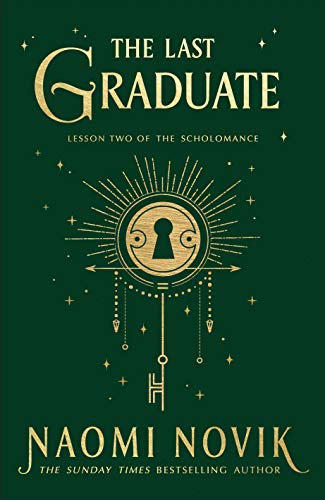
2021/091: The Last Graduate -- Naomi Novik

The only teachers in here are the maleficaria, and they don't have pets, they have lunch. [loc. 334]

Second in the now-a-trilogy that began with A Deadly Education, The Last Graduate starts where that book ended: in the cafeteria of the Scholomance, with a horde of freshmen still reeling from their magical arrival at this wizardly school that hangs in the void, and El and her friends now the senior class. Which means that, in just under a year, they'll be braving the Graduation Hall (did their attempt to fix the cleansing system work?) and the maleficaria that lurk there.

Though this year might be different. El slowly realises that the Scholomance is focussing on her, giving her a challenging schedule and a group of freshmen to protect, and channelling mals in her direction. Is it trying to nudge her towards the dark destiny she's struggled not to fulfil, or does it have another agenda?

El's classmates are realising just how powerful she is, and she's tentatively forming more alliances and friendships. Her relationship with Orion Lake, the insanely powerful mal-hunter who actually gains mana from killing maleficaria, is also developing. (El's familiar, a small white mouse, does not approve of Orion, and nor does her mother. El keeps telling herself that she doesn't approve of him either.) Orion has grown up both lauded and exploited: valued for his power, taken for granted by those who expect his protection and barely lift a finger to help themselves. El, no stranger to being isolated by her powers, begins to recognise how much damage his upbringing has caused. And she is increasingly uncomfortable with an educational setup that rewards selfishness and murderous intent.

Meanwhile, there are rumours of catastrophe from the outside world, which serve to make the students even nervier, uttterly ignorant as they are of current affairs. Even while she's tentatively planning life after graduation, El is unsure what she'll find when -- if -- she makes it out of the doors of the Graduation Hall.

I enjoyed this very much, though I noted a couple of plot points that could (maybe should) have been foreshadowed in the first book (for instance, the school's motto). It felt more hopeful than the first volume, with a strong theme of change, solidarity, revolution. El is maturing, less prickly and more receptive to overtures of friendship, and her relationship with Orion is changing them both. I enjoyed the friendship between El, Aadhya and Liu, and the shifting feuds and alliances of the senior class. The worldbuilding is lavishly detailed (El does like to digress) and the moments of beauty in a grim and dangerous setting add poignancy to the sheer grind of survival.

This book ends on an appalling cliffhanger, and now I have to wait until next year to find out whether that last spell worked ... and whether we've seen the last of some characters.

Thanks to NetGalley for the free review copy, in exchange for this honest review.

Tuesday, July 27, 2021

2021/090: Mend the Living -- Maylis de Kerangal (translated by Jessica Moore)

He likes his shifts, Sundays and nights ... He likes their alveolar intensity, their specific temporality, fatigue like a surreptitious stimulant that gradually rises through the body, accelerates and makes it sharper... likes their vibratile silence, their half-light – devices that blink in the dimness, blue computer screens or desk lamps like the flame of a candle in a La Tour painting – The Newborn, for example – and again this physicality of the work, this climate of an enclave, this watertightness, the department like a spaceship launched into a black hole, a submarine plunging into a bottomless chasm, The Mariana Trench. [loc. 234]

I wishlisted this book in 2016 following a fascinating review in the Guardian; five years later, I decided to purchase and read as part of my non-fiction diet; only very gradually did I realise that Mend the Living is actually a novel. In my defense, my limited experience of translated French nonfiction has been strikingly poetic: "Atoms in stars speak to atoms in eyes using the language of light" ... and Mend the Living won the Wellcome Book Prize, which I thought was for non-fiction ... and though some covers say 'novel', mine didn't ...

It's the story of a young man's heart. Simon Limbeau goes surfing with his friends one winter's morning: on the way home their van crashes, and Simon arrives at the hospital in a coma. His brain has ceased to function, but his heart still beats. His appalled parents are told that they have to decide whether his heart can be donated for transplant: they must decide quickly, for there's a narrow window of time during which the process can be carried out.

This is a beautifully-written book, with language that is joyous and intense and often very technical. (I found translator Jessica Moore's Afterword intriguing and thought-provoking, a fascinating personal account of the challenges involved in translating "the streaming realm of long sentences and what Maylis has called a “language hold-up” (braquage du langage) – an inventive use of rare words and concrete vocabularies." [loc 2844]). The narrative touches on the lives of many affected by Simon's situation: his divorced parents, the nurse who tends his still-breathing body, the head of organ donations, medical technicians, the transplant surgeon, the intended recipient of the heart. There are precise descriptions of medical matters (I did not know that transplanted hearts are sometimes stitched onto the original heart) and achingly credible accounts of interior emotional landscapes. I found myself rereading some of de Kerangal's intricate paragraphs, for instance the metaphor of a massive landslide for the irrevocable change, the before-and-after, experienced by Simon's mother Marianne.

This is a beautiful and strangely uplifting novel, the story of twenty-four hours in a mosaic of the individual lives affected by Simon's death. It makes the ordinary extraordinary, almost mythic, and celebrates the intricate connections of those who give Simon's heart a second life.

Sunday, July 25, 2021

2021/089: Sorceress -- K L Noone

...a ghost of the young man he’d once been, before the deliberately constructed rumors and perilous persona: the boy who’d defended his kindhearted impractical younger brother through the years... [loc. 271]

A short story rather than a novella: this was a very quick read, which I'd have liked to be longer. Read within an hour of finishing Magician, which I enjoyed enough to search out, purchase and read this prequel.

Lily is raising a child by herself, living in poverty and constantly exhausted. She learnt magic from the infamous Lorre, the world's greatest magician, but he's vanished and left Lily and his daughter to survive as best they can. Lily does not welcome the arrival of the king's disreputable bastard brother, Will, who hauls her (and baby Merry) off to the palace. The king is afflicted by some frightful magical illness, and Will -- despite his bloodthirsty reputation and well-known ambition -- doesn't want his brother to die.

I liked the tension between Will and Lily: Lily herself is a great character, independent and gifted and very human, and her frustration was wholly relateable. If Noone ever decides to tell more of her story, I'm keen to read it.

2021/088: Magician -- K L Noone

Magic shivered and scurried and sang along all the strings of his being: little swinging swaying bolts of light reached out to other lights, caught the threads of the universe, wanted to play. [loc. 315]

This was just what I needed on a muggy summer Sunday: a sweet, comfortable, low-conflict romance between a powerful but reclusive wizard and the young prince who's come in search of magical help.

Lorre has exiled himself from human society and lives on a tropical island, changing shape as the whim takes him and enjoying his separation from the human race. Here, he can't shift the balance of power, or harm anyone, or disturb the world. Sometimes people come looking for him, but he never lets them find him. Until Prince Gareth shows up, talking to thin air (of course Lorre is listening) and reading a novel and generally being optimistic, pleasant and charming. Also very handsome, which does not harm his chances of persuading Lorre to help him against the magical coldness afflicting his homeland.

Lorre's magic, his integration with the world around him, reminded me somewhat of Patricia McKillip's wizards. He's centuries older than Gareth (and possibly functionally immortal) but, frankly, does not act his age: the difference in their life experiences is written as a fascination with each other's histories, rather than a cause for incompatibility. Lorre has acquired a fearsome reputation, but he's always tried to do the right thing, though sometimes his temper has got the better of him: Gareth has read all the stories, and there's an element of hero-worship (in both directions -- Gareth is the archetypal hero) which is leavened with plenty of humour and common sense.

I especially liked how comfortable this novel felt: the stakes are moderately high but there's little peril, few confrontations and no major miscommunications. Lorre and Gareth are both likeable characters, and their growing attachment to one another is thoroughly believable and very sweet.

I hadn't read the prequel story, Sorceress, in which Lorre's history (as a dragon, and a somewhat inadequate father) is seen through the eyes of his former lover, but I didn't feel that my experience of Magician was lessened by this omission: I did buy and read it immediately after finishing the novel, though. Review soon!

Thursday, July 22, 2021

2021/087: Under Another Sky: Journeys in Roman Britain -- Charlotte Higgins

I think of Roman Britain above all as the place where these islands were begotten in writing. In a landscape that vibrates with stories, where every crag and moor, city and suburb, wasteland and industrial tract has been written into being, the Romans were the first to mould the land in prose. If it is to medieval literature that we owe the idea of Britain as a busy and productive and domesticated land, a ‘fair field full of folk’, then it was the Romans who first made it wild, a land of sudden mists and treacherous marshes, a territory of mountains and impassable rivers. [loc. 3652]

The title comes from Tacitus' account of a speech by Boudica: 'we Britons are cut off from all other men by the Ocean such that most people believe we live in another world, under another sky' [loc. 665]. Higgins spent some time travelling around Britain in a camper van, visiting Roman ruins and reflecting on the people who lived there, and the people who have written about the Romans over the centuries since their departure.

I was moved to read this after a reread of Gillian Bradshaw's excellent and evocative novel Island of Ghosts: I've been interested in Roman Britain since I discovered Rosemary Sutcliff in the school library, and am pleased to find my joy in Sutcliff shared by Higgins. ("The Eagle of the Ninth speaks deeply of its time of writing, during Britain’s post-war era of decolonisation. Reading half a century on, when the the imperial age is viewed in a more critical light, Sutcliff has Esca relate to his master in a way that we might now find troubling." [loc. 1253]) Higgins is very good at showing the past through the filters of different times and cultures: the outrage -- admittedly in the comments section of a Daily Mail article -- when a Roman woman's remains showed she'd been African; the various interpretations of grave goods by antiquarians; the stories that grew up around ruined Roman buildings.

She's an erudite and entertaining writer, and the book is replete with anecdotes about misread curse tablets, troops gathering seashells, the Roman mythologisation of Caratacus and Boudica. She discusses the Romanisation of the British, and the lack of barbarian hordes north of Hadrian's Wall. (I hadn't known that the Wall was originally thought to be the work of Severus.)

A fascinating read, containing accounts of many sites I've visited and some splendid landscape-descriptions. (For instance, the description of the oil refinery at Grangemouth: "Monstrous pipes vermiculated their way around structures made on no human scale.") It made me want to go and wander around ruins myself: it made me want to go out into a historic landscape and consider it.

Wishlisted in about 2014, when I first read reviews of the book: purchased and read this year as part of my non-fiction reading diet.

|

Friday, July 16, 2021

2021/086: A Marvellous Light -- Freya Marske

"We don't know how many men -- er, or women -- are involved."
"They're men ... if even a single woman was involved, they wouldn't have decided that a man who'd been working there one day was a more likely source of information than a woman who'd been there for years." [loc. 4104]

A Marvellous Light is the first in the 'Last Binding' trilogy, set in an alternate Edwardian England. Civil servant Robin Blyth, recently become a baronet after the (unexplained) deaths of his socialite parents, finds himself appointed as Assistant in the Office of Special Domestic Affairs. His first morning in the job is an eye-opener, as he encounters not only a lady civil servant of Indian origin -- the marvellous Adelaide Morrissey -- but the prickly Edwin Courcey, his liaison to the Magical Assembly. Courcey is a very minor magician, but yes: magic is real. And as Robin makes his way home, he falls victim to a rather darker enchantment than the snowflake conjured by Courcey: a curse is laid on him by men who believe the prior holder of his office passed on a vital secret ...

Afflicted and frightened by the curse, Robin accepts Edwin's invitation to his family home, where he meets Edwin's appalling siblings, narrowly escapes drowning, visits a charming country house with a murder maze, and begins to realise that he's attracted to Edwin -- and that it's mutual. Cue the 'can you help me with my cufflinks?' ploy, which felt like a deliberate shout-out to K J Charles' excellent Think of England.

A Marvellous Light focusses on the romance, though it doesn't ignore the magical mystery. There are themes of consent (both magical and sexual) and of confidence and its lack. Edwin and Robin, despite their shared tastes in pornography, are very different people -- the former a dedicated scholar, accustomed to hiding everything that matters beneath layers of emotional armour; the latter a hearty athletic type with a strong protective streak -- and their growing regard for one another is expressed as much in mutual support and encouragement as in romantic gestures. Their nascent relationship is inextricably entwined with, and affected by, the secret which Reggie Gatling (the previous Assistant in the Office of Special Domestic Affairs) died to keep.

That, by the way, is something that the reader knows (courtesy of a rather gruesome opening scene in which Reggie meets his end) but the characters don't: given that for much of the book there's discussion of how frightfully out of character Reggie's disappearance seems, this was unsettling. Though of course foreknowledge is an endemic issue in historical fiction: we recognise that the 'something terrible coming', feared by the Magical Assembly and by the villains alike, is very probably the First World War.

There are several characters I'm hoping to see in subsequent volumes: rude and arrogant Hawthorn, Edwin's ex; Adelaide Morrissey's sister Katy; Edwin's mother, afflicted by an unspecified malaise; Robin's sister Maud, who is keen to study at Newnham. And I look forward to seeing how the elements of the Last Contract are revealed and reunited ...

Reread for this review, and it's just as delicious the second time around. Thanks to NetGalley for the free copy, provided in exchange for this honest review.

Thursday, July 15, 2021

2021/085: Mauve: How one man invented a colour that changed the world -- Simon Garfield

Industry had shown Victorian chemists what was possible, and now nothing seemed beyond achievement; an eighteen-year-old had created a new shade for a woman’s shawl, and the full force of chemical ambition was unleashed. [loc. 1044]

Framed as a biography of William Perkin -- who in 1856, aged 18, synthesised an aniline dye while attempting to make artificial quinine -- this book also provides an overview of the history of chemical dyes, the tension between pure and applied science, and the machinations of fashion.

Mauve was one of the first of the books dealing with a single significant substance, innovator or phenomenon: dust, foam, rats, cod, salt ... I was pleased to find it on Kindle Unlimited (though vexed by the large bold type used for footnotes) and found it an interesting read, with the chemistry explained in comprehensible terms. Garfield touches on the medical properties of various dyes, something I'd like to read more about: I wonder if there might be connections to folkloric beliefs that particular colours were apt treatments for specific diseases (red hangings for smallpox, for example.)

If I have a criticism, it's that some of the content is only tangentially related to Perkin and his work: there's an account of the murder of wrestler Dave Schultz by John Eleuthère du Pont (scion of the company which had been a major producer of chemical dyes) which is tied into the main narrative by a mention of Schultz's red and mauve leotards.