Wednesday, December 30, 2020

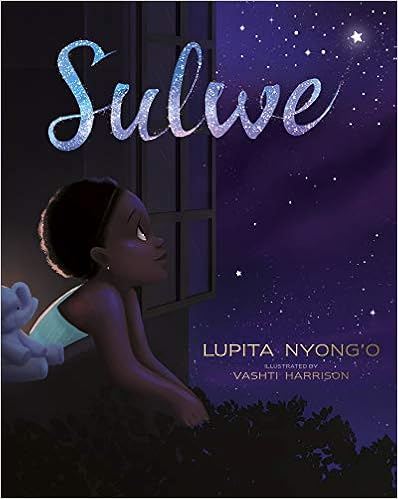
2020/154: Sulwe -- Lupita Nyong'o (illustrated by Vashti Harrison)

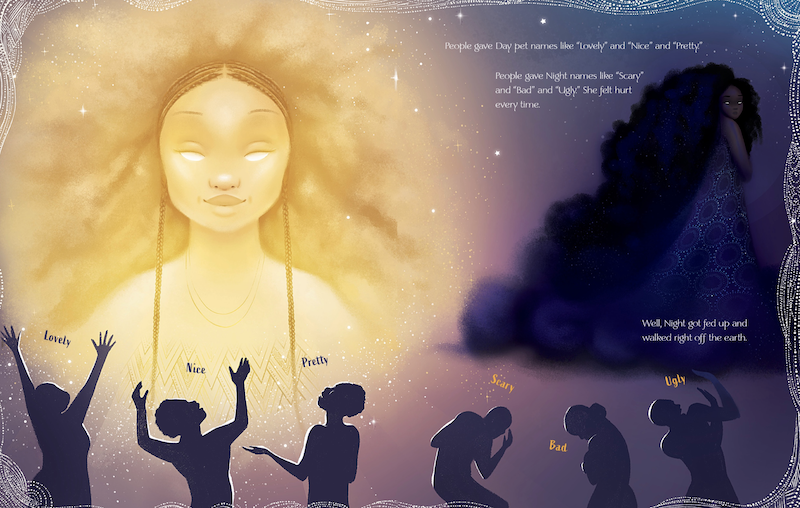
The story, written by actor Lupita Nyong'o, is about a little girl named Sulwe, whose skin is darker than anyone else's in her family, and who is teased and called names -- Blackie, Darky -- at school. She longs to be paler, and tries a number of methods to lighten her skin, such as eating pale-coloured food and using makeup. Then a star comes into her room one night and takes her on a journey exploring the origins of Night and Day, cosmic sisters who are beautiful in their different ways. As her mother has told her, the beauty within is as important as external beauty, and darkness has its own beauty. Sulwe accepts her dark skin and her own beauty.

Beautifully illustrated: Sulwe is shown with very expressive eyes, and the different skin tones are rich and varied. The mythic tale of Day and Night has a distinctly African flavour, and the whole book has deep, vivid purple and blue tones. In an afterword, Lupita Nyong'o tells of the teasing she endured because of her own dark skin, and reinforced the message that 'it's important to feel good about yourself when you look in the mirror, but what is more important is working to be beautiful inside'. While I, a white woman, have not experienced prejudice based on my skin colour, I am thoroughly in accord with the message of 'beauty inside' and feeling good about your appearance.

Read for the 'Picture Book by a BIPOC Author' rubric of the Reading Women 2020 Challenge, concluding the challenge with a whole day to spare!

Tuesday, December 29, 2020

2020/153: Strange Weather in Tokyo -- Hiromi Kawakami (translated by Allison Markin Powell)

‘Tsukiko, do you know what that means, a “karmic connection”?’ Sensei asked in return. Something to do with chance? I ventured, after thinking for a moment. Sensei shook his head with a furrowed brow. ‘Not chance, but rather, destiny. Transmigration of the soul.’ [loc. 895]

Tsukiko is in her late thirties: she has a career, though we're never given any details about it, and lives alone. She likes to drink alone, too: one night, in her local bar, she encounters one of her teachers from high school. Forgetting his name, she refers to him as 'Sensei',

Slowly and without fanfare, the two become friends. They eat and drink together (there is a lot of eating in this novel, and it made me crave good Japanese food) and discuss their individual eccentricities. Sensei had a wife, but she left him: Tsukiko doesn't seem particularly interested in romantic or sexual relationships. Sensei likes to collect railway teapots: Tsukiko has an irrational loathing of a particular baseball team. Despite the difference in their age, despite the imbalance of their relationship, they are comfortable together. Tsukiko finally identifies the emotion she feels for Sensei as love, but seems content for that love to be platonic. She reflects that she's never really grown up: perhaps it's the love of a student for a teacher.

Strange Weather in Tokyo is a very slow novel. Objectively, nothing much happens. There is, though, a sense of hidden depth, and perhaps of changes occurring which Tsukiko cannot perceive. I found the relationship between the two protagonists somewhat unsettling, mostly because of the age gap and the sense that Sensei holds all the power. Because we seldom get any insight into Sensei's true thoughts and emotions, it was all too easy to overthink some of his apparently-random observations: about karma, about souls, about emotion affecting the weather.

The translation flowed smoothly, though I was confused by the way that some lines of dialogue were within quotation marks and others weren't. The final chapter was jarring: it seemed considerably weirder and more fantastical than the rest of the novel. Eventually I realised (from the copyright notices) that it was a wholly separate short story, 'Parade'. This could have been made clearer in the body of the text.

Overall, a gentle and often poetic novel that didn't quite work for me.

Read for the 'Translated from an Asian language' rubric of the Reading Women 2020 challenge.

.

Monday, December 28, 2020

2020/152: Hexbreaker -- Jordan L Hawk

...magic was an art and shouldn’t be degraded by capitalism, and definitely shouldn’t be used in service of the police. Easy for him to say, when he didn’t have to worry about being kidnapped off the street and forced to bond. [p. 24]

Set in New York in the 1890s, just before the consolidation of the five boroughs into New York City, Hexbreaker is the story of New York cop Tom Halloran (who has been concealing his witchy heritage, and his true identity, since tragedy struck nine years before) and cat-shifter Cicero (who, as a familiar, should -- in society's eyes -- be bonded to a witch). It can be read as a variation on the 'soulmate' theme: Cicero is still desperately hoping that he'll meet and be welcomed by his witch, the one he'll instinctively recognise, the one who'll magnify Cicero's own magic. He's aware, though, that not all witches are kind to the familiars they bond with. Tom, on the other hand, is keen to conceal his witch potential, lest his criminal past be brought to the attention of his superiors.

The romantic conclusion is a given, but it's how they get there -- and how they each make sacrifices for the other -- that makes this an interesting read. I liked the worldbuilding: the implicit history of familiars and witches (parallels with slavery?), the ways in which the magical and non-magical communities of New York intersect, the trade in licit and illicit hexes which drives the 'whodunnit' element of the plot. Also very enjoyable was the friction between Tom and Cicero: the former a tough no-nonsense patrolman who, in Cicero's assessment, is "rough. Uncultured. Says ‘ain’t’... doesn't even know who Oscar Wilde was", the latter a smooth sophisticated Italian-American, or sometimes a sleek and subtle black cat, who enjoys art and poetry and is at home in the queer community.

I confess I'm more interested in the worldbuilding than the characters, but that might simply be because the 'odd couple' trope (sophisticated/rough, openly queer/repressed, et cetera) is something I've read a lot of lately. This novel was just what I needed on a bleak day between Christmas and New Year, and I'll likely read more of the series when I need a similarly cheerful, engaging romance.

Sunday, December 27, 2020

2020/151: The Mere Wife -- Maria Dahvana Headley

It’s everyone, all the people of Herot Hall, the police and the babies, the men with their names all the same, the women with their perfect faces, all cracking and showing what’s underneath, what’s always been there, coarse fur and gaping maws, whipping tails, scales, claws and hunger, and teeth, and teeth, and teeth. [loc. 3616]

Dana Mills, a US Marine deployed in a desert country, is captured by enemy forces. Her 'execution' is televised: but, months later, she staggers out of the desert, amnesiac and pregnant. (Rape or consensual? She doesn't know.) The military are keen on discovering what really happened, but Dana escapes hospital/prison and makes her way back to the town where she was born. Which turns out to have been levelled, and replaced by the pristine gated community of Herot Hall. Dana holes up in an abandoned train station underneath the mountain that overlooks Herot Hall, and bears her son -- Gren -- and guards him as he grows.

Meanwhile down in Herot Hall, Willa, the wife of Roger Herot, circulates through the routine of meal plans, cocktail hours (the toast is 'to us, and people like us') and diets approved by her mother. Her son, Dylan, grows up with every luxury: yet it's the strange 'wild' boy from the mountain whom he befriends.

If some of those names resonate, it may be because The Mere Wife is a feminist reimagining of Beowulf, that Old English poem about monsters. Headley opens her novel with translations of terms used in the original: "AGLÆCA (Old English, noun, masculine): fighter, warrior, hero: AGLÆC-WIF (Old English, noun, feminine): wretch, monster, hell-bride, hag". Though these definitions are contentious, they highlight how the same qualities can be heroic in a man in monstrous in a woman. And the focal characters in this novel are the women. You can read the title two ways: Dana is the merewif, 'woman of the mere', living beside the underground lake; Willa is, to all appearances, merely a trophy wife -- until her son is threatened. Then she enlists the help of another former Marine, Ben Woolf, who can't help casting himself as the hero.

But who are the heroes and who are the monsters?

Lots to consider here: racism (Dana thinks her son will be othered, monstered, by the folk down the mountain because of his brown skin), social class, sexism, Willa hiding her ferocity beneath designer clothes and glossy cosmetics, Dana hiding her whole self in the darkness ...

The language of this novel is rich and bloody. There are some unpleasant and unsettling scenes, and there are moments of great beauty. I loved the contrast between Dana's first-person narrative, Willa's third-person chapters (external, because she is always, always under observation -- by her mother and her mother's coterie, by CCTV, by her internalised prejudices), and especially the first-person-plural narratives of a dog pack, a group of older women and (possibly?) the assembled spirits who live underneath the mountain.

Headley's translation of Beowulf has recently been published, and I'm very much looking forward to reading it and then rereading this novel. Which, if it's not clear, I enjoyed and admired: was moved by: has taken up residence in the dark recesses of my mind.
Saturday, December 26, 2020

2020/150: The October Man -- Ben Aaronovitch

‘This is all forbidden knowledge that was not supposed to be kept,’ I said. ‘Too much risk that other countries will know we kept it.’ [loc. 572]

In which the 'Rivers of London' milieu expands to include Germany, where Tobias Winter is working for the Abteilung KDA, the “Complex and Diffuse Matters” department of the federal police. Unlike Peter Grant in the London novels, Tobi is already an established practitioner, and his liaison (Detective Vanessa Sommer) is the wide-eyed innocent with the Harry Potter jokes.

I didn't find the plot or cast of this novella as immediately engaging as Rivers of London: Tobi is more reserved than Peter Grant, his Director is a shadowy figure, and Detective Sommer, while suitably wowed by the revelation that magic is real, didn't get to do much other than provide information about the wine-growing industry. (The crime under investigation is very definitely wine-related, though the plot became more convoluted as the story progressed.)

More interesting to me was the Research Department, which has 'several tonnes' of pre-war documentation in filing cabinets: it's deemed too dangerous to transfer to microfiche, let alone a proper database. That means that the German 'magic police' have greater resources than their counterparts in other countries: and it is also clear that Tobi's boss has been keeping an eye on Nightingale, the Rivers, and Peter Grant.

Not a bad read, but not as enjoyable for me as the main canon. And of course there was added piquancy, and sadness, at reading about European policing -- European lives -- on the eve of Brexit.

Friday, December 25, 2020

2020/149: Blackthorn Winter -- Liz Williams

"Old country types used to call them the People, which is a bit ironic, really, because they aren’t."
"What, you mean they aren’t human?"
"No, I mean they aren’t people. Not like you and me. Well, not like me, anyway. ... They’re all scraps and patches, bits of greed and lust and envy and spite. And some good things too, sometimes. But not often." [loc. 5736]

Blackthorn Winter, the second in the series (quartet?) that began with Comet Weather (one of my most enjoyable reads this year), is a very wintry novel: I'm glad I read it during the liminal days at year's end.

Again, the four Fallow sisters are brought together (for Christmas) and taken elsewhere -- and elsewhen -- by resonance and ritual, by their own loyalties and friendships, and by the requirements of those who have, in one character's words, 'stayed around to help'. It's a quartet of journeys that encompasses the Wild Hunt, the Green Children of Woolpit, the Maunsell Forts, the Mithraeum, and a number of London pubs. (Williams' descriptions of these made me tremendously nostalgic for the time before Covid when pubs were somewhere you could go at Christmas.) Oh, and I believe there's a nod to the Bridge Theatre's role-swapping Midsummer Night's Dream, which made me happy.

A plethora of the arcane, with new characters introduced and existing characters reimagined. I did feel that this volume wasn't quite as tightly plotted, or written, as Comet Weather: in particular, there was a lot of dialogue that could have been trimmed without damage to the plot. Much of Blackthorn Winter is set in London, and there were moments where the geography felt unclear, or perhaps dreamlike. (Also, there is no tube station in Peckham).

Despite those minor criticisms, I enjoyed this a great deal, and learnt a lot (Lincrusta, Austin Osman Spare, the temple of Nodens). And there was a lovely warm sense of familiarity, as though the author had visited places that I knew, and had the same responses to those places.

I am very much looking forward to the next volume(s) in the sequence, and to the resolution of some tantalising sub-plots.

Wednesday, December 23, 2020

2020/148: Strange Practice -- Vivian Shaw

... treating the differently alive was not only more interesting than catering to the ordinary human population, it was in many ways a great deal more rewarding. [loc. 90]

Dr Greta Helsing (her family dropped the 'van' when they relocated from the Netherlands to London in the 1930s) in the is a GP catering primarily to the supernatural community. Her friends, acquaintances and assistants include vampires (foremost among whom is Edward, Lord Ruthven, who insists that Polidori's novel is mostly libel); ghouls, witches, mummies ... and when another vampire, the self-tormenting Sir Francis Varney, is attacked by a group of men dressed as monks, Greta is called in to help. It quickly becomes apparent that the attack on Varney is connected with a series of gruesome murders that also have a religious aspect: the 'Rosary Ripper' is roaming London and nobody is safe.

This was a fun read, though I was vexed by the frequent Americanisms. (No, we do not refer to Dennis Nilsen as 'the British Jeffrey Dahmer', nor do we have blood drives or attorneys.) What Shaw does really well here is sketching an evolving social group, with new characters introduced into a comfortable community of friends and acquaintances -- all of whom are idiosyncratic individuals displaying a realistic spectrum of physiological and psychological issues, from Ruthven's deadly boredom to Varney's self-loathing to Fastitocalon's disregard for his own wellbeing.

This felt very much a character-driven novel to me. That's not to say that the plot is dull: there were moments where everything seemed hopeless for one or more of the characters, and moments when the villain (embedded in truly scary technology) seemed invincible. But these moments mattered because of their effect on Shaw's cast. The characters, and characterisation, kept me reading and incline me to seek out more in the series.