Thursday, April 30, 2020

2020/046: Frankissstein -- Jeanette Winterson

You have appeared in the pages of a novel, she said. You and the monster you created. I am the monster you created, said Victor Frankenstein. I am the thing that cannot die – and I cannot die because I have never lived. [loc. 2198]

In 1816, a young woman is spending time with her husband, her step-sister, her step-sister's lover and his doctor in an Italian villa. Confined by appalling weather (this is the Year Without a Summer), they challenge one another to write ghost stories ...

In contemporary, or near-future, America, Dr Ry Shelley is attending a conference on robotics and artificial intelligence. Ry, who self-defines as trans but is also non-binary ('what I am is not one thing, not one gender. I live with doubleness'), encounters Ron Lord, an unashamedly misogynist sex-doll producer whose attitudes are exaggerated enough to be caricature; Claire, an event facilitator who happens to be an evangelical Christian; Polly D, a journalist who's had an unfortunate technical issue with the default settings of a sex toy; and Professor Victor Stein, a charismatic figure with interests in machine learning, medicine and transhumanism. Victor is intrigued by Ry's method of aligning their physical reality with their mental impression of theirself: he is also uneasy about Ry's partial maleness. Nevertheless, theirs is one of the love stories herein.

Winterson's shifts in key, from Ry's narrative to Mary Shelley's, are impressive and sustained. The 19th-century chapters have a lyricism and bleakness to them that brings to mind Frankenstein and its author. The 21st-century chapters are faster-paced, with more dialogue and a great deal of philosophical discussion which frames the novel's climax, and (perhaps) bring the two strands of Frankissstein together. I'm still thinking about how the two stories join, and where Ada Lovelace and the madhouse patient fit into the overall picture ...

I confess I didn't really warm to the 21st-century characters, though Ry is an intriguing and sardonic observer, and an excellent foil for the extravagantly biased perspectives of Polly D, Ron Lord and Claire. The love story between Ry and Victor is fascinating: neither is quite able to accept the other as they are, or to trust them, and yet they are drawn together.

Read for the 'A Book from the 2019 Reading Women Award Shortlists or Honorable Mentions' rubric of the Reading Women Challenge 2020. I'd intended to read Frankissstein anyway, as it's a transformative work and I generally enjoy Winterson's fiction. This was no exception: it is vastly playful, thought-provoking and often very funny. From the reviews I've read, it's also very polarising: I did not find it transphobic or reductive, but your mileage may vary.

Is Donald Trump getting his brain frozen? asks Ron. Max explains that the brain has to be fully functioning at clinical death. [loc. 2301]

Tuesday, April 28, 2020

2020/045: The Mysterious and Amazing Blue Billings --Lily Morton

“I didn’t need to lie about anything, Levi. The reason it worked was because it wasn’t a con for me.” He smiles at what must be the confusion on my face. “I am psychic,” he says slowly, his wolf eyes steady and clear on mine. “I can see the dead.” He huffs. “I can also occasionally hear the fuckers, and worst of all, they keep trying to bloody talk to me.” [loc. 948]

Graphic artist Levi Black has experienced some major life changes recently: he's broken up with his long-term boyfriend, his mother has died, and he's left London to live in York, in the centuries-old house he's inherited. The problem is that the house has been empty for quite a while: within hours of crossing the threshold, Levi decides that he can't blame the previous owners. There are footsteps in empty rooms, an overpowering scent of lily-of-the-valley, windows and doors that mysteriously fly open ... Apparently a great deal of repair and modernisation will be needed before the house can become a home.

It doesn't help to hear a dashingly-handsome ghost walk guide describing Levi's residence as 'the Murder House'. Though it does give Levi an excuse to strike up a conversation with Blue Billings, who has a tragic past, an impecunious present, an affinity for ghosts, and blue hair.

This is a sweet M/M romance, with credible emotions and motivations for both characters, which is complicated by a century-old murder mystery and an increasingly nerve-wracking series of ghostly encounters. Blue's powers, though questioned by Levi, are real; Levi's intrinsic goodness, though mistrusted by Blue, is genuine and practical. There's a strong sense of place, too: the author clearly knows York well, and evokes the narrow streets and sense of history very effectively. Also, there is an excellent bookshop.

Despite being primarily a romance, there are some dark aspects to Blue's past, and to the house's history. Overall, though, a charming and often funny read.

Sunday, April 26, 2020

2020/044: Comet Weather --Liz Williams

Stella could see it now, the snow changing to white rose petals and drifting down onto the water. The oaks flushed a darker green with the heavy leaf of midsummer, not solstice but beyond, lammas-tide when the tides of the land grow slower and the days begin to darken and things begin to ripen and die. [loc. 3870]

Bee Fallow has been the guardian of the family house, Mooncote, since her mother Alys went missing a year ago. Mooncote is a rambling old house, with the ghost of an Elizabethan privateer in the orchard, and star spirits, extravagantly dressed and bearing flowers or herbs, appearing randomly. Bee's three sisters -- Stella the DJ, Serena the fashion designer and Luna the uprooted traveller -- are unfazed by these quiet magics, and are busy with their own lives. But the sisters find themselves drawn back to Mooncote as autumn fades and Lerninsky's Comet approaches. Can they discover their mother's fate? Who, or what, are the slithery Stare siblings who suddenly seem to be worming their way into the Fallow sisters' lives? And what will the comet bring?

That is a paltry summary of a rich and very English novel which I vastly enjoyed. The Fallow sisters, with their distinct personalities and passions, and their various reactions to the weird and unsettling happenings around them, are so vividly depicted that they felt like people I knew. There's a strong theme of place, of persistence and belonging, in the novel: the Fallows have lived at Mooncote for centuries, and there are others who have been in the area for much longer. The star spirits personify the Behenian stars, which was an educational insight into medieval astrology and astronomy: Alys' father, now dead, was an astronomer, and his influence is clear throughout the novel. The ghost in the orchard, Ned Dark, sailed with Drake -- and may do so again, for time is a mutable construct in Comet Weather. And, for someone trapped in an urban environment during lockdown, the evocative descriptions of woodland, coast and hills were tantalising as well as satisfying.

I was reminded of several favourite fantasies: Rob Holdstock's Mythago Wood and especially Lavondyss; various works by Diana Wynne Jones and Alan Garner; and, oddly, Gwyneth Jones' Bold as Love, perhaps because of the vaguely counter-cultural ambience. But Comet Weather is very much its own book: a story about the sometimes difficult relationships between sisters, about the perils of hunting thieves and of seeking help from old cold entities, about women making their own way in the world and reshaping that world.

There are a lot of intriguing loose ends here (not least American cousin Nell's purpose in the story), so I was overjoyed to read that a second volume, Blackthorn Winter, is due. But when, when ...?

Saturday, April 18, 2020

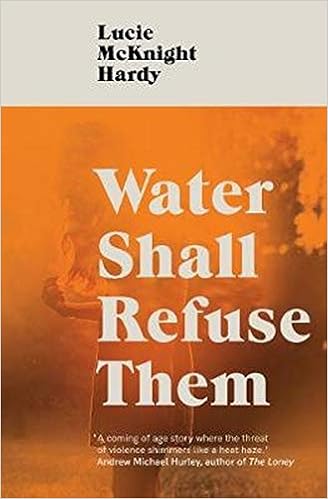
2020/043: Water Shall Refuse Them -- Lucie McKnight Hardy

The relics sat on the mantelpiece in the correct order: Robin’s egg, magpie’s egg, duckling bill and bone. Blackbird’s egg, feathers of wren…and then the space where the incantation should have continued. It niggled at me, the vacuum at the end of the rhyme an itch to be scratched. [loc. 342]

Nif (short for Jennifer) is sixteen, and looks after her four-year-old brother Lorry: their mother has withdrawn from the family after the death of Lorry's twin sister Petra, and their father, in desperation, has brought them all to an isolated cottage in Wales, for a change of scene and an escape from the suburban house where Petra died.

Nif is guided by the Creed: a kind of religion, embodied in a set of Relics which she has found (or which have found her) and demanding balance. If she breaks a cup with her right hand, she must break another with her left: if Lorry grazes one knee, he must graze the other too. Nif believes that by adhering to her growing understanding of the Creed, she'll wake up remembering the dream she dreams every night, about her little sister's death.

She becomes friends with Mally, a lad who lives in the next cottage and who, like her, is an outsider. The villagers hate Mally and his mother Janet, and blame them for an ancient visitation of the plague. Mally goes everywhere with his Polaroid Instamatic, photographing the unaware: he protects Nif from the village bullies, and tells her his secrets.

It's clear early on that Nif doesn't much care for the countryside: houses are 'clustered like flies on raw meat', sheep are 'tatty', the villagers flock and chatter like birds. But as the heatwave bakes the land, she becomes more at home in exile, and more extreme in her adherence to the Creed. Her parents, too, are changing: Linda, her mother, befriends Janet and accepts her potions and her gooseberry wine; Clive, her father, shapes and reshapes the bust of Linda that he's modelling until it barely resembles her at all.

The title can be read in several ways. This is a novel set in the summer of 1976, when England was stricken by drought, the earth parched and the rivers low. (In the novel, there's no water supply in the house: Nif has to fetch water from Janet's well.) Secondly, Nif's sister drowned in the bath. ("The accident," as Nif refers to it throughout.) And thirdly, per King James: "So it appears that God hath appointed, for a supernatural sign of the monstrous impiety of the witches, that the water shall refuse to receive them in her bosom".

I am edging around the core of the novel, Nif's practices, because I found them deeply unpleasant. This is folk horror at its strongest: much crueller than anything in Starve Acre or Little Eve. There are images in Water Shall Refuse Them that I fear will haunt me for years.

And yet, and yet: the cruelties are wholly in character, and Hardy's skilful depiction of Nif, shading from the 'good girl' who looks after her little brother to the vengeful, powerful Nif of the last pages, is pitch-perfect. Hardy's prose is rivetting and there's a splendid note of sullenness to Nif's voice. Wonderful writing, slightly too abrupt an ending, some scenes I wish I hadn't read.

Friday, April 17, 2020

2020/042: The Dinosaur Hunters -- Patrick Samphire

“I’m not killing them!” Dinosaurs were a rarity, confined by the Great Wall to this single peninsula, no larger than France on Earth. She couldn’t imagine why anyone would want to reduce their numbers any further.

“I know. But don’t you want a better look? We only caught a glimpse of that one by the stream. How many people can say they’ve seen a dinosaur close up?” [p. 49]

Steampunk-flavoured novella set on Mars in 1815. Napoleon won at Trafalgar, but the British Empire is steadfastly holding onto its Martian territories, its stiff upper lip, and its aristocratic traditions. Harriet George does not wish to fall prey to these, especially the one about being married off advantageously to save her family's fortunes: therefore, she must ensure that her hapless brother-in-law's latest police investigation, into the mysterious jewel thief known as the Glass Phantom, is a success.

But Bertrand is so very hapless...

Luckily Harriet -- or 'Harry', since she is of course masquerading as a boy -- is resourceful, brave, quick-thinking and perceptive. She and Bertrand join a party of dinosaur hunters (slaughtering innocent animals being another great aristocratic tradition) after a tip-off concerning the Countess von Krakendorff's famous ruby necklace. Any of the hunters could be the villainous Phantom. But meanwhile: dinosaurs!

I have to admit it was the promise of dinosaurs that lured me in, and they did not disappoint. But I also discovered a charming heroine, an intriguing steampunk setting, and a proper old-fashioned Mars. (And a pompous git pontificating on the 'savage' extinct Martians, and whether the fossils found on Earth bear any relation to the living Triceratops, etc, that he is hunting.) Great fun and very readable.

Sunday, April 12, 2020

2020/041: Abandon -- Blake Crouch

This is hell—the absolute loss borne from all those slivers of perfection that passed unnoticed, unrelished. [p. 513]

Abandon is a ghost town high in the Rockies. On Christmas Day in 1893, every inhabitant vanished, leaving half-eaten meals on tables, wine freezing in glasses, and Christmas gifts still wrapped. The town is, of course, rumoured to be haunted: there are also tales of hidden treasure.

A small expedition sets forth to explore. The party consists of two experienced guides, a history professor and his estranged journalist daughter, and a married couple who've lost their son and now have an affinity for ghosts and the supernatural. He takes photos, she senses the spirits of the dead.

Unfortunately there are other threats, much more substantial than ghosts: treachery is afoot, and a storm is blowing in. Abigail will discover not only the fate of the townsfolk, but the truth behind the stories. Whether she'll ever get to write about it is another matter.

Abandon was an uneasy blend of suspense, historical fiction -- Abigail's narrative alternates with scenes from the 1890s, when Abandon was a rough gold-mining town -- and action thriller. There is a lot of violence in both timelines, and some grim decisions to be made. And it definitely ends in a minor key (though I'm not sure it ever made it into a major key). A lot of loose ends, too, some of which were disappointing and some merely exasperating. At its best, the writing is precise and evocative -- though sometimes overreliant on period detail and slang -- which kept me reading. But it was not a cheering experience.

Saturday, April 11, 2020

2020/040: The Ten Thousand Doors of January -- Alix E Harrow

There’s only one way to run away from your own story, and that’s to sneak into someone else’s. [p. 92]

January Scaller, growing up as the ward of a wealthy industrialist in the first years of the twentieth century, is at once privileged and deprived. She misses her father, who roams the world collecting antiquities for Mr Locke; she never knew her mother; she endures a succession of nannies and tutors whose care for her does not extend to affection; and she is painfully aware that she is treated as a curiosity, set apart by the colour of her skin and the texture of her hair.

But January is already aware of the power of words. When she discovers a book called The Ten Thousand Doors she is drawn into the story of a man and a woman from different worlds who fall in love. And perhaps she has already glimpsed another world, through a ramshackle door standing alone in a field.

It took me a couple of tries to get into this novel: my initial, rather curmudgeonly, impression was that it was a fantasy novel for people who didn't read much fantasy! I think this is because it explores some of the tropes of YA fantasy: the lonely child who hides in books, the general oppression of that child, the discovery of a portal to another place ... January, though very young at the start of the book, becomes a likeable and determined heroine, defying society's expectations and refusing to accept her guardian's plans for her. She inspires loyalty in others, which is her salvation: she discovers her own abilities, and works to improve them.

And the story told here is larger than one young woman's coming of age and self-emancipation. There are doors between worlds, and doors are there to let things in: change, revolution, variety, magic. January wants to open doors: the conservative faction wants to keep them closed, to maintain the status quo and the patriarchal power of industrialists, colonists, oligarchs. Ranged against that faction are January and her allies: women, people of colour, scholars, wanderers, the displaced and dispossessed.

I especially liked the typographic elements (is that the right word?) of the novel: January's perceptions of the shapes of words, as well as their meaning. The capital V in Villain 'like dagger points or sharpened teeth'; 'that P, like a woman with her hand on her hip' ...

Sometimes I feel there are doors lurking in the creases of every sentence, with periods for knobs and verbs for hinges... [p. 6]