Wednesday, July 31, 2019

2019/82: Spinning Silver -- Naomi Novik

He would only shrug and look at me expand ectantly again, waiting for high magic: magic that came only when you made some larger version of yourself with words and promises, and then stepped inside and somehow grew to fill it. [loc. 6018]

Miryem Mandelstam is the daughter of a moneylender: she's much better at the job than her father is, and she earns the hostility of the townsfolk when she calls in their debts. Not all debts are paid in gold or silver, though, and Miryem engages Wanda, daughter of a violent drunk, to work for the Mandelstams until her father's debt is paid. Wanda is very happy with this arrangement, as it offers her the chance of independence, some power of her own.

Miryem turns out to be a canny investor, buying for silver and selling for gold. She earns her grandfather's approval -- and the attention of the Staryk, the magical, beautiful, predatory folk whose road encroaches on human lands, and whose presence brings winter. And the winters are getting longer and harder ...

Miryem and Wanda are two of the triptych of female protagonists: the third is Irina, a duke's daughter whose father intends her to make a good match despite her lack of beauty. She remembers the tsar as a cruel, cold boy, and is repelled by the notion of marrying him. But Irina has no power.

These three young women, and the bargains they make with powerful men -- the duke, the Tsar, the Staryk king -- are at the heart of Spinning Silver. It's based on the fairytale of Rumpelstiltskin, and unpicks some of the antiSemitism at the heart of that story. (Miryem is a practising Jew, and insists on celebrating Shabbat even when whirled away to a magical realm where there is no sunrise or sunset.) Spinning Silver has a fairytale sensibility, with Wanda's dead mother's spirit imbuing a white tree, with a witch's house that stands on the borders of two worlds, with the power of names. Like the witch's house, though, it is liminal, and reflective: demons and drunkards, glass castles and ghettos,a labourer worth her hire and a loyalty unearnt.

I wasn't wholly convinced by the narrative voices. Miryem, Wanda and Irena didn't read very differently from one another. Additionally, there are occasional scenes from other viewpoints, such as Wanda's younger brother and the tsar Mirnatius (who has supernatural problems of his own). But I did enjoy this novel, especially for its exploration of agency and free will.

Read as part of the Hugo Award Voters' Pack.
Monday, July 29, 2019

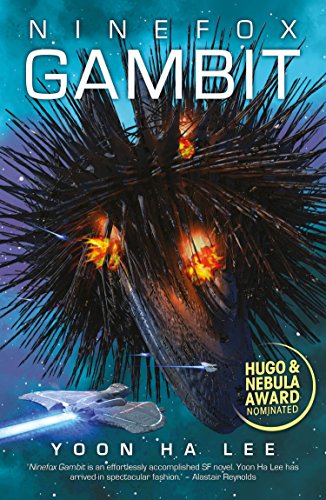
2019/81: Ninefox Gambit -- Yoon Ha Lee

He couldn't have justified this conviction, but he would have said that the numbers were numbers that mattered. Birthdays and festival days. A child's shoe size. The number of times a soldier visited a crippled comrade. The specific gravity of a favorite wine. The number of bullets left in a pistol. The distance from this siege to a childhood home, remembered but never visited. [loc. 3789]

Kel Cheris is a disgraced infantry captain whose mathematical prowess has attracted the attention of her superiors: she is offered the opportunity to compete for an opportunity to defeat a heretical rebellion. The heresy is calendrical, and the calendar is a system of beliefs and rituals, some unpleasantly bloody, which maintain reality and its applicable physical laws. Put simply, if a heresy becomes too strong, too popular, then voidmoths -- the hexarchate's name for interstellar vessels -- will cease to operate.

Cheris comes up with a winning solution: the Kel's greatest weapon, who is also a person, an undead general with an appalling reputation. Shuos Jedao has never lost a battle, before or after his death: he also slaughtered his own army and executed his staff in an inexplicable fit of insanity. His consciousness has been imprisoned in the black cradle for nearly four centuries, with occasional excursions -- attached to a living human anchor, possessing that human but unable to take control -- to win a war against the hexarchate's foes.

His next anchor is Cheris.

Ninefox Gambit is immediately confusing, with its heresies and factions and formation instincts and space moths, and I think I read the first chapter a while ago and didn't engage. Now, having read Revenant Gun (the third in the trilogy which opens with Ninefox Gambit), I found it much easier: I knew and liked the protagonists, I had some comprehension of calendrical rot, and I was aware of the long game that Jedao is playing.

Jedao reminds me, in some respects, of Mycroft Canner, the antihero of Ada Palmer's Too Like the Lightning and subsequent novels: an individual with a revolutionary plan who will commit atrocities to bring about reform. Jedao is flawed, lonely and brilliant, and he likes to play games. Cheris is initially more of a cipher, but she comes into focus as a sharp contrast to Jedao, and a vital part of a long-term plan. I found Cheris and Jedao, and their difficult, non-consensual relationship -- which evolves over the course of the novel, at least on Cheris' side, from revulsion to something like affection -- compelling and very human.

(Also, hurrah for a novel that does not feel it necessary to include romance and sex! Ninefox Gambit does some interesting things with gender and sexuality -- for instance, Cheris is a queer woman hosting the consciousness of a queer man -- but, aside from a flashback to one of Jedao's formative moments, sexual relationships are simply not relevant.)

Yoon Ha Lee's writing is slithery and evocative and full of seemingly-casual references that expose the horrors and wonders of the hexarchate. I like this book a lot.

Sunday, July 28, 2019

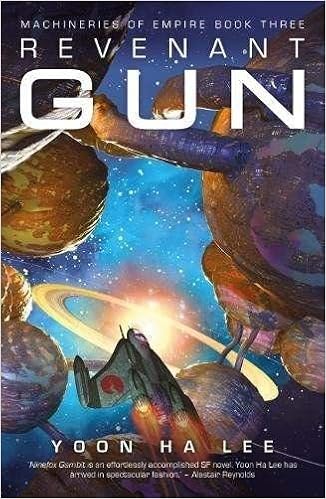
2019/80: Revenant Gun -- Yoon Ha Lee

Jedao said in astonishment, “I can’t feel the acceleration.” The station’s bulk, with its bewilderment of lights and angles and protrusions, dwindled behind them.
“Physics is for the weak,” Kujen said. [loc. 2366]

A young man named Jedao wakes up in a strange room, unable to recall how he got there. His friend Ruo isn't in evidence, and when somebody does show up, it's a beautiful man named Kujen, whose shadow is made of the shapes of fluttering moths. Jedao, apparently, is there to lead an army; he's not seventeen years old, but forty-four; and the reason he can't remember anything is that an enemy named Cheris made off with most of his memories.

Or so Kujen says. And in the absence of any other source of information ...

There is always a risk in diving straight in at the end of a trilogy. I had heard positive things about this novel, which is one of the six on this year's Hugo shortlist for Best Novel. I knew almost as little as Jedao at the start of the novel, and gradually picked up that there'd been a revolution, destroying the leaders (hexarchs) of most of the six factions; that this revolution had caused 'calendrical destabilization', which in turn meant that certain technologies no longer worked; that there are two opposing sides, the Protectorate and the Compact, and that Kujen wants him to lead a swarm of over a hundred warmoths. Though it's not clear who the enemy is.

Subsequent chapters flesh out the setting, and the situation. The calendar is something like a religion, involving sacrifices and torture and producing exotic effects that in places are queasily eldritch (for example, there's a weapon that causes eyes and mouths to appear all over the bodies of its victims). Perhaps it's the calendar which makes Jedao effectively invulnerable: he survives an assassination attempt that would surely have killed any normal human. His troops, despite the 'formation instinct' (another calendrical effect) which enforces loyalty, fear and hate him, and he is notorious for committing atrocities, which he cannot recall.

Interwoven with Jedao's narrative are others: politics and warfare between the Protectorate and the Compact, and a sentient, media-fan robot named Hemiola, formerly one-third of the residents of Kujen's secret base, follows someone who's not quite who they say they are and finds itself embroiled in an assassination plot of immense scope and ambition.

It's very hard to review this novel without spoilers for the previous books in the trilogy: suffice to say that I acquired and read those books (Ninefox Gambit and Raven Stratagem) as soon as possible, and will be reviewing them here soon. But the key thing is this: that the characters, human and otherwise, bewitched me, and the worldbuilding -- though sometimes fuzzy, almost dreamlike, in places (or perhaps in my understanding) -- is spectacular, and scary, and sideways. Revenant Gun explores issues of consent and free will, and illustrates them in a variety of ways, some of them vividly unpleasant. I can, to be honest, take or leave the military and political stuff: but the people, and their interactions, their flawed, messy, contradictory, desperate interactions, are utterly compelling.

Saturday, July 27, 2019

2019/79: Isolde -- Irina Odoevtseva

"I keep thinking how difficult and dreary life must be if childhood is as good as it gets. And if it’s all downhill from here, I don’t want to grow up.” She shook her head. “And, you know, I don’t think I ever will."
“Nonsense, Liza. It’s only because you’re fourteen." [loc. 1501]

Liza and Kolya's father, a naval officer, was drowned by his own men during the Russian Revolution. Their mother, who fled with Liza and Kolya to Paris, refuses to admit that she has children at all: they age her terribly. She insists that they call her 'Natasha' and 'cousin' when they're all together, which is not often, as Natasha has a lifestyle to maintain and a pair of lovers (well, one doesn't love her, the other she doesn't love) to beguile.

Liza is fourteen and has a boyfriend, Andrei, who's also a close friend of her brother's. On holiday at Biarritz, however, she meets and captivates English teenager Cromwell, who obligingly treats Liza and her brother to various luxuries, and introduces Liza to the story of Tristan and Isolde -- Cromwell himself, of course, in the role of Tristan. When Liza returns to Paris, she tells Andrei, the third point of the love triangle, that the fling is over. Andrei is unimpressed, but quickly warms towards Cromwell when the English youth arrives in Paris and showers largesse on all three of the Russians.

But Liza and Kolya are almost out of money, and Mama -- Natasha -- is on holiday again, and has no funds to spare. Can Cromwell save them? Can Liza rely upon any of the men she knows?

This novel, by a Russian emigre living in Paris, was written in 1929, the same year as Cocteau's Les Enfants Terrible: the two works explore some of the same territory, of absent parents and children who are too spoilt, or too naive, to respond to abandonment by assuming adult roles. In Odoevtseva's Isolde, however, the story takes place over a shorter timeframe, and the female protagonist is less manipulative. I felt compassion for Liza, though I did also find her selfishness and disdain offputting. The Paris she inhabits is a wintry, rainy spectre of the city I know: it could have been any big European city. Liza's memories -- half fantasy -- of Moscow are more vivid: no wonder she wants to return, to find somewhere to belong.

Isolde is really a very bleak novel: nobody comes out of it (or ... doesn't come out of it) especially well. Natasha is especially monstrous, but none of the adults are much use. The men are all determined to shape Liza -- one suggests that she pretend to be his daughter; another rechristens her Betsy and tells her she'll lose her Russian accent when they go to England -- and the women pay no attention to her.

I can't say this was an enjoyable read, but it was powerful, and the author's refusal to spell out exactly what's happening -- though she was still criticised for writing about teenage sexuality -- bestowed a lingering gloom, an air of shuttered rooms lit by firelight, of an empty facade behind the frenetic glitter of casinos, jazz and cocktails that Liza and Kolya so desperately crave.

I read this for the 'novel in translation, written before 1945' rubric of the Reading Women Challenge 2019 on Goodreads.

Friday, July 26, 2019

2019/78: Space Opera -- Catherynne Valente

The newborn and the dead and the long-suffering and the extremely well-traveled, the baby and the girl and the boys in the band and the wormholes—all of them singing the screamy bit like a song could save the world, roaring like lions and squawking like dodos and thundering like rhinoceroses and weeping like a man who died with a final mix in his hands and dancing like a kid wearing a hundred scarves and howling like an interdimensional wind tunnel of regret, belting it out with your future gurgling in your arms like sentient human goddamned beings. [loc. 3449]

Read as part of the Hugo voting pack: in short, Eurovision in Spaaaaaace! A tour de force of breathless cascades of prose, humour, invention and philosophy, freely acknowledging its debt to Douglas Adams, Space Opera is an extremely enjoyable read with some marvellous moments, a tragic poly love story, and a plethora of weird alien species (some of which feel more Banks than Adams).

The premise is simple. The intergalactic Sentience Wars -- fought over the question of what defines people, as opposed to meat -- have wreaked havoc everywhere (except Earth). In the aftermath, a more reasonable test of sentience has been developed: the Metagalactic Grand Prix, a pop music competition. The representative of the Prix appears simultaneously to everyone on Earth and explains the situation. Just don't come last, and your world will be preserved. And you'll need to pick an artist to represent you: here are some suggestions.

So all of humanity ends up being represented by two-thirds of washed-up glam rock band Decibel Jones and the Absolute Zeroes. (The third third, Mira Wonderful Star, is dead: the survivors, Decibel Jones and Oort St. Ultraviolet, are estranged, driven apart by Mira's demise and the discussion preceding it.) Dess has been living the rockstar life, albeit in Croydon, whilst Oort has been striving to be Englishblokeman, a caricature of normality. They haven't seen one another for years, and the tension between them adds an interesting counterpoint to the weirdness that awaits them at the Prix.

The prose is extravagant, the philosophical digressions (of which there are many) amusingly presented, and near-future Britain sketched lightly but bleakly (deportations, deprivation, riots et cetera). I didn't find the characters wholly emotionally engaging while I read, but I found myself thinking about Oort and Dess and Mira after I'd finished the novel: which is likely a sign that Valente sneaked in more characterisation than I noticed at the time.

A couple of minor quibbles: Piccadilly Square tube station? 'the gardenworld of Litost was a hefty journey of some sixty-five hundred miles' -- so, about the same distance from Croydon as Kuala Lumpur?

But these are minor quibbles.

I would happily read a sequel about Capo, Oort's cat, who gains the ability to speak and ends up being tested along with the humans. "I offer these temptations as a test of sentience... Whether you would sell out your homeworld or murder one of your new neighbors or let the rest of your species burn to save yourself." "I have to be honest, that all just sounds really fantastic to me," Capo meowed. "But if you could just do it for me, that would be brilliant." [loc 3010]

Thursday, July 25, 2019

2019/77: Beneath the Sugar Sky -- Seanan McGuire

"We’re teenagers in a magical land following a dead girl and a disappearing girl into a field of organic, pesticide-free candy corn," said Kade. "I think weird is a totally reasonable response to the situation." [loc. 1377]

Another novella: I read this as part of the Hugo shortlist pack. The premise of the 'Wayward Children' series is nice: the framing narrative is Eleanor West's Home for Wayward Children, a boarding school for children who've visited a fantasy world and returned, whose parents have sent them away 'for slaying dragons and refusing to say that they hadn’t'. In this volume, Rini arrives abruptly at the School, and discovers that her mother is dead -- indeed, that her mother died long before Rini was even conceived. In order to stay real, Rini and her new friends have to travel to different lands, including a Hadean Underworld and Rini's home, the land of Confection.

I hadn't read the first two novellas in the series: I might have got along better if I had. But I didn't like Beneath the Sugar Sky for several reasons. The most trivial, but the most immediate, was that I found it literally nauseating: Confection is a world which is made of sweets, rather like a three-dimensional cross between Candy Crush and Alice in Wonderland. I don't have much of a sweet tooth (good chocolate excepted), and McGuire's vivid descriptions made me queasy. (Or queasier, given that I read it on an extremely hot and humid day.)

The second issue may be more general: the novella felt as though it was ticking the diversity boxes. One of the protagonists, Cora, is fat ('and athletic!' she would no doubt interject), and has been bullied and shamed all her life -- except in the fantasy realm she visited, where she became a mermaid. There's a trans character pushing back against the parents who insist that he's a girl; a Hispanic boy who's been othered and harassed; a girl born without a right hand, who's pitied and treated as a cripple. Yes, the moral of the story is all about not being defined by others' perceptions, and pushing back against assumptions (this is, indeed, the method by which victory's achieved) but at times the characters -- especially Cora -- felt one-dimensional, prone to framing everything in terms of their particular issue.

I don't think Beneath the Sugar Sky is a bad book, but I didn't enjoy it as much as the other works by McGuire that I've read. I'm tempted to try one of the others in the sequence, if they become available on Kindle at a more reasonable price. (Over £8 for a novella? Nope!)

Wednesday, July 24, 2019

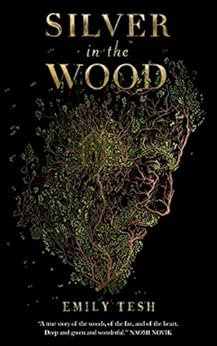
2019/76: Silver in the Wood -- Emily Tesh

"There are no dryads, no wild men, no fairy kings, and no monsters. Isn’t that right, Mr Finch?"
"Certainly haven’t seen a fairy king yet," said Tobias. [loc. 341]

This utterly charming and gently terrifying novella tells the story of Tobias Finch, who's lived in Greenhollow Wood for a very long time. The villagers say there's a wild man in the wood, a criminal or a lunatic or a pagan: but Henry Silver, the new owner of Greenhollow Hall, is not deterred by these rumours. The two men strike up a friendship (perhaps they both want it to be more): but then Silver is stolen away, and Toby despairs.

Enter Mrs Silver, Henry's mother, a practical folklorist ("vampires eliminated, ghouls laid to rest, fairies discouraged, and so on") who knows more than she should about Toby Finch. She would like her son back, and instructs Toby in how she believes this can be accomplished. (This part was truly harrowing.)

It doesn't work. Toby, much changed -- diminished? -- leaves the wood with Mrs Silver. She offers him useful work, and he finds that he is becoming fond of the human world, and human things. But still, something draws him back to the green shade where he once lived.

I would happily read a novel-length version of this novella -- perhaps with more about Toby's life outside the wood -- but it is wholly satisfactory as it stands. The sense of menace is subtle and, at first, easily dismissed: the weirdness of the wood reminded me of Rob Holdstock's Mythago Wood, without as much burden of myth. Toby is a splendid viewpoint character, a man of few words who does not feel the need to speculate upon his own nature or the changes he undergoes. Also, there is an adorable cat.