Wednesday, April 24, 2019

2019/47: I Never Promised You a Rose Garden -- Joanne Greenberg writing as Hannah Green

In the dark her room was luminous with Yri personages. We never hated you, Lactamaeon said, shining on his hard-ridden horse. The cruelty was for protection! Anterrabae said in antiphon, waving a sheaf of sparks in his hand.
We came in the era of dryness and the death of hope, called Lactamaeon.
We came with gifts, said Anterrabae. When you were laughing nowhere else, you were laughing with us. [p. 162]

I first read this in my teens and was vastly moved by it. Deborah, the protagonist, is diagnosed with schizophrenia, and is treated by psychoanalyst Dr Fried. Deborah's mental illness involves a complex fantasy world she calls Yr, which is inhabited by gods and goddesses, and haunted by the Collect -- a chorus representing criticism -- and the Censor, who prevents her speaking of Yr in the 'real' world. Deborah was once a queen in Yr, but now is a prisoner. It's a place with its own language, rich with metaphor and imagery, though Deborah accepts that there's nothing in Yr which is not the product of her own knowledge.

Dr Fried helps Deborah to make sense of early memories (did she really try to kill her little sister? was she really behind bars? what about the operation that they told her wouldn't hurt?) and her own responses to the world. And because this novel is set in the 1940s, the medical care that Deborah receives seems cruel and primitive to me. (I think it might have contributed to my terror of mental health 'treatments' and facilities.)

I was also (and am still) appalled and angered by the way that most of the medical profession attempts to 'explain away' Deborah's illness. "He worked hard to convince her that Yri was a language formulated by herself and not sent with the gods as a gift. .. He analyzed the structure of the sentences and demanded that she see that they were, with very few exceptions, patterned on the English structure." [p. 121]. As though explaining the symptom to Deborah would mend the cause. As though being told she was, literally, imagining things would make those things go away.

I remembered a great deal about Yr, and a little about Deborah's family. I did not remember very much at all about Deborah's Jewish identity, or Dr Fried's German roots and her remark that some of her earlier patients died in Nazi camps. And this, of course, entwines with Deborah's illness, and perhaps with the gods that she chooses to inhabit her imaginary domain.

This is a fictionalised autobiography: Joanne Greenberg was treated by psychoanalyst Frieda Fromm-Reichmann in the late 1940s and early 1950s. Apparently there's controversy regarding Greenberg's illness, her creativity, and the success of the treatment: but that doesn't make this a less effective work.

Greenberg: "I wrote [I Never Promised You a Rose Garden] as a way of describing mental illness without the romanticisation that it underwent in the sixties and seventies when people were taking LSD to simulate what they thought was a liberating experience. During those days, people often confused creativity with insanity. There is no creativity in madness; madness is the opposite of creativity, although people may be creative in spite of being mentally ill." source).

I still have my old paperback of this, but it's not yet been made available as an ebook: preferring to read on a device, I borrowed a scanned copy from the Internet Library, which had a few forgiveable OCR-style typos.

Tuesday, April 23, 2019

2019/46: Walking to Aldebaran -- Adrian Tchaikovsky

I’ve met aliens, sentient aliens. I’ve seen spaceships. I’ve breathed the venomous air of a planet on the other side of the universe. I’m probably the most travelled human being in the history of human beings travelling, if indeed that category is still the appropriate one with which to conjure me. I just didn’t think there would be so much getting lost and eating corpses. [loc. 64]
Gary Rendell is lost and alone, wandering the lightless passages of an alien artefact known as the Crypts. He was part of an expedition from Earth, but -- stupidly -- they split up. Now he knows much more about the Crypts than anyone else: but he's not the man he was when the Quixote, with its international crew, landed in one eyesocket of the Crypts (which happen to look remarkably like the face of a giant frog).

Gary is desperate to rejoin his companions, to find a way out, to find food and light (the novella opens with him finding an alien corpse that provides both of the latter). However, some pretty unpleasant things have happened to him since he lost contact with the others, and perhaps he won't be able to go home after all.

This was great fun, darkly humorous and poignant and occasionally very disturbing. There's more than a 'whiff of the monstrous', and I quickly learnt not to trust Gary's narrative. Walking to Aldebaran has a Golden Age feel to it, though back then it'd have been a short story: I think novella-length does work, though, for ramping up the tension, the pathos and the universe-building.

I received Walking to Aldebaran from NetGalley in exchange for this honest review.

Monday, April 22, 2019

2019/44: Everyone Knows You Go Home -- Natalia Sylvester

They were married on the Day of the Dead, el Día de los Muertos, which no one gave much thought to in all the months of planning, until the bride’s deceased father-in-law showed up in the car following the ceremony. [loc. 110]
Martin marries Isabel: she can see his father's ghost, he refuses to look, because his father, Omar, walked out on the family years before. Martin didn't even know he was dead. But Isabel and Omar talk, each Day of the Dead, and Isabel discovers secrets her husband has never shared with her, and secrets that have been kept from him by his mother Elda and sister Claudia.

Martin's nephew Eduardo turns up, an undocumented migrant, and moves in with Martin and Isabel. From Eduardo, as well as Omar, Isabel learns about how and why Omar abandoned his wife and children -- and how that abandonment is rooted in Omar and Elda's journey from Mexico to Texas in 1981.

This novel has the structure of a Greek tragedy, an eye for an eye, the past reflected in the present and the present haunted -- literally and figuratively -- by the past. It humanises the 'immigrant threat' rhetoric that has become a mainstay of American politics, and illustrates the danger and fear of migrant journeys -- and the way that, even when they've built a new life, they can't stop being afraid.

I read this for the 'book from 2018 Reading Women Challenge shortlist' rubric of the 'Reading Women 2019' challenge.

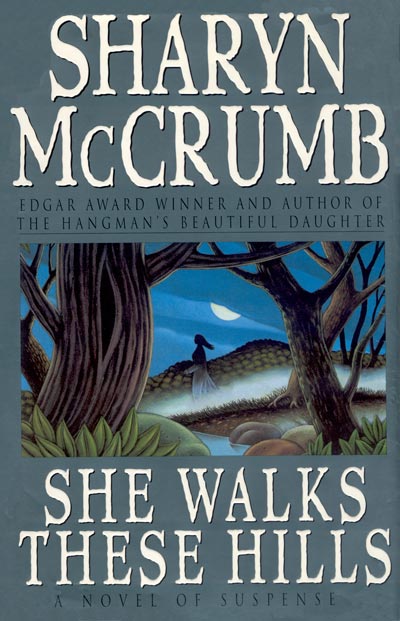
2019/45: She Walks These Hills -- Sharyn McCrumb

As Nora Bonesteel tied the wisp of black ribbon to the nail on the lid of the white bee box, she wondered if there were any other deaths she ought to mention to the bees, or if those mattered. Perhaps the bees did not need to be told yet. The other deaths had not yet happened. [p. 148]
I'd read, and vastly enjoyed, McCrumb's Bimbos of the Death Sun (murder mystery set at a science fiction convention) back before the Internet, so when I was looking for a novel set in Appalachia she was an easy choice. She Walks These Hills is not quite a murder mystery, though there are murders within it. The entwined plot threads -- an escaped convict going home, a female police dispatcher who wants to be a deputy, a hapless historian trying to recreate the historic journey of a young woman escaping from her captors -- combine in unexpected ways to tell a story of escapes, ghosts and memories.

Hiram Sorley, known as Harm, has spent many years imprisoned for murder: he suffers from Korsakoff's Syndrome (the inability to create new memories) and lives in a perpetual now. He escapes from prison and sets out for his home. Radio host Hank the Yank takes an interest in Harm's story, and sets out to investigate the circumstances of the murder for which he was imprisoned.

Martha Ayers is a police dispatcher, but knows she can handle more. She wants to be a deputy, and the sheriff gives her the opportunity. Her first proper assignment is to intervene in what looks like a typical case of domestic violence -- young Sabrina Harkryder, angry at her husband's negligent behaviour, is threatening to kill her own child.

Meanwhile, ethno-historian Jeremy Cobb has embarked on a hike through the mountains, trying to recreate the epic journey of Katie Wyler who, in 1779, was captured by the Shawnee and escaped, eventually returning to her fiancee ... It's Katie's ghost who Nora Bonesteel has seen every autumn since she was a little girl, and Katie's story that binds all the threads together.

I really enjoyed this novel. It doesn't sugar-coat rural poverty, but neither does it stereotype Appalachian culture. ('Martha wondered why city people judged urban areas by their wealthiest inhabitants and rural areas by their poorest.') The story of Katie Wyler, though fictional, resonated with historical accounts I've read; Harm Sorley's perpetual now was oddly reminiscent of Gene Wolfe's Soldier of the Mist series. I liked the blend of folklore, police procedural and tragedy, and admire McCrumb's gift of characterisation. Each individual felt individual, human, flawed, and (mostly) likeable.

I'll be looking out for more in the 'Ballad' sequence, but hopefully without the flaws of this edition: I ended up returning it because of the formatting. (I can cope with mid-paragraph breaks and mis-OCR'd words -- 'good oF boys' -- but not with the enforced white background through most of the novel, as my Kindle app is set to a pale beige background.)

I read this for the 'A book about or set in Appalachia' rubric of the 'Reading Women Challenge 2019'.

Sunday, April 21, 2019

2019/43: H is for Hawk -- Helen Macdonald

I’d flown scores of hawks, and every step of their training was familiar to me. But while the steps were familiar, the person taking them was not. I was in ruins. Some deep part of me was trying to rebuild itself, and its model was right there on my fist. The hawk was everything I wanted to be: solitary, self-possessed, free from grief, and numb to the hurts of human life. [p. 85]

Second try at this book: I suspect that, when I first started reading it, I found the author's emotional state (on the verge of breakdown after the sudden death of her father) a little too raw and relatable for my own mental wellbeing. I'm glad I returned.

H is for Hawk is a book about training a goshawk, building a relationship with a bird: it's also about T H White, who documented his own failed (and horrific) attempt to do the same; and it's about the author's grief and depression after the death of her beloved father. There are fascinating details about the history and culture of hawking, and the different species of hawks flown (but never domesticated, never tamed) by humans over the last 5,000 years.

T H White's The Goshawk recounts his lack of understanding of Gos, the hawk he tried to 'master'. His ignorance made him cruel -- though, as Helen Macdonald posits, there was a degree of sadism in his personality. I hadn't known much about White's life: he was homosexual, self-loathing, yearning for love and sabotaging his own successes. I felt immense sympathy for his hawk, and some compassion for White himself.

Quite aside from the raw emotions and the sense of exhaustion in Macdonald's account of her own goshawk, Mabel, there is some glorious nature-writing here: hawks on the wing 'loving the space between each other'; 'a torn-paper whiteness behind the sun that speaks of frost to come' ... And some melancholy observations, beautifully phrased, about the ways in which we are losing the wild, taming and destroying it. There are instincts still dormant in us, which can be woken by interaction with a wild thing: that are woken in Macdonald as she bonds with the alien creature on her glove.

I read this for the 'woman writing about nature' rubric in the 'Reading Women 2019' Challenge.

Wednesday, April 17, 2019

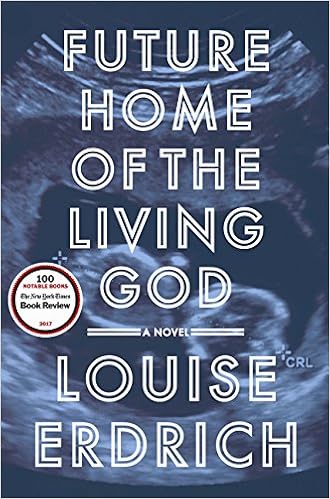
2019/42: Future Home of the Living God -- Louise Erdrich

When I tell you that my white name is Cedar Hawk Songmaker and that I am the adopted child of Minneapolis liberals, and that when I went looking for my Ojibwe parents and found that I was born Mary Potts I hid the knowledge, maybe you'll understand. [loc. 58]
Cedar is 26 years old, Catholic, and four months pregnant. She remembers the last time it snowed, when she was eight. Around her, society -- perhaps civilisation -- is collapsing: Siri's dead, GPS doesn't work, banks are running out of money, domestic animals are no longer breeding true, and the government has sealed the borders and instituted a law of 'gravid female detention', i.e. requiring all pregnant women to give birth under controlled circumstances. There are hints that throwbacks are being born, that evolution is somehow unwinding: there's something like an Archaeopteryx, and a giant sabre-tooth cat devours a Labrador in Cedar's back yard. Fewer healthy babies are carried to term, and some of them seem less human than others.

Cedar is not quite sure if her baby -- due on December 25th -- will be human or not, but she's determined to preserve it from the government and the birthing facilities. An ardent Catholic, she is pleased to find that her birth family share her faith, less pleased to discover that they are horribly ordinary, without any special powers or spiritual connections. At least they don't seem to be harbouring any unpleasant genetics -- but then, all humans carry the genetic heritage of evolutionary failures as well as successes.

Future Home of the Living God -- the slogan on a billboard outside the reservation where Cedar's Ojibwe family run a gas station -- is told in the form of a letter, or diary, that Cedar writes to her unborn child. It describes her experiences while evading the government and the unnerving, all-seeing figure of Mother, and her attempts to find a balance between the white liberal world she grew up in (we don't see much of this) and the Native family she's just coming to know. Her baby's father, Phil, is a peripheral presence, and not a wholly benign one, though Cedar initially recounts the night of conception in magical (or religious) terms.

I found the Potts family likeable and interesting characters, especially the sullen Goth-Lolita half-sister (Mary) and Cedar's birth mother (also Mary). Cedar herself is a compelling, independent and intelligent narrator: but the dystopian setting was unsettling and depressing, and all too credible. The 'pregnancy diary' aspect of the narrative ('you're four inches long and weigh as much as two sticks of butter') was an effective contrast to the disintegration of the wider world: it kept my focus on Cedar's unborn child and what it might represent.

I should note that there are plenty of lighter moments herein: Cedar's arguments with her anti-vax parents, her attempts to buy booze as currency for 'the end of the world', the friction between her and her half-sister. But: the end of the world, or the end of science, or the end of humanity ...

And I think in the end I just didn't like the ending: it felt flat, anticlimactic, despairing.

Louise Erdrich is a member of the Turtle Mountain Band of Chippewa Indians in North Dakota, and has written a number of novels focusing on the tensions between Native American and white culture. I read this novel for the 'book by an indigenous woman writer' rubric of the Reading Women 2019' challenge.

Tuesday, April 16, 2019

2019/40: Kingfisher Days: The Play -- Susan Coyne

... what scientists do is observe some aspect of the universe like Uncle Joe's fireplace, conduct an experiment (such as leaving gifts for the fairies), collect data (your letters) and analyse the results ... I think that any reasonable person would say there is some evidence to suggest that a fairy may indeed be living here at Lake of the Woods ... [p. 46]
An autobiographical play: as a little girl, Susan Coyne spent summers at the family's lakeside cottage. The summer she's five, she finds the ruins of an old fireplace, which her father tells her belonged to Uncle Joe Spoondoolak, who was an elf. Susan begins to leave little presents for the elves ... and one morning she finds a thank-you note from fairy princess Nootsie Tah.

Mr Moir, the neighbour who's teaching her about plants and gardening, helps her read and reply to the note, and Susan begins a correspondence with the fairy princess -- which is, of course, really a correspondence with Mr Moir himself.

I'd have liked to see this as a play. It begins with a framing narrative of adult Susan, arriving late and flustered, and softening as she remembers that long-ago summer: I think the juxtaposition of careworn adulthood and delighted, wondering childhood would be especially effective when the two Susans are played by the same actress.

It's a short sweet read, evoking a simple, happy time. It does seem, even within the play, that Susan's friendship with Mr Moir continued into adolescence, and was wholly healthy for them both: but I wonder if contemporary parents would be so trusting. (Susan's parents must have known what was going on, and taken as much delight in their daughter's own delight as Mr Moir does in the play.) The parents are peripheral here, letting Susan play and grow and create: and nobody ever tells Susan that she's being silly, or is too old for such stories.

I read this for the 'play' rubric in the Reading Women 2019 challenge. It reminded me that I find reading plays quite difficult, unless I've seen them! All the components are there, but they don't fit together as easily, for me, as a prose narrative.