Wednesday, July 10, 2024

2024/103: The Dragon, the Thief and the Princess — Gillian Bradshaw

“I’ll pray to the gods for you, dragon, and ask them to bless you!”
“Stop calling me ‘dragon’ like that, as though I were a dog,” said the dragon. “My name is Hathor. And I don’t believe in your human gods.”
“But you have the name of a goddess,” said Prahotep.
“You mean, she has my name,” replied the dragon. “You humans stole names from us dragons. What’s she goddess of, then?”
“Of love and beauty. It’s very appropriate.” [loc. 467]

First published in two volumes (The Dragon and the Thief and The Land of Gold), this is an historical novel for children set in a fantastical version of ancient Egypt. The 'thief' (though he's not very good at stealing things) is Prahotep, a young fisherman who's nicknamed 'Bad-luck' because that's what he brings; he encounters the dragon, last of her kind, in a cave near the Valley of Queens whilst escaping the gang of quarrying convicts whose overseer he's just injured; we meet Princess Kandaki, who's Nubian, in the second volume.

Prahotep is likeable and wily: he thinks fast and has a talent for making friends and telling stories. ('That's how you kill a lie. You tell another lie, only bigger!') The story is fast-paced and fairly simple, but Bradshaw's gift for historical ambience is always present, from the seventy days Prahotep has to wait until his father can be embalmed and buried, to the civil war raging in Nubia after a traitor assassinates the king and queen. It's light-hearted, exciting and focuses on friendship and loyalty. A charming novel: I wish more of Bradshaw's novels were available for Kindle.

Friday, July 05, 2024

2024/102: The Cat Who Solved Three Murders — L T Shearer

‘He’s twenty-two, just out of university,’ said Tracey. ‘He has a degree in English and Philosophy.’
‘Well, I suppose he can discuss the whys and wherefores of sixteenth-century poets as he’s putting crims behind bars.’ [loc. 2010]

Lulu, retired police detective, and her cat Conrad who talks (but only to her) are in Oxford for a party celebrating the sixtieth birthday of an old friend. She's happy to spend time with Julia, whose husband is the birthday boy -- but then (see title) there's a murder.

I enjoyed the first of this series, The Cat Who Caught a Killer, but was less enthusiastic about this one. For one thing, Conrad is less proactive: here, he's really just there to notice things and to discuss the case with Lulu. (Oh, and to have his claws swabbed for DNA after attacking a potential villain.) Is he just a figment of her imagination? For another, the 'canal boat' ambience is minimal: most of the action takes place in Julia's house. (Lulu even borrows clothes, presumably including underwear...) 

It's also horribly repetitive -- I lost count* of the times Lulu 'bent down so that Conrad could jump onto her shoulders'. And the Daily Mail undertones are stronger in this volume. (Blood is spattered on the wallpaper. 'It's one of your namesake's, five hundred pounds a roll ... Lulu Lytle, the woman who did Boris Johnson’s interior design at Number 10. When Bernard heard that, he insisted we use her wallpaper in the study.' [loc. 556]) I still like Conrad, but Lulu is beginning to remind me of an unpleasant former colleague: not a welcome recollection.

*(just checked: 12 times). 

Thursday, July 04, 2024

2024/101: Things They Lost — Okwiri Oduor

December staggered in like a weary mud-encrusted vagabond who had been on her way to someplace else but whose legs had buckled and now she was here. On the second, which in Mapeli Town was known as Epitaph Day, the townspeople awoke while the sky was still silver, still tinged with ruffles of pink and blue. They gargled salt water. They greased their elbows. They tucked a flower in their hair or pinned it on their lapel. They marched to the schoolhouse, where the flag flapped at half-mast for all those who had drowned in the river or choked on a fishbone or stepped on a puff adder while walking to the marketplace. With eyes bleary and heads bowed, the townspeople thought of all the ones they had ever lost. [p. 1]

It's twelve years since Ayosa Ataraxis Brown was born to Nabumbo Promise Brown, but Ayosa's memories go back to 'the Yonder Days, before she'd turned into a girl'. She is often lonely, despite the Fatumas who live in the attic, 'half girl and half reverie', caught by a fisherman four centuries ago. Though her mama is often absent (she's an award-winning photographer), the sense of her is always present for Ayosa, who experiences her mother's memories -- and those of her grandmother, flying doctor Lola Freedom -- in the house that was built by her great-grandmother, irascible English colonist Mabel Brown, after whom the town (Mapeli) was named.

Oduor's prose is intoxicating (I've marked almost every page with highlights). The people of Mapeli are vividly strange. There's Sindano, the café owner who never has any customers and has had ten fiancés die before she could marry them; there's a milkman who never speaks; there's the apothecary Jentrix and her snot-nosed granddaughter Temerity. And there is the river, which never drowns people on Christmas Day, but which swallows and spits out Ayosa several times, and deposits lost things for her to find.

Ayosa is the heart of the novel. Even when she's lonely and miserable her essential joyfulness shines through. She's amiable, curious, clever and lonely: part of the story is about her making friends with Mbui Dash, a 'throwaway girl' who feels even more magical than Ayosa herself, and who is accompanied by an excellent cat named Bwana Matambara. 

Things They Lost is not always a happy novel -- Ayosa's glimpses of the Yonder Days, oppression and slavery and murder, are horrific, and there's an ancient murder twisted up in her family history -- but it is always beautiful. It's full of women and girls who find their own paths, make their own rules: it's alive with the smells, sounds and tastes of Ayosa's life (and insects, soooo many insects). Family secrets, surreal death notices on the radio, wraiths who stalk the living: and 'Ayosa Ataraxis Brown, who can't go too many days without listening to a poem.'

This review helped me understand Things They Lost's 1980s Kenyan context and how it's reflected in the novel. It includes a link to a connected short story. 

Fulfils the ‘Author from East Africa’ rubric of the Something Bookish Reading Challenge.

Wednesday, July 03, 2024

2024/100: Claws and Contrivances — Stephanie Burgis

And the very idea of a brilliant, kind-hearted, and scholarly gentleman choosing a reckless, impoverished dreamer like herself was so laughable that she should only find it amusing. So she did. She was excessively amused. Her chest hurt from the effort of withholding what could only be laughter. [p. 250]

Having greatly enjoyed Scales and Sensibility, the first in the Regency Dragons series, I'd been saving the second in the series for when I needed a cheering, witty read. Claws and Contrivances was so enjoyable that after I'd finished it, I went back and reread the first book again!

Scales and Sensibility introduced Elinor, impoverished orphan, who'd grudgingly been given a home by appalling relatives. In contrast, the home offered to Elinor's younger sister, Rose, is the comfortable (though crumbling) Gogodd Abbey, deep in the Welsh countryside. Rose's aunt writes Gothic novels, and stages readings of them; her uncle is eagerly awaiting the arrival of a notable dragon scholar; and their neighbour, Sir Gareth, is Etonian and Dastardly. There are also cousins, and dragons -- the first of which appears in the buttery, and is rescued by Rose. And that's before the notable dragon scholar arrives...

Rose is a delight, determined to take care of everyone around her and full of schemes to outwit the wicked Sir Gareth -- schemes that involve her relatives, and any passers-by who don't refuse quickly enough. Shy, bookish dragon expert Cornelius Aubrey (last seen in Scales and Sensibility) is beguiled, but cannot square his emotions with his scientific methods. And the little dragons are cute and personable. A diverse cast, too, including an Anglo-Indian heiress, Rose's decidedly queer cousin Georgiana, and neurodivergent Aubrey. Everyone is lovely (except Sir Gareth and his staff) and everything ends happily. I am already looking forward to the next in the series!

Tuesday, July 02, 2024

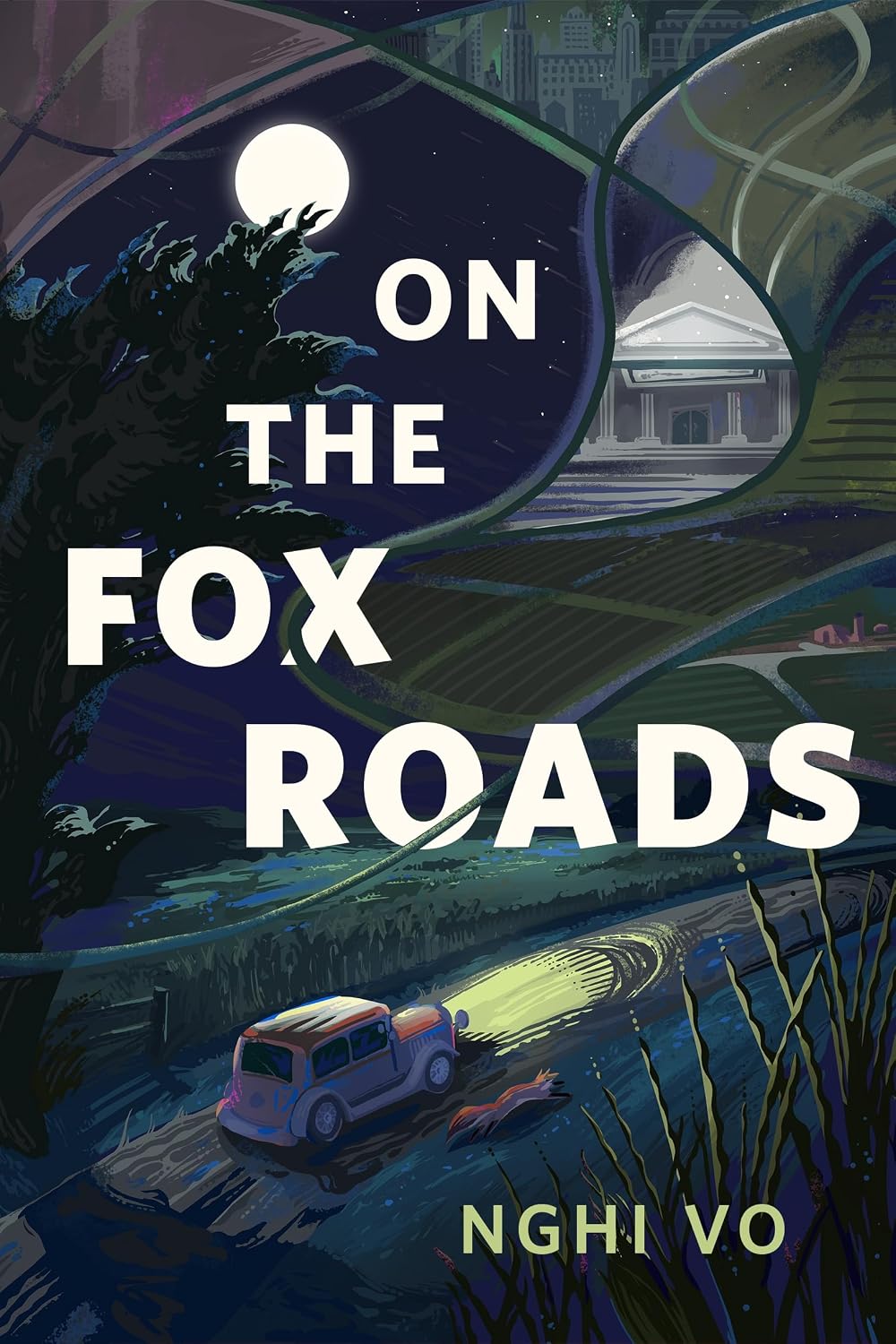
2024/099a: On the Fox Roads — Nghi Vo

The cops came through sometimes, collecting the eyes of gas-station attendants and diner waitresses, and the best way to get your eye back, Jack told me later, was to empty it straight out into the dirt...“The law says they can only take one, but it don’t say how good your eye needs to work when they give it back.” [p.11]

Two bank robbers, known to the press as Chinese Jack and Tonkin Jill, travel American small towns during the Great Depression: they acquire a stowaway, who's keen to retrieve the deeds to her parents' store. She's also Chinese-American, and travels with Jack and 'Jill' (whose name is actually Lai) for a while, learning about the fox roads (which can take you anywhere: 'all you need is a reason to get out', says Lai) and about who she really is.

This was super-short but wistful and evocative, with three intriguing characters (we don't get much background on any of them) and some elements from Chinese mythology. I enjoyed it, but the 'novelette' length (up to 17,500 words) is frustrating: I'd have liked more.

Shortlisted for the Hugo Award for Best Novelette, 2024: read as part of the Hugo Voters' Pack.

2024/099b: Mammoths at the Gates — Nghi Vo

At Singing Hills, we deal in memory. The things we remember last as long as we do and longer. The thing itself, well, it goes away. It breaks. It sinks to the bottom of the river. It dies or leaves or is lost. [p. 71]

Cleric Chih returns to their abbey, Singing Hills, to find the eponymous mammoths at the gate, and their beloved mentor Cleric Thien dead. These two facts are not unrelated. Chih's old friend Ru is now the acting Divine, and Chih isn't sure how to relate to them. There are many stories to be told, and Myriad Virtues, Thien's neixin (magical hoopoe) tells one of the darkest.

Lots here about stories, identity, and the work of the clerics, as well as the inevitability of change. I would have appreciated this story more if I had read the rest of the series, instead of only the first part. (That's a me problem: it was quite clear what was happening, and I wasn't confused, but there is depth and subtlety to the characters which I couldn't appreciate in context).

Shortlisted for the Hugo Award for Best Novella, 2024: read as part of the Hugo Voters' Pack.

Monday, July 01, 2024

2024/098: Translation State — Ann Leckie

The treaty was everything. The treaty was why we existed to begin with. The way that Reet had talked about the treaty, the way it was talked about in Pirate Exiles of the Death Moons, you would think that only the treaty stood between all humans and certain death. Which maybe was true... [p. 352]

It's a decade since I read Ancillary Justice, and for some reason I never finished the trilogy: but I did not find Translation State impenetrable or especially confusing. It helps that Enae, one of the viewpoint characters, is being slowly introduced to the wider universe after years spent tending hir recently-deceased grandmother. Sie's free to travel, and encouraged to take up a role that involves invstigating the disappearance, two hundred years ago, of a Presger Translator. The Presger are fearsome inhuman aliens: their Translators are modified humans. Another of our viewpoint characters (and the only one with a first-person narrative) is Qven, a young Translator who's been singled out for great things: and the third protagonist is Reet, who prefers to work alone and shuns social events, instead eating takeaway and watching his favourite show, Pirate Exiles of the Death Moons. (I sympathise.)

These three stories converge, via historical conflict between the Hikipu and the Phen. Enae is caught up in a pro-Hikipi political demonstration; Reet is heralded by the local 'Siblings of Hikipu' group as a descendant of legendary Hikipi rulers, due to his genetic anomalies; and Qven, whose great future is in ruins, is forced to make an alliance of convenience. The three voices are distinctive, and their concerns and actions are convincing. But I wasn't entirely satisfied by the last third of the book, which felt at once hectic (trapped in a maze!) and handwavy (major developments happening off-page, emotional bonds formed very quickly). Plus, my hackles rose at the phrase 'For reasons that it would take too much time to explain just now' -- uttered by a character, felt like the author taking a short cut.

But I did enjoy reading Translation State. It's an interesting exploration of self-defined identity, how a personality is shaped (the Translator juveniles are literally little monsters), and how ancient history can still be acutely relevant.

Having read this, I shall be rereading Ancillary Justice and following it with Ancillary Sword and Ancillary Mercy: I had forgotten how much I like Leckie's writing.

Shortlisted for the Hugo Award for Best Novel, 2024.

Fulfils the ‘About finding identity’ rubric of the 52 books in 2024 challenge.