Saturday, August 12, 2023

2023/115: Still Life — Louise Penny

‘The funny thing about murder is that the act is often committed decades before the actual action. Something happens, and it leads, inexorably, to death many years later. A bad seed is planted. [p. 169]

Chief Inspector Armand Gamache of the Surêté du Québec, accompanied by his team of investigators, has been called to idyllic Three Pines to investigate the death of an elderly local artist. Jane Neal was about to reveal her art -- within her house as well as in an exhibition -- when she was found dead in the woods, killed by an arrow. The consensus in Three Pines is that it was a tragic hunting accident, but Gamache is not convinced: he initiates a murder investigation.

I liked this a great deal, though find I recall very few plot details ten days after finishing it! (I do remember narrowing down the identity of the murderer to two people, very early on: and yes, it was one of those two.) What I found so enjoyable was Penny's cast of characters: Gamache, compassionate and principled; his over-confident trainee Yvette Nichol; married artists Clara and Peter; former therapist Myrna Landers; redoubtable Ruth Zardo, head of the volunteer fire brigade and former Poet Laureate... Three Pines is not as idyllic as it first seems: there is prejudice, homophobia, decades-held grudges, meanspiritedness, greed, blackmail. But there is also a warm sense of community, of people getting along and supporting one another.

I've every intention of reading more of this long-running and well-received series, and immersing myself in Quebecois culture: I like knowing that the books are there for when I need a not-quite-cozy, vividly peopled crime novel.
Friday, August 11, 2023

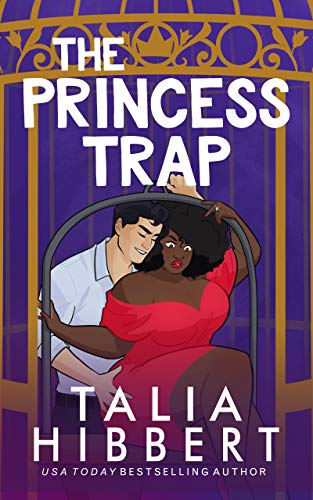
2023/114: The Princess Trap — Talia Hibbert

This was probably the fastest he’d ever fucked something up. Dragging Cherry into his life felt like dragging a princess off to his lair. He was almost certainly the dragon in this fairytale. [p. 99]

Cherry Neita is thirty years old, has a decent job, is proud of the way she looks (she's Black, tall and extremely curvy) and really can't be bothered with relationships. When she meets Ruben Ambjørn -- well, when she barges into his meeting with her colleague -- she's impressed by his good looks and general demeanour. (Ruben's first thought is 'I have to have her'.) They go on a date; things get a bit heated in an alleyway; the paparazzi show up; and Cherry finds herself fake-engaged to a minor European royal with a chequered past and some major hangups.

I liked the body positivity in this, and the sex scenes were steamy and well-choreographed, but instalove is not really my trope. I also felt there were a lot of unresolved plot threads (Ruben's awful ex; what happened to his (abusive) brother and (racist) sister at the end of the story; Cherry's sister's situation). The scenes in Ruben's home country did not feel as though they were set anywhere at all: no sense of place, or time of year. And I found the pacing very uneven, especially in the later chapters. But this might all be Just Me: I think I can sum up my mood while reading this novel by revealing that my major concern for much of it was the wellbeing of Cherry's cat Whiskey. Where does he sleep? Clearly not with Cherry.

This is one of Talia Hibbert's early novels: I found it flawed, and didn't enjoy it as much as (for instance) A Girl Like Her or Get a Life, Chloe Brown, but it's still entertaining, sexy and fun, with a happy ending.

For Shop Your Shelves Bingo, Summer 2023: purchased 26 MAR 2020, prompt 'BIPOC author'.

Fulfils the ‘body positive’ rubric of the 52 books in 2023 challenge.

Thursday, August 10, 2023

2023/113: A Place of Execution — Val McDermid

'...'The Wicker Man'? Edward Woodward plays this cop who goes off to this mysterious Scottish island to investigate a missing girl and he gets caught up in the pagan rites of the inhabitants. It’s very eerie and there are undercurrents of perverse sexual practices and strange beliefs. Well, that’s sort of what it felt like in Scardale in 1963, except we got to go home to normality at the end of the working day. And nobody tried to turn me or George into a human sacrifice...’ [p. 389]

In December 1963, a young girl goes missing from Scardale, a remote hamlet in the Peak District. Alison Carter, the stepdaughter of the local squire, was last seen walking with her dog. The dog is found tied to a tree, her muzzle taped with Elastoplast to stop her barking. There is no sign of Alison.

Detective Inspector George Bennett, new to his position and set somewhat apart from his colleagues by his university education, is determined to solve the case. Several children have lately gone missing in Manchester (newspaper accounts of these cases, the first victims of Brady and Hindley, appear in the text), but Manchester is a world away from Scardale, with its almost feudal community and the close bonds between the villagers.

Alison is not found, but there is strong (and increasingly horrific) circumstantial evidence that she has been murdered. A jury finds the accused guilty, and he is hanged.

Bennett's investigation is the subject of a book by Catherine Heathcote, who grew up near Scardale and remembers Alison Carter's disappearance. Twenty-five years later, she discovers a personal connection to the case: her friend is engaged to George Bennett's son. Heathcote's book forms the first part of A Place of Execution: it's the project that could revive her career. But after Heathcote has submitted her manuscript, Bennett gets in touch and insists that the book must not be published, because new facts have come to light.

This is a powerful and haunting novel, with vivid characterisation and a strong sense of place and time. I was particularly impressed by the inhabitants of Scardale, who almost all come from one of three families. Nearly everybody dismisses the villagers, Alison's cousins and aunts and uncles, as 'not equipped for the modern world', as inbred, as partial: there's a strong undertone of classism, and recurring jokes about Scardale's isolation. It's a strong and close-knit community, and it finds its own way to justice.

1963 is a bit before my time, but the Britain depicted in this novel is familiar to me: everyone smokes (and may ask permission if in mixed company); a clairvoyant is enlisted by a tabloid newspaper to reveal Alison's fate; children are 'protected' from the nastier aspects of life, and not deemed to have feelings. Everything was slower: but not necessarily better.

This was my first McDermid novel: I found it a compelling read, and I'm still thinking about the tragic elements, and about poor Mme Charest from Lyon, who was right.

For Shop Your Shelves Bingo, Summer 2023: purchased 14 JUL 2020, wildcard prompt.

Friday, August 04, 2023

2023/112: Broken Light — Joanne Harris

...instead of taking my invisibility as a sign that I have reached my expiry date, I can see it for what it really is. A superpower. [loc. 1563]

When Bernie Moon was a little girl -- 'when magic was easier than maths' -- she used to play House with her friend Katie. Their version of House was a kind of telepathy or empathy, a 'looking inside other people'. Katie and Bernie fell out over an incident at primary school, and Bernie lost that ability -- after a lightly-sketched but harrowing incident at secondary school -- when she had her first period. Now she's menopausal, and it's coming back...

The novel opens with a vivid dream, a woman jogging in the park at night, attacked. It's not just a dream, and Bernie's rage at the 'she shouldn't have been running alone' victim-blaming is tempered by unease at her vivid second-hand experience. Sensing predatory intentions from a man in a cafe -- who turns out to be Woody, an old friend of her husband's -- Bernie befriends barista Iris, Woody's target. She's a woman in her twenties, a comics fan who quickly recognises Bernie's gift ('Jesus, Bernie. If you’re going to have a superpower, you could at least take an interest') and encourages her to use it in positive ways. Positive for women, anyway... Woody, who now passes out every time he thinks a predatory thought, is convinced that there's a terrible feminist conspiracy to eliminate masculinity. But it's never that simple, even for somebody who can, literally, change minds.

Broken Light is told almost entirely in two voices: Bernie's LiveJournal entries, and a memoir entitled Class of '92, by Bernie's childhood friend Katie. It's evident from the start that something terrible has happened, but Harris' pacing is excellent, and keeps us guessing until (and beyond?) the end. Bernie doesn't really dwell on her own isolation, but she's married to a man who is (at best) emotionally distant; barely sees her adult son; and is endlessly frustrated by her mother. Until she joins an all-women (and very diverse) running group she doesn't really have friends.

Plenty of talking points here. Are all the men Bernie meets really that vile? Isn't she engaged in a sort of violation (a word Katie uses) when she 'looks inside' people who are unaware of her presence in their minds? Is there something especially unsettling about lurking in someone else's mind while they masturbate? Is the death of the man killed in an all-female space ('he’d seen no need to dress as a woman to do so') his own fault, or Bernie's? And why does Bernie still want to prove herself at the class reunion?

I read this voraciously, wondering (of course) what I would do with Bernie's power, what I would do in her place. Harris has said this novel was written in response to Stephen King's Carrie (in which supernatural powers arrive with Carrie's menses). I like the idea of menopause as the beginning of magic, rather than the end of visibility. Broken Light is not entirely cheerful, but I found it uplifting and positive, and full of rage, and full of hope.

This is how we change the world. Not in violence or in war, but in clarity and contemplation. Change is the thing that waits; that hopes; that sometimes skirts the shadows; that hides under the bedclothes; that tidies up the leftovers; that whispers to your children; that looks at you from polished doors and in reflective surfaces; that sometimes bleeds; and yet is strong, maybe stronger than anyone. [loc. 5180]

Thursday, August 03, 2023

2023/111: A Power Unbound — Freya Marske

... neither of them were given to trust. Both of them had been twisted up by the plain facts of their existence. The past could turn you into a strip of paper with a single side, so that comfort and vulnerability slid away down invisible channels and couldn't be grasped. [loc. 4436]

Concluding the trilogy begun in A Marvellous Light and continued in A Restless Truth, A Power Unbound focuses on Lord Hawthorn (he of the dead sister and dark past, more familiarly known as Jack Alston) and Alan Ross (journalist, pornographer and revolutionary), and their role in the increasingly urgent hunt for the final component of the Last Contract -- the tripartite physical representation (coin, cup and knife) of a contract with the fae, which makes magic possible. Jack and Alan, together with the Blyth siblings Robin and Maud, Maud's lover the dashing Violet Debenham, Robin's lover Edwin Courcey, and various free-thinking representatives of the magical establishment, are opposed by Jack's cousin George -- who turns out to be responsible for many of Jack's current woes -- and his cohorts. George, and many others, believe that dark times are coming* and that power should be concentrated in the hands of those best qualified to wield it: themselves. Jack's political and social tendencies are more Liberal, while Alan hates anyone with unearned power who uses it against others.

Power and privilege are very much in the forefront of this novel: the vulnerability of those who don't have privilege, and thus no protection against injustice; the difference between real-world power imbalances and how those imbalances play out in sexual fantasies (Alan is a pornographer); the ways in which privilege can be abused, or used to improve the lives of those without influence; ways of acquiring privilege, licit or otherwise. These issues are woven through a complex plot full of reversals, unexpected romantic and emotional developments, and explorations of the nature and origin of British -- or is it specifically English? -- magic. There are several excellent female characters (I'm particularly fond of the Countess of Cheetham, Jack's mother, and Adelaide Morrissey, as well as the Grimm), some vivid depictions of London life in the Edwardian era, and a truly unsettling wardrobe. Marske provides a tense, surprising and (eventually) very satisfactory conclusion to the trilogy: I enjoyed it immensely, and now want to reread all three novels! And I'm eager to see what she does next...

NB: beware of Amazon's subtitling: "A Power Unbound: a spicy, magical historical romp (The Last Binding Book 3)". Dear Amazon (and others), please never use the word 'romp' for anything except light-hearted erotica, which this is not: yes, there is quite a lot of explicit M/M sex, but there is also a great deal of serious plot, peril and unpleasantness.

Thanks to the publisher and Netgalley for the advance review copy, in exchange for this full honest review. UK publication date is 09 NOV 2023.

*The novel is set in 1909...

Wednesday, August 02, 2023

2023/110: The Dechronization of Sam McGruder — George Gaylord Simpson

Its teeth were six-inch daggers and gleamed white as it swung its ponderous head to face me. In a sort of hypnotic horror I thought inconsequentially, 'But your teeth should be dark brown!'. I had often seen the tyrannosaur skull in the Museum, and its teeth were deeply coloured. I had never stopped to think ... that in the living animal the teeth would be white. [p. 51]

Published posthumously, this novella is the work of renowned paleontologist George Gaylord Simpson: it comes with a preface by Arthur C Clarke and an afterword by Stephen Jay Gould (who strongly suggests that Simpson wrote this story as a riposte to those whose theories did not chime with his own).

The tale opens in the mid-22nd century, with a group of (male) scholars -- the Universal Historian, the Pragmatist, the Ethnologist, the Common Man, et cetera -- discussing whether it is ever possible to know that one is, and always will be, wholly alone. Why, yes! says the Historian, and provides the text of a testament found chiselled onto rock slabs. The author is Sam McGruder: while performing an experiment on the quantum theory of time, he accidentally sends himself 80 million years into the past with no hope of return. He laboriously records his encounters with various dinosaurs (vivid, but now outdated) and his survival strategies. He is, of course, incredibly lonely (I note that he does not attempt to tame any of the beasts he meets: surely a small herbivore would be better than no company at all?) and frequently wonders whether it would be better to just give up. But he doesn't.

An odd little novella, probably never intended for publication: thought-provoking, nicely described (I found it easy to overlook the aspects that are now outdated) and with intriguing glimpses of the future that McGruder lost.

I have a feeling that I read this -- or at least owned it -- back in the 90s: I borrowed a scanned version from the Internet Archive.

Tuesday, August 01, 2023

2023/109: The Luminaries — Eleanor Catton

'My father always told me, when it comes to whores and fortune tellers, never give your real name... I like the telling fortunes part. It was rather a thrill, to use another man’s name. It made me feel invisible, somehow. Or doubled—as though I had split myself in two.’ [p. 703]

The setting is Hokitika, a gold-rush town on the west coast of New Zealand's South Island, in the 1860s. The novel begins when Walter Moody, recovering from a traumatic and possibly supernatural experience on board the Godspeed, walks into a room at the hotel where he's staying, and discovers a group of twelve men (including a Maori and two Chinese) who eventually begin to tell their stories. They're all there to try to make sense of the death of a recluse, the disappearance of a rich young prospector, and the savage beating of an opium-addicted prostitute. The Luminaries also features forged documents, a threatening chap with a scarred face, a glamorous medium, a surfeit of opium, plus illegitimate children, long-held grudges, secret marriages, and a plethora of more or less likely explanations of the death of Crosbie Wells, the whereabouts of Emery Staines, and the mystery of Anna Wetherell's pistol.

Eleanor Catton's vast Booker-winning homage to the Victorian novel is rigorously structured around an astrological framework: twelve key characters correspond to the twelve houses of the zodiac, and another seven correspond to 'heavenly bodies', while one man, dead by the time the novel opens, stands as 'terra firma', the centre around which everything revolves. Each of the twelve sections is prefixed by an astrological chart showing the positions of the planets in the southern hemisphere in 1866; each chapter within those twelve sections is titled with an astrological description ('Mercury in Sagittarius', for example, which deals with the interaction of the characters corresponding to Mercury and to Sagittarius) and introduced by a brief summary of events within that chapter. As the novel progresses, the chapters get shorter and the summaries get longer. The title, too, is astrological in origin: the eponymous luminaries, astrologically, are the sun and the moon, and the novel deals with (though perhaps does not focus on) the characters to whom the author has ascribed those roles. Catton has said (though I can't now find the source) that she refused to make editorial revisions that did not make sense astrologically.

It's not an easy novel to review, simply because there is so much in it. I suspect I'll come back to it in a few years and find much that I missed this time. But it was a fascinating read, not only for Catton's twisty plotting and the multiplicity of truths, but also for the atmosphere of what's effectively a frontier town, and the odd blend of Victorian morality and new beginnings 'at the southernmost edge of the civilised world'. Catton doesn't obscure or apologise for racism and sexism, and she treats the non-white and non-male characters with the same respect and honesty as she does the white men. And I am very nearly certain that the explanation given near the end of the book for the death, the beating and the disappearance (to say nothing of the missing bullet, the opium poisoning and perhaps the seance) is a convenient invention by one character, rather than any kind of objective truth.

This novel also strongly reminded me of previous visits to New Zealand, particularly to Canvastown (another goldrush settlement): I would love to go back.

For Shop Your Shelves Bingo, Summer 2023: purchased 05 JAN 2014, prompt 'so long'. 832 pages in print!

Fulfils the ‘featuring one of the seven deadly sins’ rubric of the 52 books in 2023 challenge: avarice drives much of this novel.