Wednesday, September 15, 2021

2021/109: The Governess Affair -- Courtney Milan

In her memory of that night, her own silence mocked her most of all. She hadn’t screamed, and because she hadn’t, she’d felt silent ever since. [p. 25]

Serena Barton lost her position as a governess after being turned off for 'immoral behaviour'. The behaviour in question involved the Duke of Clermont, who raped her: now she is pregnant, without hope of employment, and dependent on her judgemental, agoraphobic sister Freddy for a place to live. She decides to picket sit quietly outside the Duke's London residence until he compensates her, or until her presence sparks a scandal that destroys his precarious marriage.

The Duke, who is a coward as well as a sexual predator, sends his man of business, Hugo Marshall -- popularly known as the Wolf of Clermont -- to deal with Miss Barton. Hugo, who is horribly competent at making problems go away, deals with Miss Barton in an escalating series of creative attacks, and then seals the deal by falling in love with, and marrying, her.

Despite the past sexual assault, and the Duke's moral vapidity, this is a sweet and cheering novella. Serena's rape is not described in detail, and Hugo (even before he realises what has happened to Serena) is extremely careful not to appear physically threatening. I especially liked the notes they wrote to one another, Serena in the square and Hugo in his office ... and the way in which Milan wrote the sex scene, in which Hugo treats Serena with respect as well as creativity. And the ending, in which the Duke gets his come-uppance, was profoundly satisfying.
Monday, September 13, 2021

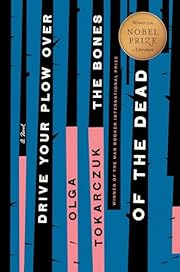
2021/108: Drive Your Plow Over the Bones of the Dead -- Olga Togarcsuk (translated by Antonia Lloyd-Jones)

When you kill [animals], and they die in Fear and Terror – like that Boar whose body lay before me yesterday, and is still lying there, defiled, muddied and smeared with blood, reduced to carrion – you doom them to hell, and the whole world changes into hell. [p. 106]

Midwinter in a small Polish village, near the Czech border. Janina Duszejko is woken in the middle of the night by the neighbour she calls Oddball: together, they discover the corpse of another neighbour (Big Foot) who has been murdered. This is the first of several violent deaths in the village. The victims are all male, and have all hunted for sport. Could the animals be taking their revenge?

Janina is a delight, as a narrator and as a character. She is eccentric, opinionated, and well-educated; passionate about animal rights, an introvert with a few close relationships; a former bridge engineer and teacher who enjoys translating the poems of William Blake, and draws up horoscopes to better understand the world and the people in it; a practical woman who lives alone, despite ill health and old age ("I am already at an age and additionally in a state where I must always wash my feet thoroughly before bed, in the event of having to be removed by an ambulance in the Night"). Her narrative offers insight into the ways that elderly women, especially single women, are treated, and into the strategems she's developed to exploit her situation. She is witty, fierce and principled. I felt as though I could hear her telling me the tale: I felt as though we could be friends.

Sunday, September 12, 2021

2021/107: To Glory Arise -- Walter Jon Williams

Privateering was not a profession for a man who held ultrafine scruples, but Malachi had hoped that the American breed would somehow be better than others, that fighting for a just cause could inspire a more upstanding brand of warfare than that inspired by tyranny. [loc. 3841]

First novel by Walter Jon Williams: not SF or fantasy, but naval, set during the American War of Independence, and written as a tie-in to the RPG Privateers and Gentlemen.

I doubt I would have stuck with this if I hadn't been reading it for book club: the opening chapters are clunky, with a lot of repetition and a sex scene that includes the phrase 'willing breasts'. It does improve a bit after that, though. The first chapters introduce the three Markham brothers -- Jehu (the one educated in England), Josiah (the religious one) and Malachi (the fun one) -- and much of the rest of the novel focusses on Malachi and his privateering adventures. There are a lot of gory naval battles (mostly against the perfidious English) but Malachi nevertheless finds time to fall in love with an English lady, Georgina, whose probing questions about his future plans can only mean that she reciprocates his feelings. Oh, wait ...

There are too many infodumps, not enough depth of character, and so much repetition that I wondered if To Glory Arise had been published in a rush, without thorough editing. I was also deeply unimpressed with the end of the novel, in which a major character is killed off in a single sentence. If I hadn't already known from his other work that Williams is an accomplished and inventive author, this novel would have convinced me not to read anything else by him.

I am, of course, spoilt by having read Patrick O'Brian at an early age: and now I want to reread some, as a palate cleanser.

Saturday, September 11, 2021

2021/106: The Only Plane in the Sky -- Garrett M Graff

I saw glass—lots of glass—in the sky. It was really bright out, and it was reflecting off the glass and the sky. Light shimmering everywhere. [loc. 711]

What I remember most about September 11, 2001, is how incredibly alone I felt. I lived alone; I couldn't get in touch with any of my friends; I didn't have TV, and this was years before Twitter, so I sat at the computer hitting refresh on the BBC website, nauseated by the photos and the reports, aware that the world was changing. As it turned out, it was several years before I saw film of the planes crashing into the towers.

I bought and read this book because I wanted to disentangle the facts, the lived experience, from my own emotional response. The Only Plane in the Sky is entirely composed of first-person accounts from hundreds of people: an astronaut on the ISS; a high-school student whose yearbook photo was taken just after she heard the news; the mayor's communications director ('I was facing what I thought would be an easy day'); a USAF pilot who was preparing to ram the hijacked planes, because she didn't have weapons; an office worker who survived in the rubble for 27 hours; many, many firefighters. I was struck by the immediacy, the subjectivity and the sheer randomness of what people focussed on. There is heroism here, and tremendous tragedy, suffering, death: but there are also surreal moments, vivid images that have stuck in memory: the aeroplane engine come to rest in a jacuzzi, the rhythmic sound of girders snapping as the plane crashed into the tower, the motion-sensor doors whooshing open and closed as debris (and worse) fell.

It was oddly cathartic to read this on the twentieth anniversary of the attacks. Now, of course, everything's there online: news footage, the 9/11 Commission Report, a number of films ... Still, I remember my own misery that night, and wish I had not endured it alone.

It felt good to be amongst friends if for no other reason than to remind me that I wasn’t the only person who had no idea what to think, feel, or do. [loc. 6353]

Tuesday, September 07, 2021

2021/105: Children of the Storm -- Elizabeth Peters

The plot would do nicely for a sensational novel, but it is all based on surmise. [loc. 298]

The Great War is over, and the extended Emerson family -- now including Amelia and Emerson's grandchildren, as well as a number of friends and associates -- return to Egypt to excavate at Luxor. Unfortunately they are plagued by accidents and misfortune, but that's surely coincidence, isn't it?

An Italian conservation expert goes missing. There are rumours of a mysterious apparition, and Ramses has an odd encounter with a 'goddess' in a Cairo tenement: some of Cyrus Vandergelt's precious discoveries go missing, and Amelia receives a cryptic warning, in a dream, from Abdullah. 'Watch over the children,' he advises: but which children?

It really is a complicated plot, with aliases and deceptions and disguises, and the denouement is as dramatic as anything that's befallen the family before. (The focus in this novel is much more on the family than on the archaeology.) All's well in the end though, and an ancient mystery (all right, not that ancient: Sethos' true name) is revealed. Also, a tantalising conclusion ...

I am saving the remaining two (I think) novels in the series for when I need more comfort reading. Hopefully not too soon!

Monday, September 06, 2021

2021/104: In the Empty Quarter -- G Willow Wilson

Jean almost told him she’d never before thought of an Arab as being ‘well-bred’, but she stopped before the words left her mouth, silently pleased by her own sensitivity. [loc. 120]

Set in 1952 in the Rub' al-Khali desert, near the Persian Gulf. Jean's husband Harold is an oil company executive: Jean is bored out of her mind, sneeringly dismissive of the other company wives, and cultivating an affair with Masoud, who's the cousin of a prince. She is allowed to accompany Harold and Masoud on a desert survey: disregarding Masoud's warnings, she falls into a cave and is trapped by a rockslide. Which is the least of her worries.

Jean is an unlikeable character, though she has imagination and a streak of romanticism which soften her sharp edges a little. It's likely that by the end of this short story (barely a novella) she has become somewhat less racist, a little more mature: I'd have liked an afterword to hint at what happens next. But this is a well-structured and nicely layered tale, and I am reminded that I enjoyed Wilson's debut novel (Alif the Unseen) and would like to read her latest, The Bird King.

Sunday, September 05, 2021

2021/103: The Golden One -- Elizabeth Peters

Men actually enjoy this sort of thing! So do I, if truth be told, but only when I am allowed to take an active part. [p. 383]

Egypt in 1917, under the shadow of the Great War. In Luxor, Amelia and Emerson encounter Joe Albion, a wealthy American collector who is perfectly happy to purchase antiquities on the black market. Their former employee Jamil may be dealing with Albion, and certainly seems to know the location of a secret, unexcavated tomb... Meanwhile, Ramses has been tasked with a mission to Gaza to investigate a possible double agent. Could it be Sethos? And is the mission actually as straightforward as it seems? (These are rhetorical questions.)

Plenty of swashbuckling here, plus a thrilling expedition across the desert in a T Model Ford Light, some inventive disguises, and vignettes of the ways in which the war has affected the Middle East, including the opportunities it has afforded women. An enjoyable and well-paced read.