Saturday, August 22, 2020

2020/102: By Force Alone -- Lavie Tidhar

Morgan laughs. ‘I keep forgetting you’re half-human, Merlin. You’re always so invested. Haven’t you got it yet? The game’s the game! Let men war and murder for king and throne. But the land’s ours. Their souls are ours. Men come and go but we remain.’
‘By what right, Morgan?’
She laughs openly in his face. ‘No right,’ she says softly. ‘By force alone.’ [loc. 2550]

In which Tidhar tackles the Matter of Britain with glee, anachronism and a mashup sensibility. The setting is Britain in the 6th century, the protagonists a set of chancers and hard men scraping a living amid the ruins of Roman occupation. Arthur is a drug-dealing thug, Merlin is half-Fae and drawn to anyone with power, Kay is a pimp, Guinevere's a mercenary, Lancelot is a Nubian kung-fu master, formerly apprenticed to Joseph of Arimathea. (Obviously.) And as for the Grail ... well, in Uther's time a dragon, or a comet, was seen in the sky, and a long bad winter follows.

There isn't a great deal of chivalry or courtliness to be found here: but there are reflections and echoes of the Arthurian cycle -- that mosaic of old stories, myth and invention built up by Mallory, and Geoffrey of Monmouth, and Chretien des Troyes, and many others -- reframed as a base tale of greed and force and treachery. There are, too, echoes of more recent narratives: a pastiche of Trainspotting here, a foreshadowing of Oppenheimer there, and a detached observer, questioning Galahad, who's dismayed to discover that 'it’s all so awful, this story of Arthur, just a sad, simple tale of violence and greed'.

By Force Alone is pervasively gritty, by which I mean violent, crude and sordid. And sweary. It's also very funny, and provides a pointed commentary on modern politics, on Brexit ('‘Foreigners!’ he says, savouring the words and their effect on his captive audience. ‘Angles and Saxons, coming over here, to fight and pillage and – and rape!’) and on the whole elaborate contraption of myth. There is magic here, as well as dreams and hallucinations: shape-shifting Morgan, Elaine, the monstrous cat Cath Palug, the Green Knight. And Merlin, at the heart of it all, at once hopeful and disillusioned: "It doesn’t really matter, he thinks, this matter of Britain. Just another way to pass the time."

By Force Alone is iconoclastic, hilarious, dark and inventive: I liked it a lot, though it's not an especially comfortable read: I consumed in small doses.

Tuesday, August 18, 2020

2020/101: Drowned Country -- Emily Tesh

“Your father also liked to sulk,” said Mrs Silver.
“I am not sulking,” said Silver.
“I cannot think what else to call it,” Mrs Silver said, “when a healthy young person insists on building himself a thorn-girt fortress and sitting in it consuming nothing but sour fruit and small beer for months on end. I blame myself. I should not have permitted you to read so many fairy tales as a boy.” [p. 19]

The splendid conclusion to the story that began in Silver in the Wood. That novella was told from the viewpoint of Tobias Finch, who'd lived in Greenhollow Wood for a very long time. Drowned Country, set two years later, is the narrative of Henry Silver, former student of the marvellous and now sulking in a ruined house while Finch assists Henry's mother in her work as a practical folklorist. The events that reduced Henry to lonely misery are related in flashback: meanwhile, Mrs Silver would very much like him to come to Rothport (a small town on the coast, strongly reminiscent of Whitby) and help investigate the disappearance of a young woman, Maud Lindhurst, who may have fallen prey to the local vampire.

Henry is reluctant -- let's call it reluctance -- to leave his house, and his wood. But the wood was once greater than it is now, and he can't use its current limits as an excuse. When he arrives in Rothport and discovers that Maud Lindhurst is not the delicate innocent he'd imagined, but instead a young woman with nerves of steel and a definite agenda, he realises that there is more at stake than his own feelings of betrayal and abandonment. Although obviously those are very important.

Henry comes off as rather less likeable in this installment than in Silver in the Wood, but there are extenuating circumstances, and a chance of redemption. The focus is very much on Henry and his feelings, but he's sufficiently self-aware to realise that he's acted reprehensibly, and miserable enough to welcome the opportunity to resolve matters and to redeem himself in the eyes of his loved ones. Tesh's attention to emotional detail occasionally makes Henry feel very self-absorbed, but the climax of the story makes it clear that he's not wholly selfish.

There's a strong sense of melancholy to much of the story, to the Wood itself, and its history: but again, some aspects of the situation can be set right. Some roots thrive better than others, and some things need to be set free.

I'd be fascinated to read more of these characters' stories -- especially that of Maud, who is as much an adventurer as Henry Silver (or his mother), yet is denied agency by society and by her parents.

Incidentally, Henry's decline is clearly due to his imperfect appreciation of cats: a warning to us all.

Silver liked cats perfectly well, but he could not imagine finding one interesting enough that it would bind him to humanity. [p. 97]

Tuesday, August 11, 2020

2020/100: The Dust that Falls from Dreams -- Louis de Bernieres

He is so high above the devastation that he is beyond the distress of it. [p. 156]

The Dust that Falls from Dreams opens in 1902, at a garden party in Eltham, celebrating the coronation of Edward VII. The hosts are the McCosh family: Mr McCosh is a businessman and inventory, his wife is a staunch Royalist who writes regularly to Buckingham Palace, and they have four daughters -- Rosie, Christabel, Ottilie and Sophie. The neighbours on one side are American, and Ash, the eldest of the three sons, has an understanding with Rosie: the neighbours on the other side are half-French, and the two sons of that household, Daniel and Archie, put on a show for the entertainment of the guests.  

And then the novel fast-forwards to the war years, and the devastation -- emotional, physical and practical -- experienced by the McCoshes and their friends and neighbours. Some of the war scenes are utterly devastating: some are incongruously lovely. Daniel finds peace and vocation as an airman: Ash, in the Royal Artillery Company, is less fortunate. Mrs McCosh goes to Folkestone with a friend and witnesses the aftermath of a bombing raid. Rosie becomes a nurse; Christabel mingles with Bohemians ... And because the barriers of class come crashing down during and after the war, the middle-class (upper middle-class?) characters find their interactions with servants and the working class greatly altered. (When Millie, the maid, becomes engaged to be married, Rosie embraces her, despite Millie knowing that 'it could not possibly be done'.) There are several points during the novel where issues of class are foregrounded, and there's often an undercurrent of friction between servants and employers. I was sometimes unsure whether an observation was a character's or the author's -- for instance, when Rosie is described as being sorry for the rag-and-bone man's horse: "It had not occurred to her that the rag-and-bone man himself was equally in need, and that he and his horse were starving together." (p. 130)  

At the heart of the novel are Rosie and Daniel, each mourning in their own way, each suffering loss and despair. Daniel's story reminded me of Kingdom of Silence, though more in specific elements than in overall theme. The novel is sometimes, and unashamedly, sentimental: at other times, especially but not exclusively in the war scenes, there's a clean precise brutality to the prose that brings a sense of terrible immediacy. 

There are many disparate strands to this novel, and not all of them are neatly tied off. Madame Valentine, the medium, seems to be the genuine article: but who is the young man who wants to be heard? Ottilie doesn't feature as much as her sisters: is she really only pining after a man who's in love with someone else? Christabel and her friend Gaskell deserve a novel of their own. 

I finished the novel feeling that it had ended very abruptly, with many plot points unresolved: but there is resolution (or at least resignation) for at least some of the protagonists.

And there seems to be a sequel: So Much Life Left Over... I'm not sure it will provide sufficient closure, because that's not how life works and de Bernieres is wholly successful at conveying the chaotic flow of the human condition: but it's on my to-read list, because I found this novel such an engaging and affecting read.

Sunday, August 09, 2020

2020/99: The Searcher -- Tana French

All of a sudden he has that sensation he kept getting, back when Trey was an unknown quantity and Cal was deciding what to do about him: an intense awareness of the spread of the dark countryside all around his house; a sense of being surrounded by a vast invisible web, where one wrong touch could shake things so far distant he hasn’t even spotted them. [loc. 1436]

A stranger comes to town ... Cal Hooper was born in North Carolina and served for a quarter of a century in the Chicago police force before taking early retirement and emigrating to Ardnakelty, a small village in the west of Ireland. He wants peace and quiet, and the soft-focus loveliness promised by the Irish Tourist Board: instead, he encounters a complex and shuttered community, and Trey, a teenager who's desperate to learn the fate of beloved older brother Brendan. 

 Cal realises that if he doesn't help Trey, nobody will, and he starts asking questions about Brendan's disappearance. It quickly becomes apparent that the Irish Tourist Board has elided some key aspects of rural life in Ireland: feuds, poverty, criminal enterprise. The gardai are, in different ways, as corrupt and prejudiced as the police force from which Cal took early retirement: and his core belief, that truth and justice matter more than anything else -- a belief which contributed to estrangement from his family, though Cal is still not sure how that happened -- is profoundly shaken. 

 French is one of my favourite authors: this may be my least favourite of her books. That's at least partially because of my own expectations, based on prior novels. The Searcher is told in third person, not in first, which robs it of some (though not all) intimacy. The setting is rural, and the folk he encounters have long memories: little resemblance to the city bustle and shifting allegiances of the Dublin Murder Squad. And I kept waiting for the weirdness: and, unless you count one character's riff about sheep-mutilating aliens in UFOs, there was none. 

 Once I acknowledged and set aside my expectations, I could focus on the creeping sense of threat; the restraint with which French describes the unspoken undercurrents of a night at the pub; the descriptions of Cal's loving manual work on the decrepit house he's bought; the rich atmosphere of the Irish countryside, its air 'rich as fruitcake, like you should do more with it than just breathe it'; the ominous flocking of crows. It's fascinating to see Cal trying to conduct an investigation without either the tools of his trade or the status of the badge he resigned. And, though on the face of it Cal is more privileged than Trey, or Brendan, could ever aspire to become, he's very much an outsider. ... Perhaps that's where I felt the dissonance between this and previous works: French's other novels frequently feature an insider discovering secrets within their community, their family or even their own mind. 

 Vivid secondary characters (I especially liked Mart, the neighbour who somehow manipulates Cal into buying him biscuits, and whose ignorance is almost a caricature); marvellous prose; a powerful story about masculinity and community in fast-changing times, and about justice in its various forms. Yet I'm not sure I'll come back to this one, at least for a while. 

 Thanks to NetGalley for the advance review copy, in exchange for this honest review. UK Publication Date: 05NOV20

Saturday, August 08, 2020

2020/98: The Once and Future Witches -- Alix E. Harrow

“Witching and women’s rights. Suffrage and spells. They’re both …” She gestures in midair again. “They’re both a kind of power, aren’t they? The kind we aren’t allowed to have.” The kind I want, says the hungry shine of her eyes. [loc. 800]

An alternate 1893, more than a century after Old Salem burned to the ground, and the witches disappeared. The Eastwood sisters -- Beatrice Belladonna, Agnes Amaranth and James Juniper -- have each made their way to the city of New Salem, each harbouring long-nursed grudges against her siblings. (These grudges, founded on betrayal and abandonment and spite, are misdirected.) When they meet again after seven years' separation, all become involved with the nascent womens' suffrage movement. Though there's an undercurrent of something darker, something less polite, beneath the meetings and the banners. The Eastwood sisters might be witches, and they might be looking to reawaken their heritage. 

 It's easy, at first, to see the three as the triptych of maiden-mother-crone: fierce Juniper, sensible strong Agnes, shy bookish Bella. But “Every woman is usually at least one of those. Sometimes all three and a few others besides” [loc. 6523], and each of the sisters ends up uncovering, or rediscovering, or reawakening another aspect of herself. 

 There is a lot of plot in this novel, and the variable pacing and multiple narrators are sometimes confusing. I'd have liked to see more of the secondary characters -- particularly Miss Cleopatra Quinn, who is awesome, and whose history and heritage could have done with more exploration. But there is so very much to enjoy and to empathise with. Juniper, who sets everything rolling (or roiling), is certainly my favourite of the three sisters ('"You girls have done very well.” Juniper wants to write the word girls on a ribbon and strangle him with it.' [loc. 3715]), and her ferocity and fury feel painfully relevant. 

 Bella, the eldest, who's so fascinated with the old stories and songs, also fascinates. This is a world where the Sisters Grimm collected 'Children and Household Witch-Tales', where translator Miss Alexandra Pope inserted a few lines about moly into the Odyssey, where an Italian witch walked through nine circles of Hell. And it is a world where the most important things are hidden in "Women’s clothes, children’s toys, songs … Places a man would never look". [loc. 3936] The subtly-refashioned fairy tales that appear as interludes in The Once and Future Witches also reveal a culture where women had power, and men feared it. 

 There is joyful rage here, and suffering, and revolution and love and diversity. There is also, uncomfortably, a tailored plague that preys on the poor and the brown; some casual period-typical racism from white characters; and some subplots that are oddly paced or insufficiently explored. The Once and Future Witches is not perfect: but as a whole, and in so many of Harrow's lyrical urgent sentences, it lives and it sings. 

 [UK Publication: 13OCT20]

Thursday, August 06, 2020

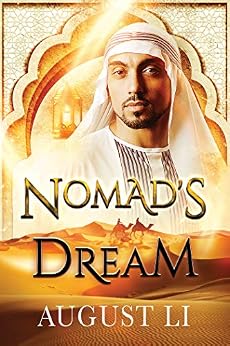
2020/97: Nomad's Dream -- August Li

Isra looked down and saw a set of tracks made by a man in his bare feet, the shape of the heel and toes distinct where they’d pressed into the fine sand covering the old cobblestones. As he had done since the height of summer when his dreams had brought him to this place, he followed those tracks... [loc. 56]

Isra al-Grayjaab is a Bedouin, happy to roam the Egyptian desert with his herds, encountering family and friends as he travels. But lately, he's been haunted by dreams of a mysterious barefoot man. Perhaps he's simply a mirage, a figment of Isra's longing for a true companion. But perhaps he's real.  

Since childhood, Isra's has a friend named Flicker (I found this name a bit jarring), who is a djinn or arafrit. When Isra tells Flicker of his dream, Flicker leads him to an amnesiac beggar sleeping rough in a ruined temple. It is, of course, the man from Isra's dream, and Isra bestows the name Janan -- and an offer of help and support -- on his new acquaintance. 

The two quickly become close: but Flicker discovers that Janan is under a curse, and when his true identity is revealed, it's clear that the stakes are higher than Isra could ever have suspected. 

As a result of reading and discussing this novel, I became more familiar with the term Orientalism (which I'd blithely assumed referred to exoticisation of Far Eastern cultures, rather than the prioritising of 'Western' over 'Arabic' / Islamic culture). Is Isra's life romanticised? Yes, to some extent: but I don't think it's more romanticised than other depictions of those who turn away from late-stage capitalism. (Compare and contrast various tales of rural British life.) And it's important, in the novel, that Isra's world is so very different to Janan's. 

I wasn't wholly convinced by the instant attraction and romantic affinity between the two leads: also, I would have expected a little more unease about a homosexual relationship in that cultural setting. (But both are discreet and not especially bothered by social constraints.) An enjoyable read, though: a sweet romance threatened by a family feud and by ancient, supernatural powers, with a happy ending that doesn't involve too much compromise.

Monday, August 03, 2020

2020/96: A Memory Called Empire -- Arkady Martine

...each and every one of those captains has led troops down into a new system, carrying all the poison gifts she can muster: trade agreements and poetry, taxes and the promise of protection, black-muzzled energy weapons and the sweeping architecture of a new governor’s palace built around the open many-rayed heart of a sun temple. [p. 11]

Mahit Dzmare, the new ambassador from small, independent Lsel Station to the huge and powerful Teixcalaanli Empire, has been an admirer of all things Teixcalaanli since childhood. With the imago, or memory-dump, of the previous ambassador Yskandr Aghavn embedded in her brain-stem, she is beginning to understand the Byzantine complexities of the Empire. But Yskandr's imago is fifteen years out of date, and Yskandr himself has vanished. Mahit has to negotiate her new role, and work out whether her guide and assistant, Three Seagrass, really has Mahit's interests at heart.

A Memory Called Empire is a dazzling novel, overflowing with ideas and world-building and fascinating characters. It's easy enough to read as a murder mystery, or as complex diplomatic tale of shifting allegiance, issues of inheritance, and the threat of subsumption into a vast unstoppable Empire: but there is also a detailed exploration of how Teixcalaanli society is shaped by its artworks (Mahit is a great admirer of Teixcalaanli poetry), its naming conventions, and the embedded remnants of its ancient past -- sun-worship, blood sacrifice, 'like something from the oldest epics'. 

Mahit is a delightful protagonist: she's treated as a barbarian by the Teixcalaanli, but she's educated, quick-witted and competent. I would have liked more Yskandr -- I confess that the whole notion of sharing one's mind with someone else's memories intrigues me mightily -- but I think if he'd been the focus of the novel, it would have been quite a different story. (Though there would have been at least as much queer representation, culture-clash and spy jinks.) 

 I'll need to reread this before I read the second novel, A Desolation Called Peace (due March 2021): that will not be a hardship, and I expect to discover new aspects and resonances that I've missed on first reading.