Monday, June 15, 2020

2020/068: Chosen Spirits -- Samit Basu

'Dystopia is pornographic, Olamina. You see it and shiver but it's also kind of fun because it's happening somewhere else, to someone else, you know? It requires distance. Some of us are actually sitting in the fucking middle of it and we may never learn to care in time. This isn’t dystopia. This is reality.’ [loc. 2347]

Delhi, the near future: Joey (Bijoyini Roy) is an Associate Reality Controller, running the Flow (live, curated, multichannel videostream) of Indi, a popular entertainment Icon who also happens to be her ex. She hires Rudra, a family friend who's being pressured into abetting his family's exploitative concerns: this sparks a chain of events that open Joey's eyes to the inequity, corruption and superficiality of the society in which she lives.

That's a poor summary of a complex and dynamic novel: I had the same feeling of sensory overload and hurtling plot that I recall from early cyberpunk novels, and the same desire to keep reading, to immerse myself in this new milieu. Basu's Delhi is far from idyllic: constant, AI-driven surveillance, Residents' Associations enforcing local restrictions, water shortages, deadly heat, riots and violence, caste and class, and the ubiquitous 'smarttatt' assistant, Narad, that probably has Siri somewhere in its ancestry.

Joey's parents look back to the Years Not to Be Discussed -- basically our own present day -- before which it was safe to express controversial opinions, go outside without a mask, et cetera. "... they'd known the end times were coming but hadn't known they'd be multiple choice." Joey and Rudri know the world has changed, but -- being privileged, liberal upper-middle-class types (I do not pretend to understand the interaction of class and caste) -- are only vaguely aware of the dissent and revolution bubbling under the city's multicultural, media-focussed milieu. But the resistance is growing. Protests are advertised via hidden QR codes in kolams, including their 'potential bloodshed rating'; Joey's parents' housekeeper, Laxmi, shows Joey the Flows of illegal immigrants and street people; and Rudri is transformed from scion of a slave-trading family to ... something quite different.

Chosen Spirits was an immensely satisfying read, despite its uncomforting depiction of the future. It's thoroughly and joyfully Indian -- cultural and regional concerns focus on China and to some extent Africa, not Europe or America: "we never thought America was better than us" -- and full of unfamiliar words (kuàizi, laifu, pyravikar, saptaparni, zenana). It acknowledges the ecology of modern media: "asteroid belts of stans, shippers, fan-fiction Flowers, re-enactors and deep-fake pornographers". Its inequalities are intersectional: race, class, gender, caste and more. And it is thoroughly science-fictional, with notions that'd anchor a simpler novel simply mentioned in passing. Highly recommended.

Sunday, June 14, 2020

2020/067: My Year of Rest and Relaxation -- Ottessa Moshfegh

I can't point to any one event that resulted in my decision to go into hibernation. Initially, I just wanted some downers to drown out my thoughts and judgments, since the constant barrage made it hard not to hate everyone and everything. [p. 17]

The unnamed narrator of My Year of Rest and Relaxation is the archetypal 'poor little rich girl': white, beautiful, wealthy and cultured, but desperately unhappy. I'm not sure the author intended us to empathise with her, but I did, to some extent. However, it's abundantly clear that she is not a nice person. She's blind to her own privilege, vile to her best friend Reva, a pathological liar, selfish and manipulative. She's obsessed with her abusive and manipulative ex, and contemptuous of the NYC art gallery where she works.

She is also suffering from severe mental illness, and her solution is to spend a year 'hibernating', sleeping or doped up as much as possible, to refresh and renew herself. With the aid of her 'irresponsible and weird' psychiatrist, Dr. Tuttle, she experiments with a cocktail of psychoactive drugs that, realistically, would probably kill anyone who took so many for so long. Infermiterol (the author's invention) turns out to be the the solution: it bestows three-day blackouts during which the protagonist apparently shops, goes clubbing, smokes cigarettes and so on, but of which she retains no memory.

At the beginning of the novel, the protagonist describes her urge to hibernate as 'the opposite of suicide ... self-preservational': but to me it seemed as though she was trying to erase herself, continuing the erasure perpetrated by her parents, her classmates, her various exes, even her (only) friend Reva. None of those people seem to perceive our narrator, or engage with her emotionally: they may as well be talking to, interacting with, themselves. Even Dr Tuttle, dispenser of pharmaceuticals, isn't interested enough to challenge any of the narrator's lies.

I found myself empathising with the narrator at various points: some of her experiences of rejection echoed some of mine. And I empathised with her urge to curl up and hide from the world. The image at the end of the novel, "a human being, diving into the unknown, and she is wide awake" [p. 289] affected me strongly, though that may just be because of the actual event it fictionalised.

Gorgeous writing, savage satire, horrible-yet-pitiable narrator: I'm not sure I'd call this an enjoyable novel but I found it compelling.

Saturday, June 13, 2020

2020/066: Winter Tide -- Ruthanna Emrys

Someone lied about us, about what we did in our temples and on beaches such as this. The government believed them: when I was twelve they sent soldiers, and carried us away to the desert, and held us imprisoned there. [p. 26]

Ruthanna Emrys' Winter Tide is a subversion of Lovecraft's The Shadow over Innsmouth: here, the monsters are white men, and the narrative focusses on characters -- Aphra and Caleb Marsh, Ron Spector, Professor Trumbull, Dorothy Dawson, Neko Koto, Charlie Day -- who are variously 'other', Jewish or queer or female or Japanese or Black.

Aphra and Caleb are the last two survivors of Innsmouth, having endured eighteen years in an internment camp, where they were befriended and helped by the Koto family when Japanese-Americans were interned during WWII. Aphra is working in a bookstore and, together with her boss Charlie, trying to piece together the ancient rituals and traditions that are her heritage, when she is approached by FBI agent Ron Spector, who wants her help in investigating a Russian spy ring which might be trying to use ancient body-swapping techniques to infiltrate the highest offices of government. In exchange, Aphra and her brother will gain access to the library at Miskatonic, where books stolen from Innsmouth -- their heritage and history -- have been locked away. During the course of their investigation they encounter a Yith (time-travelling body-swapping archivist) in human form, a young African-American woman whose FBI assignment is deeply repugnant, and a number of irritating white men.

I admired this novel a great deal: the prose is lovely and the examination and reframing of Lovecraftian 'horrors' from within is thoroughly convincing. I didn't really warm to Aphra, for some reason: perhaps her hard-earned detachment, perhaps my own emotional state. But I am interested enough in the plot and setting to want to read the second in the series, Deep Roots. And the themes -- found family, reclaiming one's heritage, pushing back against expectation -- are ones that resonate, for me.

Tuesday, June 09, 2020

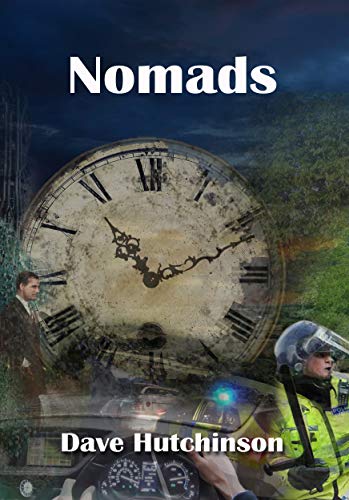
2020/065: Nomads -- Dave Hutchinson

“I’m empowered, on behalf of Her Majesty’s government, to welcome you to Earth,” she went on, “but first I need to know how long you’ve been here and where your home solar system is.”
Pep burst out laughing. [loc. 986]

A novella of two halves: in the first part, we meet Sergeant Frank Grant, comfortably policing a rural area somewhere in Yorkshire. Unfortunately, his report on an intruder at a remote farmhouse attracts the attention of Internal Affairs, and Frank has to abandon some long-range plans. The second half of the story makes it obvious that he's not going back to his flat above the police station -- though it's not at all clear what he'll be doing instead.

It's hard to write much about Nomads without giving the plot away (the quotation at the top of this review doesn't spoil anything), but there are hints and allusions scattered through the opening chapters that combine to produce a sense of oddness, and make complete sense after the Big Reveal. I did feel, though, that the final few chapters were rushed: there's a lot more story to tell, and I'd love to read it.

Like all of Hutchinson's work, there's a low-key comfortable cynicism and some dry wit here. The everyday business of subterfuge -- safe houses, minders, decoys and press releases -- is sometimes reminiscent of Le Carre: no glamour here. Frank is a pragmatic protagonist, not given to bemoaning his lot, and possibly not as wholesome as his narrative suggests. I would like to see more of him.

Sunday, June 07, 2020

2020/064: Passionate Travellers -- Trish Nicholson

(Note that we are prying: Montaigne did not intend his travel journal for publication, but it is too rich a document to be forgotten, and we will be discreet.) [loc. 2529]

The travellers' tales in this volume are organised by geographical region, and then by period: so, under 'Central Asia and India' we find Fâxiân (a Buddhist monk) travelling in 399CE; Alexandra David-Neel, entering Tibet in disguise in 1924; and missionary Mildred Cable, travelling to Huozhou in 1901.

Statistically it's an interesting mix: 8 women, 13 men; the earliest is Herodotus, ~428BCE (his account was one of the finds at Oxyrhynchus), the most recent Gladys Aylward, 1932. Many journeyed for religious reasons, others for sheer love of adventure. (And one chap crossed America on a penny-farthing, because he could.)

I read this book over a period of several months, partly because some of the travelogues are better reading than others (I especially enjoyed the chapters on Robert Louis Stephenson, Alexandra David-Neel and Octavie Coudreau) and partly because I found it more pleasant to dip into these tales -- remote in time and space, but filled with timeless concerns and recognisable idiosyncrasies -- than to read them all in one rush. For one thing, a lot of the journeys start off with the problems of travel in that place at that time ...

A few minor issues ('white and guilt paintwork'; a claim that the lowest temperature on Earth was recorded in Tibet; a reluctance to call Byzantium by that name; references to 19th-century attitudes in a chapter about a 20th-century journey) but they didn't spoil an intriguing book, which introduced me to travellers that I hadn't heard of before.

Saturday, June 06, 2020

2020/063: Creatures of Will and Temper -- Molly Tanzer

...they were connected by a will not their own that loved them both equally and sought to add their uniqueness to its understanding of the world. [p. 305]

Evadne and Dorina Gray are sisters, but there's little common ground between them. Dorina is the golden child, indulged by their parents, fond of art and clothes and beauty: Evadne is plain, restrained, and a practitioner of the unfeminine art of fencing. When she inadvertently witnesses her sister debauching one of the local girls, she tattles to their mother -- and ends up as chaperone to Dorina on the latter's long-anticipated trip to London. The girls are to stay with their uncle, the painter Basil Hallward, and Dorina hopes that he will help her in her ambition to become a noted art critic.

But Basil is reserved and melancholy, mourning the death of the close friend he's immortalising in oils, and all would be dire for Dorina if she had not been introduced to Basil's friend Lady Henrietta Wootton, known as Henry. Henry's aesthetic interests intrigue Dorina, while Evadne is appalled to see a grown woman dressing in men's suits.

Evadne seeks solace in a fencing school, recommended by the young man she hoped to marry: Dorina throws herself into the social whirl that has Henry at its heart. But both the fencing school and the aesthetes' dinner parties harbour secrets which put the girls in danger ...

Victorian lesbians! Diabolists! Fencing! Art! And a dialogue with Oscar Wilde's The Picture of Dorian Gray! (As the author says in her afterword, "envisioned through a glass…not darkly, but brightly": this is a much more cheerful tale than Wilde's original.) I found the final few chapters rather breathless, and the epilogue glossed over too many aspects of the situation: but this was a madly enjoyable read with a complex and credible relationship between the sisters, and tantalising hints of the relationship between Lady Henry and her ginger-loving guest. (The diabolism in this novel is quite different to the usual midnight sacrifices and raving possession.) The villain wasn't too difficult to identify, especially given some of their habits, but on the whole the plot progressed satisfactorily.

Wednesday, June 03, 2020

2020/062: Daisy Jones and the Six -- Taylor Jenkins Reid

Daisy: I had absolutely no interest in being somebody else’s muse. I am not a muse. I am the somebody. End of fucking story. [loc. 393]

A rockumentary in the form of a novel, Daisy Jones and the Six is told entirely in interview format, featuring the voices of The Six, their erstwhile singer Daisy, and various friends, colleagues and lovers. It's set in the 1970s -- I was horrified to discover that this is tagged as 'historical fiction' by many on Goodreads! It can't be history, I remember those years! -- and examines groupie culture, creative differences and the fragile interface between emotion and art. There's a distinctly feminist mentality here, which Reid manages to convey without anachronism. Possibly that's because the story does focus on Daisy, and on several other excellent women (Karen the Six's keyboard player, Camila the band's founder's wife, Simone the disco star who's Daisy's best friend).

I found this an easy and enjoyable read. The voices of the various interview subjects are sufficiently differentiated to make the 'oral history' format read smoothly: there are also many delightful instances of mis- and re-interpretation (though one might ask why the individuals concerned didn't discuss these with one another, rather than waiting to be interviewed many years later). (Oh, wait, yes: rock stars.) Ego, narcissism, a classic love triangle -- as well as the predictable sex'n'drugs'n'rock'n'roll -- make this a credible and often amusing take on the Seventies rock-star lifestyle, and the tensions that can make or break a band.

Late in the novel we discover the identity of the interviewer: I found this an interesting twist while reading, but now wonder what purpose it serves.

Soon to be a TV series -- I may actually watch it.