Tuesday, July 23, 2019

2019/75: The Green Man's Heir -- Juliet McKenna

She could well have seen who had killed the girl. If so, what good was that? A dryad was one witness the police could never take a statement from. [loc. 234]
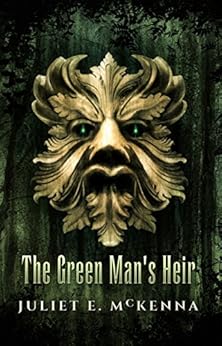
Daniel Mackmain is a woodworker and carpenter, whose mother is a dryad. Dan doesn't care to put down roots, to settle anywhere or with anyone: all too soon they'd notice that he was different. Still, he longs to find someone who truly understands his life.

Dan's living in rural Derbyshire, led there by dreams, and thinks he might have found some woodlands ancient enough to harbour dryads like his mother. He's right: but that's not all they harbour. A local girl is murdered, with a dryad as the only witness, and there are other bones lying undiscovered in the wood. Something is stalking the woods, something worse than the boggarts that torment the pub dog; something far worse than Dan's irritatingly nosy landlady or his fed-up girlfriend. Dan finds help from unexpected sources, but he's also human enough, and visible enough -- and behaving suspiciously enough -- to be a person of interest to the local police, and to the thing that walks by night.

I wanted to like this more. However, I didn't find Dan likeable or relateable -- he has an explosive temper and is really unpleasant to the nosy landlady, and to others -- and I felt his first-person narrative was rather flat: he describes making a sandwich, or going to the supermarket, in much the same tone as a fight against supernatural evil or an encounter with an apparently-benevolent nature spirit. I also experienced narrative dissonance, in that I found myself very sympathetic to one of the nasties, because the language Dan used to describe it was so very un-nasty. Poor frantic little wyrmling, crying for its parent!

The Green Man's Heir is very much a book of two halves: in each half, Dan locates and battles a supernatural villain, with the help of a not-quite-human female, but there is very little crossover between the two stories. I'm not convinced, either, that the title really works with the book as it stands, though I concede that a sequel may clarify that matter.
Sunday, July 21, 2019

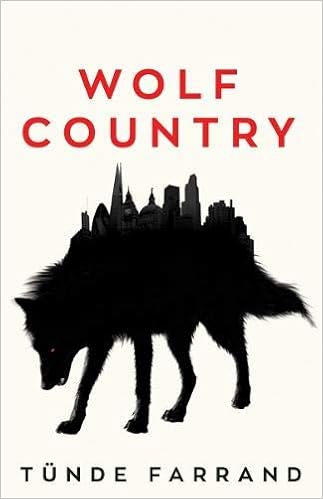
2019/74: Wolf Country -- Tunde Farrand

There must be a reason why ninety-six per cent of people choose retirement over instant euthanasia. [loc. 622]

A near-future Britain in which secure employment and free (urban) housing are provided to those who earn their Right to Reside by consuming luxury goods. The cost is not financial, but social: when an individual can no longer work, they are entitled to a year's luxury retirement at a Dignatorium: after that, euthanasia.

Which actually doesn't sound so bad -- no more retirement homes, slow helpless undignified deaths, poverty et cetera. Except of course it's not that straightforward.

Alice is abandoned by her husband, who's missing presumed dead: within days, her carefully-tended consumer lifestyle is crumbling around her, and she is 'demoted' from High Spender to Low Spender. She begins, belatedly, to ask some questions about this new social order, and gets some answers she really doesn't like. She's forced to contact her estranged sister Sofia, now one of the elite Owners, who explains the horrifying truth behind the state's promises, and the fate that awaits Philip.

This is an odd book. It's not wholly successful, and the prose is unexciting: but it's a compelling read, though I found it hard to sympathise with selfish, blinkered Alice ("I used to be a brainwashed consumer zombie... how could I have known better?") even when she began to realise the real story behind the Dignatoriums and the Right to Reside. I'm not sure the finale fitted the rest of the book, and it certainly goes against the stated wishes of the person most drastically affected by it . And I would have liked more background on the world outside London. The British countryside's basically off-limits, and ordinary people are discouraged from venturing out of the cities by the threat of giant mutant wolves -- the reality of which could have been expanded upon. But what about the rest of the world? There are mentions of America, but little else.

An accessible depiction of a dystopia, but I don't think it's sufficiently consistent or coherent to be truly frightening.

Saturday, July 20, 2019

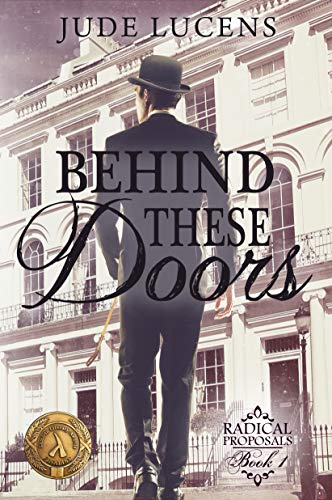
2019/73: Behind These Doors -- Jude Lucens

“Actually… I’m not sure I’m up to this level of—of sophisticated aristocratic entanglement.”
“I’m sure it’s not exclusive to aristocrats.”
“Oh really?” Lucien glared at him. “D’you think anyone else has the time for this kind of complication? We’re a bit too busy earning our daily bloody crust for that!” [p. 226]

Lucien Saxby is a society journalist, writing for the Daily Mail (though in 1906 that was a more reputable organ than it is now). He meets the Honourable Aubrey Fanshawe at the theatre one night, and goes home with him: and that should be that, except that one of Aubrey's companions at the theatre takes it upon himself to complain to Lucien's editor about Lucien's behaviour towards Lady Hernedale. Disentangling and defusing this potentially-ruinous accusation brings Aubrey and Lucien together again, despite working-class Lucien's distrust of the nobility and Aubrey's fear of blackmail and exposure.

It's not as though Aubrey's unhappy with his polyamorous relationship with Lord and Lady Hernedale, also known as his childhood friends Rupert and Henrietta. And Lucien is close to William, with whom he was brought up, and has other occasional lovers. But neither of them feels that marriage to a woman is desirable, and neither has experienced any emotional connection like this before.

Behind These Doors also features Miss Enfield, a female journalist who's far better at political reporting than Lucien but will never get plum assignments because of her sex; the delightful Henrietta, who is quite vehement on the subject of women's rights herself; Lucien's childhood friend William, now an invalid; Aubrey's pragmatic manservant Grieve; the redoubtable Rupert, and his slimy brother-in-law Lowdon. It's a larger cast than in many romances, and there is quite a bit of plot that doesn't impact on the various relationships, at least not directly -- though Lucien fights fiercely for his independence and reputation as a journalist, and Aubrey finds himself having to deal with drastic changes, not only in his personal affairs but in his understanding of his own, hitherto unconscious, privilege.

I frequently complain about lack of communication in novels, especially romances, but I would like to stress that this is not an issue in Behind These Doors. They talk a lot. None of the characters are very good, initially, at telling one another the things that really matter, whether practical ('these people are also my lovers') or emotional ('I really l-l-like you'): all of them get much better at it over the course of the novel. There is plenty of examination of privilege, both class- and gender-based: the focus on the women's rights movement -- with a great deal of accurate historical reportage -- and on the involvement of aristocratic women in that movement was well-handled, as on a more intimate level was Lucien's upbringing on the fringes of the aristocracy and his exasperation with Aubrey's naivete.

A good interview with the author, in which she discusses Behind These Doors and planned sequels.

Thursday, July 18, 2019

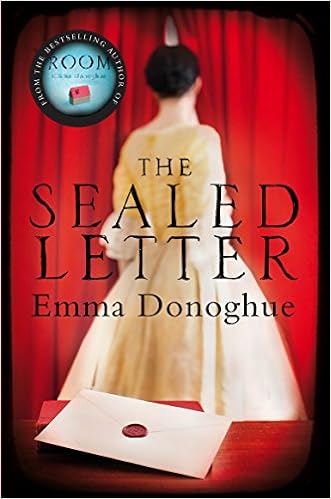
2019/72: The Sealed Letter -- Emma Donoghue

A proof of a suspicion, only. No one has named that suspicion, in court or in the newspaper. (Not the kind of thing anyone wants to spell out, even in these tell-all times.) A word to the wise. Those who don’t understand it won’t even notice what they’re missing; those who do, will comprehend the whole business in a moment. Sealed up. [loc. 4189]

When Emily Faithfull -- known as 'Fido' -- owner of a women's press and dedicated campaigner for women's rights, runs into her old friend Helen on Farringdon Street in the summer of 1864, it's the first time they've met for seven years. Helen and her husband Captain Codrington had invited Fido into their lives: Fido had attempted to mediate in their unhappy marriage. Then the Codringtons went to Malta, and Fido was abandoned.

But now, amid laments of letters lost in the post, Helen and Fido are reunited. Fido is ecstatic, though saddened to learn that Helen's marriage is no happier: indeed, Helen seems to be having an (entirely platonic, she claims, and emotionally necessary) affair with a young officer. Fido does her best to inject reason and propriety into Helen's life: Helen, however, is hedonistic and duplicitous (not to mention her disregard for the rules of hospitality: she draws Fido into her web of lies), and Fido's efforts are unsuccessful. When Helen's long-suffering husband Harry -- whom Fido has always liked and admired -- finally files for divorce, though, Fido is drawn into Helen's version of the story: into the possibility of perjuring herself for the sake of her friend's happiness.

I found Helen alarming and predatory, almost sociopathic: but I could also see why innocent, unworldly Fido was drawn to her. What a contrast to Fido's world of Employment for Women, her work with the Langham Place group, her friendships with fellow activists. (Though as the novel progresses, some of the shine of Fido's ardent endeavours is dulled: an employee turns out never to have quit prostitution, the sisterhood of the Reform Firm becomes rather less sisterly, the press is targetted by saboteurs.)

The Sealed Letter illustrates the damnable dual standards of the Victorian legal system: 'the possessions of the woman who commits murder, and those of the woman who commits matrimony, are both dealt with alike: by confiscation', remarks Fido. Worse: a woman's children are regarded as 'gifts' from her husband, which can be withdrawn: Helen is (or claims to be) devoted to her daughters. There's always the possibility, too, that Helen will be deemed mentally unfit by the court, in which case Harry can have her confined to an asylum for the rest of her days.

But at the heart of the novel is Fido's gradual discovery that her feelings -- loyalty, friendship, love -- for Helen are not reciprocated. It's an acutely intimate, and sometimes painful, portrait of a friendship, or perhaps a love affair, and its disintegration. I felt that the reader's perception of Helen was clearer than Fido's, but then we don't have the history that Fido and Helen -- and Fido and Harry, and Helen and Harry -- have lived.

The Sealed Letter is based on the Codrington divorce case of 1864: you can read Emma Donoghue's note here. 'I ... love finding gaps in the evidence which leave room for me to invent,' says Donoghue in her Afterword. In particular, her speculation on the contents of the titular letter -- laid before the court by Harry as evidence in the increasingly sensational divorce case -- is remarkably poignant, and casts a different light on some of the novel's events.

I was jolted by some apparently-anachronistic simile / metaphor -- would Fido really feel that her tank was empty? -- and some abrupt, temporary viewpoint switches: but 1860s London came to life.

I actually purchased this Kindle book seven years ago -- and finally read it to meet the 'Lambda Award winner rubric of the Reading Women Challenge 2019.

Saturday, July 06, 2019

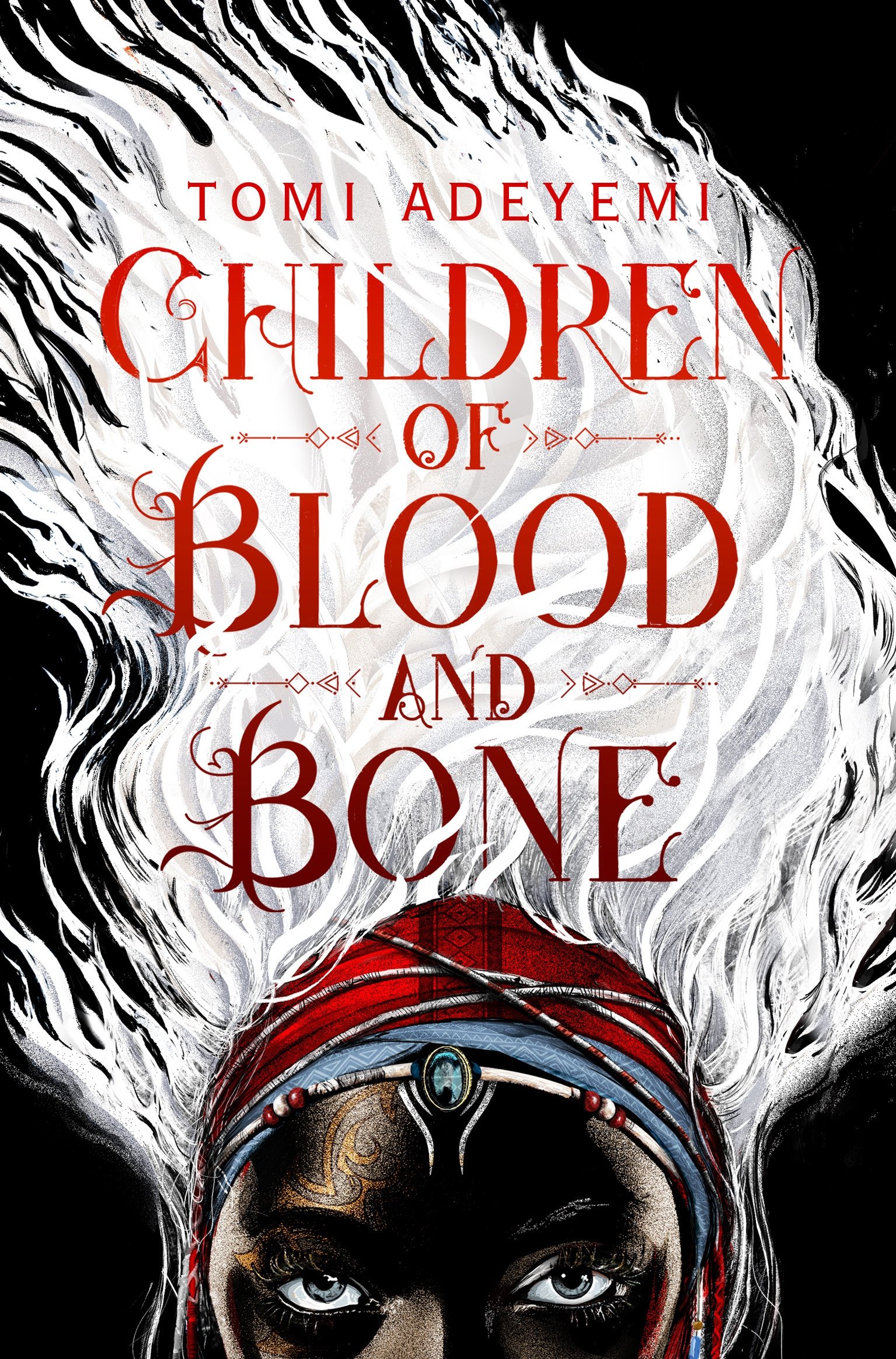
2019/71: Children of Blood and Bone -- Tomi Adeyemi

"... eleven years ago, magic disappeared. Only the gods know why."
....I know the truth. I knew it the moment I saw Mama in chains, hanging with the maji of Ibadan from that lifeless tree. The gods died with our magic.
They're never coming back. [loc. 243]

I am not the target audience for this YA fantasy novel, rooted in West African mythology. I am glad it exists and has garnered so much praise, but I didn't find it satisfying. In fact, it took me three starts before I got more than a quarter of the way through.

There are three narrators: the protagonist is Zélie, who saw her mother murdered for being a 'maggot' -- the derisory name for magic-users, or maji, who have straight white hair rather than the more usual black curls. Zélie is tough, capable, a fighter: she also has a hot temper.

The second viewpoint character is Amari, a princess who sees her father kill the slave-girl who was Amari's best friend -- and who turns out also to have been a maji. Fleeing the palace, she encounters Zélie, and discovers that their fates are linked.

Unfortunately, they are pursued -- by Amari's brother Inan, the third narrator. He is determined to take his sister home; unaccountably drawn to Zélie; and deeply afraid of the white streak in his own hair, the whiteness that no dye can hide ...

The setting and world-building is rich and detailed, a blend of Yoruba religion and Nigerian geography with fantastical elements. (I was bemused by trying to visualise a 'bull-horned lionaire', or a 'horned leopanaire'.) The magical system is clearly described: there are ten clans of maji, each with a different deity and domain. Eleven years before the story begins, the Raid -- a wholesale slaughter of maji by the king's soldiers -- apparently wiped magic from the face of the earth. The aftershocks of that slaughter resonate throughout Orisha.

Thematically, Children of Blood and Bone deals with power and corruption, and especially the oppression of a disempowered group. The cruelty and injustice of the king's forces is horribly reminiscent of contemporary brutality. The poverty in which Zélie and her family live contrasts sharply with the opulence of the royal palace: again, not a million miles from our own inequalities.

Unfortunately I found the plot (collect some magical items, go to a temple, perform a ritual at the solstice) rather cliched; and I was thoroughly unconvinced by the budding romance between Zélie and Inan. The writing style didn't engage me, either: short punchy sentences, dialogue that was sometimes melodramatic and sometimes flat, some clunky phrases ('on the coast of the sea'). And I felt that there were too many vividly-described scenes of violence and murder.

I wish this book, and others like it, had existed when I was a teenage fantasy reader. I will be interested to see how Tomi Adeyemi's writing develops over her next few novels.

[I received a free copy of this novel, via NetGalley, as part of the Hugo Award Voters' Pack.]

Friday, July 05, 2019

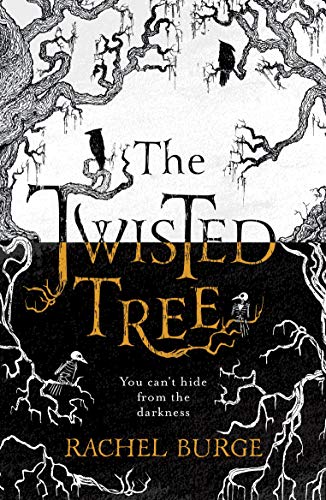
2019/70: The Twisted Tree -- Rachel Burge

For now, all you need to know is that our ancestor, a weaver woman named Aslaug, made a sacred vow that she and her line would take care of the tree in the garden. [loc. 921]
Martha adores her Norwegian grandmother, who she calls Mormor -- but she hasn't heard from Mormor since the accident in Mormor's garden, when Martha fell out of a tree and lost her sight in one eye. She's also acquired the ability to read a person's thoughts by touching their clothing. Can Mormor help? Without her mother's knowledge, Martha sets out for Norway, heading for the tiny island of Skjebne where her grandmother lives.

Except that when she reaches her grandmother's house, Mormor is nowhere to be found -- but there's a strange boy, Stig, sleeping there. And nobody's been watering the tree in the garden...

This is a dark fantasy rooted in Norse mythology. There are some interesting ideas, but I didn't find Martha very coherent as a character: she is ashamed of her appearance, crushes on Stig, witnesses the aftermath of violent death, is hunted by a monstrous creature, crushes on Stig ... And Stig is a mystery. Because the narrative is from Martha's POV, we never get to find out Stig's story -- only the scraps that he confides to Martha, and the conflicting emotions that she picks up when she touches his jacket.

I did not find the conclusion satisfactory. There are too many loose ends. What happened to Nina? Who's going to water the tree? If a dog is saved, why not a human? And of course, the perennial annoyance: why did the characters not communicate with one another? Most, if not all, of the horror could have been avoided...

Kudos, though, for a body-positivity talk from Hel; a sensible, if not always sensitive, treatment of mental health issues; a sense of female empowerment (most of the characters, alive or dead or immortal, are female) and plenty of echoes of Norse mythology.

Tuesday, July 02, 2019

2019/69: Hither, Page -- Cat Sebastian

Secrets were the invisible skeleton of society. Everything depended on the strength of secrets, and on not being able to see them; like a skeleton, once the secret was visible to the naked eye, something had gone drastically and irretrievably wrong. That was when people started to die. [loc. 1379]

Sheer coincidence that I read two M/M romances consecutively, both set in English villages in the 1940s. They're very different stories, though.

James Sommers is a country doctor, haunted by his experiences in WWII, who's set up a practice in the small village of Wychcomb St. Mary. Everyone in the village knows everyone else -- and they all agree that Mildred Hoggett, a cleaner who's employed by several prominent villagers, is up to no good. And then she dies in suspicious circumstances.

Enter Leo Page, sent to Wychcomb St. Mary to determine whether the murder has anything to do with espionage. Leo is rootless -- it's rare for him to work in England, or under his real name -- and ruthless, prepared to do whatever it takes to ensure that loose ends are tidied away and a potential double agent isn't spooked.

Leo finds himself wishing that he was the sort of chap who could lead a normal life. He doesn't even know what's inside a Christmas cracker. And Wychcomb St Mary may be seething with secrets and the aftermath of war -- James Sommers certainly is -- but perhaps it's still a place where Leo can make a home.

This is a cosy murder mystery with a cast of intriguing characters, all of whom have secrets (though some of those secrets aren't very well concealed). The vicar's wife is definitely not telling Page, or Sommers, everything she knows -- especially about evacuee Wendy, the beneficiary of Mrs Hoggett's will. And the two old ladies, Edith and Cora, may not be as harmless as they seem.

James Sommers' PTSD is sensitively described rather than dramatised; Leo Page's back story is sketched rather than set out; and there is a thoroughly satisfactory ending for all the (surviving) characters.

First in a new series. Incidentally, the action of the novel takes place over a week in December 1946: I'd strongly recommend reading it in winter, for it is a very wintry novel, with fresh snow and roaring fires ... and an epidemic of tonsillitis!