Sunday, October 28, 2018

2018/74: The Stranger Diaries -- Elly Griffiths

‘Diaries don’t tell you what people think. Just what they think they think.' [loc. 2556]

I've been reading and enjoying Griffiths' Ruth Galloway books (most recently The Chalk Pit) for years, so was keen to read this standalone novel, set in West Sussex rather than North Norfolk: thanks to NetGalley for the review copy of The Stranger Diaries, in exchange for this honest review!
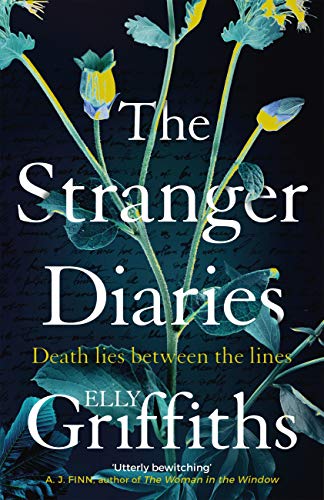
The Stranger Diaries is a Gothic thriller with three first-person narrators: schoolteacher Clare, whose friend Ella has been found dead; Detective Sergeant Harbinder Kaur, who (together with her partner DS Neil Winston) is investigating Ella's death; and Georgia, Clare's teenage daughter, who has quite a few secrets of her own, and doesn't share them all on social media.

Clare Cassidy is a divorcee who's moved to Sussex to start a new life with her daughter Georgia. Clare teaches English and creative writing at Talgarth High, formerly the home of Victorian ghost-story writer R. M. Holland, a figure who has fascinated Clare since she read his short story 'The Stranger' in her teens. She's working on a book about Holland, and wondering whether the school is really haunted by the ghost of his wife -- or his daughter, if she even existed -- when her comfortable life is interrupted by the death of her friend and colleague Ella. Someone (the killer?) had left a note by Ella's body: 'Hell is empty': not just a quotation from The Tempest, but also a line from Holland's 'The Stranger'. And then Clare begins to find notes in her private diary, in a handwriting she doesn't recognise...

This is a well-paced and twisty murder mystery with a feast of red herrings. The male characters are, on the whole, unsympathetic: Clare's ex-husband Simon is brusque and unreliable, Georgia's friend Patrick prone to dramatics, DS Winston ineffectual, Clare's head of department Rick an unscrupulous adulterer. In contrast, the female narrators have distinctive voices and intriguingly varied perspectives on the situation.

And there are diaries throughout: R. M. Holland's diary, much studied by Clare; the diaries that Clare keeps ('like the heroine of a nineteenth-century novel', says Harbinder disparagingly); Georgia's carefully-polished entries on the site MySecretDiary. ('I can’t imagine how it must feel to write your diary by hand, knowing that you only have one chance to express yourself, that the ink is on the paper for ever,' she muses.) The thing with diaries, of course, is that you can never be entirely sure that nobody else is reading them. Or that you've told the truth to yourself.

There were a couple of points, especially regarding standard police practice, where my sense of disbelief fell flat: but on the whole The Stranger Diaries is an excellent read, full of autumnal atmosphere and hints of the supernatural, and threading the text of R. M. Holland's (imaginary) story 'The Stranger' through the gathering menace of the contemporary plot.

Saturday, October 27, 2018

2018/73: Bone Rider -- J. Fally

... 'They’ll never believe you’re not under my control. They’ll think I contaminated you. Maybe they’ll think I laid eggs in you. Or that I’ll burst out of your chest. Or other gross things. They’ll— '
“Shut up,” Riley ordered, chilled by the utter belief and gnawing horror in McClane’s voice. No surrender. [loc 4558]
The romantic, steamy and bloodthirsty story of a Russian hitman, a Texas slacker, and the smartass sentient alien armour that ... complicates their lives.

Bone Rider opens onboard an alien spaceship, which subsequently crash-lands in Texas. This is because System Six, a self-aware symbiotic armour system, does not want to be scrapped. It's not his [sic] fault that his bond with his host is imperfect. Fleeing the US military, System Six encounters Riley Cooper, also on the run after discovering that his boyfriend is actually a hit-man for the Russian mob.

System Six is nothing if not adaptable. Riley makes ... well, not an excellent host, but an interesting one, and he exposes his new friend to Earth culture, including a Die Hard marathon: System Six adopts the name McClane, and the two (in one body) flee the growing number of parties interested in capturing or killing one or both of them.

Meanwhile, Misha will stop at nothing to get Riley back. And the US Government will stop at nothing to retrieve the alien technology that Riley's hosting. Riley, on the other hand, is becoming quite enamoured of his armour, which turns out to have some surprising talents.

This was immense fun, though there are some significant flaws: far too many viewpoint characters; canon-typical violence where 'canon' is the Die Hard school of Hollywood thriller, i.e. really bloodthirsty; an ending that seems somewhat facile; some unresolved tensions and issues. On the other hand, it's surprisingly strong on female characters for a gay romance -- I especially liked Misha's sister -- and the protagonists are credible, rounded individuals. It's also a very funny novel, and I really wish I'd read it before I saw Venom ...

Tuesday, October 23, 2018

2018/72: Fire and Hemlock -- Diana Wynne Jones

"if I were to tell you what they were in That House, you’d laugh and not believe me. Nowadays they lay it on the men not to tell, you know.” [p. 306]
Reread: I hadn't read this for a long time, but remembered a surprising amount of detail, from Polly's doubled memories to her removal of the opal necklace that's supposed to protect her from malefic forces.

Polly is about to return to university when a stray thought unravels the realisation that she's forgotten a very important part of her life. For several years, as an adolescent, she had an intense relationship with the cellist Thomas Lynn. Strange things happened while they were together, almost as though the stories they told one another were somehow coming true. Then, Polly seems to remember, she did something awful ...

Fire and Hemlock is Diana Wynne Jones' treatment of the stories of Tam Lin and Thomas the Rhymer -- pretty young men stolen away by the Queen of Faerie. It's also a story about the making of a female hero, Polly: and it has uncomfortable undertones of grooming. Thomas Lynn, the young musician who's doomed to be the next tithe to hell, moulds Polly into the kind of person who might be able to rescue him: he does this by telling her stories, sending her books, and generally encouraging her to be self-reliant and courageous.

Without Mr Lynn, Polly's life might be very bleak. Her parents are separated: her father is feckless, her mother paranoid. Only Granny -- her father's mother -- provides any kind of stability ... especially after Polly's memories are amended by Laurel, who, if not the actual Queen of Elfland, is certainly a powerful supernatural force. Polly forgets Tom, and Laurel: but Laurel does not forget Polly.

This time around I found myself rather more sympathetic towards Laurel. She does merely what is in her nature. And to a greater or lesser extent she is as trapped by her story as Thomas is. It's hard to be sure what she is keeping at bay: Jones never makes clear the fate that awaits Tom, or the origin of the powers that Laurel wields. But, despite her power, she is not omnipotent: and her 'chilly logic' binds her as much as it binds her victims.

After reading this I watched the 1970 film The Devil's Widow, also a reworking of the Tam Lin story: this one is set in the late 1960s and features Ava Gardner as the older woman, and Ian McShane as her latest prey. It's an odd film (as you can tell just by looking at the poster) and not wholly successful, but very atmospheric: I do wonder whether Diana Wynne Jones ever saw it.

There are so many layers to this book: I wonder what I'll notice next time around? (And will it be in nine years' time?)

Sunday, October 21, 2018

2018/71: King Hereafter -- Dorothy Dunnett

"What else were you born for?"
"Why not happiness, like other men?" Thorfinn said.
"You have that," said his foster-father. "But if you try to trap it, it will change. Why do you resist? It is your right."
"I resist because it is no use resisting," Thorfinn said. "Do you not think that is unfair? I shall be King because I was King; and I shall die because I did die; and did I remember them, I could even tell what are the three ways it might befall me." [loc. 5055]
Dunnett's epic standalone novel, dealing with the life and death of the historical Macbeth, and theorising -- based on years of original research -- that Macbeth and Earl Thorfinn were the same person.

This isn't my favourite of her works: rereading, I'd forgotten just how much discussion of history and religion she packs in. (Much more religion than usual, because part of the story -- though not the focus -- is the tension between the pagan faith of Thorfinn-Macbeth's youth and the Christianity which promises a more practical and peaceful future.) But, rereading for some salient details about Vikings in the Isle of Man (spoiler: did not find any) I was beguiled all over again by the prophecies of Thorfinn's stepson Lulach the holy fool; by the forces that pull Thorfinn in different directions, embodied in hearty Norse foster-father Thorkel, gentle priest Sulien and stoic wife / political pawn Groa.

There is a great deal of beautiful prose here: Dunnett perhaps pays more attention to landscape and seascape, because less happens in urban contexts than in the Niccolo or Lymond series. King Hereafter, with Thorfinn's love of the sea and a host of vivid descriptions of seafaring, makes me suspect that Lady Dunnett loved to sail (see also the Johnson Johnson books. And, I suppose, Mr Crawford's galley-years?)

As in her other books, King Hereafter has a multitude of viewpoint narrators, all looking inward to Thorfinn, whose narrative voice is seldom present. He is, after all, the hero: the man who tries to create from feuding islands and little kingdoms something called 'Scotland' (well, Scotia) centuries before it's ready. There's an interesting insight into early medieval 'Scotland': it had no towns. "But the desert offers no protection to the young and the old and the sick …" [loc 9839]

A hint of homophobia (in regard to Rognvald, the golden-haired cousin who hates Thorfinn) and period-typical violence, rapine, and brutality: but these flesh out the bones of the history, rather than being used to elicit anachronistic responses from the characters, and are not included simply to shock. King Hereafter is a thoroughly immersive novel, and its final third a masterclass in the inevitable crumbling of a nascent nation, and the slow spiral downwards of its king.

Friday, October 12, 2018

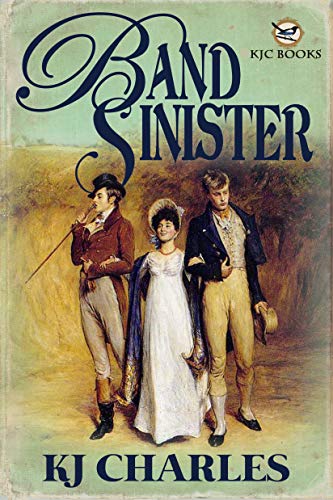
2018/70: Band Sinister -- KJ Charles

"I know it's not Latin because obscenity was the sole aspect of my classical studies to which I paid attention. I believe the word there is irrumare," Philip added, somewhat smugly.
"Fellare," Guy corrected without thinking.
"I'm sure Catullus has irrumare."
"He does, but it doesn’t mean quite the same thing."
Philip's grin was an evil joy. "You really will have to explain the distinction." [loc. 2691]
A splendidly Heyeresque romp, in which nobody dies horribly (though Amanda's riding injury, unlike those in Heyer novels, is graphic and frightful) and all receive their just, and most beneficent, desserts.

Guy Frisby and his sister live quietly in the countryside, their lives blighted by a dreadful scandal (or two) and their finances controlled by disapproving Aunt Beatrice. Guy whiles away his time reading unexpurgated Latin poetry and trying not to think too hard about why he prefers it unexpurgated: Amanda, meanwhile, has been writing a Gothic novel, The Secret of Darkdown, whose characters are based on their disreputable neighbour, Sir Philip Rookwood, and his coterie of wickedness, a.k.a. the Murder. ('if you go around belonging to a hellfire club called ‘the Murder’ and having orgies, you can’t complain if people wonder about you'.)

Guy is horrified. Amanda is blithe, and has been paid ten pounds for her novel.

Then Amanda breaks a leg, badly, while riding on Sir Philip's land, and Guy hastens to her rescue only to discover that Sir Philip's doctor (who is Foreign) insists that Amanda's life is at risk if she is moved. So Guy and Amanda must remain at Rookwood Hall for days if not weeks, constantly on guard for signs of debauchery.

These signs are not immediately apparent. Sir Philip's house-party seems to consist wholly of well-mannered young(ish) men, though two are black, one's a Jew, and at least one is an atheist. Poor Guy! The company he's forced to keep is quite unlike anything he has previously encountered -- even before he accidentally witnesses something thoroughly ... illegal. Yes. Legality is the only possible issue that Guy could have with Sir Philip's behaviour towards the rakish Lord Corvin.

This novel is a thorough delight: not one but two charming love stories, and some thoroughly transgressive (i.e. 'modern') elements including polyamory, a trans character, enthusiastic consent, fossils, the possibilities of sugar-beet, Latin vocabulary, and a passionate scene in which the two protagonists never actually touch. There is even, touchingly, an element of compassion and redemption for repressive Aunt Beatrice: I really admired that, because it would have been so easy and so credible for her to remain unchanged.

A cheering and positive read, with some characters I wouldn't mind seeing again, some very funny lines (Amanda is especially witty) and a sense that everything has worked out for the best.

Thursday, October 11, 2018

2018/69: Excession -- Iain M. Banks

call me highway call me conduit call me lightning rod scout catalyst observer call me what you will i was there when i was required through me passed the overarch bedeckants in their great sequential migration across the universes of [no translation] the marriage parties of the universe groupings of [no translation] and the emissaries of the lone bearing the laws of the new from the pulsing core the absolute center of our nested home [loc 7866]
The Excession, a black-body sphere that seems to be older than the universe and which resists all investigation, appears on the edge of Culture space. A group of Minds (artificial intelligences, embodied in various spacecraft) are extremely interested in the Excession. So are the Affront, a thoroughly nasty species ('hearty but horrible') who attempt to gain control of the Excession and thus put themselves on a more level playing-field vis-a-vis the Culture.

One of the Minds, the Sleeper Service, is sent towards the Excession by its fellow Minds. The Sleeper Service has been home for over forty years to Dajeil Gelian, who has prolonged her pregnancy for decades due to betrayal by her lover, Byr Genar-Hofoen (who was also a woman at the time but is now a man, and likes hanging out with the Affront). The price of the Sleeper Service's cooperation is an engineered reunion between the two.

I remember greatly enjoying Excession when I first read it, back in the last millennium. This time around, I found Genar-Hofoen thoroughly toxic, noted a sour tang of misogyny, and was much more interested in the Minds and the Excession -- and the dastardly plot which has been hatched with the Excession as an excuse.

Splendid big-screen space-opera, some fascinating ideas (like the Sleeper Service's tableaux of people in suspended animation, recreating famous historical battles et cetera, and the Grey Area's habit of non-consensually reading the minds of genocidal leaders), and an interesting critique of the Culture's -- well, the Minds' -- pragmatism and sense of honour. Never mind Banks' enjoyment of the grotesque or his often-unpleasant characters, his creations are magnificent.

Sunday, October 07, 2018

2018/68: The Strange and Beautiful Sorrows of Ava Lavender -- Leslye Walton

I’ve been told things happen as they should: My grandmother fell in love three times before her nineteenth birthday. My mother found love with the neighbor boy when she was six. And I, I was born with wings, a misfit who didn’t dare to expect something as grandiose as love. [p. 56]
Ava Lavender is born with wings, and followed by a mute twin (Henry). Her family, French immigrants living in Seattle, are variously strange: there's a great-aunt who transforms into a canary to win the affection of an ornithologist, and another great-aunt who cuts out her own heart, and their brother René who has an affair with a married man and is murdered. Grandmother Emilienne ignores their ghosts, marries, produces Ava's mother Viviane -- who is as 'foolish' (and unlucky) in love as the previous generation. Her childhood sweetheart impregnates her, then marries someone else, leaving Viviane to raise their children -- Ava and Henry -- in an overprotective bubble.

Of course Ava sneaks out to hang out with other teenagers, who are curiously accepting of her difference. Of course she has admirers -- in particular Rowe (her friend's brother) and Nathaniel (a devout Christian who thinks Ava is an angel). Of course things go terribly wrong, and then -- maybe, finally, in the third generation -- blissfully right.

The Strange and Beautiful Sorrows of Ava Lavender has elements of magic realism: it felt somewhat like an Alice Hoffman novel, though perhaps with a shallower cast. (The men are, typically, driven by lust or violence: the women are, typically, crippled by their hearts.) There is a brutal, and vividly-described, sexual assault which did not seem to fit the tone of the rest of the novel: its shockingness was effective, but it's a cheap effect. (I'd add that this is not only a sexual assault, but a physical mutilation that made me think of an enraged child destroying something beautiful.)

Some beautiful prose, and an epic family migration -- rural France to 1920s New York to Seattle in the Second World War and beyond, all vividly evoked. The magical elements (ghosts, mood-changing baked goods, women who crumble into heaps of blue ash) are fascinating, and the ending surprisingly hopeful. This novel -- aimed, I discovered after reading, at a young adult audience -- seems to have two themes: one is 'love makes us such fools' (where 'us' is primarily 'women'), but the other, depressingly, is 'most men are dangerous'. Too much realism, not enough magic.