Showing posts sorted by date for query ian mcdonald. Sort by relevance Show all posts

Monday, May 04, 2026

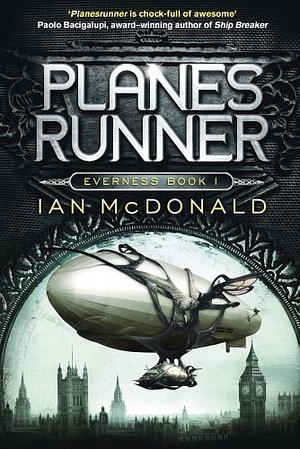
2026/071: Planesrunner — Ian McDonald

It was a deep, dark shock, a fist clenched around the heart, for Everett to realise that every decision he had made, every action he had taken, had caused someone to pay a high and terrible price. It was never like that in the action movies. There were never any consequences. [loc. 3205]

On a rainy December night in London, thirteen-year-old Everett is walking along the Mall to meet his father Dr Tajendra Singh: they're going to a lecture on nanotechnology at the ICA. Then Tajendra is abducted, leaving Everett with a few photos of the car in which he was taken away -- and, soon, an email that plunges Everett (named after Hugh Everett, who developed the Many Worlds theory) into a complex and perilous quest through multiple realities. Tajendra knows his son's aptitude for maths, pattern-spotting and connections. He's made plans to cover every contingency, and his priority has been to safeguard the infundibulum, a map of the multiverse which can lead the bearer -- via Heisenberg gates -- to trillions of other Earths.

I love the worldsbuilding: the world where Einstein was a quantum theorist, the world where the Moors invaded Britain after the Romans, the world where something mysterious has happened to the moon, even the world where, in 2010 or so, Michael Portillo is PM.  And of course E3, which is where Everett finds himself at the end of Planesrunner -- on an airship, in the company of multiple strong female characters. (E3's London is fascinating, not least for its variations on the inequalities of race, class and gender.) The YA label, and the sometimes-predictable plot beats, don't detract from Planesrunner's pleasures, and Everett is a likeable, relatable and interesting protagonist, solidly grounded in the mundane realities of teenage life despite being plunged into adventure.

This is Ian McDonald's first YA novel, which I purchased in 2013 and have unaccountably left in the TBR for all those years. I shall be reading the other two novels in the Everness trilogy soon, and not only for Everett's adventures and a conclusion to the story. 
Friday, February 06, 2026

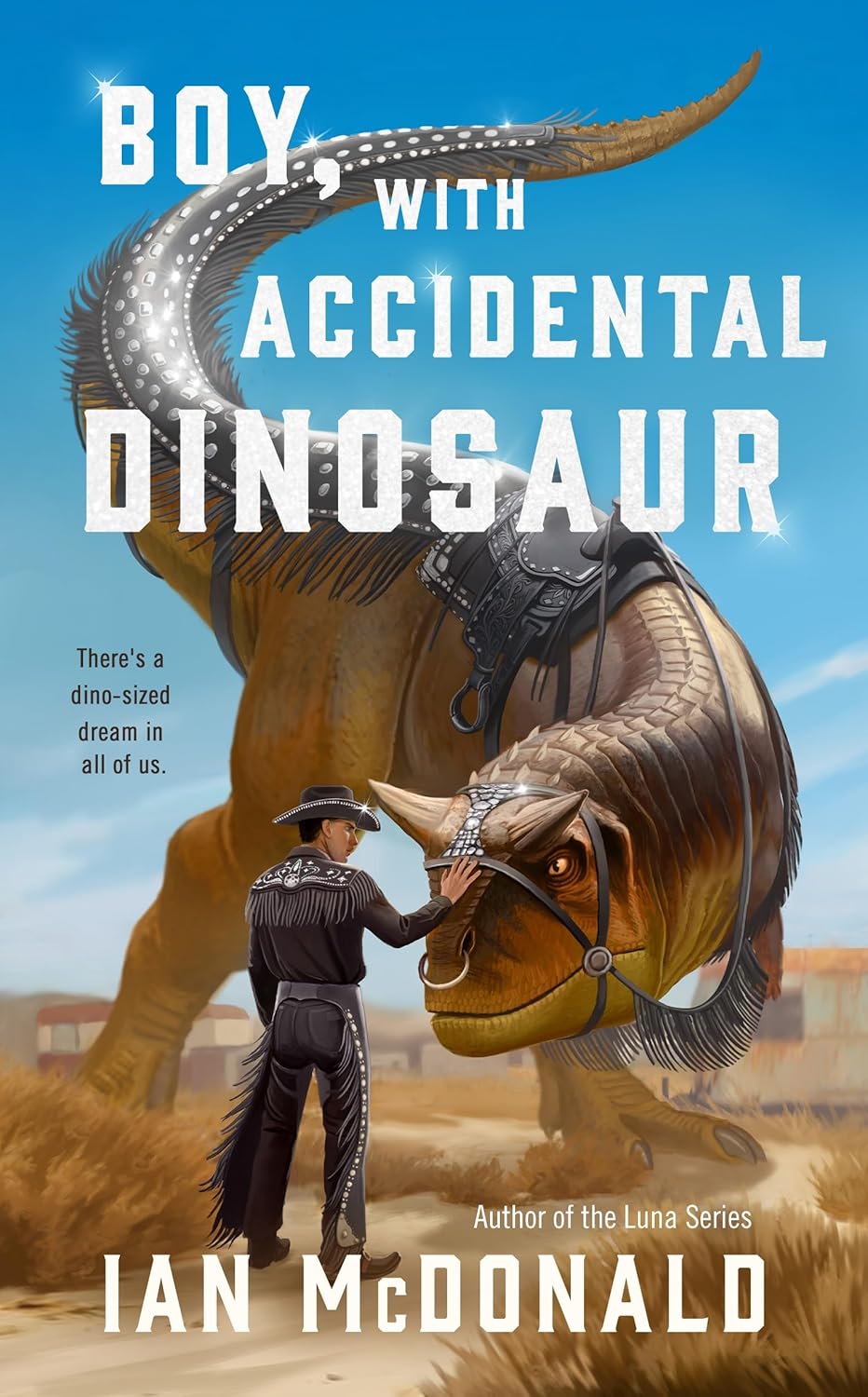
2026/022: Boy, With Accidental Dinosaur — Ian McDonald

Under a high blue heaven, under the zealous sun, the kid and his dinosaur travel a hot, empty highway. [first line]

Tif (short for Latif) is an orphan of Arab descent, whose ambition is to become a buckaroo at one of the dino rodeos. The novella's opening presents him, with his dinosaur, on a journey: only gradually are we shown where he's going, and why -- and where he's come from.

This is the post-apocalyptic future of the country formerly known as the United States of America, now a dangerous wilderness of miliciano gangs, religious states, and aggressive Dominion raiders. Tif's parents were killed in the South Dakota purification. He's recently been sacked from Dino! Dino! after a Timursaur escaped and wreaked havoc. Subsequently he's undertaken to return an old, maimed Carnosaur to the B2T2 time portal in the mountains of Colorado, and let it live out its remaining years 'under its own sun'. En route, he joins Memphis Red’s Tatterdemalion Circus; falls in love (or lust) with its star, the enigmatic Prince; and, perhaps, finds family.

That's the novella in a nutshell, but there's a novel's-worth of worldbuilding and characterisation here. McDonald doesn't waste time explaining the post-Chaos future, or the cyberpunk-flavoured Silver Clowns, or the Dust Tarot with which a Clown reads Tif's future. The B2T2 portal is a natural phenomenon, 'a place where two times lay up against each other, close as kittens, separated only by the finest layer of space-time fur, that could be stroked, and parted' [loc. 515]. That's where the dinosaurs are captured, and where they must be returned: 'leave no dangling timelines'. Naturally, the approach to the B2T2 is festooned with various flavours of protest camp.

There is danger, chaos and glamour; there is a strong sense of the cruelty involved in parading living creatures for entertainment. And there is so much emotional honesty and truth, in the backstories of the characters Tif encounters as well as his own journey. I would have loved this even more at novel length: but kudos to the author for keeping it tightly focussed and leaving the reader wondering about the wider world, the stories that happen outside the scope of Boy, with Accidental Dinosaur.

Something wild and magnificent and innocent is trapped and caged. Betrayed. For stardust, for floodlights, for the ronda and the roar of the crowd. For beer and nuts and nachos. [loc. 958]

Saturday, September 28, 2024

2024/144: The Wilding — Ian McDonald

The beauty and terror that welled out of this place took hold of Yeats’s mystic, holy Ireland, held it up and ripped it apart. Beneath its torn skin was old Ireland, deep Ireland, the Ireland buried in the bogs and beneath the fields of grazing, turned to leather and knot and iron-oak. Waiting down there. [loc. 2304]

Lough Carrow used to be a working bog: now it's a rewilding project, left to nature for two years during the Covid pandemic. Some of the locals mutter suspiciously about wolves being sneaked in while nobody was looking. Pádraig runs the Wilding, but most of the novel's from the point of view of Lisa, a young woman with a murky past, a stolen copy of Yeats' Selected Poetry and a place awaiting her at UCL. Lisa oversleeps after celebrating the latter, and thus gets landed with wild sleepover -- five twelve-year-olds and their three teachers, trekking through the bog and camping in its remotest corner.

The kids are a handful: all on medication, with mental health issues, traumatic histories and/or bad attitudes. But there are things even worse than adolescent children in the bog, and once Lisa and her cohort set off the pace of the story (if not of their trek) is headlong.

I heard the author reading from this at Worldcon and was gripped, though The Wilding was not quite what I was expecting. Lisa is a splendid character, backstory and backbone and some attitude of her own: her interactions with the kids shift in tone over the course of the novel but are always credible and human. The kids themselves are at first annoying but become individual, even likeable, with distinctive voices and very different perceptions of the world. The descriptions of the natural environment, of the silence and non-silence of the bog, of light on water and blurry motion at the edge of vision, are spectacular. And there are echoes of Yeats' poems throughout.

There's a reference to Pádraig 'checking for signs of incipient folk horror' when he touches base with the villagers, but The Wilding's horror is something older and weirder than a few peculiar locals. Some of those locals are very peculiar: I'm sure Dom Purvis and his maps and zones is a callout to Holdstock's Mythago Wood... McDonald has been one of my favourite authors for many years: though his scope here is perhaps narrower than in his best-known (SF) novels, his prose is as glorious as ever.

Monday, August 28, 2023

2023/121: Hopeland — Ian McDonald

We don’t look at time right. We’re chronologically lopsided. We can think about millions of years in the past but not millions of years in the future. We can think about the age of the dinosaurs, or the Romans, but we can’t push our minds two thousand years ahead, let alone millions... We can think about the time when we were not, but we can’t think about the time when we will not be. [loc. 1726]

Hopeland begins in Soho during the London riots of 2011 and ends in Greenland in 2033. Or perhaps in Eirin (once Ireland) in 2981. Or perhaps it does not end.

Amon Brightbourne is a particular kind of composer, his creations a mosaic of found sound and samples, tailored for an audience of one. In the summer of 2011 he's trying to find the gig he's meant to be playing at, but instead he meets Raisa Peri Antares Hopeland, a member of Hopeland, which is 'a nation within all nations, a religion with no belief, a family with no marriage': effectively, a non-geographic nation. Raisa is competing with another Hopelander, Finn, to find a mystical artifact, which turns out to be a gigantic Tesla coil: whoever brings it to life will become an Arcmage, an Electromancer. Amon is captivated, even before Raisa introduces him to Hopeland: but when Raisa visits Brightbourne itself and discovers the secret of Amon's improbable luck -- his Grace -- she flees.

Raisa heads north, to Iceland; Amon heads south, to Ava'u, a Polynesian island group (where, a century before, the founder of Hopeland began to think about self-selecting families.) There he plays music, meets princesses, and encounters the redoubtable Kimmie Pangaimotu. Amon's life is one of quiet melancholy, until reality crashes into him in the form of Hurricane Velma. Ava'u becomes a climate-orphaned nation on the move, and it heads north -- with, in a uniquely McDonald flourish, its ancient gods in tow, tethered by a weather balloon.

Which is nothing like all of the story, but enough to give you a taste of its blend of steampunk, fantasy and climate-crisis SF. Only a taste, because there is so much here: William Blake and Peter Ackroyd; volcanos and constellations; the KLF and a musical composition that lasts a thousand years; the Hopeland kids that don't have a gender until they're ready to choose and the fakaleiti Kimmie who's chosen a gender at odds with the sex she was assigned at birth; ephemeral enthusiasms and deep time; and storms, storms everywhere, tropical and Arctic, stronger by the year.

Climate change is real.

It took me a while to appreciate the balance between Amon, with his Grace, and Raisa the Unfinisher. (Despite one element of the conclusion, I'm not convinced that Finn is an equal part of the balance.) Amon and Raisa, between them, create a possible future that's more hopeful than anyone in the earlier chapters of the novel could reasonably expect: and in the final chapter, 'All is Full of Love', we see the fullness of the world(s) they have brought into being. Not alone -- it takes a nation -- but not without them.

The future described in this novel is not always bright, but Hopeland finds joy even in the darkest of times. McDonald's prose is often exuberant, sometimes lyrical, and has as many registers as the perpetuum mobile of Brightbourne's Music. I loved this novel and found it tremendously cheering. You can see for centuries from here, and the view is a delight.

Wednesday, May 02, 2018

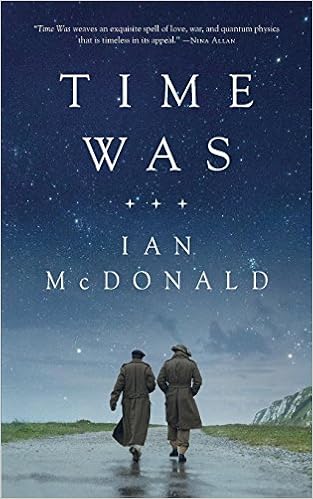
2018/17: Time Was -- Ian McDonald

"That's them," Thorn said. "I'm sure of it. But ..."
I have never been able to resist the word "but." It's the ragged edge of the photograph, the texture of a provenance disturbing the flat perfection of a book. [loc. 275]
Book dealer Emmett Leigh, skimming stock at a closing-down Spitalfields bookshop, finds a slim volume of poetry entitled 'Time Was'. The author is anonymous, identified only by initials: more intriguingly, the book contains a letter from one soldier, Tom, to his lover Ben. Emmett (whose own romantic record is nothing to write home about) is fascinated by the letter and eager to find out more about Tom and Ben: his researches lead him to other copies of 'Time Was', and to photographs of the two men together. They always look more or less the same age, but the photos and letters date from different eras, different wars: Norfolk in 1915, Alexandria in 1942, the Crimea in 1856, Bosnia in 1993 ...

Ian McDonald's novella encompasses the Shingle Street mystery (rumours of a failed German invasion in 1940, and burned bodies washing up on the beach of this small Suffolk village) with the Rendlesham incident (UFO sightings in a Suffolk forest in the winter of 1980). It's a love story -- actually, it's two love stories, though Emmett's affair with the redoubtable Thorn is somewhat derailed by his growing obsession -- and a story about identity. (I did wonder why Emmett didn't make an obvious connection.)

Beautifully written with a cracking sense of place -- whether Shingle Street, Spitalfields or Rome -- and a real poignancy. This could have been fleshed out to novel-length (perhaps with more from Tom, and especially from Ben), but it says all that needs saying in novella form.

Tuesday, January 22, 2013

2012/65: Dead Water -- Simon Ings

They have no idea where they are, or when, but they are beginning to grasp that geography matters less to them than it matters to the living. They make their own journeys with the stories they tell. They fashion – somehow, they don’t yet know how – their own escapes. They survived a barren and virtually unpeopled Arctic: they’ll make a story of this place too. Stories are their breath. Their food. Their blood. And they’re getting stronger. [location 795]
The term 'dead water' refers to the phenomenon of a ship making no headway through waters of different densities and temperatures. It also, in this novel, encodes a global conspiracy involving shipping containers and a mad magnate. The plot of Dead Water -- Simon Ings' best novel yet, I believe; certainly the one I've enjoyed most -- reels from the wreck of the airship Italia in the Arctic (1928) to a nightmarishly-detailed train crash in India (1995), to the tsunami of Boxing Day 2004, to a private satellite network run from a grimy Soho office, to dodgy deals done in Dubai, to a ship seized by pirates off Sri Lanka. In range, cast and complexity it's reminiscent of Ian McDonald (India! djinni!) or Neal Stephenson (a long game of vengeance); the structure calls to mind Cloud Atlas, though Dead Water is not a nested narrative. It's also marvellously poetic, and often blackly humorous.

It's bloody hard to write about. <g>

This is a dense novel, a great deal of observation and examination shoehorned in around the plot(s). It's to Ings' credit that his excursions into side-story don't feel forced; the pace seldom slackens, and when it does it's necessary respite. But everything within Dead Water is connected, though some connections are more tenuous than others.

I learnt a lot from this novel. A lot about shipping containers, obviously: but also about the unique problems of building skyscrapers in the desert; forgery techniques in Mumbai; the biological origin of ambergris; fluid dynamics, in smoke as well as water; the impact of 9/11 on the global shipping industry; how to evade bureaucracy when sailing from Darwin to Timor ...

I was fascinated by the boys Abhik and Kaneer, whose life existence is changed by the sudden appearance of a Moyse shipping container; by Eric Moyse, reclusive shipping magnate with a vision (and an excellent retirement plan); by Vibeke Dunfjeld, whose physicist sweetheart -- Eric Moyse's protege -- dies in the Italia crash; by Roopa, daughter of a heroic policeman, and her implacable quest for vengeance. But most of all by the boys, unlimited by space and time, eager for stories and for vengeance of their own.

A few plot threads seemed unresolved, but in a novel of this scope it isn't essential to tie up all the loose ends, and the story as a whole is complete.

After the concert he retires to the penthouse suite, orders all light bulbs removed from the apartment, and behind bespoke blackout curtains that utterly extinguish the desert sun he writes a string of clumsy, blindhanded memos giving his staff explicit instructions not to look at him or speak to him unless they’re spoken to. For six months he subsists entirely on black tea, chocolate and pemmican: Arctic rations.[location 3005]

Tuesday, May 24, 2011

2011/22: The Dervish House -- Ian McDonald

"...it all began with this woman in Ereğli who started to see into souls and tell fortunes: the peri were whispering it to her, apparently. Then there's this businessman in Nevbahar: he's very interesting, very up to day; it's not fairies or djinn; it's robots. Those swarm-robots that build up into all kinds of different robots. But at some level it's the same; he finds lost things and gives prophecies." (location 4648, Kindle doesn't give me page number)

The Dervish House takes place over five days in Istanbul, summer 2027, soon after Turkey's admittance to the EU. The novel's six protagonists, all living in or near the eponymous Adem Dede 'dervish house', react to an apparent suicide-bombing on the local tramline. That bombing kick-starts a chain of events that feature djinn, nanobots, microcalligraphy, junk DNA, terrorism-trading, energy scams, family ties, the Green Saint and a Mellified Man.

The six protagonists -- ranging from nine-year-old Can Durukan to elderly Georgios Ferentinou -- are distinct voices, each with his or her own concerns and preoccupations. It took me a while to crystallise the thought that each protagonist's thread typifies a different genre, as well as a different perspective. There's a Dan Brown-style treasure hunt; a Boy Detective with his trusty sidekick(s); a country girl making good; a romantic tale of lost love and betrayal; a fast-paced techno-thriller with cyberpunk overtones; and a young man who comes out of the fire and experiences redemption and revelation.

The joy of The Dervish House, for me, is in how intimately connected the different threads are. The connections aren't always clear -- not least to the protagonists, whose brains aren't wired to recognise what's happening around them -- but everywhere there are patterns within patterns, and everything converges towards a denouement that is as much beginning and middle as ending.

It's an incredibly complex book, lush and sometimes overwhelming with texture and detail: McDonald's prose is rich and precise, and he's got the gift of encapsulating a moment, a character, a cityscape in one sentence. (Adem Dede Square is "small enough for two tea shops but big enough for rivalries": Leyla's family "gave her gold and had their eyes closed in every single photograph".) It's a novel about Istanbul, a city poised at the interface of Europe and Asia. It's also 'about' economics and trade; about the ways that history interpenetrates and defines the present and the future; about patterns, and how the human brain can see them.

Though The Dervish House addresses some of the same themes, and features some of the same entities, as Brasyl and River of Gods, it stands alone , and it's a very different novel, reflecting the ambience of the culture in which it's set. And now I want to go to Istanbul ...

Tuesday, August 14, 2007

#41: Brasyl -- Ian McDonald

The young woman on his sofa is a refugee from another part of the polyverse. Swallow that intellectual wad and everything else follows. Of course they are caught between the ritual assassins of a transdimensional conspiracy, and mysterious saviours. Of course refuge must be offered, though it marks him irrevocably as a player.

Brasyl hits the ground running, peppered with idiomatic street slang and casual references to an unfamiliar world. It's Rio de Janiero, present day, and television producer Marcellina Hoffman is after a tasty new reality show. All does not, however, go according to plan.

Then it's 2032, Sao Paolo, and Edson Jesus Oliviera de Freitas is trying to broker a deal, playing on the typically Brazilian themes of futebol and sex. This time, though, he falls in with the wrong crowd.

And it's 1732, and Father Luis Quinn, S.J., arrives in a Brazil that's ever so slightly skewed from our own. His mission: to track down and Admonish Father Gonçalves, who is suspected of unorthodox methods. Father Quinn does not find anything that he could have expected.

Switching between the very different chase/quest plots of those three timelines -- Marcellina discovers that she has a double who's trying to destroy her life; Edson falls in love with a quantumeira; Luis Quinn becomes oracle to a hostile tribe -- the threads pull slowly together, to reveal the interconnections between the stories. The pace is seldom less than hectic, whether it's that of a canoe expedition up the Amazon, the race to discover an ageing footballer -- the Cursed Barbosa -- before the tabloids do, or the theft of four quantum computers.

And McDonald is not a lazy writer. Some of the themes may have been covered before but his angle, his eye for detail, his knack for the details that reveal a personality and for phrases that hang in the mind (swashing down into sleep like a coin through water) is as overwhelmingly engaging as in River of Gods.

As each thread spins to its climax, the novel begins to resolve, and at points I found myself exhilirated by the ride but wondering what I'd missed: who's on which side? Can any of the timelines affect one another?
there's no heart reality from which everything else diverges. Every part of the multiverse exists, has existed, will exist independently of every other.
Yet echoes of Father Quinn's actions pepper Marcellina's adventures, and time and again some familiar-seeming figure pops up out of context ...

I'm not wholly keen on the ending (though that may be because I was caught up in the rush of the stories, and failed to note key divergences) but I'm utterly beguiled by the whole. A special part of my regard applies to the 1732 timeline, with the French natural philosopher Robert Falcon duelling and plotting and strategising, and resigning himself to 'a world without vistas', with no hope of a return to Paris. If I've a quarrel with any of that part of the story, it's that the author didn't include in his 'Playlist for Brasyl' any of the gorgeously strange Latin American Baroque music that I know he's been listening to ...

Saturday, April 30, 2005

#39: River of Gods -- Ian McDonald

OK, now I see what all the fuss is about.

I only finished reading this novel a couple of hours ago: it hasn't sunk in yet, so this 'review' will be a little disjointed. But I want to buy lots of copies and press them upon those of my friends who haven't already read it. This is science fiction at its best -- not to say that there are not other subgenres that I enjoy, but River of Gods is wide-screen, cast-of-thousands SF with joy and verve and excellent writing and an apparently endless wellspring of Plot. If it had just been Plot, I would've admired it immensely: but McDonald's cast of ten protagonists are so finely drawn, so multi-dimensional and uniquely damaged, that I wanted to weep for a couple of them. A lot of SF disappoints me because of its lack of that human dimension, or because of clunky writing. This novel did neither.

What's it about?

Incarnation and reincarnation: popular culture and the cult of Celebrity: artificial intelligence: gender issues: emergent evolution: pocket universes: gods and mortals: Balkanisation: survival on the streets: betrayal and abandonment: parents and children: escape.

And all the other things that are bubbling up in my head as I assimilate it.

I want to quote huge chunks of the prose, because it's so very clear and poetic and precise. Let me leave you with this:

Abandonment, that tastes like sick in the back of your throat, always on the edge of coming up; it feels like dizzy, like walking along the edge of a high stone harbour over a sea that glimmers and moves so far below you cannot be certain where it is, but brown, brown; abandonment is empty dull brown...
Incomprehension feels like a hair on the tongue.
And anger is heavy like a hammer but so light it can fly with its own wings, and the darkest, darkest rust.


reposted here from LJ in order to keep all my reviews in one place