At the beginning of this ~700-page novel, peace breaks out between the Eremians and the Vadani. Valens, very soon to be Duke of the Vadani, is not best pleased, as he has fallen irrevocably in love with Veatriz, a nobly-born Eremian hostage, who ends up married (for political reasons) to the Eremian Duke, Orsea.
However, this is a K J Parker novel, so there is plenty of time for bloodshed, battle, feuding and treachery.
Off to the east lies the Mezentine Empire, vast and technologically superior. The engineer Ziani Vaatzes is sentenced to death for innovation, for straying from the strict Specifications that govern all Mezentine technology. In an uncharacteristically dashing escape, he evades his sentence and his captors and ends up working for the Eremians, who have just been comprehensively thrashed by the Mezentine army.
Vaatzes is a clever man, and he has a Plan. ("I use the materials available to me," he says to one of his weapons, later. "If I can't use steel, I have to use flesh instead. Not what I'd have chosen, but you do your best with what you've got.") This plan -- not wholly divulged by the end of Devices and Desires, part one of a trilogy -- is designed to return Vaatzes to his home and reunite him with the wife he loves. And the plan, the machine, is ruthless: the inevitable result of engaging the machine would be the end of the world.
Which would all be so much epic-fantasy-by-the-inch if Parker's characters weren't so richly drawn. Valens is a romantic who nevertheless manages to be a resourceful, hardheaded statesman, a skilled huntsman and an astonishingly mundane correspondent. Orsea, thrust into a position of power which he never expected, has a headful of grandiose ideas but lacks the ability to bring them to fruition. Veatriz is half of a marriage that can't provide the intellectual stimulation she requires. Vaatzes is a sympathetic character, as long as you set aside that stuff about the end of the world (and the appalling bodycounts in the battles he instigates): there's more to him, and his crime, than Parker explains in this first volume. Psellus, a Mezentine civil servant seconded to Necessary Evil (the Department of War) is a bumbling fool who'd like a quiet life, but there's a quality to him that indicates he won't get one any time soon. And Miel Ducas, Orsea's chief advisor and best friend (not to mention childhood sweetheart of Veatriz, and former heir apparent to the title of Duke) is an extraordinarily likeable character, a nobleman comfortably aware of his flaws, a good man through and through -- and an unwitting part of Vaatzes' terrible machine. Does it sound odd to say that I was angry on his behalf for what befell him?
The Engineer trilogy looks set to accomplish something rare in epic fantasy: there is, as far as I can tell, no magic. There are no gods (though characters do say 'for God's sake', &co; I take this as an aspect of Parker's way with dialogue). Early on, there's a vague mention of the Ducas family, as old nobility, being prone to prophetic dreams: but none occur. And there are a couple of dreams that might have supernatural provenance, but probably don't.
Another thing I like about K J Parker's writing: the colloquial dialogue, the tone (not exactly light-hearted but certainly not all doom and gloom), the black humour and the wry observations. Parker can make me laugh out loud at a scene where Miel is explaining to Orsea that he'd probably recognise an executed spy, what with his memory for faces, except that unfortunately they've already sent the head off to the spymasters. The humour isn't as thickly applied as in a Pratchett novel, but it's often as funny.
This novel -- purchased because of my great respect for Parker's previous 'Fencer' and 'Scavenger' trilogies -- has been sitting on the shelf since Easter, or possibly before; as soon as I'd finished it (which was in a hotel room in Lille) I ordered the next one, Evil for Evil, from Amazon (isn't web'n'walk wonderful?) because I was desperate to find out what happened to everybody.
Showing posts sorted by relevance for query k j parker. Sort by date Show all posts
Showing posts sorted by relevance for query k j parker. Sort by date Show all posts
Friday, August 24, 2007
Saturday, September 01, 2001
Shadow -- K J Parker
A man wakes up, half-immersed in a stream that runs through a battlefield, with no recollection of his identity. Overhead, crows circle, waiting. He has a vague memory of arguing with his reflection in the water, but that must have been a dream. Poldarn, taking the name of an obscure - and possibly made-up - god whose priestess he encounters, quickly adapts to a life without a past. His vivid dreams hint at that past, from a bewildering number of viewpoints: which dreams are truly his memories? Against a backdrop of a crumbling empire, beset by Viking-like raiders, Poldarn tries to reconstruct his identity. There are those who recognise him, but none of them live long enough to tell him his name. All that he can be sure of is his superlative skill with the sword and his ability to survive.
With the help of the fake priestess, Copis, he becomes a divine impersonator, a high-risk courier, and a button merchant - each role leading to another teasing encounter with a nameless face from his past. Legends and folk tales seem to link his fate with the story of the god Poldarn: could he, in fact, be a god and not know it?
Meanwhile, the sword-monk Monach (‘just a word for ‘monk’ in the southern dialect’) has been instructed by his Order to find the man who is calling himself Poldarn. The Order’s purposes are unclear, even to Monach, but they’re privy to knowledge about the god Poldarn that might help the mortal version to make sense of everything that’s happening to him.
K J Parker’s first fantasy trilogy, beginning with Colours in the Steel, met with critical acclaim for its straightforward grittiness, dark humour and attention to technological detail. The setting of the Fencer trilogy was a world of minimal magic, with few of the supernatural or mystical elements that have come to typify post-Tolkien fantasies. Shadow is similarly prosaic, focussing on the mundane rather than the magical. Parker conveys an intimate understanding of the mechanics of day-to-day life in a mildly industrialised Renaissance world - button-making machines, sword-fighting technique, the decades-long war against the raiders - without losing the tension of the narrative or glorifying its nastier aspects.
There are other similarities to Parker’s earlier novels. The prophetic dreams: the mirroring of dream and reality, highlighted by identical phrasing: the sheer complexity of plot, which is hinted at rather than revealed. Parker also has a rare gift for characterisation, and the plot is driven by credibly flawed individuals, rather than high-minded archetypes. Poldarn’s quest for his identity takes some improbable turns, working towards a revelation that is genuinely surprising and keeps the reader guessing until the end.
Shadow proclaims itself as ‘Book One of the Scavenger Trilogy’. Does the world really need another weighty fantasy trilogy, at over £10 for the trade paperback editions? Yes, when it’s by a writer as fresh and innovative as K J Parker.
With the help of the fake priestess, Copis, he becomes a divine impersonator, a high-risk courier, and a button merchant - each role leading to another teasing encounter with a nameless face from his past. Legends and folk tales seem to link his fate with the story of the god Poldarn: could he, in fact, be a god and not know it?
Meanwhile, the sword-monk Monach (‘just a word for ‘monk’ in the southern dialect’) has been instructed by his Order to find the man who is calling himself Poldarn. The Order’s purposes are unclear, even to Monach, but they’re privy to knowledge about the god Poldarn that might help the mortal version to make sense of everything that’s happening to him.
K J Parker’s first fantasy trilogy, beginning with Colours in the Steel, met with critical acclaim for its straightforward grittiness, dark humour and attention to technological detail. The setting of the Fencer trilogy was a world of minimal magic, with few of the supernatural or mystical elements that have come to typify post-Tolkien fantasies. Shadow is similarly prosaic, focussing on the mundane rather than the magical. Parker conveys an intimate understanding of the mechanics of day-to-day life in a mildly industrialised Renaissance world - button-making machines, sword-fighting technique, the decades-long war against the raiders - without losing the tension of the narrative or glorifying its nastier aspects.
There are other similarities to Parker’s earlier novels. The prophetic dreams: the mirroring of dream and reality, highlighted by identical phrasing: the sheer complexity of plot, which is hinted at rather than revealed. Parker also has a rare gift for characterisation, and the plot is driven by credibly flawed individuals, rather than high-minded archetypes. Poldarn’s quest for his identity takes some improbable turns, working towards a revelation that is genuinely surprising and keeps the reader guessing until the end.
Shadow proclaims itself as ‘Book One of the Scavenger Trilogy’. Does the world really need another weighty fantasy trilogy, at over £10 for the trade paperback editions? Yes, when it’s by a writer as fresh and innovative as K J Parker.
Sunday, March 01, 2009
The Company -- K J Parker
This review originally appeared in Vector, the critical journal of the British Science Fiction Association, in Spring 2009.
.. as long as 'A' Company was still alive and together, as long as the five of them were together, the war could never end. It was part of them, their core, their reason, what they were for; they kept it alive and it kept them alive, which was why it, they, had lasted so long, against all the odds. 'A' Company could no more die in war than a fish could drown in the sea.
K. J. Parker's first stand-alone novel – previously s/he (the publicity material indicates a female author, but there is something masculine about the style) has published the Fencer, Scavenger and Engineer trilogies – is distinctly Parker in its focus on the military, the practical, the psychological: and yet it's oddly disappointing.
The war is over. General Teuche Kunessin ('the most devastating fighting man on either side of the war') returns to his homeland, intent on reuniting his comrades from 'A' Company and fulfilling the dream that kept them alive: the colonisation of an abandoned island, which he's ensured will not be of interest to the military. There'd been six of them, but one died right at the end of the war. (The Company is, as much as anything, a thriller about how the sixth man, Nuctos, died.) The remaining veterans, despite their arguments and objections, all leap at the opportunity. Supplies (including wives) are acquired. Sphoe is colonised, and turns out to have rather more resources than they'd been expecting.
As ever, Parker's eye for the gritty realities of a (pseudo)medieval society is impressive. When Kunessin was a boy, his family fell on hard times, because a battle was fought on their field, leaving a harvest of corpses: we can't bury them all, not in time. Can't burn them: there's not enough timber in the valley to fire this lot ... They'll start to rot, and they'll breed worms and flukes: the stock'll pick them up and they'll die. ... It'll be three years, soonest, before this land's fit to be grazed again. And Parker's a master at showing what's said and what's not – the male characters, in particular, are men who'd sooner die than talk out loud about emotions, but nevertheless very clearly have and are driven by said emotions – and at showing us the world through an individual's eyes, coloured and skewed with their perspective. Kunessin sees the sun 'slanting down over the roofs ... like a shower of pitched-up arrows'. Aidi analyses the profit and loss of each transaction. Menin has a sharp eye for nature's bounty.
In a series of flashbacks, we slowly discover how Kunessin amassed the fortune that enabled him to buy Sphoe, a ship, supplies. There are other flashbacks, illuminating the pasts of the other colonists: early on we discover that a couple of the wives have secrets in their pasts. All rumour and conjecture of course, nothing ever proved. And – in a quintessentially and aggravatingly Parker twist – there's an account of the betrayal of Nuctos, carefully crafted using only the third-person pronoun. It's several hundred pages before we can put a name to the viewpoint character of that section, and I cannot help but feel that this is cheating.
'A' Company ('the biggest bunch of underachievers the world had ever seen') are connected by more than chance: they've survived years of war together, and the sense of 'us against the rest of the world' – something darker and more codependent than mere camaraderie – is one of the strongest threads in the novel. Given that focus, the finale is successful, but it feels hasty and unfinished, as though there might be more going on than a bunch of soldiers surviving against all odds.
The Company, though flawed, is an enjoyable read, not least for Parker's dry humour and the careful construction of plot and backstory, and for another fantasy in which there's no magic, no music and beauty only in the eye of the beholders.
.. as long as 'A' Company was still alive and together, as long as the five of them were together, the war could never end. It was part of them, their core, their reason, what they were for; they kept it alive and it kept them alive, which was why it, they, had lasted so long, against all the odds. 'A' Company could no more die in war than a fish could drown in the sea.
K. J. Parker's first stand-alone novel – previously s/he (the publicity material indicates a female author, but there is something masculine about the style) has published the Fencer, Scavenger and Engineer trilogies – is distinctly Parker in its focus on the military, the practical, the psychological: and yet it's oddly disappointing.
The war is over. General Teuche Kunessin ('the most devastating fighting man on either side of the war') returns to his homeland, intent on reuniting his comrades from 'A' Company and fulfilling the dream that kept them alive: the colonisation of an abandoned island, which he's ensured will not be of interest to the military. There'd been six of them, but one died right at the end of the war. (The Company is, as much as anything, a thriller about how the sixth man, Nuctos, died.) The remaining veterans, despite their arguments and objections, all leap at the opportunity. Supplies (including wives) are acquired. Sphoe is colonised, and turns out to have rather more resources than they'd been expecting.
As ever, Parker's eye for the gritty realities of a (pseudo)medieval society is impressive. When Kunessin was a boy, his family fell on hard times, because a battle was fought on their field, leaving a harvest of corpses: we can't bury them all, not in time. Can't burn them: there's not enough timber in the valley to fire this lot ... They'll start to rot, and they'll breed worms and flukes: the stock'll pick them up and they'll die. ... It'll be three years, soonest, before this land's fit to be grazed again. And Parker's a master at showing what's said and what's not – the male characters, in particular, are men who'd sooner die than talk out loud about emotions, but nevertheless very clearly have and are driven by said emotions – and at showing us the world through an individual's eyes, coloured and skewed with their perspective. Kunessin sees the sun 'slanting down over the roofs ... like a shower of pitched-up arrows'. Aidi analyses the profit and loss of each transaction. Menin has a sharp eye for nature's bounty.
In a series of flashbacks, we slowly discover how Kunessin amassed the fortune that enabled him to buy Sphoe, a ship, supplies. There are other flashbacks, illuminating the pasts of the other colonists: early on we discover that a couple of the wives have secrets in their pasts. All rumour and conjecture of course, nothing ever proved. And – in a quintessentially and aggravatingly Parker twist – there's an account of the betrayal of Nuctos, carefully crafted using only the third-person pronoun. It's several hundred pages before we can put a name to the viewpoint character of that section, and I cannot help but feel that this is cheating.
'A' Company ('the biggest bunch of underachievers the world had ever seen') are connected by more than chance: they've survived years of war together, and the sense of 'us against the rest of the world' – something darker and more codependent than mere camaraderie – is one of the strongest threads in the novel. Given that focus, the finale is successful, but it feels hasty and unfinished, as though there might be more going on than a bunch of soldiers surviving against all odds.
The Company, though flawed, is an enjoyable read, not least for Parker's dry humour and the careful construction of plot and backstory, and for another fantasy in which there's no magic, no music and beauty only in the eye of the beholders.
Monday, September 01, 2003
Memory -- K J Parker
This review originally appeared in Vector, the critical journal of the British Science Fiction Association, in September 2003.
Memory, the concluding volume in K J Parker's 'Scavenger' trilogy, opens with Poldarn lost in a wood. This may well be the best place for him. Since waking with amnesia on a battlefield at the beginning of Shadow, he has reconstructed enough of his past - from dreams, from chance-met strangers, from the people of his homeland - to realise that he may have been happier with no memories at all. Whoever Poldarn was before he lost his identity and assumed the name of an apocalyptic deity, he wasn't a nice person. Even the people close to him have been reluctant to tell him everything they know about his past career.
But ignorance is not bliss: far from it, in Parker's world. Post-amnesia Poldarn has always tried to do good; he's acted in self-defence, or to protect others, with the best possible motives. At worst, he's taken the only sensible course of action. In Shadow and Pattern, he rescued a cavalry officer from scavengers, saved his people from a volcano, and married a nice girl from a neighbouring settlement. Regrettably, this is a world where every action seems to have the worst of possible consequences. Poldarn's personal affairs make most of Greek tragedy look like Pollyanna. (Indeed, there are parallels between Poldarn's experiences and that of tragic heroes such as Oedipus).
It's obvious to Poldarn, by the beginning of Memory, that he's better off not knowing who he used to be, and so he buries himself (metaphorically speaking) in the middle of nowhere, using his smithing skills to get work at a bell foundry. Fate, however, has other plans for him. There's a reunion of his schoolmates, which might be a cheerful affair if this were a different novel. Memories and dreams are forced into context as catastrophes. Names and identities are shuffled, cast aside, revealed and obscured again as the mythic tragedy of Poldarn's life draws towards its conclusion.
After all that, it may come as a surprise to learn that this is also a very enjoyable novel. Parker's worlds - compare the magic-less setting of his 'Fencer' trilogy - have no room for the quaint, the archaic or the beautiful. Tolkien's characters wouldn't last a day here, with the possible exception of some of the orcs. If there is anything supernatural - gods, magic, fate - at work in the complex knottings of the narrative, it's kept offstage. Everything can be explained by common sense, a commodity that Parker's characters have in abundance (though it's seldom enough to save them). Their speech is resolutely mundane and their actions selfish, pragmatic and often unsullied by morality.
Parker's novels are firmly rooted in technology, and some will find the long descriptions of medieval smithing techniques unnecessary. They're key to Poldarn's character, though, and keys to the plot as well. The titles of the novels in this trilogy - Shadow, Pattern and Memory - allude to metal-working terms; they're metaphors for the processes by which Poldarn recreates himself, and they encapsulate some of the questions implicit in his situation. How much of his identity is a reaction to the world? Can he free himself from the person he was before he lost his memory? Can he make the decisions that determine his future, or is he being manipulated by others?
The plot is quietly and breathtakingly complex, with dreams and memories echoed throughout the story arc. Parker's attention to detail repays meticulous reading. A couple of casual asides in Memory led me to reread the whole trilogy, an immensely rewarding (if not always cheerful) experience. Perhaps surprisingly, Poldarn is a likeable and sympathetic character, and it's appallingly easy to overlook the swathe of carnage and moral disaster that he leaves behind him. He has more than enough good intentions to pave the road he's walking.
One criticism: the book could have done with more meticulous proofing. There's at least one place where a single incorrect substitution could indicate a whole new sub-plot.
Memory, the concluding volume in K J Parker's 'Scavenger' trilogy, opens with Poldarn lost in a wood. This may well be the best place for him. Since waking with amnesia on a battlefield at the beginning of Shadow, he has reconstructed enough of his past - from dreams, from chance-met strangers, from the people of his homeland - to realise that he may have been happier with no memories at all. Whoever Poldarn was before he lost his identity and assumed the name of an apocalyptic deity, he wasn't a nice person. Even the people close to him have been reluctant to tell him everything they know about his past career.
But ignorance is not bliss: far from it, in Parker's world. Post-amnesia Poldarn has always tried to do good; he's acted in self-defence, or to protect others, with the best possible motives. At worst, he's taken the only sensible course of action. In Shadow and Pattern, he rescued a cavalry officer from scavengers, saved his people from a volcano, and married a nice girl from a neighbouring settlement. Regrettably, this is a world where every action seems to have the worst of possible consequences. Poldarn's personal affairs make most of Greek tragedy look like Pollyanna. (Indeed, there are parallels between Poldarn's experiences and that of tragic heroes such as Oedipus).
It's obvious to Poldarn, by the beginning of Memory, that he's better off not knowing who he used to be, and so he buries himself (metaphorically speaking) in the middle of nowhere, using his smithing skills to get work at a bell foundry. Fate, however, has other plans for him. There's a reunion of his schoolmates, which might be a cheerful affair if this were a different novel. Memories and dreams are forced into context as catastrophes. Names and identities are shuffled, cast aside, revealed and obscured again as the mythic tragedy of Poldarn's life draws towards its conclusion.
After all that, it may come as a surprise to learn that this is also a very enjoyable novel. Parker's worlds - compare the magic-less setting of his 'Fencer' trilogy - have no room for the quaint, the archaic or the beautiful. Tolkien's characters wouldn't last a day here, with the possible exception of some of the orcs. If there is anything supernatural - gods, magic, fate - at work in the complex knottings of the narrative, it's kept offstage. Everything can be explained by common sense, a commodity that Parker's characters have in abundance (though it's seldom enough to save them). Their speech is resolutely mundane and their actions selfish, pragmatic and often unsullied by morality.
Parker's novels are firmly rooted in technology, and some will find the long descriptions of medieval smithing techniques unnecessary. They're key to Poldarn's character, though, and keys to the plot as well. The titles of the novels in this trilogy - Shadow, Pattern and Memory - allude to metal-working terms; they're metaphors for the processes by which Poldarn recreates himself, and they encapsulate some of the questions implicit in his situation. How much of his identity is a reaction to the world? Can he free himself from the person he was before he lost his memory? Can he make the decisions that determine his future, or is he being manipulated by others?
The plot is quietly and breathtakingly complex, with dreams and memories echoed throughout the story arc. Parker's attention to detail repays meticulous reading. A couple of casual asides in Memory led me to reread the whole trilogy, an immensely rewarding (if not always cheerful) experience. Perhaps surprisingly, Poldarn is a likeable and sympathetic character, and it's appallingly easy to overlook the swathe of carnage and moral disaster that he leaves behind him. He has more than enough good intentions to pave the road he's walking.
One criticism: the book could have done with more meticulous proofing. There's at least one place where a single incorrect substitution could indicate a whole new sub-plot.
Thursday, December 27, 2007
#75: The Escapement -- K J Parker
The conclusion to Parker's 'Engineer' trilogy: I've always admired Parker's plotting, encyclopaedic military knowledge and understated humour, but the 'Engineer' books are the first in which the characters have really caught my interest. They are competent and practical, fitted for their roles but capable of improvisation when everything falls apart. They have ambition, humour, hopes and fears. They are human and likeable.
What can I say? K J Parker doesn't do happy endings. Though it could be said that these are happy endings. Marriage! Reinstatement! A long and pampered life! Military supremacy! Vengeance! The comforting knowledge of having been right all along! Everything has worked out just right, in theory. And in practice everyone is fiercely miserable. Apart from the happy dead, of course.
The quickest way to a man's death is through his heart, but if you want to get into his brain ...
Psellus, promoted beyond his competence and struggling to hold onto the Mezentine Empire, is grimly determined to solve the mystery of why Vaatzes committed abomination in the first place, and to find a solution to the real, nasty and million-strong consequence of that abomination. The book starts with the same scene -- the fencing lesson -- as the previous two: it's Psellus's lesson this time, and he learns something different from it, something new.
And everywhere people are musing on the uselessness of honour and the emptiness of revenge. Miel Ducas, courtesy and breeding all but worn away by his partner in crime, but still preferring to be lynched as a highwayman than dishonoured as an aristocrat ("if you weren't a stupid, ignorant low-class woman you'd understand that", he thinks but is still too courteous to say); Vaatzes protesting that "revenge is the last thing on my mind. I never believed in it and I don't want it"; Veatriz considering love, and how it doesn't solve everything, and how only a romantic like the Machiavellian Duke Valens -- who knows the way to any man's heart, except perhaps his own -- would think that it did. "Poor man, he's lived his life thinking that the book closes at the first kiss, and that being in love is like crossing a border, over which they can't follow you. Perhaps he thought love could be starved out with a blockade, or stormed with overwhelming force, once the defences had been undermined."
In The Escapement, lies are layered: the lies about the Mezentine Empire, its foundation, the Specifications that dictate every aspect of life. The lies that two people in love tell one another. The lies that a commander tells his men. The lies that rivals tell one another, the sins of omission; the truths that aren't believed.
There's a great deal of detail about medieval / Renaissance warfare, especially siege warfare, that might choke the reader unaccustomed to Parker's pace. Easier to go with the flow, to see how metaphors are constructed from that material: the illuminating glow of the cold spot in a forging, the perfect ignorant mimicry of an illiterate copyist, the escapement that lets a mechanism work in a controlled way, rather than running free. Pain 'like an army of occupation; a strong garrison in the centre, but elsewhere its control was patchy'. (That's from an incident that befalls Duke Valens, an incident requiring messy and ingenious surgery: it's based, Parker adds in an endnote, on a wound sustained by Henry V at the Battle of Shrewsbury.)
There are some threads that don't seem satisfactorily concluded (Daurenja's past; the founding of the Empire) and some tics that become quite infuriating (characters who are never named). And if a happy ending is required, this is not the book for you. But it's clever and wistful and emphatically practical, marrying philosophy and ethics with the fine art and coarse, bloody science of warfare, and though the resolutions are icy-cold and implacable, it all comes out like clockwork.
What can I say? K J Parker doesn't do happy endings. Though it could be said that these are happy endings. Marriage! Reinstatement! A long and pampered life! Military supremacy! Vengeance! The comforting knowledge of having been right all along! Everything has worked out just right, in theory. And in practice everyone is fiercely miserable. Apart from the happy dead, of course.
The quickest way to a man's death is through his heart, but if you want to get into his brain ...
Psellus, promoted beyond his competence and struggling to hold onto the Mezentine Empire, is grimly determined to solve the mystery of why Vaatzes committed abomination in the first place, and to find a solution to the real, nasty and million-strong consequence of that abomination. The book starts with the same scene -- the fencing lesson -- as the previous two: it's Psellus's lesson this time, and he learns something different from it, something new.
And everywhere people are musing on the uselessness of honour and the emptiness of revenge. Miel Ducas, courtesy and breeding all but worn away by his partner in crime, but still preferring to be lynched as a highwayman than dishonoured as an aristocrat ("if you weren't a stupid, ignorant low-class woman you'd understand that", he thinks but is still too courteous to say); Vaatzes protesting that "revenge is the last thing on my mind. I never believed in it and I don't want it"; Veatriz considering love, and how it doesn't solve everything, and how only a romantic like the Machiavellian Duke Valens -- who knows the way to any man's heart, except perhaps his own -- would think that it did. "Poor man, he's lived his life thinking that the book closes at the first kiss, and that being in love is like crossing a border, over which they can't follow you. Perhaps he thought love could be starved out with a blockade, or stormed with overwhelming force, once the defences had been undermined."
In The Escapement, lies are layered: the lies about the Mezentine Empire, its foundation, the Specifications that dictate every aspect of life. The lies that two people in love tell one another. The lies that a commander tells his men. The lies that rivals tell one another, the sins of omission; the truths that aren't believed.
There's a great deal of detail about medieval / Renaissance warfare, especially siege warfare, that might choke the reader unaccustomed to Parker's pace. Easier to go with the flow, to see how metaphors are constructed from that material: the illuminating glow of the cold spot in a forging, the perfect ignorant mimicry of an illiterate copyist, the escapement that lets a mechanism work in a controlled way, rather than running free. Pain 'like an army of occupation; a strong garrison in the centre, but elsewhere its control was patchy'. (That's from an incident that befalls Duke Valens, an incident requiring messy and ingenious surgery: it's based, Parker adds in an endnote, on a wound sustained by Henry V at the Battle of Shrewsbury.)
There are some threads that don't seem satisfactorily concluded (Daurenja's past; the founding of the Empire) and some tics that become quite infuriating (characters who are never named). And if a happy ending is required, this is not the book for you. But it's clever and wistful and emphatically practical, marrying philosophy and ethics with the fine art and coarse, bloody science of warfare, and though the resolutions are icy-cold and implacable, it all comes out like clockwork.
Tuesday, May 29, 2012
2012/23: The Hammer -- K J Parker
Gignomai picked up his book, but he’d lost interest in it long ago. He’d stolen it for Furio last year, because Furio liked books with knights and tournaments and castles and dragons. But most of the characters in it were just like his family, though the author didn’t seem to have realised that, or he wouldn’t have made them out to be heroes. (p.88)
Gignomai met'Oc is the youngest son of a noble family, living in splendid (and squalid) isolation in a nameless colony. The met'Oc family home is on the Tabletop, an easily-defended upland: the family's power, though somewhat in decline since their exile from Home, is maintained by their possession of the only firearms in the whole of the colony. The rest of the colonists eke out a hand-to-mouth existence, trading with Home for the manufactured goods that can't be acquired in any other way.
(The colony, by the way, occupies a small corner of the land formerly inhabited by the so-called Savages: as becomes clear later in the novel, the Savages couldn't give a damn about the colonists, because they don't believe the colonists are real in any significant sense.)
The novel opens with young Gignomai using a sledgehammer to crack a nut -- or, rather, solving the problem of a chicken-thieving wolf by overly drastic means. "Next time, he decided, I'll make sure I think things through." (p.7) Next time ... but next time is fourteen years later, and the collateral damage is proportionately higher.
The Hammer is a novel of three parts: 'Seven Years Before', 'The Year When' and 'Seven Years After'. It should come as no surprise that we don't learn what happened in that pivotal year until quite late in the book. Whatever it was, though (and it's not quite as grim as the linchpin of The Belly of the Bow), it's the straw that breaks Gig's back, sends him sneaking out past his father's sentries into the colony, with a stolen heirloom and a massive grudge against his whole family.
Gignomai is a likeable character, with friends who seem fond of him (some of the narrative is from their viewpoints). He's hard-working and surprisingly humble, though apparently unable to let go of a certain sense of noblesse oblige. He's not a typical met'Oc, though: instead of wanting to rule the colony, he comes up with a plan to make it independent. "The colony gets rid of Home, everybody gets the stuff they need – even the savages, so they’re doing well out of it. Everybody gains, nobody gets hurt. What could be better than that?" (p.131) Unfortunately, he doesn't realise -- or perhaps doesn't care -- that he's in a K J Parker novel, that nothing is ever that simple, and that no good will come of it.
There's rather more tidying-up, fewer loose ends, at the end of this novel than in some of Parker's earlier works: one might almost say that the motivations and morals are hammered home. (ahahaha). I've remarked before on Parker's tendency to use pronouns instead of names, and the inevitable confusions and misreadings that ensure: this is much less noticeable in The Hammer than in, for instance, The Company. And though the action, the scheming, the grand plan are necessarily at a smaller scale in Parker's standalone novels than in the Fencer, Scavenger and Engineer trilogies, there are advantages to this: The Hammer is a well-structured book that brings us closer to its protagonist than we ever were to Bardas, Poldarn or Vaatzes.
Tuesday, December 30, 2008
#46: The Company -- K J Parker
... as long as 'A' Company was still alive and together, as long as the five of them were together, the war could never end. It was part of them, their core, their reason, what they were for; they kept it alive and it kept them alive, which was why it, they, had lasted so long, against all the odds. 'A' Company could no more die in war than a fish could drown in the sea. (p. 344)
Parker's first stand-alone novel -- previously s/he (the publicity material indicates a female author, but there is something masculine about the style) has committed the Fencer, Scavenger and Engineer trilogies -- is distinctly Parker and yet oddly disappointing.
The war is over. General Teuche Kunessin ('the most devastating fighting man on either side of the war') returns to his homeland, intent on reuniting his comrades and fulfilling the dream that kept them alive: the colonisation of an abandoned island, which he's ensured will not be of interest to the military. There'd been six of them, but one died right at the end of the war. (The Company is, as much as anything, a thriller about how the sixth man, Nuctos, died.) The remaining veterans, despite their arguments and objections, all leap at the opportunity. Supplies (including wives) are acquired. Sphoe is colonised: and turns out to have rather more resources than they'd been expecting.
As ever, Parker's eye for the gritty realities of a (pseudo)medieval society is impressive. When Kunessin was a boy, his family fell on hard times, because a battle was fought on their field, leaving a harvest of corpses: we can't bury them all, not in time. Can't burn them: there's not enough timber in the valley to fire this lot ... They'll start to rot, and they'll breed worms and flukes: the stock'll pick them up and they'll die. ... It'll be three years, soonest, before this land's fit to be grazed again. (p. 63) And Parker's a master at showing what's said and what's not -- the male characters, in particular, are masterfully drawn as men who'd sooner die than talk out loud about emotions, but nevertheless very clearly have and are driven by said emotions -- and at showing us the world through an individual's eyes, slanted and skewed with their perspective. Kunessin sees the sun 'slanting down over the roofs ... like a shower of pitched-up arrows'. Aidi analyses the profit and loss of each transaction. Menin has a sharp eye for nature's bounty.
In a series of flashbacks, we slowly discover how Kunessin amassed the fortune that enabled him to buy Sphoe, a ship, supplies. There are other flashbacks, illuminating the pasts of the other colonists: early on we discover that a couple of the wives have secrets in their pasts. All rumour and conjecture of course, nothing ever proved. And -- in a quintessentially and aggravatingly Parker twist -- there's an account of the betrayal of Nuctos, carefully crafted using only the third-person pronoun. It's several hundred pages before we can put a name to the viewpoint character of that section, and I cannot help but feel that this is cheating.
'A' Company ('the biggest bunch of underachievers the world had ever seen') are connected by more than chance: they've survived years of war together, and the sense of 'us against the rest of the world' -- something darker and more codependent than mere camaraderie -- is one of the strongest threads in the novel. Given that focus, the finale is successful, but it feels hasty and unfinished, as though there might be more going on than a bunch of soldiers surviving against all odds.
Overall: very much enjoyed, not least for Parker's dry humour and the careful construction of plot and backstory, and for another fantasy in which there's no magic, no music and beauty only in the eye of the beholders.
Parker's first stand-alone novel -- previously s/he (the publicity material indicates a female author, but there is something masculine about the style) has committed the Fencer, Scavenger and Engineer trilogies -- is distinctly Parker and yet oddly disappointing.
The war is over. General Teuche Kunessin ('the most devastating fighting man on either side of the war') returns to his homeland, intent on reuniting his comrades and fulfilling the dream that kept them alive: the colonisation of an abandoned island, which he's ensured will not be of interest to the military. There'd been six of them, but one died right at the end of the war. (The Company is, as much as anything, a thriller about how the sixth man, Nuctos, died.) The remaining veterans, despite their arguments and objections, all leap at the opportunity. Supplies (including wives) are acquired. Sphoe is colonised: and turns out to have rather more resources than they'd been expecting.
As ever, Parker's eye for the gritty realities of a (pseudo)medieval society is impressive. When Kunessin was a boy, his family fell on hard times, because a battle was fought on their field, leaving a harvest of corpses: we can't bury them all, not in time. Can't burn them: there's not enough timber in the valley to fire this lot ... They'll start to rot, and they'll breed worms and flukes: the stock'll pick them up and they'll die. ... It'll be three years, soonest, before this land's fit to be grazed again. (p. 63) And Parker's a master at showing what's said and what's not -- the male characters, in particular, are masterfully drawn as men who'd sooner die than talk out loud about emotions, but nevertheless very clearly have and are driven by said emotions -- and at showing us the world through an individual's eyes, slanted and skewed with their perspective. Kunessin sees the sun 'slanting down over the roofs ... like a shower of pitched-up arrows'. Aidi analyses the profit and loss of each transaction. Menin has a sharp eye for nature's bounty.
In a series of flashbacks, we slowly discover how Kunessin amassed the fortune that enabled him to buy Sphoe, a ship, supplies. There are other flashbacks, illuminating the pasts of the other colonists: early on we discover that a couple of the wives have secrets in their pasts. All rumour and conjecture of course, nothing ever proved. And -- in a quintessentially and aggravatingly Parker twist -- there's an account of the betrayal of Nuctos, carefully crafted using only the third-person pronoun. It's several hundred pages before we can put a name to the viewpoint character of that section, and I cannot help but feel that this is cheating.
'A' Company ('the biggest bunch of underachievers the world had ever seen') are connected by more than chance: they've survived years of war together, and the sense of 'us against the rest of the world' -- something darker and more codependent than mere camaraderie -- is one of the strongest threads in the novel. Given that focus, the finale is successful, but it feels hasty and unfinished, as though there might be more going on than a bunch of soldiers surviving against all odds.
Overall: very much enjoyed, not least for Parker's dry humour and the careful construction of plot and backstory, and for another fantasy in which there's no magic, no music and beauty only in the eye of the beholders.
Saturday, August 10, 2019
2019/86: Sixteen Ways to Defend a Walled City -- K J Parker

I’m an engineer, I told myself. People bring me problems, and I fix them. ... I fix broken people with things, with stuff; with tricks, lies, devices. I’m resourceful and ingenious. I don’t confront, I avoid; and one of the things I do my best to avoid is justice, and another one is death. [loc. 3967]
According to the manuals, there are fifteen ways to defend a walled city. 'You can try one of them and if that doesn't work ...' Colonel Orhan of the Engineers finds himself in the unenviable position of defending a city that's besieged by an enormous army of mysterious origin -- a city in which, despite his rank, he's a second-class citizen by reason of his skin colour. Orhan has no resources, no authority, and no particular loyalty. He can fake or finagle two out of the three.
Orhan's life has been a series of abrupt changes: orphaned by war, sold into slavery, captured by the other side, freed, promoted. He's appreciative of his luck, and wryly amused that his various enemies have done him more good than any of his friends. (Of which more later.) He's ingenious, corrupt and untrustworthy -- both as a character and as a narrator: an amiable sort, thoroughly competent, though with a bit of an attitude problem -- he does like to be right, even when it's not politic -- and a chip on his shoulder.
I did not warm to him.
I've read and enjoyed many novels by K J Parker (see some of my reviews) and I know the kinds of things to expect. There's nothing as nasty here as in, for instance, The Belly of the Bow; nothing as apocalyptic as the Scavenger trilogy; and nothing as poignant as in the Engineer books. But I disliked Orhan more than most of Parker's characters: I detected an underlying bitterness and a streak of sheer nastiness, and felt that if I met this man in real life I'd be constantly on my guard.
Orhan regards love as a 'major pest', like hope. He's been in love once in his life, and is determined not to do it again. His love affair was not a wholly satisfactory experience, as it led to him plotting to murder his best friend. Orhan has reason to reflect upon this, for a similar situation arises in Sixteen Ways to Defend a Walled City. This time around, though, his loyalty to his friend (a different friend, obviously) wins out. But in both cases the women seem like ciphers, tokens to be won or stolen.
(Delightful statement in a positive and thoughtful Amazon review: "Some suggest it denigrates women (I disagree, there are three female characters and two of them are amongst the smartest people in the book)". Three female characters! Well, that's all right then ... I should not mock: the novel is told from the viewpoint of a character who really isn't that interested in women, embedded in a society where women seldom have any kind of power or agency. It is not surprising that there are few female characters, but it's worth observing that those who do appear are mostly not treated well by the narrative.)
An early title of this novel was Worms and Lions, contrasting the mundane and the heroic: the lions will fight gloriously, but the worms will eventually triumph. This would be a very different novel if told from the viewpoint of one of the stereotypically heroic characters -- the leader of the besieging army, for instance, or the military leaders of the city. Or perhaps one of the women ... But what we get instead is a gritty, hyperrealistic novel that doesn't gild slavery, genocide, treachery, military technology or matters of the heart. It's a good novel, but not a cheering one. Sometimes a little gilding helps the horror go down.
Wednesday, November 01, 2000
The Proof House -- K J Parker
At the close of The Belly of the Bow (1999), Bardas Loredan had just committed an unforgivable crime – a sin of the kind that, traditionally, begets Furies and divine vengeance (and phrases like ‘a Use of Weapons for the fantasy genre’). The conclusion of the trilogy, then, surely features Fate knocking on the door, and subsequently the head, of the offender. Right?
It’s not that simple: The Proof House is not your regular heroic fantasy. This is a world whose ecology is mercifully free of elves and dragons. The gods, if not yet dead, must be hiding, since no one believes in them any more. The heroes – like Bardas Loredan, whose claim to fame in this concluding volume is that he’s survived the collapse of a siege tunnel – are only too ready to tell you that it could’ve been anyone.
Magic? Well, there’s the Principle, which teaches (rather like Time Travel 101) that there’s one right and proper way for history to go. If anyone attempts to use the Principle to change the course of events, history becomes self-adjusting and generates a coherent, if not comfortable, alternative route to a logically-equivalent conclusion. (Does it matter, in the long run, which city falls, or which man dies?) Way back in Colours in the Steel (1998), someone set a curse on Bardas Loredan: the wrong curse. Everything that’s happened to him, his family, his former secretary and his business associates can be traced back – albeit tortuously – to that mistake. If it was a mistake…
Actually, there’s more than a tinge of the conspiracy to this trilogy. Alexius the Patriarch, well-meaning originator of the wrong curse, is convinced that it’s all his fault, and spends the rest of the trilogy attempting to make amends. Bardas’ sister Niessa, with a lifetime’s experience of manipulating family, friends and colleagues, has an entirely separate agenda. Their brother Gorgas has always had Bardas’ well-being and happiness at heart, sometimes beyond all reason: an unsettling case of brotherly love that’s definitely too much of a good thing.
Freud would have found, in the Loredans, extensive material for a study of the dysfunctional family. K J Parker’s characterisation is subtle enough that the Loredans’ behaviour is simultaneously shocking and convincing: not an easy feat when the characters in question are borderline sociopaths whose family motto might well be a reversal of the old saw about being cruel to be kind. They’re the real (anti) heroes of the trilogy – as much instruments of Fate as they’re its victims.
Colours in the Steel used the metaphor of a sword being tempered in fire: The Belly of the Bow described the strength that comes from being under pressure, like the wood in the inner curve of a bow. Bardas Loredan’s ‘promotion’ takes him, as overseer, to the proof house, where armour is tested to destruction for weak points and flaws. In amongst the exhaustively detailed descriptions of every stage of manufacture, there’s plenty of room for metaphor and allegory – and for chillingly prosaic battlefield scenes (mud, blood and folly) which reveal more than a passing acquaintance with military history.
This was never the sort of trilogy that would end with everything neatly wrapped up, married off or killed: there are plenty of unresolved threads to tease the mind long after the book’s been closed. The Proof House is a fitting and unpredictable conclusion to the trilogy, executed with enough artistry, humour and intelligence to set it apart from the summer crop of fantasy epics.
It’s not that simple: The Proof House is not your regular heroic fantasy. This is a world whose ecology is mercifully free of elves and dragons. The gods, if not yet dead, must be hiding, since no one believes in them any more. The heroes – like Bardas Loredan, whose claim to fame in this concluding volume is that he’s survived the collapse of a siege tunnel – are only too ready to tell you that it could’ve been anyone.
Magic? Well, there’s the Principle, which teaches (rather like Time Travel 101) that there’s one right and proper way for history to go. If anyone attempts to use the Principle to change the course of events, history becomes self-adjusting and generates a coherent, if not comfortable, alternative route to a logically-equivalent conclusion. (Does it matter, in the long run, which city falls, or which man dies?) Way back in Colours in the Steel (1998), someone set a curse on Bardas Loredan: the wrong curse. Everything that’s happened to him, his family, his former secretary and his business associates can be traced back – albeit tortuously – to that mistake. If it was a mistake…
Actually, there’s more than a tinge of the conspiracy to this trilogy. Alexius the Patriarch, well-meaning originator of the wrong curse, is convinced that it’s all his fault, and spends the rest of the trilogy attempting to make amends. Bardas’ sister Niessa, with a lifetime’s experience of manipulating family, friends and colleagues, has an entirely separate agenda. Their brother Gorgas has always had Bardas’ well-being and happiness at heart, sometimes beyond all reason: an unsettling case of brotherly love that’s definitely too much of a good thing.
Freud would have found, in the Loredans, extensive material for a study of the dysfunctional family. K J Parker’s characterisation is subtle enough that the Loredans’ behaviour is simultaneously shocking and convincing: not an easy feat when the characters in question are borderline sociopaths whose family motto might well be a reversal of the old saw about being cruel to be kind. They’re the real (anti) heroes of the trilogy – as much instruments of Fate as they’re its victims.
Colours in the Steel used the metaphor of a sword being tempered in fire: The Belly of the Bow described the strength that comes from being under pressure, like the wood in the inner curve of a bow. Bardas Loredan’s ‘promotion’ takes him, as overseer, to the proof house, where armour is tested to destruction for weak points and flaws. In amongst the exhaustively detailed descriptions of every stage of manufacture, there’s plenty of room for metaphor and allegory – and for chillingly prosaic battlefield scenes (mud, blood and folly) which reveal more than a passing acquaintance with military history.
This was never the sort of trilogy that would end with everything neatly wrapped up, married off or killed: there are plenty of unresolved threads to tease the mind long after the book’s been closed. The Proof House is a fitting and unpredictable conclusion to the trilogy, executed with enough artistry, humour and intelligence to set it apart from the summer crop of fantasy epics.
Tuesday, August 28, 2012
2012/36: Sharps -- K J Parker
There was no defence. If you tried to block, you needed both hands; you'd mutilate yourself for life, and you could only do it once. So: no defence. Instead there was attacking and avoiding, ideally at the same time, so that in escaping your opponent's attack, you formed and forwarded your own. That, he realised was the difference, and the reason why he'd done so badly at Joiauz. You couldn't just endure. It was pure aggression. "Welcome to the messer," Suidas said, as they halted to catch their breath. "You can't protect yourself. Your only way out is to kill the other man." [location 2689]
Permia and Scheria have been at war, on and off, for years. At the opening of Sharps an uneasy peace prevails, not least because a Scherian general (codename: the Irrigator) drowned an entire Permian city. Now, forty years later, the two countries -- both plagued by economic recession, civil unrest, and religious extremism -- maintain a cold-war policy of mutual, begrudging tolerance.
Let the Games begin!
Four skilled individuals are chosen to make up a Scherian fencing team, which will tour Permia and pave the way for the resumption of diplomatic relations. Not that they actually have to do any diplomacy themselves, which is probably for the best... Phrantzes, the team's manager, is a ageing fencing champion; Suidas is a veteran of the wars, suffering from PTSD and self-medicating with alcohol; Giraut got caught with a senator's daughter, and ended up killing the senator; Iseutz, the sole woman on the team, has flatly refused to marry; and Addo, perhaps the most skilled fencer of them all, happens to be the son of the Irrigator. Oh, and there's Yvo Tzimisces, the political officer, who might've stepped straight out of a Le Carre novel. (Tzimisces is my favourite character. He has class.)
They're all very popular in Permia (Parker's depiction of fencer fandom is delicious): but they're expected to fight with messers, rather than rapiers. The messer is basically a large knife, designed to inflict maximum damage: a far cry from the buttoned foils and blunted longswords of competitive swordplay. ("It's like ten centuries of scientific fencing hadn't happened," says Suidas sadly. [loc. 2701]) The messer is also a metaphor, hence the novel's title (and the excerpt above). They're fighting with sharps, no holds barred: and the opponent isn't necessarily the other fencer, or a Permian, or an enemy.
And, as though there weren't already sufficient ingredients for disaster, it turns out that someone on the team has an extra page to their agenda. This agenda may include assassination, treachery or vengeance: or, of course, all of the above.
Parker's earlier novels / trilogies tended to focus on a single protagonist. The Engineer trilogy had several protagonists, whose stories wove together to further the broader plot. Sharps, by contrast, has an ensemble cast: five individuals who are constantly interacting, share an apparent goal and have similar cultural backgrounds. (Several of them are also connected by the 'folly pillar, complete with a lavishly paid pretend stylite to sit on top of it' [loc. 1915], purchased by one of Addo's ancestors.) The fact that none of them can be trusted as narrators, viewpoint characters or even sportsmen is beside the point: the relationships that form and fracture reveal motives and feelings that are otherwise unexplored.
As usual with Parker's novels, Sharps is darkly humorous, intricately plotted, and full of surprises. There's less of the obfuscation-by-pronoun; the women get a better deal (though there is still at least one nagging wife too many); nobody gets turned into a weapon, though to be fair most of them are weapons already, one way or another. And there's no magic: this is not so much a sword'n'sorcery novel as sword'n'spying.
Incidentally, Sharps is set in the same world as The Folding Knife and the Engineer trilogy: there are mentions of the Aram Chantat, the Invincible Sun and the Mezentine Empire. However, it's clearly later in the history of that world: Scheria and Permia have an eighteenth-century feel, though I might have been misled by the props.
Thursday, October 14, 2010
2010/74: The Folding Knife -- K J Parker
"I think that if someone tried to rob you in the street, you'd pick his pocket, sell him a better knife and probably offer him a job as a tax collector."
Basso raised an eyebrow. "I choose to take that as a compliment." (p. 353)
Bassianus Arcadius Severus -- Basso to his friends, of whom he has few -- is notorious for his luck: not that it's all good, but that it all works, eventually, in his favour. Not necessarily in the favour of friends, family, country: but Basso seems a born survivor.
Basso's life story -- arranged marriage, a job in a bank, children, adultery, murder, political rise, legal reform and eventual retreat -- plays out in a world that's reminiscent of Ancient Rome. (If my classical history was better, I could probably name some of Parker's inspirations.) The Vesani Republic mirrors Roman culture and society. The Mavortine Confederacy (nineteen tribes, some nomadic, very loosely linked by an expired alliance) has been thoroughly subjugated. The Eastern Empire was once a substantial threat: now it's nearly a millennium past its prime. It's time to do a little empire-building ...
Though The Folding Knife is marketed as a fantasy novel, there isn't any magic in it; no fantastical beasts, no gods, no spells. It could be argued that Basso's luck is preternatural: it could even be argued that the eponymous knife -- which Basso inherits from his mother, who acquires it on the day of his birth from a woman who tries to rob her -- bestows some arcane protection, or glamour, or fortune upon the bearer. (The first scene of the novel is Basso's loss of the knife. The rest of the novel explains why this matters.)
Parker's writing captivates me, as usual. It's intelligent, sardonic and vivid, awash with detail and alive with dialogue. (Though, yes, there's still an over-reliance on personal pronouns, the elision of a few key facts, and some apparently out-of-character behaviour that only makes sense if the reader adopts an almost paranoid perspective.) A lot of plot is packed into this single-volume story, some of it so tightly compressed that it's easy to miss. The tagline on the cover is 'Even great men make mistakes': it's inevitable that the reader will be watching out for the single terminal mistake that's implied by the blurb. I'm not sure if it's the mistake about his sister, or an oversight regarding a military man, that's more terminal: I'm not sure if the latter is a mistake at all. Basso, after all, frequently claims to be stupid but is generally considered to be very clever indeed: if he didn't spot the inconsistency that I spotted, maybe it's not there. Or maybe it's easily explicable. But, as Basso repeatedly reminds us, 'there's always another reason'.
Parker has a knack for portraying credible, dysfunctional relationships: Basso, though essentially a solitary man, is revealed by his relationship with his estranged sister, the tragically-misnamed Tranquillina (a.k.a. Placidia, in at least one early reference); his nephew Bassano, who's almost too good to be true; Aelius, a career soldier born in the Mavortine Confederacy and all too happy to make war against it; Antigonus, the slave who teaches Basso the basics of economics.
I'm not wholly satisfied by the finale: it seems hasty. But I suspect that all the necessary material, all the clues, are there -- have been there from the first chapter -- and that, for once, it's Basso who hasn't seen it coming.
Friday, July 28, 2023
2023/107: The Last Witness — K J Parker

"What's so sad about it ... is that all the really bad things you ever did were done for love." [p. 136]
The anonymous narrator of The Last Witness has what he believes is a unique talent: he can steal memories. The person whose memory is stolen has no idea that they've forgotten -- or lost -- something: the memory thief has a new memory that is indistinguishable from his own.
People pay him to take their memories of things they want to forget; people also pay him to take inconvenient memories from other, inconvenient people. Our narrator picks up a lot of useful skills this way, such as playing the flute. He also collects a great deal of dangerous knowledge: bribes, corruption, murder, every nasty thing that humans can do to one another.
Of course, these are also useful skills.
Our narrator believes his talent is unique, but perhaps it's not. Perhaps someone else can steal memories, or even put ideas into other people's minds. Perhaps this has already happened to him.
This is a dark little story, somewhat obfuscated by Parker's habit of not using names. Instead we have the first-person narrator, the father and son, the ambassador, the skinny girl, the sister. There are a few likeable characters, but the narrator is not really one of them -- though by the end of the novella I did feel some sympathy for him. Parker explores the concept of memory-theft thoroughly: the narrator's principled stand on never divulging the content of any memories he's stolen; the risks of people seeking revenge on him, or attempting to force him to tell the secrets he's stolen; the danger of being unable to distinguish between events that happened to him and stolen memories of other people's lives; the possibility that at least some of his (generally horrible) behaviour did not originate in his own mind.
'Only forget,' he says near the beginning of the story, 'and who’s to say any of it ever happened? What’s forgotten might as well never have existed.' For you, yes: but for the people around you, perhaps not so much.
For Shop Your Shelves Bingo, Summer 2023: purchased 06OCT2015, prompt 'snack' -- it's a novella.
Saturday, January 10, 2026
2026/009: Sister Svangerd and the Not Quite Dead — K J Parker

...we dig up their filigree and cloisonné and their rusted-solid clocks, we conserve and steal their books, and we know deep in our hearts that there are some things -- a lot of things -- that human beings used to be able to do once upon a time but can do no longer: that as a species we've shrunk and diminished, and we'll never be smart like that ever again. [loc. 220]
I was a great fan of Parker's earlier work, but lost enthusiasm somewhere around Sixteen Ways to Defend a Walled City -- an enthusiasm that I have now regained, and look! one and two-thirds trilogies to catch up on! Not including the new trilogy that begins with Sister Svangerd and the Not Quite Dead ...
The eponymous Sister is a former prostitute turned deadly assassin: our narrator, Brother Desiderius, is her partner -- in a strictly professional sense, of course -- and a talented forger. Unlike Sister Svangerd, he happens to be an atheist. The two are sent to the fifteenth ecumenical council in Choris Anthropou to assassinate a princess: but of course it is not that simple. There are angels and/or devils; ancient gospels acquired by what might look like coincidence; heresies and schisms, convenient and inconvenient demises, and ... well, the titular Not Quite Dead. Desiderius spends a lot of time bemoaning the fall of the old empire (which gives the novel a somewhat Dark Ages feel) and refusing to believe in either the Invincible Sun or the Loyal Opposition. He clings to that atheism despite all signs to the contrary: I do love a stubborn protagonist, especially one who's given to philosophising.
I liked this a great deal, though recognised some familiar Parkerian tics: overuse of pronouns, a world-weary narrator who regards himself (probably rightly) as more competent than those around him, a certain cynicism (wholly reasonable, considering the setting and the events). I liked Sister Svangerd -- also fearsomely competent, and as flawed as Desiderius in completely different ways. The setting feels medieval, and not especially magical. (This is a good thing.) And I am vastly intrigued by the Loyal Opposition, of whom I expect to see more in the remaining two-thirds of the trilogy.
I would love a map and a timeline encompassing the whole of Parker's oeuvre: I'm pretty sure it all takes place in the same world, with its echoes of Classical and medieval history, its familiar technologies, its fierce and pointless wars, its great cities and fallen empires.
Thanks to the publisher and Netgalley for the advance review copy, in exchange for this full honest review. UK Publication Date is 27 JAN 2026.
Tuesday, August 28, 2007
#46: Evil for Evil -- K J Parker
A beautiful design like yours encourages luck to happen: you attract it, like decoying geese.
In the second volume of the Engineer trilogy, the plot becomes more tortuous. Ziani Vaatzes' plan, his Machine that may or may not mean the end of the world, moves into another phase, with the help of his new recruit Daurenja -- a monster of a man to look at, with an impressive CV that enables him to solve engineering problems that baffle Vaatzes.
Meanwhile the Eremian nation is on the run, though there's a creditable resistance (organised by Miel Ducas, who's still driven by duty even while acknowledging it as a form of that monstrous thing called Love) and the Mezentine army is finding occupation a little more troublesome than anticipated.
And Veatriz, plus ineffectual husband Orsea, find themselves thrown on the mercy of Duke Valens (who is sulking about not being able to write long rambling letters to Veatriz now that she's part of his court).
The glory's in the detail, though: the neat understated revelation about the instigator of Vaatzes's original deviation from Specification; the gradual sense that, for all Vaatzes' doomy scheming, there might be a greater plot in motion that he's merely another component of; the exploration of the many and varied ways in which men and women may be made into weapons; and the realisation that, without Duty and all that chivalrous nobility, Miel Ducas (still the most likeable character, for my money) is the very worst sort of weapon, a loose cannon.
Still: Valens gets married (for political reasons) and ends up betrayed by a man whose very name should've indicated he was up to no good (I missed mention of him in the first novel). Vaatzes' wife Ariessa turns out to have some secrets of her own (and I can't help wondering if one of those secrets is a change of name). Horrible things happen to Miel Ducas, not least (possibly, and at the most inappropriate moment possible) Love. Orsea's tale continues just as it ought. A quantity of sulphur is delivered, and the fine art of pottery-glazing revealed in more depth than anyone might expect from an alleged fantasy novel. . And meanwhile in the labyrinthine offices of Mezentine bureaucracy, Psellus is ending up with rather more work than he expected.
... Oh, it's all so bleak. And yet funny, and fascinating, and tragic and epic and convoluted.
(I could nitpick about Parker's overuse of pronouns -- it can be tricky to disentangle a passage such as "there were times she wished she hadn't had to marry him. It had made sense at the time, of course, when he'd [a different 'he'] explained it to her". I could remark upon the occasionally clumsy proofreading -- nobody's eyebrows narrow when they're thinking -- or the hammering-home of one point or another by frequent epigrammatic utterances on same. But through the rose-tinted spectacles of appreciation, admiration and enjoyment, I find these traits appealing.)
I am desperate to read the final volume of the trilogy, even though I suspect it will not end well for any of the characters I like.
Wednesday, January 29, 2020
2020/012: Prosper's Demon -- K J Parker
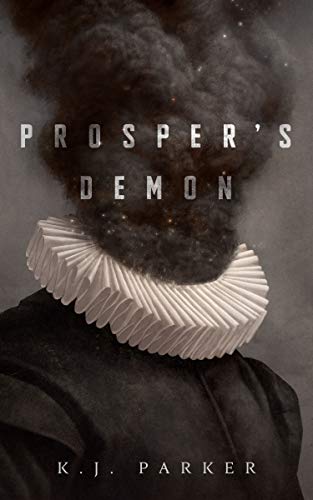
... only two things live forever, the instruments of darkness and works of genius. Which, I now had disturbingly good reason to believe, might not be such separate categories as I’d once thought. [loc. 877]
A grimly cheerful novella about an exorcist, a couple of demons and a polymath with ambitious ideas: also extremely informative on the subject of casting massive bronze statues.
Our nameless narrator first encountered a demon before he was born: one particular demon, in fact, that periodically possesses other humans, until our narrator locates Him and drives Him out. Maybe that early experience is part of the reason he's the best at what he does. Exorcising a demon from a human isn't pleasant for either party, but the demons -- who are immortal -- suffer magnitudes more.
Curious statistic: in this Renaissance-adjacent world, the human population is fifteen million, and they are plagued by exactly 72, 936 demons, two of which feature in this story. There's the one that our narrator met in the womb, known as He, and a new one that he identifies as female. Both demons have plans involving Prosper of Schanz, a polymath genius who wants to make a bronze horse larger than anything that's ever been made -- and who also wants to tutor the young prince who will eventually ascend to the throne. A worthy conduit for demonic machinations ...
Morally grey, sometimes really quite unsettling, and often very funny. The opening scene is especially gory, but it's the narrative equivalent of an opening chord, rather than setting the tone throughout. This is classic Parker with its combination of practical engineering, lesser evils balanced against greater ones, and a narrator with an unhappily clear view of his own failings.
Tuesday, January 22, 2013
2012/66: A Game of Thrones -- George R. R. Martin
"You are the gentle sex," said Lord Karstark, with the lines of grief fresh on his face. "A man has a need for vengeance."What to say about A Game of Thrones? I doubt I can add much to the screeds that have been written about it in the last (eep) seventeen years.
"Give me Cersei Lannister, Lord Karstark, and you would see how gentle a woman can be," Catelyn replied.[location 14060]
This is not feel-good fantasy, at least not yet. There's plenty of brutality, and not just amongst the 'barbarians': there is war, and treachery, and cruelty. A Game of Thrones a complex, densely-plotted epic, with a large cast of rounded characters and a coherent world that differs from our own in ways that, in this first volume, are unclear. The seasons, for a start, are longer -- 'winter is coming' -- which makes it peculiarly difficult to get a sense of the passage of time. And while I'm being critical: one drawback of having multiple narrators, in a book this length, is that Martin can keep the reader on tenterhooks for a long time after ending a chapter at a critical moment.
I liked it, but I didn't love it. I think I found the tone too level, the humour lacking. (Though I did laugh out loud at the singer named Marillion. US readers will probably not find this as entertaining as will UK readers, especially those of a certain age.) After finishing this book, I mentioned online that I preferred K J Parker, and I maintain that Parker's novels are just as complex and a heck of a lot wittier.
That said, Martin has some truly splendid female characters (I wonder if this was more remarkable in the 1990s than it is now?) and some intriguing hints at the larger story, which I believe is still unfolding. I shall keep an eye out for cheap copies of the other books in the series, but don't currently feel inclined to pay a fiver a time for Kindle e-books, and don't believe my wrists are up to reading the dead-tree versions. (Excellent holiday reading, though -- truly immersive!)
Question: would I enjoy the book more, or less, if I had also watched the TV series? (Managed one episode. Everyone was improbably good-looking.)
Friday, October 15, 2010
2010/75: Blue and Gold -- K J Parker
I'd finally given her what she wanted, the elixir of eternal youth, effected by the removal of her internal fire (the catalyst of change) through the agency of death. She'd have been so pleased, if only she'd been there to see it. Still, you can't have everything ... (p. 70)Saloninus, philosopher and alchemist and the 'greatest living authority on ethical theory', is on the run. His wife is dead (having imbibed one of Saloninus' experimental concoctions) and his brother-in-law Phocas, the Prince Regent, is keen to keep Saloninus around, to harness that alchemical genius for his own ends. If Saloninus can transmute base metal to gold, Phocas might finally forgive him for the death of his own wife, executed for adultery...
Blue and Gold, set in the same world as The Folding Knife -- I'm unsure whether it's contemporaneous: there doesn't seem to be obvious crossover -- is a novella about another individual who's amoral, dishonest and too clever for his own good. Saloninus is unexpectedly charming, and always several steps ahead of his own narrative (which is, he warns us, thoroughly unreliable). Parker teases us with scraps of alchemical theory, allusions to Saloninus's philosophical works (Ethical Dilemmas, On Form and Substance) and discussions of the real challenges on the table: explosives, the gold standard, the impossibility of the colour blue.
Short, erudite and witty: great fun.
Sunday, June 28, 2009
#47: A Song for Nero -- Thomas Holt
When you're the last of the Julio-Claudian dynasty, heir to the likes of Tiberius and Caius Caligula, you're pretty well obliged to measure up to a fairly high standard of debauchery. It's expected of you, like wearing the toga and being able to recite your Homer. When they bring on the Libyan eunuchs on all fours dressed in goatskins, you can't turn round and say, No, thanks, I'd rather read a book. (p.38)
I don't read much comic fantasy, so I'm not familiar with Holt's better-known work (though I did enjoy Expecting Someone Taller and Who's Afraid of Beowulf?). A Song for Nero is a historical novel: what if Nero didn't die by his own hand as everyone thought, but switched places with a boyfriend who strongly resembled him, and went on the run with his dead boyfriend's brother Galen? What if Nero and Galen have been roaming around the Mediterranean for ten years, living on their wits as not-very-successful conmen and hustlers? And what if Nero's ready to rediscover himself? His great crime, according to the establishment, was to sing and play an instrument in public. Lucius Domitius -- as he's always known in these pages -- still yearns for recognition of his artistic talent, though he's terrified of being recognised if he actually performs his own work.
A Song for Nero is a pacy romp through the seamy underside of Roman life: slavery, brothels, crime syndicates, disgustingly bad wine, Queen Dido's fabled treasure and Virgil's Georgics (a.k.a. 'On Farming'). There's more than a few similarities to Homer's Odyssey, too, especially as the novel moves towards its conclusion. Galen and 'Lucius Domitius' are oddly likeable characters, considering their lack of morals, general bad behaviour and sleazy pasts. (Holt has Seneca delivering a speech about the virtues and achievements of Nero as Emperor: there's a certain amount of exculpation here. But it's not all hagiography by any means: several characters have very good reasons for wishing Nero properly dead.)
There are few women in this novel -- something I didn't notice until the first female speaking role, if you see what I mean, around page 200 -- and mostly they're rather unpleasant. Luckily Galen and Lucius Domitius don't seem to be greatly interested in any flavour of carnal pursuit: Galen does fall for someone, but this does not turn out well. And Lucius Domitius may have had all the carnal pursuits he can handle for one lifetime. Also, though there's no hint of sexual attraction between the two, it's clear that they are codependent: I hesitate to tag Galen's feelings for Nero as 'love', but there is a strong attachment.
Holt's prose, and some of his imagery, reminds me strongly of K J Parker. There's the colloquial, cynical tone; a certain fatalism; an emphasis on the randomness of life; the sense that there might or might not be something slightly odd, supernatural-type odd, going on, but that it's really not important, just one of those things the universe dreams up to confound humanity. There are some insights into family history at the end of the book that cast both Galen and Lucius Domitius in quite a different light. Reading Holt's description of returning to a familiar house, now run-down and ruinous, felt so familiar that I was sure I'd read that part of the novel before, perhaps in a review: then I remembered similar scenes in several of Parker's novels.
There was the gate, probably the same bit of mouldy old string holding it onto the post as when I'd left; there was the mounting-block, half crumbled away, with weeds growing up through the cracks. There was the well, and the staked-off rectangle of gravel we tried to grow beans in, and right next to the back door, the midden -- maybe a tad taller and nastier-smelling than it'd been in my day, but you can't really call that progress ... (p453)
But maybe it's just that they've read the same books. Or that I'm manufacturing similarities in the prose of two authors I like very much.
And once or twice I thought, this is a better ending than the one in all the books. Far better this way than the big fight scene, stringing the great bow and shooting down the noble lords of Ithaca like stray dogs. So much more sensible, if you will insist on coming home, to settle down in a quiet way, do an honest job of work, raise a good crop of corn and grapes and beans, and not worry about who rules over who, or what the rights and wrongs of it all are. ... the trouble with Ithaca is, when you finally get there, you find out it's moved on, and the place where it used to be is called something else now, and strangers live there who don't hold with your sort. (p. 498)
Thursday, March 24, 2022
2022/41: The Devil You Know -- K J Parker

Those awesomely strong monarchs of the deep had brains the size of walnuts. And so it is, as far as I can tell, with the gods. All power and no intellect. Strength makes you stupid. It’s the weak who grow smart. [p. 111]
A sequel, of sorts, to Blue and Gold: Saloninus, the philosopher-protagonist of that earlier work, makes a deal with a demon. Twenty years of restored youth, invulnerability to accident, and a demonic servant to obey his every whim: and, yes, straight to hell at the end of the contract. This contract has been drawn up by demonic bureaucrats (is there another sort, I hear you cry) and is guaranteed loophole-free. But Saloninus, the alchemist, is good at changing things beyond recognition.
The story is told in alternating first-person narratives, Saloninus and his unnamed demonic liaison. One ends up rather liking the latter, with his (its?) appreciation of human art, enjoyment of tea, and growing conviction that Saloninus has something up his sleeve. Saloninus himself is a thoroughly unreliable narrator, prone to recounting an incident -- for example, the death of his wife -- and later explaining that appearances might have been deceptive and something completely different occurred. As, indeed, seems to have been the case with that contract.
The Devil You Know (second book with this title that I've read recently!) is vastly entertaining, darkly amusing and pleasingly complicated, a riff on the Faust legend with a protagonist who's cleverer and more cunning than Faustus. An excellent reminder of how much I enjoy (most of) Parker's fiction.
Thursday, December 26, 2019
2019/136: A Conspiracy of Truths -- Alexandra Rowland
We were trying to come up with things that were true, but garden-variety truth is so dull. It just doesn't catch the heart and mind the way Truth does, and to tell the Truth, oftentimes you must lie. [p. 324]

An elderly, itinerant storyteller is arrested in the cold northern backwater of Nuryevet, on charges of witchcraft and brazen impertinence. He manages to persuade the judge he's not a witch -- and is then imprisoned on suspicion of spying. His court-appointed advocate, Consanza, is initially suspicious of a pro bono client who won't even tell her his name (it's a 'religious matter': he's a Chant, a member of an ancient order of storyteller-priests, and 'Chant' is the only name he has), but unthaws slightly as she comes to know him. And Chant, though he has no magical abilities, does have the power of story on his side, and a knack for finding the story to suit the circumstance. As he plays the games of Nuryevet's political factions, and plays those factions (and fictions) against one another, he creates his own story about Nuryevet, and whether it's worth saving, and what might take its place.
This is a timely tale: fake news, a climate of fear, good people letting bad things happen, bureaucracy run amok ... Nuryevet has a rather Slavic feel, at least from the inside of Chant's various, poorly-heated prison cells. In some ways it's remarkably liberal to a contemporary eye: there's no evidence of homophobia, sexism or racism. (Chant is dark-skinned, his apprentice Ylfing somewhat lighter-skinned, a distant tribe is described as having skin the colour of shelf mushrooms.) Polyamorous marriages, for love or business or to avoid tax burdens, is the norm. But one person in five is a lawyer, because everyone is trying to protect what they have -- assuming they have anything. Nuryevet, Chant recognises, is a story, a consensus: and one of its underpinnings is 'the idea that they could feed their poor to the story like cattle to a sea monster so the wealthy could eat its leavings'. [p. 200]
I was reminded, in a good way, of the work of K J Parker -- with its focus on economics, bureaucracy, corruption and geography, rather than on the fantastical elements and chosen ones of a magical realm. Rowland's female characters are rather more likeable than Parker's, and the novel features real magic. Not that Chant is at all magical: but he is a showman, and his knowledge of chemistry proves as effective as a spell.
It's worth noting that despite the narrator being held prisoner for almost all of the novel, there's little or no sense of claustrophobia. By telling, and hearing, stories, Chant both creates and inhabits the world beyond the prison walls. And by narrating the story that is A Conspiracy of Truths to an individual who is not identified until late in the novel, he sustains an air of mystery quite separate to the already-answered question of his survival.
A lot of the buzz about this novel centred on Ylfing, Chant's seventeen-year-old, 'boy-crazy' apprentice. He is indeed a delight, and the affection and loyalty between him and his elderly, cynical, grumpy master is evident despite Chant's disclaimers of watering eyes et cetera: but Ylfing's loyalty is poorly rewarded, and that's one of the novel's most poignant aspects. Luckily the sequel (A Choir of Lies) focusses on Ylfing ...
I had to buy an American paperback edition of this book, because it's not available on Kindle in the UK. (Benefits include beautiful cover, soft spine and general niceness.) Buying the physical edition meant that I had to time the reading to when I'd be at home for an extended period (good lighting, easy to take notes, no need to carry book anywhere). So this was my Christmas present to myself: it is good to give and to receive!
Subscribe to:
Posts (Atom)