Friday, October 31, 2025

2025/178: Nothing But Blackened Teeth — Cassandra Khaw

One girl each year. Two hundred and six bones times a thousand years. More than enough calcium to keep this house standing until the stars ate themselves clean, picked the sinew from their own shining bones. [loc. 238]

Talia has always wanted to get married in a haunted house: when she announces her marriage to Faiz, their wealthy friend Phillip flies the couple and their friends -- Cat the narrator and Lin her ex -- to Japan, and sets up a sleepover in an abandoned mansion. They have "“booze, food, sleeping bags, a youthful compulsion to do stupid shit... and a hunger for a good ghost story”" [loc. 202]. And they have a setting rich with stories about dancing girls buried in the walls, and a legend of an aborted wedding where the groom died en route.

Cat is an interesting narrator because she's not sane or sober. Talia hates her, because she once dated Faiz; but everyone in the group seems to have dated everyone else. Cat is more sensitive than the others to the ambience of the house, and to the presence there: the ghost whose kiss she feels. And she's the one thinking of ohaguro, teeth blackened with a solution of vinegar and iron filings, like the dead bride.

A novella with a slow start and a crescendo to horrific violence. Is Cat a wholly reliable narrator?

This was a Hallowe'en read which led me down various Wikipedia rabbit-holes: Khaw drops in various Japanese terms without explication, and though one can appreciate the story without understanding every nuance, my need to know distracted me from the story. I loved the prose, though, and the subversion of horror tropes was splendid.

Tuesday, October 28, 2025

2025/177: Starling House — Alix E Harrow

It’s something about the way the shadows fell in Eden, after Eleanor died. It’s the way everything soured: the river ran darker and the clouds hung lower; rich coal seams went dry and healthy children sickened; good luck went bad and sweet dreams spoiled. [p. 49]

When Opal's mother died, Opal lied her way into becoming her brother Jasper's legal guardian. In the decade since then, she's been working hard at awful jobs to try to raise enough money for him to go to a decent school. She's haunted by dreams of the car crash that killed her mother, and by half-forgotten fragments of the book she loved as a child: 'The Underland', by Eleanor Starling. And she's strangely drawn to Starling House, the Gothic mansion on the edge of town. 'Town', in this instance, is Eden, Kentucky: a down-on-its-luck, working-class town, blighted by the pollution from the local power plant, and suffering a statistically-unlikely number of accidental deaths.

When Opal encounters the reclusive occupant of Starling House, brooding Goth-styled Arthur Starling, he offers her the perfect job: cleaning and caring for the house. The money will pay for Jasper's education and Opal will get to explore the house that's fascinated her for years. But there's more to the house, and to Arthur, than meets the eye.

Opal is not a reliable narrator, but slowly her story -- and that of her family -- comes together. In parallel there's the story of Eleanor Starling and the house which bears her name. And the house ('a foolish old house with ambitions of sentience', according to Arthur) is wakening under Opal's ministrations, letting in the light. Like Hill House, it dreams, but its dreams are rather more pleasant. Opal isn't the only one who's interested in Starling House, though. Elizabeth Baine, who claims to be from Gravely Power (the company that runs the power plant) encourages Opal to spy and steal. She claims the house is an 'anomalous aperture'.

This is a story about stories: about the variations on a theme of Eleanor Starling, and about the Gravely family, and about dreams, and about homes. Every time Opal discovers another variation on the history of Eleanor and of Eden, her perceptions shift. As well as the obvious fairytale elements ('Beauty and the Beast', though who's who?) there are elements of Greek mythology: the rivers of the underworld, the prohibition on looking back. And there are simpler, uglier stories: 'Once there was a bad woman who ruined a good man. Once there was a witch who cursed a village. Once there was an odd, ugly girl whom everyone hated, because it was safe to hate her. [p. 275].

I am awed by Harrow's ability to make place into character. Starling House is as much a character in the novel as Baines, or Jasper, or Arthur himself. Eden, too, has an ugly kind of personhood to it. The prose is vivid and engaging, and though the focus is mostly on Opal and Arthur, there are some intriguing subplots.

Note that Amazon helpfully tells you that you've finished the ebook before you get to 'SEVEN YEARS LATER: A bonus short story set after the events of Starling House'.

Monday, October 27, 2025

2025/176: Everything I Need I Get From You — Kaitlyn Tiffany

...fans are connecting based on affinity and instinct and participating in hyperconnected networks that they built for one purpose but can use for many others. [p. 270]

The subtitle, 'How Fangirls Created the Internet as We Know It', is somewhat misleading. The Archive of Our Own -- built by (mostly female) fans, currently hosting over 16 million fanworks, proudly cost-free and independent since 2007 -- gets a single sentence. In contrast Tumblr (owned by a succession of big tech companies) is repeatedly lauded as an archive as well as a medium for sharing and communicating. 

The book's focus is very much on One Direction (1D) fandom, and the author's personal experience is part of the story. She explores how fandom can be a coping mechanism, a creative outlet, a way of life: and she doesn't shy away from some of the more troubling aspects of fandom, such as outspoken fannish certainty that (for instance) two members of One Direction were in a committed relationship. The prevalence of this notion affected the band, as well as the multitude of believers.

Tiffany discusses 'affirmational' vs 'transformational' fandom (terms she attributes to a Dreamwidth post from 2008): affirmational fandom celebrates the source for what it is, transformational fandom transforms it. She describes how fans use and abuse the internet and associated technology to connect and communicate, to celebrate, but also to protest and organise. The Black Lives Matter activism on various high-profile blogs is one instance of the latter: Tiffany also cites the ways in which fans use technology to circumvent local restrictions, for example spoofing IP addresses to upvote a band's singles for the Billboard charts. (Guess which band?)

My vague sense of disconnection with this book clarified on page 126, when the author says 'My mother was born in 1965'. Aha! Tiffany is very much part of a younger generation of fandom than mine: digital natives, people who grew up with the internet and with internet fan communities.

And, the excesses of 1D fandom aside (there is a thorough exegesis of the Harry Styles Vomit Shrine), I think that quite a lot of the themes discussed in this book also apply to old-school SF fandom. At the start of the book, Tiffany says 'Before most people were using the internet for anything, fans were using it for everything' [p.7]. Like many of my readers, my initial reasons for getting online included the urge to connect with other people who liked the same books. And in those long-ago days of Yahoo Groups (closed, apparently, in 2020) and that newfangled thing called LiveJournal, I discovered my tribe.

Hello, tribe.

Sunday, October 26, 2025

2025/175: Love in the Time of Cholera — Gabriel Garcia Marquez

All that was needed was shrewd questioning, first of the patient and then of his mother, to conclude once again that the symptoms of love were the same as those of cholera. [loc. 1023]

Love in the Time of Cholera is the long and rambling love (or 'love') story of Fermina Daza and Florentino Ariza. They fall for one another as teenagers, and have a romantic correspondence by letter and telegram -- but never a conversation. When Fermina sees Florentino again after an absence, she realises she feels nothing for him, and rejects him. Instead she marries Doctor Juvenal Urbino, a young doctor determined to eradicate cholera, and they make a life together.

Meanwhile Florentino embarks on a life of promiscuity. Six hundred and twenty two affairs, plus casual (and not always consensual) liaisons too numerous and nameless to count. His worst conquest is saved for last: his young ward América Vicuña, who's a teenager when Florentino is in his seventies. "...he won her confidence, he won her affection, he led her by the hand, with the gentle astuteness of a kind grandfather, toward his secret slaughterhouse". [loc. 4548]

Still, he has to pass the time somehow until Fermina's husband dies: then he will 'have' Fermina. (The thought that she won't 'have' him never seems to enter his daydreams.) Between affairs, he becomes President of the Caribbean Riverboat Company, which destroys the ecology of the local river system in its insatiable greed for firewood to stoke the boilers. A metaphor, you say?

Though this is not a long novel in terms of page count, it felt interminable. Fifty years of Fermina's marriage (culminating in Dr Urbino's death while trying to catch his pet parrot): fifty years of Florentino's sexual predation. It's a sweeping saga that explores love in its many forms, and how an individual's definition of and perception of love changes as they grow older. But it also 'explores' racism, promiscuity, paedophilia, murder and suicide, misogyny, illness... 

If we knew nothing of Florentino's story -- only that he reappears after Dr Urbino's death, and helps the widowed Fermina come to terms with her grief -- it would be a glorious romance. Sadly, I can't stop trying and failing to balance that romance with América Vicuña's fate.

I have never quite got around to reading Marquez, and I wonder if I would have appreciated this book more in the 1980s, when it was published. But surely even then I would have found the behaviour toxic? I will read One Hundred Years of Solitude at some point: I'm told there's more magical realism and less sleaze. Not yet, though. It'll wait.

“Love is the only thing that interests me,” he said.
“The trouble,” his uncle said to him, “is that without river navigation there is no love.” [loc. 2768]

Friday, October 24, 2025

2025/174: My Name Isn't Paul — Drew Huff

I don't want to be a sentient empathy-filament-abomination, so I only eat human food. [loc. 65]

Paul Cattaneo is dead: to begin with. He's been replaced by a Mirror Person who wears a 'skinsuit' replica of Paul Cattaneo's body. His friend 'John O'Malley' (formerly Noonie) is another Mirror Person. 'We are forty-something blue-collar human men. We aren't fuckin' bugs.' Unfortunately, (a) they are bugs and (b) they will soon go into heat, which involves fornicating with another Mirror Person, finding a human in whom to deposit the eggs, and watch the larvae feed. So, yes, fuckin' bugs.

This is the story of 'Paul', a.k.a. Uxon, who's consumed by self-loathing, mourning a friend's suicide, and trying to deny his own nature. It's about being a person as well as being an eldritch abomination: about Paul's relationship with Paul Cattaneo's wife (who spotted the change in the man who was pretending to be her husband, because he no longer beat her) and about how the other Mirror People -- refugees from another dimension, probably -- rally round to support him when he goes off the rails. It's about living in the 'wrong' body and rejecting the biology of that body.

It's a neat idea, but perhaps would have worked better as a novel than a novella. Some truly icky scenes (there are content warnings at the start of the book, hurrah!) and multiple viewpoints. For me, this was interesting rather than engaging, but your mileage may vary.

Thanks to the publisher and Netgalley for the advance review copy, in exchange for this full honest review. UK Publication Date is 18th November 2025.

Thursday, October 23, 2025

2025/173: Slow Gods — Claire North

They like to make sure I am observed. When no one is looking, that's when I forget to be ... acceptable. Normal. Part of this world. [loc. 1116]

This is the first-person account of Mawukana Respected na-Vdnaze ('Maw'), who's born into poverty and debt in an uber-capitalist civilisation known as the Shine. When the Slow -- a huge, ancient construct that is something like a god -- sends a message warning of a future supernova that will destroy all life within a radius 100 light years, the Shine suppresses the warning. People are afraid, and furious: there is civil unrest: Maw is imprisoned, sentenced to what's effectively slave labour, and then forced to become a Pilot.

Pilots are necessary to interface with machine navigation in order for spaceships to travel through 'arc-space', where the darkness seems alive and aware, where people are haunted by hallucinations and the sense of presence. ('Various words are ascribed to the 'otherness', the unknowable 'thing' waiting in the dark. Common ones are: uncanny, malign, sinister, slippery, clawing, cruel, malevolent, mischievous...' [loc. 1686]) Most Pilots go mad or die after a few trips. Maw dies, it seems, on his first trip: but it isn't permanent. The darkness has somehow got inside him.

But he is useful. Other worlds are taking the supernova warning seriously: organising the mass evacuation of hundreds of worlds; reacting to the certain deaths of the billions who can't be saved; racing to preserve cultural treasures. Maw, the Pilot who's lasted longer than any other, is at the heart of it all.

I read Maw as being on the autism spectrum even before his first death: he talks about 'always doing something a little bit wrong', about not really having emotions but picking up on the feelings of others, about not getting the hang of smalltalk. Whatever happens to him in the dark changes a great deal about him, but at heart he is still an imperfect person -- or an imperfect copy of one.

This book has a plethora of pronouns: he and him, she and her -- but also, in the Shine, hé and hím, shé and hér, for individuals who exemplify the current concept of 'man' or 'woman' (the Shine does not accept other gender identities); qe and qim for AI individuals; xe and xer, te and ter, and more. There's an amusing interlude about pronouns and about how different cultures assign them differently and for differing periods. "So... the important thing is your genitals?" blurts one character when this is explained.

There are, to be fair, a lot of infodumps, signposted as Interludes: this is a huge and cosmopolitan universe, with many civilisations and many inhabited planets. Most of the non-AI characters are more or less humanoid, but there are aquatic and avian sentient species too. There are also sentient, organic, plant-based spaceships, like the splendid Pride of Emni. The universe-building is a delight: each culture, each society, distinct and idiosyncratic. I was reminded, at times, of Iain M. Banks' Culture: at other times, of Ursula Le Guin's gift for depicting a society.

I loved Slow Gods, even through the misery and cruelty of the first few chapters. I like Maw as a character, though I can see why he needs constant supervision so as not to become 'dysregulated'. I like his quan (AI) companions, especially Rencki, and his gentle let's-not-call-it-love affair with a curator (whose gender is never specified, because irrelevant). I like that Maw gardens, and that he learns to accept himself. I love Claire North's writing: every new project of hers is a surprise, with a different flavour and a different focus. (See Ithaca and the rest of the 'Songs of Penelope' trilogy; The First Fifteen Lives of Harry August, Touch, The Sudden Appearance of Hope.) And I am quietly joyful that, amid the genocide and murder, the slavery and war, this is a novel about life as a miracle and love as its guiding principle.

I don't know how you're meant to be this small in a universe this big, this insignificant in a galaxy where every decision matters, where every life is precious. I don't know how to feel so huge and so loud inside, and so small and quiet before the dark. [loc. 4061]

Thanks to the publisher and Netgalley for the advance review copy, in exchange for this full honest review. UK Publication Date is 18th November 2025.

Wednesday, October 22, 2025

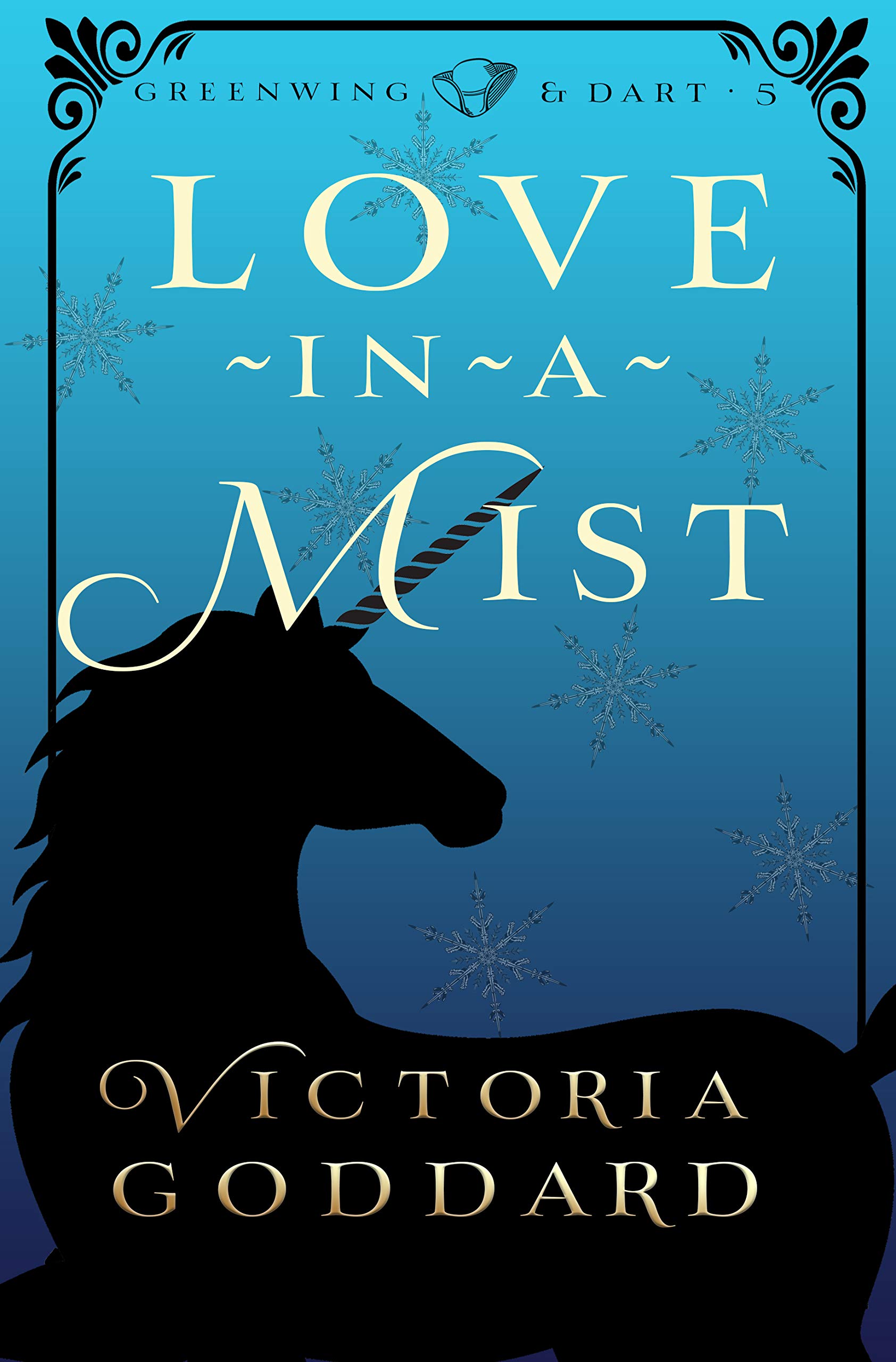
2025/170-172: Whiskeyjack, Blackcurrant Fool, Love-in-a-Mist — Victoria Goddard

Perhaps it was not the blind malignancy of fate making my life so complicated. Perhaps it was me. [Whiskeyjack, loc. 4159]

Rereads to sustain me through a bad cold and the aftermath of my birthday celebrations: I can think of few better remedies.

Whiskeyjack (original review here) introduces layers of complication, curses, several people who are not who they say they are, and Mr Dart's magic becoming more obvious to those around him. After reading Olive and the Dragon, Jemis' mother's letter has new poignancy.

Blackcurrant Fool (original review here) is the one where they all go to Tara: there are highwaymen, kittens, dens of iniquity, and Jemis' toxic ex-girlfriend. Also a devastating denouement, and some healthy post-colonialism. In some respects this is my least favourite of the novels, though it can't be because of the setting...

Love-in-a-Mist (original review here) is a country-house murder mystery, with a unicorn, the revelation of the Hunter in Green's identity, coded messages in the personal ads, and a missing heiress. I think this might be my favourite so far.

Even just rereading my old reviews is making me want to plunge on to the currently-final novel, and the novellas... but I will save those for especially awful days between now and Bubble and Squeak.