Saturday, April 21, 2018

2018/16: The Portable Veblen -- Elizabeth McKenzie

... the work of maintaining your life with your own skills was never counted in hours. The days were long and arduous, but there was no wishing them to go by. The very word "weekend" was a monstrous little propaganda of modernity. Of gladness that time had passed, your very life! [p. 190]
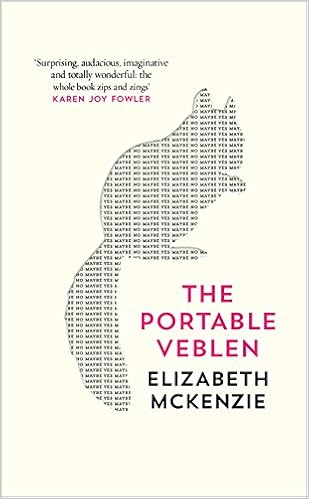
Veblen Amundsen-Hovda ('experienced cheerer-upper, and freelance self', or alternatively something of a slacker) falls in love with Paul, a research neurologist (inventor of the Pneumatic Turbo Skull Punch) who's grown up in a hippie, marijuana-scented family home, and wants a normal life. Spoiler: he is not going to get that with Veblen, who is delighted by the squirrel that clatters around in her loft, who hasn't got around to mentioning the antidepressants, whose general good cheer at once charms and vexes Paul.

And of course, having agreed to marry, they must meet one another's families.

Paul's parents are pretty much devoted to his disabled brother Justin (the nature of the disability is never discussed by Paul). Veblen's father is in a psychiatric hospital. Veblen's mother Melanie -- possibly the star of this novel: certainly the most vivid character -- is a narcissistic hypochondriac who seizes on Paul as a representative of the American medical profession, and proceeds to relate her impressive catalogue of symptoms. It is to Paul's credit that he does not immediately run screaming from the house.

Veblen's relationship with her mother rang nauseatingly, claustrophobically true. (Possibly the reason it's taken me so long to write this review: Melanie, though nothing like my mother in most respects, nevertheless felt very familiar.) It's the kind of relationship that flavours every aspect of life: no wonder Veblen thinks of Paul as 'a human safe house from her mother', though he turns out to be more of a bridge. Each helps the other grow up, in a sense; both Veblen and Paul have to let go of their families -- or at least learn how to become an adult, rather than a child, within those families -- before they can truly commit to one another.

I think this is the first novel I've ever read that features a love triangle where one of the three is a squirrel. (And there are tantalising hints that there is rather more to the squirrel than Paul, at least, would ever suspect.)

Often very funny; frequently philosophical; sometimes almost painfully raw. And there is plenty of plot to fit around the familial interactions -- a whole black comedy of the American pharmaceutical industry. An entertaining and unsettling read.
Monday, April 16, 2018

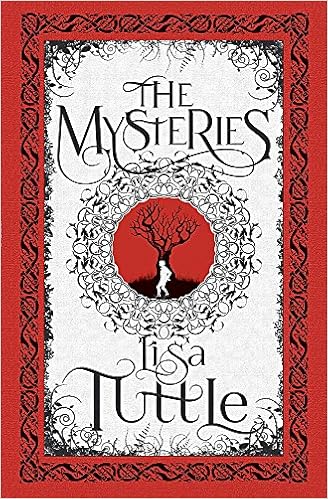
2018/15: The Mysteries -- Lisa Tuttle

Nobody wanted to be merely human these days. Kids imagined being Harry Potter or Buffy or Sabrina the teenage witch, with magical powers their birthright. But Etain wasn't a person at all, certainly not a role model. Unlike a modern girl, she was merely a possession. She could be bought or sold, won back or stolen. [p. 105]
Ian Kennedy is a private detective who specialises in finding missing people -- specifically, those who have vanished without trace. His profession is rooted in his past: his father disappeared when he was a child, and his girlfriend Jenny left him. Since then, he's tried to track down those who have vanished. He is engaged by Laura Lensky to find her missing daughter Peri, who seems to have vanished off the face of the earth. Laura's friend Polly -- why can't he place the name? -- recommended Ian, and Laura, along with Peri's boyfriend Hugh, is desperate to find a sensible and rational explanation for Peri's disappearance.

Ian's first-person narrative jumps from present to past (his investigation into the disappearance of Amy Schneider, which seems to have been the case that made his name) as well as from personal to historical: the chapters of his narrative are interspersed with accounts of historical disappearances, some of them well-documented (the Flannan Isles lighthousekeepers, the British Ambassador to the Austrian Empire) and some more like folklore.

And Ian, unlike Laura, is perfectly willing to consider the possibility of some supernatural agency. He's familiar with Celtic myths -- primarily the story of Midir and Etain -- and has, during the Amy case, met at least one young woman whose need to escape the mundane world seems to Ian a kind of suicidal impulse.

Hugh, Laura and Ian all have their own motivations for finding Peri -- and their own reasons for being reluctant to face the facts. Ian, for me, was not a likeable character: he's prone to sexist generalisations, he's arrogant, and by his own account of Jenny's disappearance he refused to accept that she wanted to leave. On the other hand, his memories and perceptions are not always reliable ...

This is a gradual novel: it starts slow, and picks up the pace -- and the strangeness -- to the denouement. Midir and Etain are't the only mythological resonances here: there are also echoes of Demeter and Persephone, and perhaps of Orpheus and Eurydice. I'm still not sure if Ian gets what he wants: I'm not sure if he knows what he wants. But he knows enough to realise that he's missing something, excluded from something, mysterious.

Friday, March 30, 2018

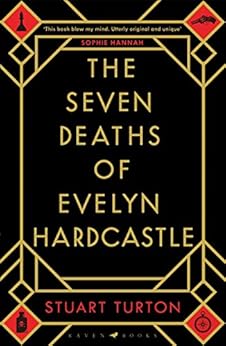
2018/14: The Seven Deaths of Evelyn Hardcastle -- Stuart Turton

I'm reminded of Daniel's pleas yesterday, his delicate way of speaking, as though I might fracture if pressed too hard. He thought I was mad, as this maid does now. Given what's happening to me, what I think is happening to me, I can't be certain they're wrong. [loc. 1563]
A country-house murder with a time-loop twist. Our narrator wakes in a forest, with no memory of his own name: no memory of anything except the name Anna. He hears a woman's scream, then is given a silver compass and told 'East' by a mysterious figure whose face he never sees. Following directions, he stumbles up to the front door of Blackheath, where a house party is taking place. Soon, a masked figure appears, and informs him that a murder will occur late in the evening -- a murder that won't look like a murder. (The title, of course, refers to the victim.) Our narrator is there to solve it -- and he has eight chances, living the same day eight times as eight different guests. If he succeeds, he will have a tomorrow. If he fails, says the masked figure, the loop will reset, and he'll live through this day another eight times.

He's not the only person investigating the crime. He has rivals, each aiming to be the one to solve the murder and win their freedom. He may also have an ally -- though he's not always clear as to which of the other characters that might be. And, of course, the masked figure's information may be inaccurate. Can our narrator retain enough sense of himself and his mission to solve the murder? And if he saves the murder victim in the process, has any crime been committed?

This is a cleverly-constructed whodunnit, effective on several levels. There's the standard murder mystery: one of the people in the house kills one of the other people in the house. There's the way that each loop, and the associated host, adds both context and confusion to the narrator's understanding. There's the underlying issue of why he's been set to solve the murder at all. And there is the deliciously subtle way in which his personality is modified -- sometimes in unpleasant ways -- by the personalities of the hosts he inhabits.

There are some interesting philosophical notions here, as well as the convolutions of what turns out to be a very twisty murder-mystery. The Seven Deaths of Evelyn Hardcastle is packed with detail, and eminently readable (though I could have done with fewer run-on sentences). Interesting, unusual, recommended.

Thursday, March 22, 2018

2018/13: Lud-In-The-Mist -- Hope Mirrlees

He knew so well both that sense of emptiness, that drawing in of the senses (like the antennæ of some creature when danger is no longer imminent, but there), so that the physical world vanishes, while you yourself at once swell out to fill its place, and at the same time shrink to a millionth part of your former bulk, turning into a mere organ of suffering without thought and without emotions; he knew also that other phase, when one seems to be flying from days and months, like a stag from its hunters – like the fugitives, on the old tapestry, from the moon. [loc. 521]
I have owned a paperback of this novel for at least fifteen years, but hadn't read it until prompted to do so in advance of the 'Fantastic Read' panel at Follycon. My loss. (Other books discussed on that panel: Swordspoint and Summer in Orcus.)

Published in 1926, this novel has been hailed as a classic of high fantasy. I wonder if Mirrlees would be pleased at its success, or disappointed that her theme of 'life vs art' was ignored in favour of the lush, almost preRaphaelite descriptions of Lud-in-the-Mist.

Lud-in-the-Mist is the capital of Dorimare, a country that borders on Fairyland. Centuries before the events of the novel, the two countries coexisted peacably: then the merchants rose up in revolt, banished their ruler Duke Aubrey (who, rumour has it, fled to Fairyland and lives there too) and forbade mention of anything to do with Fairyland.

But now, it seems, Fairy fruit is being smuggled into Lud-in-the-Mist: and Nathaniel Chanticleer, law-abiding citizen -- indeed, Mayor -- must face up to the uncomfortable truth that both his children (Ranulph and Prunella) have tasted that forbidden produce, and are languishing for want of it. When Ranulph escapes his chaperone and runs away to Fairyland, Nathaniel sets out to rescue him. How fortunate that the young ladies of Miss Crabapple's Academy, lured by their odd new dancing master Professor Wisp, have already skipped away in the same direction: they -- including Nathaniel's own daughter Prunella -- can be returned to the bosoms of their families by some never-detailed action of Nathaniel's. (I am thoroughly unimpressed by Nathaniel's lack of concern for his daughter.)

En route to Fairyland, which is also in some sense the land of the dead (the country people call both Fairies and the dead 'the Silent People), Nathaniel Chanticleer investigates a cold-case murder; uncovers a smuggling racket; and discovers some unexpected truths concerning the disreputable physician Endymion Leer. And returning from Fairyland, he brings reconciliation of a kind that the Dorimarites had, apparently, never considered before.

Lud-in-the-Mist feels like a conservative (or indeed Conservative) idyll of bourgeouis Englishness: its colours are rich (though its inhabitants are homogeneous) and its characters self-satisfied, prosperous and law-abiding. Yet there's this dark underside, the awareness of 'impenetrable shadows' surrounding the small bright places where civilisation reigns: and there is, too, Nathaniel's own underlying melancholy, 'life-sickness', an oversensitivity to 'the figments of his own fancy'. All this against a backdrop of Dionysian 'fairy fruits', the recurring image of fugitives fleeing from the moon, and the memory of lost Duke Aubrey.

Mirrlee's writing reminds me of pre-Raphaelite paintings, jewel-coloured and vivid. There is, too, a certain sardonic tone to some of her descriptions that, had it been more pervasive, I would have found irritating: Mirrlees, though, balances it nicely with gentle amusement at the gentlefolk of Lud-in-the-Mist, and with occasional profundities -- 'There is nothing so dumb as a tree in full leaf' [loc 355] -- which have stayed with me.

I think I'll be returning to this novel again and again.

Sunday, March 04, 2018

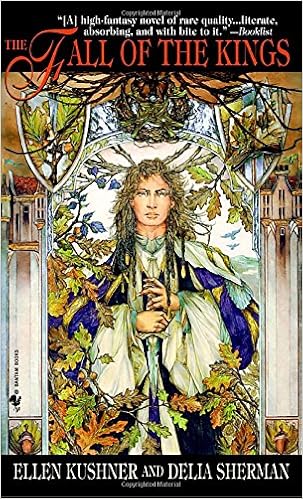
2018/12: The Fall of the Kings -- Ellen Kushner and Delia Sherman

"...We know, up in the North, we've always known; about the Sacred Grove and the Deer Hunt and the Royal Sacrifice."
"The Royal Sacrifice, or the King's Night Out," drawled Fremont into the silence. "It sounds like a bad play." [p. 147]
Set forty years after The Privilege of the Sword, and about sixty after Swordspoint, this is the story of Theron Campion, posthumous son of the Mad Duke (his parentage is revealed in the short story 'The Death of the Duke), and his love affair with scholar Basil St Cloud, an historian who's interested in the legends of the old kings and their wizards. It's common knowledge that the wizards claimed they were bound by magic to the Land; they chose the kings who would rule; the system was dismantled two centuries ago by the nobles, who saw through the wizards' fraudulent tricks. Even the suggestion that magic might exist is illegal. St Cloud, however, insists on researching primary sources, and what he finds makes him question the consensus.

Meanwhile, the nobles on the Hill are becoming increasingly concerned about rumours of trouble in the North. Can the so-called Companions of the King be anything more than 'an association of young men, young and unmarried, who gather in the woods from time to time to celebrate elaborate rituals that draw equally from local folklore and a youthful taste for mysticism and indiscriminate copulation'? [p. 348] And does Theron's family tree explain their interest in him?

Theron is something of a dilettante, studying at the University until he takes up his duties as Duke Tremontaine: Katherine, the heroine of The Privilege of the Sword, is the current head of the family, and between her benevolent rule and that of Theron's mother Sophia (a surgeon), Theron is allowed to indulge himself. He doesn't reveal his relationship with Basil to his family: Basil, after all, is a commoner, whose father is a tenant farmer on Theron's estates at Highcombe. (Basil can't complain, as he can hardly be open about having an affair with one of his students.) Instead, Theron courts Lady Genevieve Randall, who he thinks might rather like to be Duchess Tremontaine some day.

The Fall of the Kings is much longer, and more richly detailed, than the two preceding books. There are more characters (including more women), and more plot threads: I especially liked the scenes of student life, with claret and eels and arguments about whether the earth revolves around the sun. And I'm especially glad to have read this novel, at last, in its proper place in the sequence, with the weight of backstory behind it. I can see, from Theron's 'outsider' point of view, how Katherine grows up (though I do wonder why she has chosen to remain single) and learn the fate of the Black Rose's child, the utterly splendid Jessica. And it's interesting to see why magic has gone unmentioned in the previous novels -- and how the Tremontaine family have retained their power over the centuries. [I note, too, that the revelations of Tremontaine cast the events of The Fall of the Kings in a different light.]

Now I am more than ready to embarque upon Tremontaine Season 2 ...

Thursday, March 01, 2018

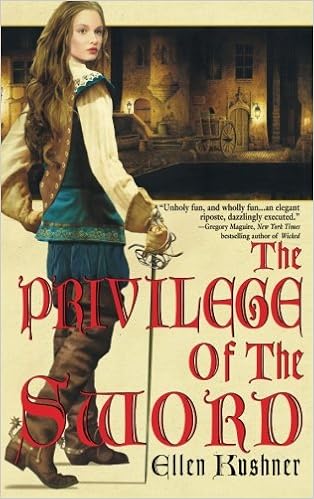
2018/11: The Privilege of the Sword -- Ellen Kushner

"A nobleman of the city brought your poetry's virtue into question — 'Duller than a rainy Tuesday and twice as long' was the way you put it, Bernhard, I believe? A challenge was issued. There was a duel, and the swordsman defending the honor of your verse was defeated."
"But — one man sticking another with a sword cannot change my poetry from good to bad just like that."
"The duel is the ultimate arbiter of truth. Where men's judgment may be called into question, the opinion of the sword always holds fast." [p. 100]
Reread after rereading Swordspoint: my previous review of The Privilege of the Sword, from 2006, is here. That review gives a good summary of the plot: Katherine Talbert goes to stay with the Mad Duke, who is Alec from Swordspoint; is taught sword-fighting by the Duke's reclusive friend; uses her new-found martial skills to avenge a female friend's honour, and her increasing confidence and independence to begin to make her own choices.

Rereading this time around, I found myself noticing the feminist aspects of the novel. Katherine is scornful of the swordsmaster who suggests she might be frightened by the mess and blood of a sword fight: "I am not afraid. I see twice as much blood every month". She dislikes the masculine clothing the Duke asks her to wear, because it shows her body more than she likes. She becomes profoundly aware of the ways in which her society treats women as second-class citizens.

I'm also much more aware of structural and narrative techniques than when I first read The Privilege of the Sword. We see Alec and Richard from an outsider's viewpoint: the great romance of Swordspoint, and how time and society have warped it, and what remains true. Alec, here, has matured into something glittering and powerful and, to be honest, not always very happy: Richard has undergone other changes, but is less altered by them. And I did feel that Alec, for all his delight in affronting society, was not nearly as subversive as his niece Katherine.

Onwards to the third novel in the sequence, The Fall of the Kings: I had never read them in sequence, or without intervening distractions, before ...

Tuesday, February 27, 2018

2018/10: Behind the Scenes at the Museum -- Kate Atkinson

I had thought that when she died it would be like having a weight removed and I would rise up and be free of her, but now I realize that she'll always be here, inside me, and I suppose when I'm least expecting it I'll look in the mirror and see her expression or open my mouth and speak her words. [p. 327]
A rambling, discursive story of four generations of women: Alice, her daughter Nell, Nell's daughter Bunty (short for Berenice); and Bunty's daughter Ruby, the narrator. The novel begins with Ruby's conception in 1951, and progresses in thirteen chapters to 1992: but each chapter has a 'footnote', telling the story of another family member. Sometimes the footnotes mirror what's happening in Ruby's narrative, and sometimes they add context to a name, or an object (a pink glass button, a lucky rabbit's foot, a locket).

The women of the family are prone to flight (Alice, Lillian, Patricia), and tend to regret not running when they have the chance. (None of them really marries for love, at least not the first time around: all of them long for love, even if they don't recognise it.) Each of the four main characters, at some point, believes that she's living the wrong life: this epiphany sometimes arrives as a spiritual or supernatural event, sometimes in more mundane form.

Alice's story begins in 1888: Ruby's ends in 1992. The wider world is relentless: many of the family (especially the men) fall victim to one war or another. But growing up in York, a town where 'the past is so crowded that sometimes it feels as if there's no room for the living', gives Ruby, in particular, an air of disrespect for life and death. Or is this just children (or the children in this novel) in general? Ruby's pragmatic lack of empathy (wondering, for instance, how a dead sibling's Christmas presents will be divided between her and her remaining siblings) was horribly credible.

Bunty is not a good mother. She is unhappy and unloved, and bestows unhappiness and emotional abuse on her daughters. Learning about her past -- and her mother's history, too -- granted me compassion for her. (If only real life came with a crib sheet about one's parents' heartbreaks, disappointments, secret shames and grudges!)

There are so many secrets in Behind the Scenes at the Museum: and secrets, kept, turn toxic. Children are born out of wedlock; die (as do adults) in mysterious circumstances; remember minutiae, forget life-changing events. Atkinson is excellent at seeding the narrative with clues, hints, and coincidences: connections fray and are rewoven, lost children turn towards home, similes foreshadow (or echo) parallels in different lives.

I note that this review is also rambling and discursive. And I've forgotten to mention that this intricately-constructed novel is often very funny (though the humour can be pitch-black), as well as poetic, poignant, and sometimes farcical.

And it makes me want to write a version with the women of my own family. Plenty of gaps to fill: plenty of women running away in search of different selves. Plenty of women surviving.