Saturday, December 21, 2019

2019/130: The Fortune Hunters -- Joan Aiken

“It isn’t only that sometimes I can’t remember what I’ve been doing. Now I’m beginning to be afraid—afraid that I might find out.” [loc. 2218]

Annette has recently moved to a small town near the coast. She's experienced three major life events in recent months: the death of her father, a substantial windfall, and an unpleasant bout of 'pneumonia complicated by jaundice', which has left her prone to fits of amnesia.

Her job as a magazine editor is being looked after by her colleague Joanna, who also suggested that she move house, and has introduced her to a family connection, famous artist Crispin James. Annette leaps at the opportunity to study with James, though her new friend Noel -- an archaeologist from New Zealand who's excavating a nearby Roman villa -- has reservations about the man.

And then there's the mysterious neighbour, and the children's toys that keep appearing in the garden, and Annette's sense that she has forgotten something very important.

Not the best of Aiken's romantic thrillers, but an enjoyable read. The romance is slight, and very much in second place to the mystery plot. Annette's amnesia is depicted with unsettling authenticity, and her vulnerability on that front contrasts nicely with her determination to retain her independence. An old-school Gothic feel, an adorable dog, and an outre plot that could have done with slightly more foreshadowing.

Monday, December 16, 2019

2019/129: Gaudy Night -- Dorothy Sayers [reread]

The young were always theoretical; only the middle-aged could realise the deadliness of principles. To subdue one’s self to one’s own ends might be dangerous, but to subdue one’s self to other people’s ends was dust and ashes. Yet there were those, still more unhappy, who envied even the ashy saltiness of those dead sea apples. [loc. 6327]

I think this might have been the first Lord Peter Wimsey novel I read, and it's still my favourite, perhaps because it's told wholly from the viewpoint of Harriet Vane. She's fragile in quite a different way to shell-shocked, upper-class Lord Peter. Harriet, who first appeared on trial in Strong Poison, is labouring under the knowledge that she owes her life to a man who's in love with her. For a weaker woman, or a more Gothic heroine, this would mean a glad surrender to marriage, but Harriet is proud and fiercely independent, and can't countenance an(other) unequal relationship.

Part of Gaudy Night is about how she and Peter come to be on a more level footing. Part of it is 'the reconciliation of heart and mind' [phrase borrowed from this splendid blog post about the novel], of Harriet's work as an author of detective fiction and her own passionate nature. And part of it is the almost claustrophobic locked-room mystery which Harriet and Peter attempt to unravel: a series of vile and well-aimed poison-pen letters and acts of vandalism, perpetrated upon the scholars and staff of the fictional Shrewsbury College.

This novel makes me nostalgic for a life I never had: my own university career was, by choice, in a more modern and less rarefied institution, and I wish now that it had been closer to what's described here. (Though 'here' is the inter-war years: and there's a heck of a lot of class-based prejudice, as well as period-typical sexism: Harriet deals admirably with the latter but is unconcerned with the former.) And, like all the best romances, it has that bittersweet air of unattainable harmony. But I still think it's delightful, and witty, and it was the novel that sprang to mind when I identified an urgent need for 'all-female college life' atmosphere.

Incidentally, several of Sayers' novels are available at Faded Page, which follows Canadian law regarding public-domain works.

Tuesday, December 10, 2019

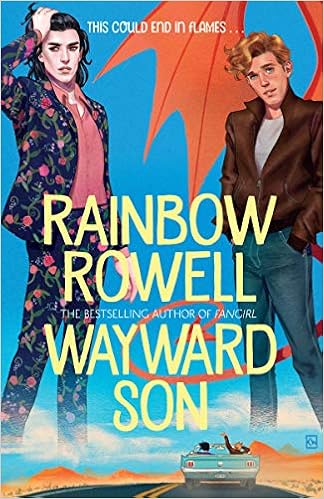
2019/128: Wayward Son -- Rainbow Rowell

The therapist said I needed to work through the past to keep it from undermining the present. And I said— Well, I didn’t say anything. I skipped my next appointment and didn’t make any more. [loc. 442]

I very much enjoyed Carry On, and was looking forward to this sequel (which turns out to be the middle volume of a trilogy): I was disappointed, though, because all the characters seem to have been hit by a stupidity spell which prevents them from communicating with one another, planning ahead or having a clue about the world outside Watford School of Magicks.

The Insidious Humdrum is gone, as is the Mage: Simon Snow, still bewinged and betailed, is sharing a flat with his best friend Penelope Bunce, and Baz is a frequent visitor. But all is not well: Simon is, quite reasonably, in the throes of PTSD, and his magic is gone. He's in therapy, but his budding relationship with Baz has failed to blossom, and he's more or less dropped out of his university course (whatever it is: I'm not sure that any of the trio's degree choices are mentioned).

So naturally Penny suggests that the three of them go on a road trip across America.

It'll be fun! They can visit her American boyfriend Micah in Chicago! And drop in on Agatha, who isn't answering Penny's texts! (Agatha has moved to California without her wand, discovered that she doesn't know how to tie shoelaces, and fallen in with a group called the NowNext who want to change the world.) And Penny already has the tickets!

It is, obviously, not that simple. Penny would be disowned if her mother knew what she was doing; Baz's favourite spells are all British idiom, which won't work in the USA, and also he is a vampire; Simon is ... well, Simon is not doing so well. And none of them has looked at a map, or read up on American magick. Their failure to communicate or plan, individually and collectively, lands them in all kinds of trouble. Even Baz's new-found hyperviolence can't solve everything. (I found this development deeply unpleasant, as well as out of character. Vampires are people too.)

And the book ends, not with any sort of closure or character progression, but on a massive cliffhanger.

The high point of this novel, for me, was discovering that Beatrix Potter single-handedly wiped out all the vampires in Lancashire. There are other positives: some excellent new characters; insights into how the magickal and non-magickal worlds intersect in America (the Renaissance Faire incident is especially amusing); and a number of laugh-out-loud one-liners. And yes, I will almost certainly read the trilogy's conclusion. But non-communication as a plot driver is one of my least favourite tropes.

Monday, December 09, 2019

2019/127: Carry On -- Rainbow Rowell [reread]

(Just when you think you’re having a scene without Simon, he drops in to remind you that everyone else is a supporting character in his catastrophe.) [p. 196]

Reread in preparation for Wayward Son (review coming up!): my original review from 2016 is here. I think I enjoyed it more this time around, not least because I was very much in the mood for something witty and frivolous and romantic -- and it is all those things, as well as being a sharp interrogation of the Harry Potter canon, and an interesting riff on some of J K Rowling's ideas and themes.

Tuesday, December 03, 2019

2019/126: The Namesake -- Jhumpa Lahiri

At times he feels as if he’s cast himself in a play, acting the part of twins, indistinguishable to the naked eye yet fundamentally different. At times he still feels his old name, painfully and without warning, the way his front tooth had unbearably throbbed in recent weeks after a filling ... [p. 105]

Ashima is a young bride whose new husband, the rather older Ashoke Ganguli, has brought her to America where he has an academic post. She's pregnant, and terrified of raising a child in a country where she knows nobody and nothing. At least she still has her family back in Calcutta, including her beloved grandmother who'll be choosing the baby's 'good' or official name. Sadly, however, the letter bearing the name goes astray in the post: and then comes the news that the grandmother has died. Unable to leave the hospital without bestowing a name upon the child, Ashoke suggests the name of the writer who changed his life: Nikolai Gogol.

Young Gogol grows up more American than his parents could ever be, though even his mother is adapting, slowly and subtly, to American life. Although Gogol and his sister Sonia are taken on long holidays to India, speak Bengali, and socialise with other Bengali families, they're also completely at home with beefburgers, popular novels and rock music.

Gogol isn't comfortable with his 'weird' name, though, and when Ashoke tries to explain its origin (he narrowly survived a horrific train crash, signalling to rescuers with a page from a book by Gogol) Gogol is uninterested. He officially changes his name to Nikhil, and becomes more and more American, dating white women and turning away from his heritage.

I found this an odd novel: a series of accidents and coincidences that echo and resonate with one another, all the little tragedies of ordinary lives (marriage, divorce, infidelity, death) knitting together to bring Gogol-Nikhil finally to the point where he's ready to accept the gift his father gave him, his original name. The Namesake is a touching depiction of the relationships between Gogol and his parents, and the sense of foreignness that each feels in different ways.

Read for the bonus 'Jhumpa Lahiri' rubric of the Reading Women Challenge 2019 on Goodreads.

Monday, December 02, 2019

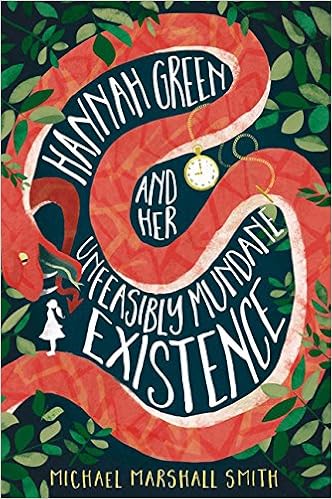
2019/125: Hannah Green and Her Unfeasibly Mundane Existence -- Michael Marshall Smith

One of the perilous things about being an adult is there comes a point where the doors of your mind open far wider than required by your own concerns. There’s no ceremony when this occurs, and no warning. It simply happens one day and suddenly you find there are seventy things going on at once and you’re flinching amidst a maelstrom of love and lost opportunities and hard choices and the tenacious grasping hands of the past, not to mention tidying the garage. Adults are not distracted for the sake of it, so cut them a little slack. [p. 276]

A cheerful, uplifting and delightful book about things that are not intrinsically cheerful: parents separating, the nature of evil, and people behaving badly.

Hannah Green is eleven and life is horribly unfair and bleak and mundane. Her parents have separated, and Hannah lives in Santa Cruz with her dad, who is not adjusting well to single parenthood. He suggests that she might like to go and stay with her grandfather in Washington State. So off Hannah goes -- only to discover that her grandfather has a number of secrets, among which is that he heard Johann Sebastian Bach playing the organ, and that his longevity is due to him having built an awesomely complex device for the Devil.

Yes, that Devil. Who, despite this being (possibly?) targetted at a young adult or teenage audience, is not at all nice. It's in the job description, of course, but modern audiences are accustomed to transformative works where the Devil is misunderstood, or reformed, or subject to a case of mistaken identity. Not here. This Devil is prone to bestowing cancer on airport security staff, making petty criminals explode, and arranging unpleasant accidents for insufficiently polite waiters.

Someone or something has been interfering with the natural balance of things. The Devil, and Hannah's grandfather, and Hannah herself need to restore balance. Along the way, Hannah learns a great deal about the power of Story and the drawbacks of adulthood. There is also an accident imp named Vaneclaw (who resembles a four-foot-high mushroom), a petty criminal named Nash, and a potentially evil rollercoaster.

Which last might be a metaphor for this novel: fun but scary, with some nauseating bits, utterly compelling while it's running, and over too soon. (The novel, however, is well-crafted and not in the least creaky.)

It's also worth noting that there is a strong authorial presence here: a sardonic, straight-talking, oddly reassuring narrative voice that constantly demolishes the fourth wall and subtly draws attention to the subtext of apparently straightforward scenes. (Is it the author? Or is it another layer of fiction? Who knows? Does it matter?)

I liked this novel a lot, though would hesitate to recommend it to anyone under about 16 on the grounds of the Devil being really quite likeable, despite his cruelty.

Sunday, December 01, 2019

2019/124: A Perfect Spy -- John Le Carré

Never able to resist an opportunity to portray himself on a fresh page, Pym went to work. And though, as was his wont, he took care to improve upon the reality, rearranging the facts to fit his prevailing image of himself, an instinctive caution nevertheless counselled him restraint. [p. 289]

I've given this book a low rating because of my emotional reaction to it -- it's splendidly written, but the sheer, empty inevitability of the ending left me feeling hollow myself.

Magnus Pym, diplomat and secret agent, goes missing after the funeral of his charismatic con-man father Rick. The reader knows that he's checked in, as Mr Canterbury, at a bed-and-breakfast in a seaside town in Devon: he's well-known to his landlady there, and it's a safe bolthole for him to write the story of his life, or lives.

Meanwhile his mentor, Jack Brotherhood, is leading the hunt for Magnus, and beginning to uncover traces of Magnus' double life: his long friendship with Czech agent Axel, his multiple affairs and his relationship with his wife Mary and son Tom, and above all his defining relationship with his father. It's a series of betrayals, a house of cards held together by a son who's inherited his father's gift of masks. Does the son have a heart, a soul? Hard to say.

The narrative is often very entertaining (high points include Rick's attempt to become an MP) and meticulously observed: a glance between two guests at a dinner party; a woman walking as though she hates her skirts; Tom (Pym's son) reading a fantasy novel, 'a book in which everything came right', over and over again.

A Perfect Spy is a long read, and I found myself drawn into some scenes at the expense of the overall arc and its inexorable march towards an unhappy ending. Apparently this is Le Carré's most autobiographical novel, and I applaud him for being capable of laughing at some aspects which -- if not heavily gilded for the purposes of fiction -- must have been appalling to experience.

Beautifully written, a whole that's greater than the sum of its parts: but it left me low.