Monday, August 13, 2018

2018/50: False Lights -- K. J. Whittaker

She realised with detached horror that she was in London – London – and soldiers were firing at will into a crowd of unarmed citizens. This wasn’t just an occupation. It was a tyranny. [loc. 3078]
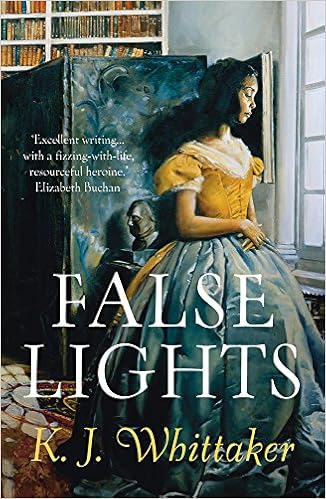
An alternate history that opens in the Scilly Isles, eighteen months after a Napoleonic victory at Waterloo. England is occupied, with Napoleon's brother Jérôme and his ex-empress Joséphine (who, in this timeline, didn't die in 1814) holding court at Carlton House in London. In the Scillies, French soldiers kill Captain John Harewood, a black sea-captain who triumphed at Trafalgar, and capture his daughter Hester, who overhears her captors discussing a dangerous secret.

Meanwhile, the young Earl of Lamorna (John 'Jack' Crowlas; known as Crow) is trying to extricate his teenaged brother Kitto from a daring but doomed act of sabotage. Crow's groom Arkwright has an agenda of his own; so does Crow, who is juggling allegiances, plots and loyalties, along with hallucinations of the dead and memories of his own appalling failure in the line of duty. As for the female protagonists, Hester's childhood friend Catlin manages to surprise a Duke; Lady Louisa, stepmother to Crow and Kitto, is determined to get what she wants; and Hester herself, well aware of how society treats anyone with Black forebears, has to contend with jealousy, ostracism and treachery as well as explicit racism.

The novel's title is a reference to the wreckers of Cornwall and the Scillies, who lit false lights to lure ships onto the rocks, and salvaged whatever washed up. That sense of trickery and desperation weaves through False Lights. Although there's a classic romance with the usual reversals, there is also a story about rising up under an unjust dictatorship; a story about spies and double agents; Hester's story about confounding racism, sexism and prejudice; and Crow's story of a man trying to live with his memories and his mistakes. Whittaker is to be applauded for making Crow so thoroughly unlikeable at the beginning of the novel -- though to a certain extent that's through careful choice of narrators. (The novel is told in third person, with scenes from multiple characters: Whittaker does an excellent job of differentiating these, though some of them -- such as Arkwright -- are more effective than others.) Crow is clearly suffering from what we'd term PTSD, and even when he behaves heroically the horrors are with him.

Apart from one moment when I screeched aloud (no, nobody would have been galloping across Tower Bridge in 1817, as it did not exist), I found the novel convincing and compelling: there may be flaws in the historical research, but it hung together well. (There is an afterword in which the author discusses her approach, including the resurrection of Joséphine). Whittaker's writing is vivid and sometimes brutal: she doesn't romanticise warfare or poverty. I very much enjoyed False Lights, and I'm looking forward to the sequel, Russian Gambit, due in 2019.

Friday, August 10, 2018

2018/49: Ghost Wall -- Sarah Moss

... a ghost wall, said the Prof, sitting back on his haunches. I was just telling your dad, it’s what one of the local tribes tried as a last-ditch defence against the Romans, they made a palisade and brought out their ancestral skulls and arrayed them along the top, dead faces gazing down, it was their strongest magic. [loc. 946]
Silvie (short for Sulevia, Ancient British goddess of springs and pools) is a young seventeen. Her father, Bill, is a bus driver with an avid interest in archaeology: he, Silvie's mother Alison and Silvie have been invited to join Professor Slade ('call me Jim') and a trio of students (Dan, Pete and Molly) in an 'experimental archaeology' camp somewhere in Northumbria. Jim's interest is scholarly: Bill, on the other hand, would apparently like nothing more than to go back to those simpler, more honest times, free of immigrants and womens' rights and inequality. He is an emotionally and physically abusive husband and father, holding his wife wholly in thrall, and Silvie in a toxic bond of love and fear. Silvie is good at going away inside her head, but even there she doesn't escape her father's dominance.

Molly and Silvie become friends, and bond over forbidden trips to the nearest shop (why, yes, they are both wearing 'Iron Age' tunics and moccasins: but ice cream!) despite the issues of class and privilege that might divide them. Meanwhile, the men -- 'they’re not much interested in the foraging and cooking, they just want to kill things and talk about fighting' -- are talking about the ghost wall, the bog burials, the sacrifices, the liminal zone between life and death, and the rituals and curses by which the Iron Age folk protected themselves. But what about the victims? (The book opens with a short description, third person, of one such woman.) Silvie, at least, understands that you don't sacrifice something you don't love.

This is a very short novel, but quite chilling. A surprising amount of unease stems from the increasing friction (never discussed, of course) between the six members of the group. But there is also the constant presence of the idea of sacrifice, of the dead watching the living: the idea that the dead are not gone. "They had to be pinned to their graves with sharp sticks driven through elbow and knee, trapped behind woven wooden palings, to stop them coming back, creeping home dead and not dead in the dark." [loc. 912]

Moss' prose is poetic, and she's good at layering sensory impressions and simple words to build up ambience. I wasn't wholly comfortable with the way that dialogue and first-person thoughts were blended -- no speech marks, a great many run-on sentences -- but I think this technique did make the novel more immersive.

I'd add a trigger warning for domestic violence and child abuse: I don't know if the latter has any sexual element, and the lack of clarity on that point bothers me somewhat.

Thanks to NetGalley for providing a free advance review copy in exchange for this honest review!

Wednesday, August 08, 2018

2018/48: Rogue Protocol -- Martha Wells

Being a SecUnit sucked. I couldn’t wait to get back to my wild rogue rampage of hitching rides on bot-piloted transports and watching my serials. [loc. 1042]
GrayCris, the Big Bad of the first Murderbot novella, is being investigated for illegal activity pertaining to alien remains, and Dr Mensah has become involved. Murderbot, being better-placed to acquire evidence of GrayCris' wrongdoing (and not wanting anyone to pester Mensah about that missing SecUnit), heads to an abandoned terraforming facility at Milu to investigate.

Murderbot is not the only individual interested in Milu. There are a pair of human security consultants, Wilken and Garth, who are employed as bodyguards to Don Abene and her assistant Hirune -- and possibly also expected to look after Don Abene's 'pet robot', Miki, who vexes Murderbot by referring to humans as its 'friends' and generally being cheerful, positive and wholesome. (I wonder if Miki is any relation to Twiki?)

Murderbot uses Miki's feeds to monitor the situation as the humans head for the terraforming facility, and gets to experience (in private, of course) quite a few emotions, including something that is absolutely not jealousy of a human-form bot. Because Miki is treated as one of the family -- maybe like a pet, maybe like a child, certainly like a friend. It's a kind of relationship between human and bot that Murderbot has never experienced, and it provokes a great deal of reflection. Not that there's much time for reflection when GrayCris' dastardly plot becomes clear ...

Murderbot is as likeable (and relatable) as ever, and Wells is very good at depicting the changes that Murderbot is experiencing -- even when (especially when?) Murderbot is unwilling or unable to consider those changes itself.

There are some excellent one-liners ('There needs to be an error code that means “I received your request but decided to ignore you.”' [loc 39]) and some intriguing observations: and a great lead-in to the fourth and final novella, Exit Strategy, due in October 2018.

Also worth noting that pretty much all the human characters are female.

Sunday, August 05, 2018

2018/47: Lord of Light -- Roger Zelazny

Time like an ocean, space like its water, Sam in the middle, standing, decided. [loc 4237]
From the blurb of the 1973 UK paperback: "A Brilliant Novel of Men Like Gods Long After the Death of Earth". (Why, yes, there are women too. Please file under 'period-typical sexism', of which more below.)

Lord of Light (winner of the Hugo award for best novel, 1968) is set in the far future, on a planet colonised by humans, who defeated the original inhabitants by developing -- through a combination of technology, genetics and psychology -- god-like powers. Each individual having a unique Aspect, they assume the personae of gods of the Hindu pantheon, ruling over a caste-based society composed of the less powerful colonists. Reincarnation, via body transfer, is standard -- though it's controlled by the Lords of Karma, who have recently started using a psych-probe to 'tape' the minds of those applying for new bodies.

The events of the novel occur several thousand years after the arrival of the colonists. Sam, the protagonist, wants to overthrow the deicratic rule of the 'gods', and make technology and reincarnation available to all rather than the domain of the elite. His chosen tool is Buddhism, and his allies include the native life-forms of the planet, now pure energy and considered as demons. Over the course of the novel, various gods turn to Sam's cause: in particular, the Lord of Death, Yama, who is a technological genius and also happens to be in love with Sam's ex, Kali.

I adored Lord of Light when I first encountered it in my teens, and I still think it may be Zelazny's best standalone novel -- though my opinion has altered somewhat since my last reread, which was likely in the 1990s. Although I still know whole paragraphs more or less word for word -- and found myself looking out for familiar typos ('I would have numbered its days internationally', thanks Sphere) -- I had somehow completely failed to notice what I would now tag as 'period-typical sexism'.

When I was thinking about this review, I wondered if it was narrative sexism or the sexism of a particular character: Sam is particularly prone to using sexist (and transphobic) slurs to rile an opponent, but that opponent is also described in problematic terms.
It was almost as if sex were a thing that transcended biology; and no matter how hard he tried to suppress the memory and destroy that segment of spirit, [he] had been born a woman and somehow was woman still. Hating this thing, he had elected to incarnate time after time as an eminently masculine man, did so, and still felt somehow inadequate, as though the mark of his true sex were branded upon his brow. It made him want to stamp his foot and grimace. [loc 976]
So, it's not just Sam -- though he is the character most likely to remark on sex and gender. The demons, pure energy beings who long ago rejected the flesh, have hung onto misogyny: Taraka dismisses Kali as 'only a woman'. The plot hinges on a love triangle: the two men in that triangle are the novel's two protagonists, while the woman seldom appears. The goddess Ratri actually gets to be part of the plot: she is punished by being reincarnated into bodies of 'more than usually plain appearance'.

Despite its problematic aspects, Lord of Light remains a splendid read. I still don't especially like Sam, but Yama is one of my favourite of Zelazny's characters: his final scenes -- the import of which I completely missed as a teenager! -- are intensely moving. The world-building is visually ravishing, never heavy-handed, and creates a sense of an alien world that has become a human home: there are proverbs, customs, ways in which the strangeness has become comfortable. Not comfortable for the original inhabitants, obviously: but for a novel based on forcible colonisation, Lord of Light is remarkably sympathetic. 'To them, we are the demons,' says Sam: and, to Taraka (demon king), 'perhaps some reparation might be made'.

Three final points:
- there is no legitimate English-language ebook edition. If your French is up to it, you can purchase Seigneur de Lumière.
- there was going to be a film; Jack Kirby was involved; and this was used as a cover to rescue US officials from Iran: see How Roger Zelazny's Lord of Light transformed into the CIA's Argo covert op and The book that Argo forgot: SF Classic Roger Zelazny’s Lord of Light. (The latter also gives a good overview of the novel.)
- no review of this novel would be complete with a nod to one of the most egregious puns in SF, painstakingly built up when Sam is considering reincarnation and sends the Shan of Irabek to test the waters.

I still think it's one of Zelazny's best: and having reread it, I found myself rereading it again, for sheer enjoyment.

Thursday, August 02, 2018

2018/46: The Scottish Prisoner -- Diana Gabaldon

Jamie had the obscure feeling that cliché on top of treasonous insanity was more than anyone should be obliged to put up with. [p. 313]
Following the discovery of a poem written in Erse, Lord John's brother Hal recruits Jamie Fraser (the eponymous Scottish prisoner) to accompany Lord John on a mission to Ireland, where they hope to uncover a treasonous plot -- and possibly the seeds of another Jacobite uprising. Accompanied by the disreputable, and likely murderous, Irishman Tobias Quinn, Lord John and Jamie Fraser discover more about the situation -- and one another -- than they might reasonably have expected. Even on their return to London, the consequences multiply.

There's a bittersweet note to this novel, even for those who haven't read Voyager (the timespan of which encompasses The Scottish Prisoner -- indeed, this whole novel occurs during section V, chapter 16). While I very much enjoyed the growing respect and friendship between John and Jamie, I already knew that nothing about their respective positions would have changed at the end of the novel. (Actually, that feels improbable: their friendship does deepen, with each making sacrifices and taking risks for the other: how can this have so little impact on later interactions in Voyager?)

An enjoyable tale with its own resolution, and with some intriguing revelations about both protagonists. I especially enjoyed the London scenes towards the end of The Scottish Prisoner: Lord John being thoroughly competent, even when it becomes clear that a mistake has been made. But I still feel that the events of this novel should have had more visible impact on the 'main' (e.g. Jamie-centric) canon.

And now I have run out of Lord John novels to read. Boo.

Tuesday, July 31, 2018

2018/45: Voyager -- Diana Gabaldon

"Do you think that the size of the book is justified by the complexity of the story?" Grey asked ...
"What is it -- twelve hundred pages? Aye, I think so. After all, it is difficult to sum up the complications of a life in a short space with any hope of constructing an accurate account."
"True. I have heard the point made, though, that the novelist's skill lies in the artful selection of detail. Do you not suppose that a volume of such length may indicate a lack of discipline in such selection, and hence a lack of skill?"
"...In this case ... I think it isna so. Each character is most carefully considered, and all the incidents chosen seem necessary to the story." [p. 168. Jamie and John are discussing Samuel Richardson's Pamela -- or are they?!]
I read Voyager (on Kindle, fortunately: the paper version is over a thousand pages long) in order to understand the context in which the Lord John Grey books are set. (See Lord John and the Private Matter, Lord John and the Brotherhood of the Blade, Lord John and the Hand of Devils). Also because, as mentioned in previous reviews, I had found Gabaldon's prose easy, entertaining and engaging to read.

Voyager packs an awful lot of plot into its thousand pages. (That leading quotation indicates that Gabaldon is well aware of the perils of this approach.) Parts of the novel are set in 1968, when Jamie Fraser's time-travelling wife Claire resolves to return to Jamie in The Past. In the eighteenth century, it covers the period 1746 to 1767. The Lord John novels and novellas fit neatly into the gaps in Voyager, being set between 1756 and 1761: one pleasure of reading Voyager was the exploration of Lord John's complex friendship with Jamie Fraser, and his post-army career.

I didn't take to Claire, though she is a competent and passionate heroine. Most of her narrative is first-person, while other scenes are third-person: that jarred, and I might have liked Claire better if I'd seen her through a more objective lens.

Coincidences abound; the cast is large, and prone to melodrama and misbehaviour, as well as quite illogical flights of jealousy; a number of famous figures (or their ancestors) make fleeting appearances. Almost all of Jamie and Claire's friends and relations are disaster-prone: kidnapping, rape, blackmail, murder, shipwreck, betrayal ... And it is one thing after another, after another, after another. There's only the slightest sense of resolution at the end -- for, after all, there are another five books, so far, in the sequence.

I found the best stratagem was to suspend my critical faculties -- or at least the ones that focus on structure and credibility -- and enjoy the ride. And on that basis (and admittedly skimming some of the Jamie-and-Claire scenes) Voyager gave me exactly what I wanted: entertainment, amusement, engagement, and more of Lord John Grey's story.

Tuesday, July 24, 2018

2018/44: Lord John and the Hand of Devils -- Diana Gabaldon

‘I assure you, Tom, if the phallus of St. Orgevald does not protect me, nothing will.’ [loc 2251]

A collection of three novellas featuring Lord John Grey, who was my summer crush this year. (I prefer my crushes fictional.)

'Lord John and the Hellfire Club' is set some time before Lord John and the Private Matter. Lord John is approached by a personable redhead with a deadly (undisclosed) secret, who is promptly murdered. Investigations lead Lord John to Francis Dashwood's Hellfire Club and its ostentatious wickedness -- and to Lord John's former lover, George Everett, who's a member of the Club. Mostly interesting for the views on sodomy asserted by various characters. Lord John may have a fiery temper, he has had a lifetime of repressing his responses to homophobic slurs.

'Lord John and the Succubus' takes place between Lord John and the Private Matter and Lord John and the Brotherhood of the Blade. Major Grey is English liaison to the Imperial Fifth Regiment of Hanoverian Foot, and finds that his duties include riding his horse Karolus through a graveyard at night in order to identify the resting-place of a succubus. Grey, as a rationalist, perceives some logical issues with this task, but obliges anyway -- and discovers the corpse of an English soldier. Discovering the connection between the soldier's death and the rumours of a succubus, Grey also has to fend off the attentions of a widowed noblewoman, whilst wondering if handsome Stephan von Namtzen's friendliness is simple good nature, or something more.

'Lord John and the Haunted Soldier' was my favourite of the three novellas. Set directly after Lord John and the Brotherhood of the Blade, it deals in part with the Commission of Enquiry to which Grey is called after being severely injured by an exploding cannon. Turns out that his half-brother Edgar may be implicated, as his mills made the gunpowder used in that gun. Meanwhile, Lord John still suffers after-effects of the explosion, and a shard of metal in his chest could kill him at any moment. And he's haunted by the ghost, or the memory, of Lieutenant Lister, who was standing next to Lord John when a cannon-ball decapitated him.

In all three novellas, Lord John's honour, his rationalism, and his compassion urge him above and beyond what might be expected of him: and his wit and intelligence (and his friends) save him from the perils incumbent on his actions. Gabaldon's prose is well-paced and very readable: she takes a joy in unusual words (for instance 'absquatulating', a forgiveable anachronism) and her humour -- or Lord John's, perhaps -- tends to dryness rather than farce. I enjoy her books, though (spoiler!) it will turn out in later reviews that I really just enjoy Lord John Grey.