Friday, January 25, 2019

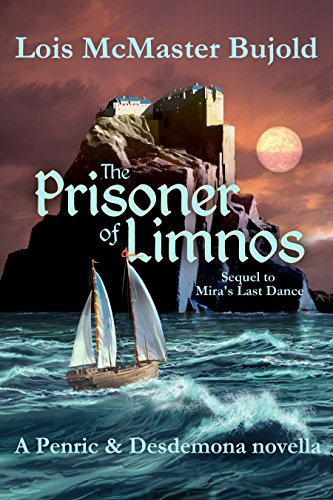
2019/07: The Prisoner of Limnos -- Lois McMaster Bujold

... even demons mourned, and had a long time to do so. Grief, guilt, regret… not everything they learned how to do from their human riders was a boon. He did not press. [loc. 1775]
Penric (and Desdemona, the ten-souled demon whose host he is) are in Orbas, reluctant to return to Penric's duties in Orbas while the delectable Nikys seems oblivious to Pen's intentions. Then Nikys' mother is abducted, and Penric and Desdemona vow to rescue her.

The alternation of Pen's and Nikys' narratives gives depth to this otherwise slight story: Nikys is concerned that she would be marrying Desdemona as well as Penric, while Penric wishes that hosting the souls of ten dead women would give him some advantage in dealing with a single living female. There is also a delightful relationship between Nikys' brother Adelis' fiancee, Tanar, and her eunuch factotum Bosha. And there are the gods, who in this world are real.

I do like the world of the five gods, and I like Penric and Desdemona, but I'd like a bit more meat in the next story.

Sunday, January 20, 2019

2019/06: The Burning Page -- Genevieve Cogman

'I have spent most of my life preferring books to people,' Irene said sharply. 'Just because I like a few specific people doesn't change anything.' [p. 332]
After the events of The Masked City, Irene has been put on probation, which means that she and her apprentice Kai get all the most tedious and / or dangerous jobs. The Library, meanwhile, is under attack: and although Irene fears that she's a priority target (she read a secret in a book, and now she knows too much) her superiors don't agree.

The Burning Page is rather less hectic than The Masked City, but Irene and Kai do get to travel, and chase, and be chased. They visit a version of Imperial Russia, where Irene's book-acquisition is stymied by the fact that the Empress has borrowed the key volume as bedtime reading: 'I do feel a bit guilty about snatching it mid-read from someone's bedside table'.

Meanwhile, Peregrine Vale is suffering the after-effects of events in the previous book, and finding himself strangely drawn to likeable-but-untrustworthy Fae Lord Silver. And someone known to both Vale and Irene may be betraying their secrets to the mastermind behind the Library's troubles.

I enjoyed this more than The Masked City: it's light reading, true, but the prose and dialogue are witty and the characters interesting. I'm looking forward to the fourth and fifth volumes, though trying not to buy more e-books unless they've dropped in price on Amazon. Never say never, though ...

Saturday, January 19, 2019

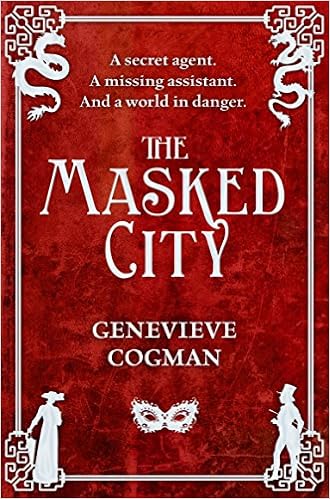
2019/05: The Masked City -- Genevieve Cogman

Could the story have turned against her? Was this the part of the narrative where the heroine in disguise is confronted by her arch-enemies – or possibly where the protagonists find and dispose of the villainous spy, all depending on the reader's viewpoint? [p. 172]
At the end of The Invisible Library, Irene was working for the interdimensional Library in a steampunk-flavoured alternate London. She has become close to detective Peregrine Vale, and still admires the physical beauty of her apprentice Kai, who is a dragon (in human form: dragons, in this universe, are agents of order and stability).

Then Kai is abducted by the Fae (agents of chaos and change) and, pursued by Irene, is taken to a Fae-ruled version of seventeenth-century Venice. Can Irene save her apprentice before the forces of chaos overwhelm him? Can she trust the Fae she meets on the Train? (Train is capitalised because it's a powerful Fae entity in its own right, usually known as the Horse and directed by the Rider.) Can she even stop to breathe? Evidence suggests not: this is a hectic and headlong chase of a book, with obstacles at every turn and allies indistinguishable from enemies.

I would have liked more about the Horse and its Rider; I did enjoy the exploration of Fae culture and etiquette, and some of the new Fae that Irene encounters -- in particular Zayanna, who is holding out for a hero of any gender, and thinks Irene very heroic -- are interesting trope-embodiments as well as entertaining characters.

Was Kai's uncle's name actually a pun? If so, *groan*.

I do like Irene's mixture of level-headed competence and steely resolve. In this alternate Venice, she finds herself at the mercy of Narrative -- the way the stories go, or are supposed to go -- in a way that reminded me of Seanan McGuire's Indexing. She's also operating as a diplomat way above her pay grade; and her Library bosses won't be happy with some of the deals and alliances she makes.

After reading this episode, which ends on something of a cliffhanger, I went straight on to the next one ...

Friday, January 18, 2019

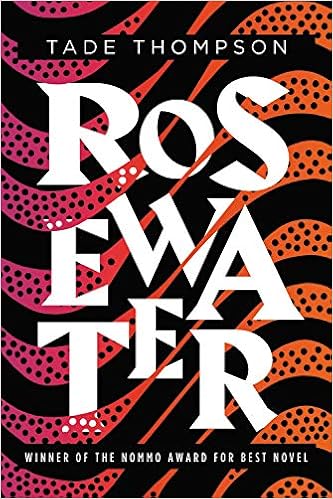
2019/04: Rosewater -- Tade Thompson

"We have more experience than any Western country in dealing with first contact. What do you think we experienced when your people carved up Africa at the Berlin Conference? You arrived with a different intelligence, a different civilisation, and you raped us. But we're still here." [p. 231]
Kaaro is a sensitive, able to read the thoughts and emotions of those around him. He works for a bank, blocking criminal sensitives from stealing personal information from the thoughts of their victims: protection is achieved by reading classic literature aloud. Well, that's the day job: Kaaro also works for the government, conducting interrogations and finding lost or hidden things. Or people. The mental space in which Kaaro operates is termed the xenosphere, and it is a consequence of the arrival, in 2012, of an alien lifeform known as Wormwood, which landed in Hyde Park, burrowed into the earth's crust and seeded the biosphere with a network of fungi-like filaments that bind to human nerve endings.

Wormwood has not departed. It established itself in Nigeria in the 2050s, creating a biodome around which the town of Rosewater has accreted. Once a year the biodome opens, briefly, and the sick are healed, or changed: the dead resurrect. Kaaro was there when the dome was raised, but his narrative -- shifting between the 2040s, 2050s and 2060s -- only gradually approaches the events within the dome, and the link between Kaaro himself and Wormwood.

Kaaro is not an especially likeable character: he's sexist, immoral, a thief who steals from his own family. But when he hears of the deaths of other sensitives, and begins to investigate the phenomenon, he finds that he is uniquely qualified to unravel the crime.

I liked this novel a lot. The world Thompson has built is quite different, yet recognisably a product of our own: America has taken isolationism to extremes, Nigeria is ascendant because of Wormwood's presence, and humans -- though some of them have been transformed into quantum extrapolators -- are still driven by mundane human urges, lust and love and envy and greed. Kaaro's first-person narration is rich with physical detail and sensory extravagance: when he enters 'thoughtspace', his experiences are hallucinogenic, and he perceives them with every sense.

First of a trilogy, but does stand alone: definitely worth reading.

Tuesday, January 08, 2019

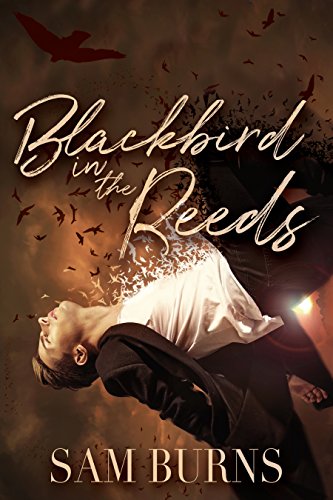
2019/03: Blackbird in the Reeds -- Sam Burns

"People in this town are afraid of outsiders, but it's not like regular, small-town paranoia. It's like 'you could learn our secret and get us all killed' paranoia." [p. 145]

Devon Murphy is something of a drifter. Like his mother, he has the knack of getting people to do what he wants -- but unlike his mother he isn't comfortable with his gift, so tends to avoid close relationships. When his grandmother summons him to the small coastal town of Rowan Harbor, Devon packs up his life in his father's old Corvette and hits the road.

And then hits a tree, writing off the car and breaking his wrist, as he swerves to avoid a deer. Luckily he's only a few miles from Rowan Harbor. Even more luckily, the huge wolf which emerges from the woods doesn't seem to be a man-eater. And pretty soon, help is at hand.

Devon feels instantly at home in the town, though it's years since he visited. His old friends are delighted to see him, and he makes new friends too -- though one of them has suffered a spate of 'accidents' that seem rather too coincidental. Devon would like to find out more about Maria's problems, and he'd really like to understand why everyone was so pleased when he got a blast of static electricity shaking 'professional bad cop' Wade Hunter's hand. (Doesn't hurt that Wade is gorgeous.)

But there's something strange about the town, and it's not just the low crime rate or the way that Devon seems to have been expected.

This is a sweet, simple, charming M/M romance with supernatural elements. It's the first in a trilogy of trilogies (so one can forgive the 'happy for now' ending and the lack of resolution). There are some nitpicks: the romance happened almost instantaneously, the protagonist seemed a little too unconcerned that not only his gran but his childhood friends had been keeping the truth from him, there was no real obstacle / antagonist. But the characters were all likeable, the dialogue was good, and the setting delightfully cosy.

Does anyone remember the Nightworld series (never completed) by L. J. Smith? This reminded me of those, which I devoured as quickly as I could find them in the late 90s.

Monday, January 07, 2019

2019/02: The Alehouse at the End of the World -- Stevan Allred

"Can you not tell me what I must do?"
"Perhaps I can look it up," said the cormorant. He produced a book from under his wing, Mortimer’s Compleat Atlas of the Afterlife ... [loc. 891]
A fisherman (never named) has been living on a desert island, shipwrecked. He receives a letter from his beloved (never named: hardly anyone has names: the fisherman calls her CariƱa, but that is just his pet name for her), with a covering note informing him of her death. He has not seen her for years: but, determined to find her again, he sets out in an unseaworthy craft -- convinced that he'll die in a storm -- to seek her on the Isle of the Dead.

Then he is swallowed by a whale, and deposited on the shore of the Isle of the Dead, which is currently governed by a scornful and narcissistic crow. This crow, together with his companions (a pitying pelican and a curious cormorant), turns out to be a shapeshifter, and possibly a demigod. The crow is wholly unhelpful, but the fisherman does finally understand that the dead arrive nightly, by canoe, on this island -- which has been swallowed, whole, by the fearsome Kiamah beast after the death of the Old Gods -- and have their souls harvested by the crow and their bodies burnt. The souls become clams, and return to the material world to be reborn. But the fisherman can't imagine how he can locate the soul of his beloved. And the birds -- including the most likeable character here, a six-foot-tall frigate bird (no name) with a spyglass and a pistola -- anticipate a fearsome cosmological event.

There is also a fertility goddess, Dewi Sri, and some ethereal beings known as the Turropsi, the weavers of fate. There are invented words, and words that are deliciously obscure. There are love triangles, disguises, and indulgence in pleasures licit and otherwise. This is a world that reminds me of Pacific Northwest mythology, with overtones of late medieval travellers' tales and a surreal ambience that's sometimes humorous, and sometimes bleak.

It's taken me months to read.

It also felt far, far longer than it actually is. That may just be an artefact of reading so slowly. I'm still not sure why it didn't engage me. Perhaps it's the lack of names? Perhaps the misogyny of some of the characters? (A man is unfaithful. A woman is unfaithful. Guess who dies at the end?) A imaginative, vivid fantasy that, for me, fell flat.

I received a free copy of this book from NetGalley, in exchange for this honest review.

Saturday, January 05, 2019

2019/01: Confessions of the Fox -- Jordy Rosenberg

... his confinement became the door inside him between his waking life and something still unwoken, something lying close-packed like a bomb at his core, poised to shiver into a coruscated, glinting shower of—of—of what, he knew not. But there was Something just beyond the door inside him. Some difference within that he did not yet want to know. [loc. 589]
Dr R. Voth ('a guy by design, not birth') acquires a manuscript purporting to be the confessions of the infamous 18th-century criminal Jack Sheppard. Confessions of the Fox is a transcription of the 'mashed and mildewed pile of papers', interspersed with Dr Voth's footnotes. Some of those footnotes are rambling, discursive, personal -- Dr Voth's university is an increasingly intrusive and coldly commercial employer; his neighbour Ursula is fascinated by queer theory -- and others expound upon and explicate the Confessions. In which the canonical persons of 'Jack Sheppard, Thief' and his lover 'Edgworth Bess, Sex Worker' are revealed as something other. Jack's mother, abandoning him to a cruel apprenticeship, tells him to be a good girl: yes, Jack is assigned female at birth. Bess's father, heading for the Fens after being stranded in London, is a Lascar sailor: yes, Bess is a woman of colour. “Between [Bess's] characterization and that of Jack’s assigned sex, what we have here is either the most or the least authentic Sheppard document in existence,” notes Voth. [loc. 542]

Such a reframing could in other hands have been a solemn and poignant exploration of the marginalised Other in eighteenth-century London, but here is an exuberant riot of transgression, transformation, romance and rebellion. Not to mention the marvellous Elixir, formulated by mutineers who've escaped the East India Company, and stolen by Jack from the Thief-Taker General, Jonathan Wild: this Elixir seems an early form of hormone therapy, and does Jack a world of good. But commerce rears its head, of course: like everything -- even Jack, even Bess -- it is a commodity to be bought and sold, a way for others to profit from the labour of the underclass.

I was tremendously entertained by this novel, though suspect that others will appreciate more the academic references and in-jokes (my understanding of queer theory is patchy). That didn't hinder my admiration for the twining of Jack's great adventure with Voth's own narrative -- including his escape from an increasingly draconian University which requisitions his 'improperly utilised leisure hours' (he plays Phone Scrabble) and insists on a transcript, with illustrations, of Sheppard's MS. ("...when I said that I had sent him the missing page of the manuscript, containing an illustration of Jack’s genitalia, what I actually did was Google “waterlogged slug” ... [loc 4661]).

This is a beautifully constructed, vastly enjoyable and splendidly written novel that made me think a lot: I started rereading whilst checking a quotation for this review, and am already seeing more layers. Highly recommended.