Monday, September 24, 2018

2018/57: Weirdo -- Cathi Unsworth

"I was there ... I saw everything ... But unlike everyone else you're chasing after, nobody saw me." [p. 153]

Weirdo switches between 2003, when private detective Sean Ward visits an infamous murderer at a secure facility in East Anglia, and 1984, when the youth of a (fictional) Norfolk seaside town run wild one summer. New forensic evidence indicates that the 'Wicked Witch of the East', the teenaged murderess Corinne, may not have acted alone. Ward would like to clear her name, if he can: but discovering the truth about the events of that distant summer is not an easy task.
Bad things start to happen when glamorous Samantha arrives from London. Corinne draws away from her old friend Debbie as she's dragged into Sam's lies and deceptions. She's not the only one affected, but various parents and grandparents are (mostly) convinced by Sam's charm, and her influence goes unchecked and unnoticed -- until Corinne and her friend Noj resort to desperate measures in an attempt to banish Sam.

The town of Ernemouth is far from idyllic. There's corruption everywhere in Ernemouth. Though Corinne may be innocent in some ways she is tarnished in others, helpless in the face of her mother's greed and amorality, growing up fatherless (though when the identity of her absent father is revealed, being fatherless might be the better option). Corinne's contemporaries, as teenagers or as adults, maintain a consensus of secrets and distractions -- as does the author. (I can't think, offhand, of another novel where the identity of the murder victim is as much, or more, of a mystery than the identity of the murderer.)

(Come to think of it, many characters in this novel have secret identities, or secret connections: ties of blood, of marriage, of loyalty. There's a lot of hiding in plain sight.)

Ernemouth in 1984 is horrifically credible. I remember Norfolk in the mid-eighties, though happily not from a small-town perspective: Corinne and Debbie's trips to Norwich ('bought a load of records in Backs and seen a really cool pair of boots in the shop at the bottom of Elm Hill that Debbie was determined to save up for. Had chips on the Haymarket and half a cider in The Murderers' [p. 80]) might as well be lifted from my diary. The sheer claustrophobia of the town and its people is as horrific as the events that lead to Corinne's conviction -- and the events of the same summer that go unpunished. This is a bleak and compelling novel, dealing with toxic friendships and with a touch of what might be real magic, and the 1984 narrative in particular is tremendously evocative.
Wednesday, September 19, 2018

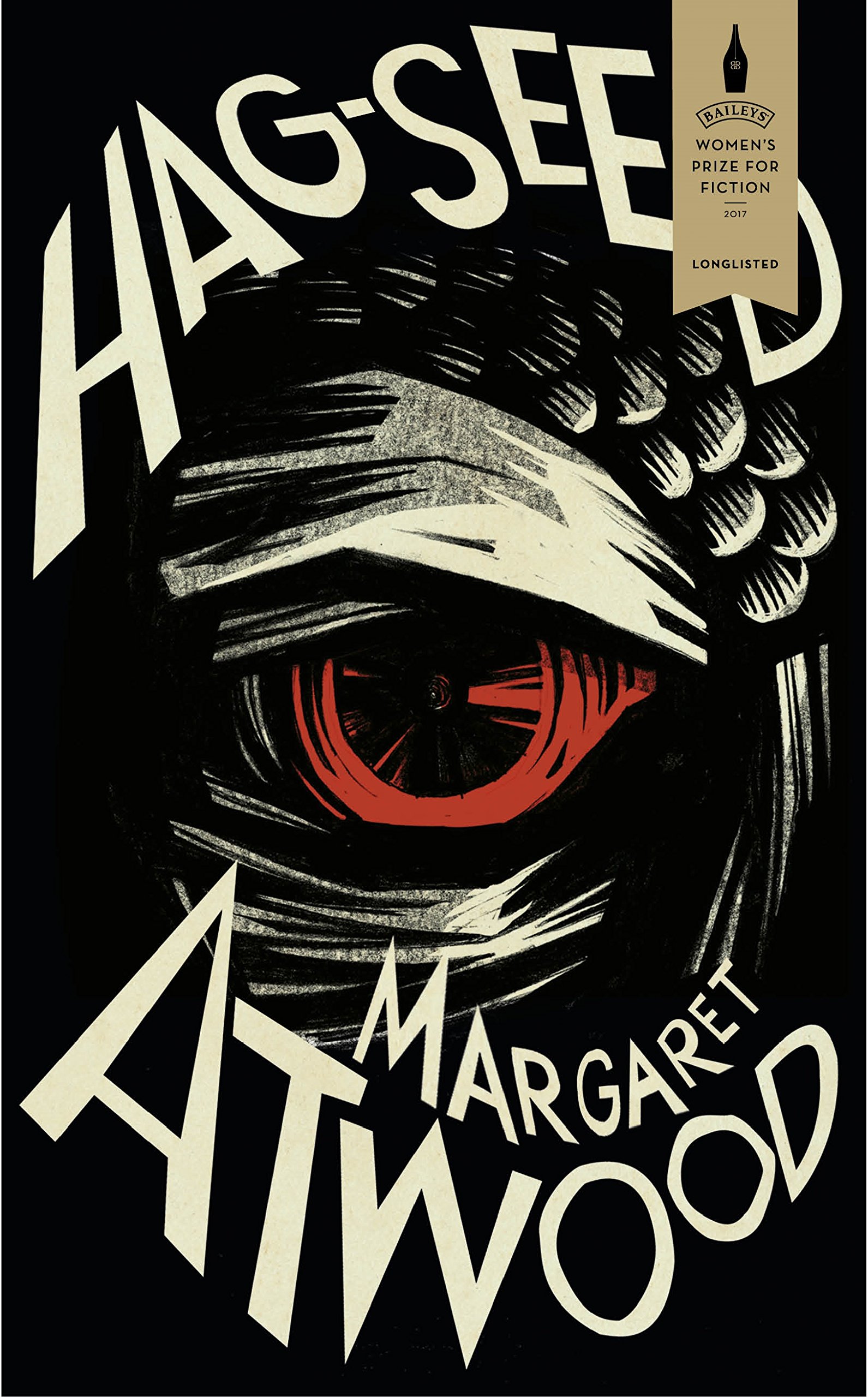
2018/56: Hagseed -- Margaret Atwood

The island is many things, but among them is something he hasn't mentioned: the island is a theatre. Prospero is a director. He's putting on a play, within which there's another play. If his magic holds and his play is successful, he'll get his heart's desire. [p. 116]

The Hogarth Shakespeare was launched in 2012, its goal to publish 'Shakespeare’s works retold by acclaimed and bestselling novelists of today'. I wasn't that impressed by Anne Tyler's Vinegar Girl, a halfhearted reimagining of Shakespeare's The Taming of the Shrew: but a friend recommended Hagseed, Margaret Atwood's take on The Tempest, and it is truly glorious.
Felix Philips is Artistic Director of a small but acclaimed Canadian theatre festival, working on his masterpiece production of The Tempest and oblivious to the machinations of his factotum, Tony, who (with the help of friends in high places) ousts Felix from his role, and from his career. Felix sulks off into exile, mourning his Tempest, but also mourning (and in a sense haunted by) his dead daughter Miranda, for whom the production was to have been a kind of memorial.

One cannot sulk forever in a pioneer shack in the wilderness, though: and eventually Felix takes up a position as a drama teacher at the Fletcher Correctional Institute. He gets to stage a Shakespeare play annually, with a cast of felons. And this year it's to be The Tempest: and the treacherous Tony, and his politician friend Sal, will be guests of honour. The stage is set for Felix's long-delayed revenge.

I especially liked the cast of inmates, who are prohibited from swearing except if they use profanities from the play, which means they read it very closely. ("You're such a poxy communist," says SnakeEye. "Shove it, freckled whelp," says Red Coyote. "No whoreson dissin', we're a team," says Leggs. [p. 127]). There's a hacker-Ariel, a drug dealer who provides Felix with some chemical aids for the production, and a veteran with PTSD who plays Caliban. (None of the inmates want to play a Girl, so Felix brings in a real live actress, Anne-Marie, who has some pertinent things to say about the play itself.)

It's part literary critique -- 'how many prisons can you count in this play?'; Caliban as a victim of colonialism; how far vengeance should go -- and part revenge tragedy. Felix, though the most rounded character in the novel, is actually very cruel to his victims, and he never quite loses his arrogance. On the other hand, he does seem to learn something from the inmates, and from Anne-Marie, and from Estelle, the 'twinkling' professor who's a major supporter and facilitator of the theatre scheme. He is substantially changed by the end of Hagseed: he is freed from his self-imprisonment -- and he is not the only one who's freed.

This is a novel of many layers. It's thought-provoking, well-structured and wry. And it is great fun, especially when Atwood has the prisoners rewrite Shakespeare's text:
SIGN: A SUDDEN TEMPEST

ANNOUNCER: What you’re gonna see, is a storm at sea: Winds are howlin’, sailors yowlin’, Passengers cursin’ ’em, ’cause it gettin’ worse: Gonna hear screams, just like a ba-a-d dream, But not all here is what it seem, Just sayin’. [Grins].Now we gonna start the playin’.

(No, it is not all like that. But that's the opening of the novel, and it hooked me comprehensively.)

Saturday, September 15, 2018

2018/55: The Mystery of Nevermore -- C. S. Poe

there are 101 things in life I simply don't have the patience for, and finding someone else's rotting heart in the floorboards of my shop just about topped the list. [loc. 84]
Sebastian Snow, owner of the Antique Emporium, has plenty on his mind: cashflow issues, his collapsing relationship with closeted NYPD detective Neil Millett, and srock control. Arriving at the shop one morning to find that there's been a break-in, and that there is a rotting heart under the floorboards, does not help his equilibrium.

The lead detective on the case is, luckily, not the loathsome Neil, but one Calvin Winter, who is kind and good-looking and I think we can see where this is going. Or can we? Cal has problems of his own, and is certainly not out and / or proud. It doesn't help that Sebastian, under suspicion of murder (and on the hunt for an incredibly rare Edgar Allan Poe chapbook), ends up revealing his relationship with Neil to Neil's colleagues.

The relationships in this novel didn't ring true for me. I couldn't see why Sebastian had stayed with Neil for four weeks, let alone four years (though he does say that the rot only started when they moved in together) or why Cal, so prone to cute endearments (ugh), effectively makes a play for Sebastian and then backs off. The murder mystery is not especially mysterious (there is something dodgy about the villain the very first time we encounter them) and while Sebastian's visual impairment (he has monochrome vision) is intriguing, it has very little impact on the plot. When one's favourite character in a novel is the narrator's father, it doesn't bode well.

Tuesday, September 11, 2018

2018/54: The Rules of Magic -- Alice Hoffman

...the rules of magic. Do as you will, but harm no one. What you give will be returned to you threefold. Fall in love whenever you can.
The last rule stopped Franny cold. "How is this possible?" she asked. "We're cursed."
"Anything whole can be broken," Isabelle told her. "And anything broken can be put back together again. That is the meaning of Abracadabra. I create what I speak." [loc. 695]

A prequel to Practical Magic (which I am now keen to reread, not having read it since the last millennium), this novel deals with the aunts -- Franny and Jet -- and their brother Vincent. Growing up in New York and New England in the 1950s and 1960s, the siblings are aware from an early age that they're cursed to ruin anyone who falls in love with them.

Or something like that. There are loopholes, technicalities, get-out clauses. Being in love is not the same as loving somebody; 'when you truly love someone and they love you in return, you ruin your lives together'; anything broken can be mended. These truisms are not much use to the young men who, besotted by the Owens sisters, meet tragic fates. Vincent, meanwhile -- the first male Owens child in centuries -- finds the family curse expressing itself in different ways.

Meanwhile, the world is changing around the Owens siblings: they are coming of age in the era of Monterey (where Vincent charms the audience with a song), of the Vietnam war and the draft, of Stonewall and LSD and free love. Despite their mother's efforts to keep them away from magic and romance, all three fall in love, and all three are both blessed and cursed by their heritage.

Beautifully written, full of metaphors that unpack into life lessons -- for instance, a cousin who becomes a rabbit: the moral of the story being that if you deny who you are, it's 'easy to become something else entirely': this is a theme that underpins the novel -- this is classic Hoffman. It felt slightly stale to me, but I think that's because my previous Hoffman read (Nightbird) shared many of the same themes, such as the ancestor who was a witch and her relationship with a witchhunter; the ancient curse visited upon a new generation; the brother-sister relationship. That's a much lighter novel, though, intended for quite a different audience: I think Rules of Magic is likely a better book, and one that I'll return to.

Wednesday, September 05, 2018

2018/53: The Magick of Master Lilly -- Toshba Learner

... alas the interpretation he did choose to believe was from a French Catholic Priest (of the Queen’s staff) who did convince him the Angel was in fact a Demon sent by evil Protestant forces to sway him from his true path. And thus the King decided to ignore the warning. [loc. 2462]

A promising premise -- the career of William Lilly, astrologer to King Charles I -- but this novel is badly in need of an editor. I received an advance copy from NetGalley (in exchange for this honest review) and hoped that the issues I noted would be corrected before publication, but a quick check of the sample chapters on Amazon, and the e-text on Google Books, dashed my hopes.
I can forgive the archaisms ('I did love it' instead of 'I loved it', 'it were' rather than 'it was'). The plethora of words used wrongly, whether typos or something else, really bothered me. Ships have 'tall masks'; Charles I is 'short of statue'; Lilly wishes to introduce some 'brevity', but his mistress does not smile ... Sometimes turns of phrase become nonsensical; for 'has not gone amiss' read 'has not been missed' ...

I could go on. And I feel mean and curmudgeonly for picking apart the words and ignoring the story: but it's hard to judge a novel when the act of reading it is fraught with constant small annoyances. (Do not start me on anachronisms. Tattoo! Silhouette! Dachshund!)

Lilly's gift is not only to read the future in the stars (he did, in fact, predict the Great Fire with remarkable accuracy) but 'to manipulate outcomes, not just predict them'. He is engaged to read the King's horoscope, and to exorcise a young girl possessed by a demon -- I admire his handling of the latter case. He's certainly adept at politicking -- both in the mundane world, and in the rarified company of the Grand Council of Theurgy.

But his attitude to his wife (they do not love one another) is despicable, and his treatment of his mistress towards the end of the novel infuriating. I would have liked to warm towards Master Lilly, but despite the very real physical and psychic dangers he endures, I didn't really have a sense of him as a vulnerable, troubled human being.

Saturday, August 25, 2018

2018/52: Now We Shall Be Entirely Free -- Andrew Miller

the thought that had touched him several times since coming back from Spain, that we are not private beings and cannot hide things inside ourselves. Everything is present, everything in view for those who know how to look. [loc 3776]
1809: a soldier, near death, is brought to a house in Somerset by a postilion, and nursed slowly back to health by the housekeeper. The soldier's name is John Lacroix, and he has survived the retreat to Corunna. In body, at least: he has become deaf, and his feet are raw, but he is otherwise largely undamaged physically. His mind is another matter, and it's clear that something terrible happened to him during his last days in Spain. When a fellow officer visits to recall him to his regiment, he flees -- first to Bristol, then north to the Hebrides.

On his trail are two hunters: an English corporal, Calley, who has testified against Lacroix, and a Spanish officer, Medina, who represents the victims of an atrocity perpetrated by English soldiers in the small Spanish village of Morales. The two have been enjoined to 'do what your country requires of you'. Calley, it transpires, is not the kind of fellow you would wish to encounter on such an errand: but perhaps the violence which he applies to every obstacle is justified, or at least explicable. Perhaps.

Somewhere in the Hebrides (the particular island is never named) Lacroix meets the Fender siblings, who are members of a community of free thinkers. Emily, the least eccentric of the three, is losing her sight: Lacroix finds in her a kindred spirit, and begins to understand his own freedom in contrast to her 'small independence'. But will love, given or received, help him to confront the terrible things in his past?

Miller's narrative is slow, and seldom straightforward. We see Lacroix and Calley through the eyes of many observers: their perceptions don't always equate with our own. The clues about what happened at Morales are scattered throughout the novel: I'm not sure they're ever stitched into a comprehensive account, except in the reader's mind. Instead, we see how thoroughly the experience has permeated Lacroix: seeing gas-lamps lit, he imagines "if there had been lights like these that night in Spain ..."

This is a novel full of resonant images: 'lyrical and full of light', I have written, though perhaps that's only the ending. Complex philosophies are presented simply, as when a Somerset farmer says 'the man standing still knows just as much and will have his boots less worn. The world will pass through him'. Or Lacroix, reflecting that 'everything in view for those who know how to look'. Which could be a metaphor for Now We Shall Be Entirely Free: it's all there if you look.

I'd recently read False Lights, which also features an officer tormented by memories of war. Now We Shall Be Entirely Free takes a different approach, both with the original horror and the man's reaction to it. Miller's novel feels more vivid as an exploration of PTSD (perhaps because the sufferer is the central character here, and the theme is escape rather than redemption), but this is not to disparage False Lights. These are two very different novels which happen to be set in the same period. They are maps of different territories.

Thanks to NetGalley for providing a free ARC in exchange for this honest review!

Tuesday, August 21, 2018

2018/51: Exit Strategy -- Martha Wells

'Mensah said I could learn to do anything I wanted. I learned to leave.' [p. 64]

The fourth and final Murderbot novella, which pulls together threads from All Systems Red, Articial Condition and -- especially -- Rogue Protocol.

Murderbot's personhood is, for me, the theme of Exit Strategy. It debates free will, dips further into bothood than before, and strenuously resists being defined as, or passing as, human. When Doctor Mensah suggests that "we tend to think that because a bot or a construct looks human, its ultimate goal would be to become human," Murderbot responds "That's the dumbest thing I've ever heard." [p. 152]

Ewwww, humans.

Right from the outset, Exit Strategy is about Murderbot acknowledging and accepting itself as cyborg -- neither bot nor human, but a melding of organic and inorganic parts, each with benefits and drawbacks. Human neural tissue, for instance, retains memories when data storage is wiped: it's Murderbot's organic parts that resist Company-mandated memory purges, and that hold the memories of its past. After disaster, the connections forged and reforged by the human parts of Murderbot (especially when it remembers soap opera Sanctuary Moon) are vital to the recovery, or reintegration, of its sense of self. Murderbot's love of trashy soap opera is not only a cheering example of the curative powers of lowbrow entertainment: it becomes clear that Sanctuary Moon has had an immense influence on the development of Murderbot's personality.
"It made me feel like a person." ... It gave me context for the emotions I was feeling, I managed not to say. "It kept me company without ..."
"Without making you interact?" she suggested. [p. 114]

It's good to see Murderbot interacting with its original team -- the clients from All Systems Red -- again, and being accepted by them, not as a weapon, but as a person. ('An angry person,' adds Pin-Lee.) And there is a great deal of plot wrapped around the core theme of self-actualisation: which is good, because one of the other things I like about Murderbot is its sheer competence. (You can be competent without confidence.)

This volume mentions, in passing, the history of cyborgs in this universe: I'd like to read more about that, and about the gradual redefinition of cyborgs from Augmented Reality people to ... well, machines. Murderbot has more personality than a lot of humans. I'm really looking forward to Wells' forthcoming Murderbot novel.