"They'll tell stories of you in years to come," Charmion continued.
Centuries. Millennia.
"I hope so."
I did not understand what it was I wished for. I hoped to become a legend, but I forgot what all stories must have: a monster.
I could not have known that monster would be me. [loc. 452]
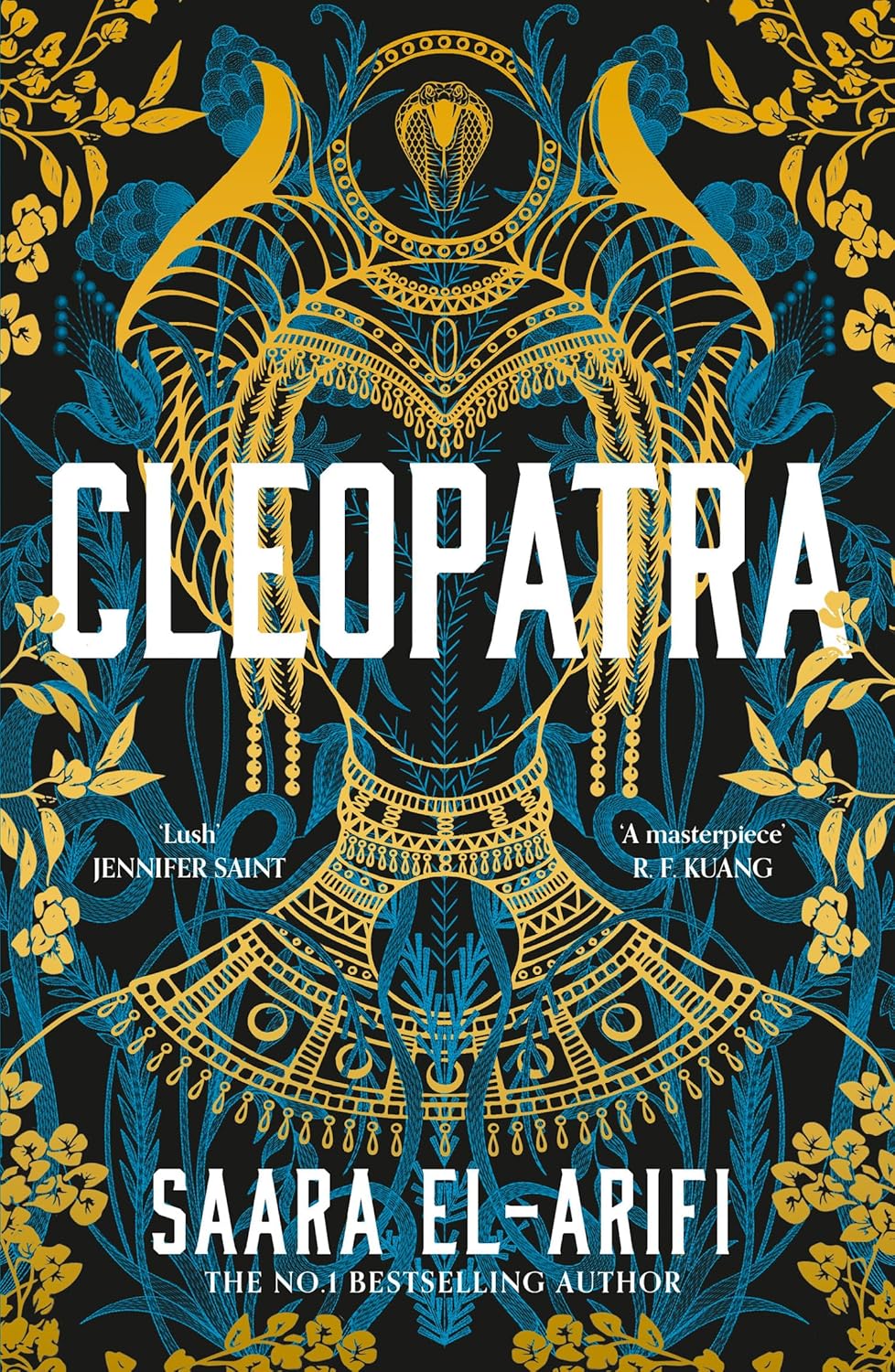
Cleopatra narrates her own story from a perspective that remains obscure until the end of the novel. The novel begins with the death of Cleopatra's father Ptolemy XII and her own ascent to the throne of Egypt as the last Pharaoh: and it ends, of course, with her death.
Cleopatra, in this account, is a clever, learned woman, sometimes ruthless but also driven by love -- and not only romantic love, but also love for her children, her country, and even her siblings. The Egypt in which Cleopatra lives and rules is a magical land: the Ptolemies have been gifted by the gods, each having a birthmark and a magical talent bestowed by their patron deity. Cleopatra's patron is Isis, but she hasn't manifested any gift. In order to be accepted as a divinely-sanctioned ruler, she studies healing in secret.
El-Arifi's prose is sweeping and emotional, filling in the gaps in the historical accounts of Cleopatra's life. Cleopatra herself is aware of these accounts, and comments wryly that 'history is a disease, masquerading as truth'. Even in her lifetime she encounters prejudice based on the stories told by Romans and dissidents: she reminds Anthony that 'you must always know the story of the storyteller'.
Throughout the novel, Cleopatra speaks directly to the reader, commenting on her lack of foresight or her growing ruthlessness. Her siblings have plotted against her, and her lovers haved wives to return to. There is war, famine, and civil unrest. The breaking of the 'fourth wall' is at first intrusive, but becomes easier to accept as the story progresses -- though its rationale isn't clear until the devastating finale.
I didn't find it easy to warm to Cleopatra, though her love for her children (and to a lesser extent her lovers, Caesar, Marcus Antonius, and Charmion) made her more likeable. I also found the pacing uneven: major events in the final third of the novel were skimmed over, while Cleopatra's disguised adventures among commoners became repetitive. There were also some vexing typos: 'familial' rather than 'familiar', coins 'exchanging' hands rather than 'changing' hands. And when Cleopatra and Anthony admire some flowers, they're apparently looking at bougainvillea -- an anachronism, as it's native to south America.
Overall, though, this was an interesting and engaging novel. I liked the touches of magic realism, and the mundane trickeries that helped Cleopatra convince her people that she and her children were blessed by the gods. I also liked the emphasis on Cleopatra's intelligence and her taste for learning: 'the Library of Alexandria was my haven'. And that ending!
Thanks to the publisher and Netgalley for the advance review copy, in exchange for this full honest review. UK Publication Date is 26th February 2026.
No comments:
Post a Comment