Monday, February 23, 2026

2026/032: Maria — Michelle Moran

Dear Mr Hammerstein,
It may come as a surprise that I am writing to you, as it appears that the theater industry believes I am dead and can now make up whatever they wish about me... [opening line]

I read this for the prompt 'based on the top-grossing movie in the year of your birth'. Set in 1959, it's a novel about Maria von Trapp and her response to the forthcomming stage musical of 'The Sound of Music': her letter informs Hammerstein that she has 'several ideas about how the script can be fixed'. Hammerstein -- already ill with the stomach cancer that would kill him within a year -- is too busy (and possibly too nervous) to talk to her, so instead his secretary Fran has a series of conversations with Maria.

Moran has thoroughly researched Maria von Trapp's life, and especially her religious faith. Maria tells Fran about her unhappy childhood, her religious calling, her time with Georg von Trapp (not a martinet: apparently Maria was the stricter of the two) and the family's life in America after escaping (not over the mountains but on a train) from the Third Reich. Maria is at pains to right the record: meanwhile, Fran is wrestling with a romantic entanglement of her own. Can Maria's account of true love with Georg set her on the right path?

This was a quick and pleasant read, though I didn't really connect with either Fran or Maria. There were some interesting scenes of pre-war Austrian life, and I found the later story -- refugees in America, literally singing for their supper, with one of the children experiencing severe stage fright -- more interesting than the main narrative. It would probably have helped if I was a fan of (or even very familiar with) the film and the musical! Moran is a very readable writer, though, and the story was well-paced and compassionate.


Saturday, February 21, 2026

2026/031: Frankenstein in Baghdad — Ahmed Saadawi (translated by Jonathan Wright)

‘I made it complete so it wouldn’t be treated as rubbish, so it would be respected like other dead people and given a proper burial.’ [p. 27]

Baghdad, 2005: after the American invasion and occupation, just as the sectarian civil war is kicking off. Antique (junk) dealer Hadi, trying to retrieve a friend's remains after a car bomb, finds that body parts at the mortuary are all jumbled together, with little effort to reconstruct each corpse. He begins to assemble a body, picking and choosing from the scraps of anatomy that are in plentiful supply on the streets of Baghdad. But it's only when a hotel guard is killed by a car bomb, and his spirit is wandering in search of a body to reunite with, that the creature -- the Whatsitsname, says Hadi -- becomes animate. And the Whatsitsname is keen on justice: he wants to avenge the owners of each of his constituent parts. This endeavour is somewhat complicated by the fact that those parts will rot and fall off if he doesn't complete his vengeance within a certain, undefined period of time.

Add to this Hadi's neighbour Elishva, who's convinced that St George has promised the return of her son Daniel (lost in the Iran-Iraq war) and who believes the Whatsisname is Daniel, somewhat changed by his experiences; ambitious young journalist Mahmoud, who hears Hadi's story, writes it up as 'Urban Legends from the Streets of Iraq' and isn't happy when his boss retitles it 'Frankenstein in Baghdad'; and Co lonel Brigadier Majid, head of the Tracking and Pursuit Department, is wondering why his squad of fortune-tellers, astrologers and magicians can't predict where the Whatsitsname will strike next. (I did like this conceit: "... the Americans, besides their arsenal of advanced military hardware, possessed a formidable army of djinn, which was able to destroy the djinn that this magician and his assistants had mobilized." [p. 144]

As in Shelley's original, the creature is the most eloquent of the narrators. (Interestingly, most of the people who recognise the story as Frankenstein are remembering the Robert de Niro film.) When the Whatsitsname records his account of his actions, we begin to understand that there are many shades of criminality and innocence in both his victims and those he's avenging. He hopes for an end to the killing, so that he can rest. 'I’m the only justice there is in this country,' he laments.

This is a rambling novel, often blackly comic, sometimes phantasmagorical: a commentary on the continuing conflict, a satire on the American 'intelligence' that fails to predict or prevent 'serious security incidents'. The Whatsitsname's story is as poignant as Shelley's original, and his sense of a balance to be restored, of vengeance to be wrought, gives him more purpose than most of the other characters.

Sometimes gory, often featuring grim scenes of bombs and executions, Frankenstein in Baghdad was an unexpectedly enjoyable read. Perhaps there were slightly too many viewpoint characters: perhaps the ending is overly open. But it's a window opening on a culture, a society and a city that is constantly in the news: and it made me think.

Thursday, February 19, 2026

2026/030: White Eagles / Firebird — Elizabeth Wein

I was born in a nation at war. I grew up in the shadow of war. And, like everyone else my own age, I had been waiting all my life for "the future war". [Firebird]

Two short novels written for less-confident readers, featuring young female pilots in the Second World War: I listened to the audiobook, read clearly and evocatively by Rachael Beresford.

In White Eagles, 18-year old Kristina Tomiak is called up to join the Polish air force -- the White Eagles. Her twin brother Leopold is envious that his call-up papers haven't arrived. A damaged plane lands at the airfield, reporting an encounter with the Luftwaffe: the pilot is injured, the passenger is dead. Kristina needs to get precious information to Lvov -- and it's the end of August, 1939.

The rest of the story deals with Kristina's escape from the Nazis and flight across Europe, accompanied only an unexpected stowaway who's determined to get to England. It's an exciting and inspiring tale, told in the third person, with lots of grounding details (a pilot charging across a bed of marigolds to get to his plane; a friendly mechanic who's happy to be paid in Hannukah chocolate and apples) and all the peril, violence and terror that goes with the territory.  I enjoyed this, but loved Firebird more.

Firebird, set in 1941-42, begins with young fighter pilot Nastia (short for Anastasia: 'Naystia', not 'Nastier') defending herself to a tribunal: 'I am no traitor'. She's a loyal citizen of the Soviet Union, a true revolutionary: her father was involved in the execution of the Romanovs, and her mother was a spy. Now, as the Second World War descends on Russia, she must fight to defend the glorious Motherland. But all is not as it seems and when the battles begin, secrets are revealed and everything that Nastia once knew is challenged.

Despite having more flight experience than anyone else in her cohort, she's relegated to training pilots while the lads go off to the front line. But the Chief -- the only other woman instructor at the Leningrad Youth Aero Club, 'an abrasive, loud woman with bleached blonde hair... and a face that was always heavy with powder and lipstick' -- points out that new pilots must be trained. When they finally go to war, it's the Chief who inspires Nastia, and the Chief who Nastia follows in a desperate air battle. And when the Chief parachutes from her damaged plane, Nastia makes the decision that brings her in front of that tribunal.

The twist in this story delighted me: I've just listened to the final few chapters again. It's cleverly foreshadowed and thoroughly pleasing (and, as Wein acknowledges in her afterword, historically implausible). Nastia's first-person narrative, coloured with all the emotions of wartime, felt really immediate and compelling.

There's a third book in the 'War Birds' series, The Last Hawk, which I hope to be able to read soon. Though the novellas in this series were written for younger, less confident readers, Wein pulls no punches: there is brutality, assault and peril. And, alongside those, there is a strong sense of hope, pride and joy.

Wednesday, February 18, 2026

2026/029: Bread of Angels — Patti Smith

How can we leap back up? Get back on our feet, grab a cart, and start gathering the debris, both physical and emotional. Crush it into small stones, then pulverize them and as the dust settles, dance upon it. How do we do that? By returning to our child self, weathering our obstacles in good faith. For children operate in the perpetual present, they go on, rebuild their castles, lay down their casts and crutches, and walk again. [loc. 2494]

Another memoir from Patti Smith, author of Just Kids and M Train (the latter of which I have not read). Bread of Angels (the title refers to 'unpremeditated gestures of kindness') covers Smith's childhood, her years as a pioneering punk artist, and her 'walking away' from success to have a real life, marrying Fred 'Sonic' Smith and having children. That period is mostly elided: 'Our life was obscure, perhaps not so interesting to some, but for us it was a whole life' and later, 'The trials and challenges that Fred and I suffered were our own'. 

Then came a catastrophic period when she lost several of the men close to her -- Robert Mapplethorpe, Richard Sohl, Fred, and her own brother Todd. This sparked her return to music, and recording, after an absence of 15 years. Further touring, and another series of deaths, revelations and reunions: and travel, and touring. I saw her on the tour commemmorating the 50th anniversary of Horses ('bred in an innocent time and we did our best to now deliver it infused with experience') and she was marvellous -- exactly as I'd expected.

There are many, often abrupt, shifts of tone and language in Bread of Angels: from simple accounts of her childhood and family life to exuberant evocations of performance ('my whining Fender Duo-Sonic drew altruistic swords with the mournful wailings of Lenny’s Stratocaster, Richard Sohl introduced an unexpected melodic shift creating the melancholic beauty of Abyssinia'). Sometimes you can hear the voice of the woman who wrote the lyrics to 'Horses': sometimes she's talking about the boat in their back yard (I can sympathise!) or the beauties of the natural world, the 'many tongues of nature... the language of trees, and the clay of the Earth'.

A fascinating read: I'm now more inclined to read M Train, which apparently focusses more on her life with, and grief for, Fred.

Tuesday, February 17, 2026

2026/028: The Kite Runner — Khalid Hosseini

"There is only one sin, and that is theft... When you kill a man, you steal a life. You steal his wife's right to a husband, rob his children of a father. When you tell a lie, you steal someone's right to the truth. When you cheat, you steal the right to fairness.”

This novel, by an expatriate Afghani author, explores guilt, betrayal and redemption in Afghanistan. The narrator is Amir, son of a wealthy Pashtan father ('Baba'), whose mother died giving birth to him. His closest friend is Hassan, the son of Amir's father's servant Ali: his mother ran away when he was little. The Hazara (the ethnic group to which Hassan and Ali belong) are oppressed, discriminated against and mocked. Baba, to young Amir's horror, treats Hassan as well as he treats Amir himself. The boys enjoy the traditional Afghan sport of kite-fighting, and Hassan is Amir's 'kite runner', pursuing the conquered kites with preternatural accuracy.

Amir's greatest kite-fighting triumph -- when Baba will finally be proud of him -- is overshadowed by Hassan being attacked and raped by a local bully, Assef. Amir witnesses the attack but is too scared to intervene. He's unable to reconcile his guilt and their friendship, and becomes cold and cruel towards Hassan. Eventually he fakes a theft and forces his father to dismiss Ali and Hassan.

Five years later comes the Soviet invasion: Baba and Amir escape, ending up in California. And fifteen years after that, Amir -- now married, though childless, and still racked with guilt -- receives a letter from a family friend, asking him to come back to Afghanistan: 'There is a way to be good again'.

This was a fascinating insight into Afghani life, and a harrowing story. (I listened to the audiobook, very well read by the author: I think I might have stopped reading if I'd had a print/Kindle copy.) Hassan's unrequited loyalty was pitiable: Amir's cowardice -- which extends into his adult life, in some respects -- was contemptible: I sympathised with both. At the heart of it, for me, was Amir's relationship with his father, and his fragile sense of superiority when it came to Hassan. Amir is shattered when he realises that his father, who's always insisted that theft is the worst crime and that a lie is theft of the truth, turns out not to have been wholly honest with him.

The final third of the novel, set in Taliban-controlled Afghanistan, is horrific. Power corrupts, and bullies don't change... There is a happy ending of sorts, but that doesn't stop The Kite Runner being tragic, distressing and harrowing. It's also an excellent insight into life as a refugee in America, though sadly things seem to have been easier for immigrants in the 1980s than they are now.

One drawback of audiobooks is that I can't keep a record of the bits I really liked. But there were some excellent descriptions of daily life and of landscape, and the various journeys out of and back to Kabul were rivetting.

Sunday, February 15, 2026

2026/027: Nonesuch — Francis Spufford

...here they still were, since they were not the dead ones, under the weary yellow lighting, sharing the unspoken knowledge that, every night the bombers came, ten thousand possible exits from life opened silently, and unpredictably, and without appeal, down which anyone and anything could fall. [loc. 4817]

My initial review: rereading for this 'proper review' was sheer delight, and I am eager to read the second half of this duology.

The story begins in August 1939. Iris Hawkins lives in a Clapham boarding house, works at a City brokerage, and is fascinated by economics. One evening, she flees a disastrous date and ends up at a bohemian dance club, where she encounters the other two protagonists: Geoff Hale, a gawky engineer who works for the BBC, and Lall Cunningham, the icy recipient of Geoff's unrequited love. Iris intends her seduction of Geoff to be a one night stand, but things become more complicated when she's pursued by a monstrous, inhuman creature which turns out to have something to do with Hale Senior's role as archivist of an occult society.

Spufford's depiction of London in the first year of the Second World War is tremendously evocative, often cinematic. The beauty of silently-falling incendiaries contrasts with the squalor of piss-reeking shelters: the ironwork of Leadenhall Market (still a working market back then, stinking of blood) with the soda-water effervescence of a liberated spirit. Did I mention that this novel has strong elements of the fantastical? There are Biblically-accurate angels in the architecture, and indications that history has been changed in the past -- and could be changed again.

I loved Iris, who is competent, intelligent and sensual. Her interest in economics made it interesting to me -- even the fluctuations of the Stock Exchange index, reflecting events in the wider world, felt integral to the story. (I think Spufford's said that she was partly influenced by C S Lewis' Susan: Iris demonstrates that you can like stockings and lipsticks and boyfriends, and still be clever and resourceful.) But I also found myself warming to Lall, despite her fascist allegiance. She too is smart and quick-thinking: she too is brave and determined. Though she's technically the villain of the piece, I kept cheering for her -- for instance, when she's confronting a pair of elderly perverts in pursuit of initiation into an esoteric order. (Also, she saves the cat.) Geoff, seen through Iris' eyes and her growing appreciation, is also intriguing: I'd have liked more of his viewpoint, and his engineering work for the war effort.

But the focus is always on Iris. This is a distinctly female-oriented, and feminist, novel. I was impressed by Spufford's sex scenes, written from Iris' perspective, and the ever-present practicalities of contraception. And I also enjoyed the ways in which Iris, denied agency by the double standards of the time, claims that agency by demonstrating her intelligence, courage and wit.

There's a lot more I could write about here: economics, and John Maynard Keynes, and the homoerotic murals in artist Eleanor's Sussex farmhouse; fascism ('practical patriotism') on the streets of Chelsea; the precarious calm and magic of Midnight Mass in 1940; the demographics of the clientele of a brokerage firm that's partly Jewish-owned. But instead I urge you to read this novel, because despite the setting and the stakes it is brimful of joy.

Thanks to the publisher and Netgalley for the advance review copy, in exchange for this full honest review. UK Publication Date is 24th February 2026.

Thursday, February 12, 2026

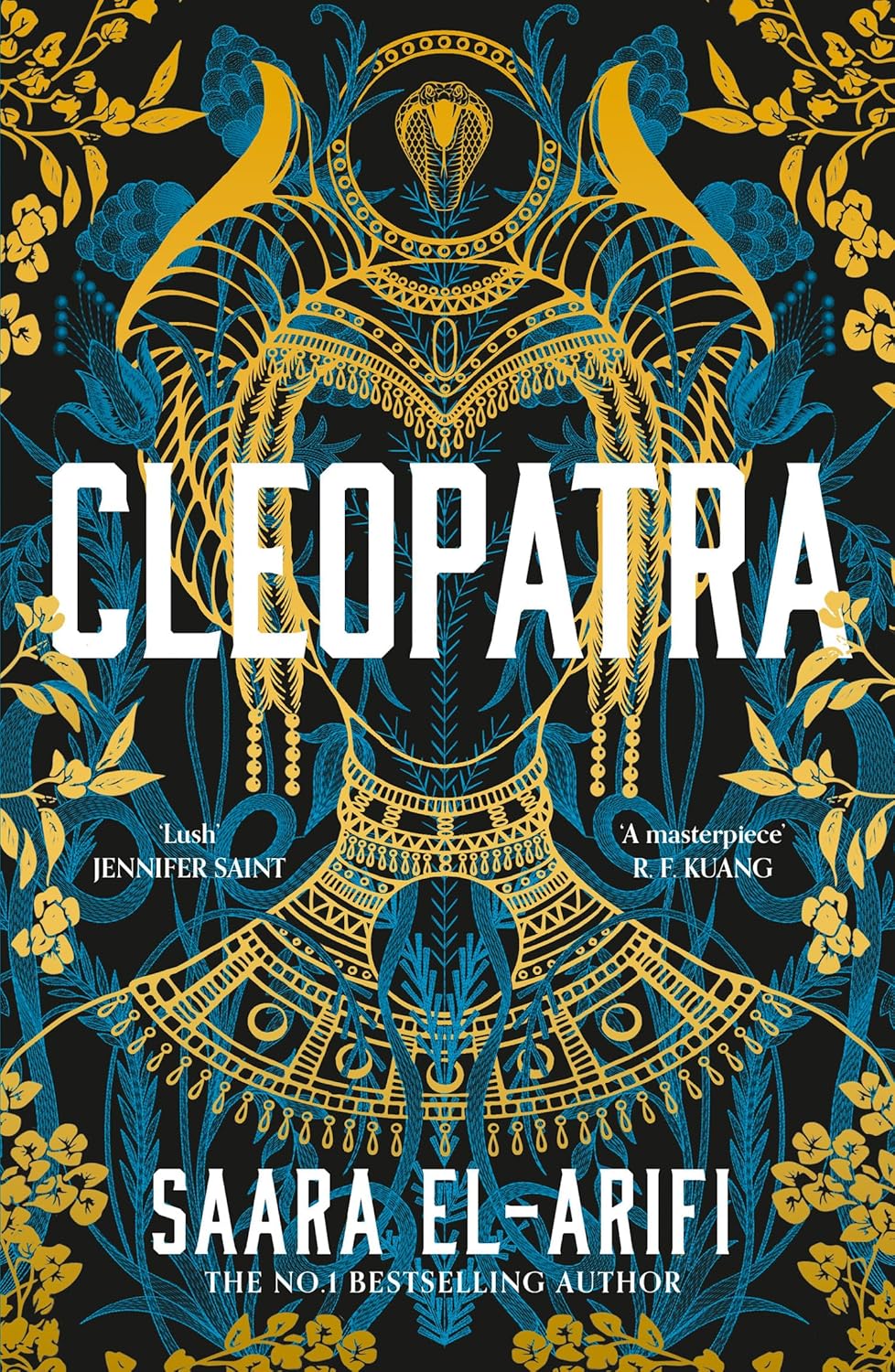
2026/026: Cleopatra — Saara el-Arifi

"They'll tell stories of you in years to come," Charmion continued.
Centuries. Millennia.
"I hope so."
I did not understand what it was I wished for. I hoped to become a legend, but I forgot what all stories must have: a monster.
I could not have known that monster would be me. [loc. 452]

Cleopatra narrates her own story from a perspective that remains obscure until the end of the novel. The novel begins with the death of Cleopatra's father Ptolemy XII and her own ascent to the throne of Egypt as the last Pharaoh: and it ends, of course, with her death.

Cleopatra, in this account, is a clever, learned woman, sometimes ruthless but also driven by love -- and not only romantic love, but also love for her children, her country, and even her siblings. The Egypt in which Cleopatra lives and rules is a magical land: the Ptolemies have been gifted by the gods, each having a birthmark and a magical talent bestowed by their patron deity. Cleopatra's patron is Isis, but she hasn't manifested any gift. In order to be accepted as a divinely-sanctioned ruler, she studies healing in secret.

El-Arifi's prose is sweeping and emotional, filling in the gaps in the historical accounts of Cleopatra's life. Cleopatra herself is aware of these accounts, and comments wryly that 'history is a disease, masquerading as truth'. Even in her lifetime she encounters prejudice based on the stories told by Romans and dissidents: she reminds Anthony that 'you must always know the story of the storyteller'. 

Throughout the novel, Cleopatra speaks directly to the reader, commenting on her lack of foresight or her growing ruthlessness. Her siblings have plotted against her, and her lovers haved wives to return to. There is war, famine, and civil unrest. The breaking of the 'fourth wall' is at first intrusive, but becomes easier to accept as the story progresses -- though its rationale isn't clear until the devastating finale.

I didn't find it easy to warm to Cleopatra, though her love for her children (and to a lesser extent her lovers, Caesar, Marcus Antonius, and Charmion) made her more likeable. I also found the pacing uneven: major events in the final third of the novel were skimmed over, while Cleopatra's disguised adventures among commoners became repetitive. There were also some vexing typos: 'familial' rather than 'familiar', coins 'exchanging' hands rather than 'changing' hands. And when Cleopatra and Anthony admire some flowers, they're apparently looking at bougainvillea -- an anachronism, as it's native to south America.

Overall, though, this was an interesting and engaging novel. I liked the touches of magic realism, and the mundane trickeries that helped Cleopatra convince her people that she and her children were blessed by the gods. I also liked the emphasis on Cleopatra's intelligence and her taste for learning: 'the Library of Alexandria was my haven'. And that ending!

Thanks to the publisher and Netgalley for the advance review copy, in exchange for this full honest review. UK Publication Date is 26th February 2026.

Monday, February 09, 2026

2026/025: The Dispossessed — Ursula Le Guin

... all the operations of capitalism were as meaningless to him as the rites of a primitive religion, as barbaric, as elaborate, and as unnecessary. In a human sacrifice to deity there might be at least a mistaken and terrible beauty; in the rites of the moneychangers, where greed, laziness, and envy were assumed to move all men’s acts, even the terrible became banal. [p. 130]

Technically a reread, but when I read this at the age of 14 or 15,  I didn't really understand it: I recalled very little of characters, themes or incidents.

The brilliant physicist Shevek comes to realise that the collectivist society of Annares, a moon colonised by an anarchist movement, is not conducive to his work. He travels to the 'home world', Urras, which is ebulliently capitalist. Eventually he realises that Urras, too, stifles his scientific creativity.

That's a brief and reductive summary of a complex novel, in which two separate timelines -- the years before Shevek's departure for Urras, and his time on Urras itself -- are twisted together, in alternating chapters, to show how neither cold, bleak Annares or lush, corrupt Urras nurture those who dwell there.

To me, the setting had a Cold War flavour: there's even a Wall between Annares and (access to) Urras. It borders the spaceport: does it keep the Annaresti in, or the Urrasti out? Annares' collectivism, and the relative lack of sexism, reminded me of Soviet Russia, as seen through the lens of Spufford's Red Plenty and Pulley's The Half Life of Valery K. Anarchists and revolutionaries on Urras dream of being reincarnated on Annares: 'a society without government, without police, without economic exploitation': there's little sense of the reverse being true, despite the kinder physical environment of Urras. And Annares society doesn't always adhere to its lofty ideals: academic infighting is part of the reason why Shevek has to leave.

This was written in 1974, and in some ways shows its age. The term 'Terran' feels dated, a golden-age word for Earthlings. And there's one scene, in which Shevek sexually assaults a manipulative socialite, that really jars my modern sensibilities. Nothing happens as a consequence: we never see the woman again: Shevek apparently forgets the incident. I wonder if Le Guin would have written that scene differently now?

Still not sure I fully appreciate the political elements, but I'm fascinated by the ways in which Odo's Revolution colours Annaresti life: in language, in custom, in the ways it's acceptable to speak. (No 'egoising', even for children. No private ownership: 'the handkerchief that I use' rather than 'my handkerchief'.) And how it has shaped Shevek, a man who will not compete for dominance and is thus indomitable [p. 116].

On Anarres he had chosen, in defiance of the expectations of his society, to do the work he was individually called to do. To do it was to rebel: to risk the self for the sake of society. Here on Urras, that act of rebellion was a luxury, a self-indulgence. [p. 271]

Sunday, February 08, 2026

2026/024: Wolf Worm — T Kingfisher

Some thoughts burrow into your mind as thoroughly as a wasp larva burrows into an unsuspecting caterpillar. [loc. 3387]

Set in North Carolina in 1899, this novel taught me more than I ever wanted to know about various parasitic insects. The narrator, Sonia Wilson, is a scientific illustrator who's accepted a position with the reclusive Dr Halder, who lives in an isolated, decaying house in the woods. En route, Sonia's local guide warns darkly that he's seen the Devil in these woods, but Sonia has been raised by a scientist and discounts this as mere superstition. 

She's not wholly charmed by her new employer, who won't tell her about the artist who painted half of his collection but wants her to finish the job. Sally, the maid, has a nice line in lurid tales of blood thieves, and local Native midwife Hezekiah Kersey says darkly that the land is 'alive and all of a piece'. But despite the Gothic ambience and Dr Halder's paranoia ('Are you spying on me, girl?') Sonia is determined to work hard, painting botfly larvae and certainly not following her employer as he sneaks out to the woods at night.

Sonia is an excellent protagonist. The author's afterword mentions that she was formerly a scientific illustrator, and that depth of knowledge shows in the descriptions of Sonia's work: how to blend watercolours, depict an insect's eye, and use a patented caterpillar inflator. I won't go into the specifics of the creeping horror pervading this novel, because I don't want to think too closely about that. But I will say that it's extremely effective, refreshingly unusual and thoroughly revolting. Ah, nature in her manifold glories!

Kingfisher's prose is smooth and readable, and often very funny: her imagination is ... unsettling, and her characters odd and interesting. I really enjoyed Wolf Worm, while simultaneously wanting to stop reading because ewww. Happy endings for many, though!

Thanks to the publisher and Netgalley for the advance review copy, in exchange for this full honest review. UK Publication Date is 26th March 2026.

Saturday, February 07, 2026

2026/023: Universality — Natasha Brown

What allowed some people to ‘make it’ while others faded away, as Hannah herself almost had? She knew it wasn’t a matter of hard work; she couldn’t have tried any harder than she did those last few years. Luck was a possible answer, but it seemed too callously random. Increasingly, Hannah felt another, truer word burning in her throat: class. The invisible privilege that everyone tried to pretend didn’t exist, but – it did. Hannah knew it did. She recognised it, and saw its grubby stains all over her own life. [p. 63]

A short novel about class, truth and culture wars. It begins with a 'long read', journalist Hannah's account of a lockdown-busting rave on a farm at the height of the Covid pandemic, and the drug-fuelled attack in which a radical anarchist is bludgeoned by a young man named Jake, wielding a gold bar. Except, of course, it's not quite as simple as that. Hannah's article takes considerable liberties with the truth, ruins the reputation of the farm's owner -- wealthy banker Richard Spencer -- and attracts the attention of anti-woke columnist Lenny, who is Jake's mother.

This short novel unravels and recolours the events described in Hannah's article, and shows us Hannah, Richard, Lenny and Jake in their natural habitats. (Also Pegasus, the victim of the attack.) Unfortunately, I didn't find any of them likeable, and though I appreciated Brown's satirical take on late-stage capitalism and cancel culture, I didn't find this an enjoyable read. Structurally interesting: mercifully short.

Friday, February 06, 2026

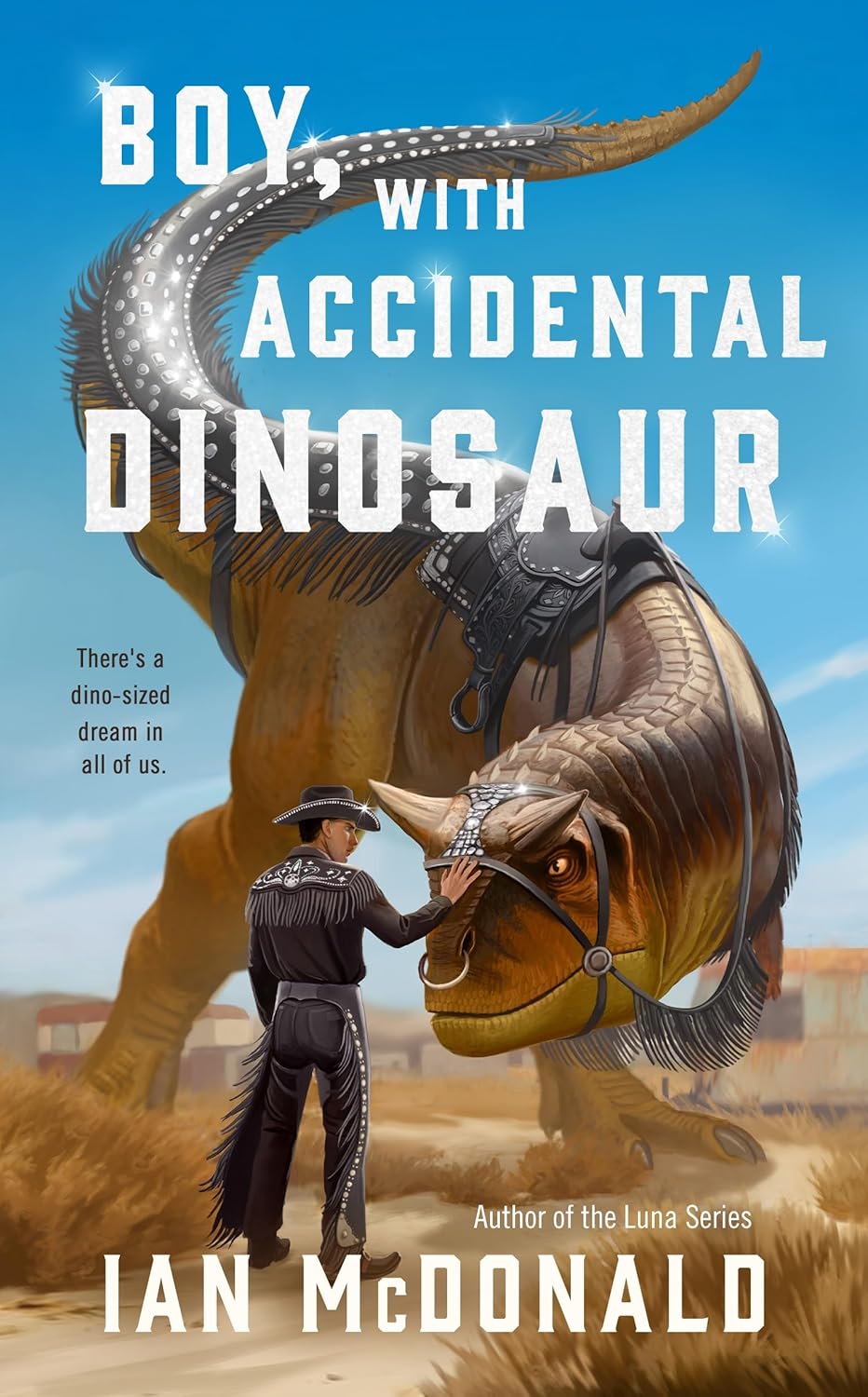
2026/022: Boy, With Accidental Dinosaur — Ian McDonald

Under a high blue heaven, under the zealous sun, the kid and his dinosaur travel a hot, empty highway. [first line]

Tif (short for Latif) is an orphan of Arab descent, whose ambition is to become a buckaroo at one of the dino rodeos. The novella's opening presents him, with his dinosaur, on a journey: only gradually are we shown where he's going, and why -- and where he's come from.

This is the post-apocalyptic future of the country formerly known as the United States of America, now a dangerous wilderness of miliciano gangs, religious states, and aggressive Dominion raiders. Tif's parents were killed in the South Dakota purification. He's recently been sacked from Dino! Dino! after a Timursaur escaped and wreaked havoc. Subsequently he's undertaken to return an old, maimed Carnosaur to the B2T2 time portal in the mountains of Colorado, and let it live out its remaining years 'under its own sun'. En route, he joins Memphis Red’s Tatterdemalion Circus; falls in love (or lust) with its star, the enigmatic Prince; and, perhaps, finds family.

That's the novella in a nutshell, but there's a novel's-worth of worldbuilding and characterisation here. McDonald doesn't waste time explaining the post-Chaos future, or the cyberpunk-flavoured Silver Clowns, or the Dust Tarot with which a Clown reads Tif's future. The B2T2 portal is a natural phenomenon, 'a place where two times lay up against each other, close as kittens, separated only by the finest layer of space-time fur, that could be stroked, and parted' [loc. 515]. That's where the dinosaurs are captured, and where they must be returned: 'leave no dangling timelines'. Naturally, the approach to the B2T2 is festooned with various flavours of protest camp.

There is danger, chaos and glamour; there is a strong sense of the cruelty involved in parading living creatures for entertainment. And there is so much emotional honesty and truth, in the backstories of the characters Tif encounters as well as his own journey. I would have loved this even more at novel length: but kudos to the author for keeping it tightly focussed and leaving the reader wondering about the wider world, the stories that happen outside the scope of Boy, with Accidental Dinosaur.

Something wild and magnificent and innocent is trapped and caged. Betrayed. For stardust, for floodlights, for the ronda and the roar of the crowd. For beer and nuts and nachos. [loc. 958]

Monday, February 02, 2026

2026/021: The Earl Meets His Match — T J Alexander

“The fact of your existence is a miracle,” Harding said in a tone that brooked no argument. “... the scrutiny that you must have lived under...”
“Well, I also have pots of money,” Christopher pointed out, “so let’s not pretend it’s all been a chore.” [loc. 3139]

Delightful and cheering Regency romance. Lord Christopher Eden must, according to the terms of his inheritance, marry before his twenty-fifth birthday. That gives him four months to find a bride -- which is the last thing he wants. For Christopher is no ordinary man: he has a singular secret, which only his tailor is privy to.

In order to present the proper appearance to the Ton, Christopher must engage a valet, even though he's never allowed another man to dress him. Enter James Harding, handsome and stoic and surprisingly understanding. Harding has secrets of his own, though, and their mutual attraction can never come to anything.

Or can it? ☺

Apart from a third-act crisis which gets the prize for 'most ridiculous miscommunication of the year' (yes, I know it's only February), this rolled along merrily, with some interesting insights into gender roles and practicalities in 19th-century England. Excellent female characters, too. I particularly liked the twist at the end, which was perfect for both Christopher and Harding.

Recommended to me by a friend: thank you, Nina! I shall look out for more by this author.

Sunday, February 01, 2026

2026/020: Once Upon a Time I Lived on Mars — Kate Greene

What if a mission to Mars didn’t have as its main goal a barrage of scientific studies, or the demonstration that humans can build ships to send us to faraway lands and keep us alive in the harshest environments? What if it’s not driven by the fear of our eventual extinction or by opportunities afforded it by current economic systems—mining for resources, etc. Or what if it is those things, but also, in its design, it contains questions about what it means to be a human being alive and alone and unable to achieve contact with others in this universe? [p. 131]

In 2013, Kate Greene spent four months as second-in-command of the Hawai’i Space Exploration Analog and Simulation (HI-SEAS) mission, which was designed to simulate life on Mars. The six crew members lived in cramped quarters, with artificial communication delays, pre-packaged food, constant surveys for one another's experiments, and compulsory spacesuits for excursions beyond the habitat. The essays that comprise Once Upon a Time I Lived On Mars -- subtitled 'Space, Exploration and Life on Earth' -- are all rooted in Greene's HI-SEAS experience: but that's a launchpad to discuss climate change, the breakup of her marriage, the history of space flight, and the thorny questions of whether humans should go to Mars, and who gets to decide.

In some ways this book, published in 2020, feels very dated. There's such a sense of hope for the various planned Mars missions (some of which were cancelled or postponed due to Covid) and for the possibilities offered by spaceflight. Reading in 2026, after Trump's cuts to the NASA budget and the damage to Russia's only launch facility at Baikonur, it feels like a lost future. And though Greene has major reservations about Elon Musk's role as cheerleader for the space programme, the book was clearly written before his more egregious exploits.

Yet there is a great deal of interest here. Greene is a science journalist, and her background shows in areas such as the assessment of whether all-male crews are the best option. (They're not: small women use half as many resources as large men, according to former NASA researcher Alan Drysdale.) I also learnt that Neil Armstrong's spacesuit was designed by Playtex, that Jeff Bezos 'dumps roughly $1 billion of his Amazon stocks into Blue Origin to keep the company in cash' [p. 175] and that, four billion years ago, the Moon was only 20,000 miles from Earth.

Often lyrical, often hopeful, but more about life on Earth than life on Mars.

I wonder about the arguments against going to Mars that claim we need to first focus on fixing problems here at home. Might going to Mars be a way to help us see our planet and ourselves anew? Couldn’t a human expedition to Mars be good for those on Earth too? Though, as with many things, it could very well depend on who does the going. [p. 162]