Thursday, March 26, 2020

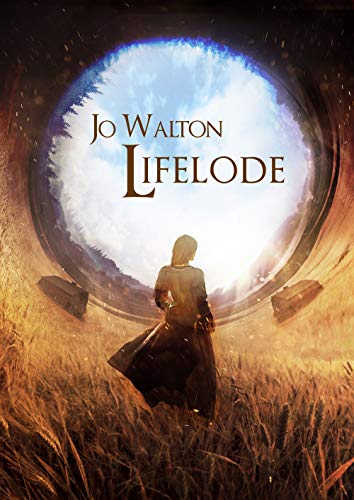
2020/034: Lifelode -- Jo Walton

Every year from the time she comes from Margam Taveth makes a huge plait which the harvest queen cuts at the festival. This is the last year she makes one, because later they remind her of Jankin and all that has happened. [loc. 1655]

If you travel east from the small village of Applekirk, you will eventually meet gods and lose your sense of self: and should you travel back towards Applekirk, you'll find that time has passed more swiftly there than it has for you. Travelling west brings you to lands without magic ('yeya', or more formally 'the aeaean arts') where the people are little more than automatons.

The scholar Jankin comes east to Applekirk and finds himself drawn to the women of the manor house, Taveth and Chayra. Hanethe, who grew up long ago in the manor house, flees west to Applekirk, pursued by a vengeful deity. Both Jankin and Hanethe bring change: and Taveth, who is at the heart of Lifelode (though by no means the only narrator), reflects on events of the past.

Except that for Taveth, past and present and future all blur together. She sees across time, sees the older and younger selves of those around her, sees everything but can change nothing: and thus 'the order of events is hard to set straight'. Lifelode is present-tense throughout, no matter who's narrating or whether the events are in 'the past' (the time before Jankin and Hanethe come to Applekirk) or not. This creates a sense of simultaneity: everything happens at once, everything is immediate. "She'll never get over it," says one character of Taveth's reaction to a tragedy: 'truthfully, for she never does'.

The underlying plot is simple, almost mythic: the vengeance of a goddess of marriage against someone who has offended her. (The offence is an interesting one, and the manner in which it's committed unique to this setting.) The goddess's vengeance is wreaked against those who shelter the guilty party: against Ferrand, the lord of Applekirk, and his wife Chayra, and his 'sweetmate' Taveth, and her husband Ranal. Jankin, entering stage left (or west), throws the family's interpersonal relationships into disarray: Hanethe, entering stage right (or east), brings social complications.

The world-building is fascinating: this is a world without notable gender roles (women, as well as men, are soldiers), a world where all kinds of sexuality (and none) are accepted and unremarkable, a world that may be flat, a world where gods and magic exist according to longitude. The focus of Lifelode, though, is on the family who hold the manor at Applekirk -- especially the women, and their relationships: with their children, with the villagers, with their lovers, who may be the people they fall in love with or simply the people they love. (I don't think there are any explicit M/M relationships here, though there's at least one F/F ...) It's a beautifully-crafted novel, with a vaguely medieval feel and a focus on the ways that people communicate (and don't communicate) with one another.

Lifelode -- the word refers to one's purpose, one's vocation and how one puts food on the table -- feels like a very summery novel. For all the magic and the grand themes, it's comfortable and comforting: exactly what I needed. Finally available in affordable ebook format, hurrah!


Wednesday, March 25, 2020

2020/033: The Clocks in This House All Tell Different Times -- Xan Brooks

“I’m sorry. There is no excuse for what I did. It’s too easy to say that we came back as beasts. We were beasts to begin with and then the war brought it out.” [loc. 3724]

Set in 1923, in a world still shadowed by the aftermath of the First World War. Lucy, fourteen, befriends Winifred, John and Edith when her grandfather arranges for her to go on Sunday-evening excursions to meet the Funny Men. These are four war veterans, each horribly disfigured, nicknamed after the characters in The Wizard of Oz: the Tin Woodman, the Lion, the Scarecrow and Toto (the latter in a wheelchair, his legs amputated). It's not initially clear that this is anything more than just, as the facilitator Coach says, giving these men the company of innocent children who 'are able to judge the quality of the man as opposed to what condition his hide is in'.

But all too soon it does become clear that the children are not just there for innocent companionship. They are there for what Winifred (known as Fred) calls 'Mench', short for 'Unmentionables': they are there because their guardians have prostituted them.

Fred says it can't be rape because they're getting paid. Lucy, the protagonist, is more worried about occasionally not hating it. She becomes quite fond of the Funny Men, especially the Tin Man. And when everything changes -- when Lucy and Fred find themselves drawn into the decadent, cocaine-fuelled, jazz-soundtracked social whirl at Goodwood House -- Lucy and the Tin Man manage, in a way, to save each other.

This is a deeply unsettling book, all the more so because it's often poetic and philosophical. In parallel with Lucy's story, there is the parable of Arthur Elms, who on the battlefield developed the ability to snap his fingers and produce flames. Arthur is not a likeable fellow -- he is referred to at one point as a 'discount Aleister Crowley' -- but it's interesting to see someone who has gained, rather than lost, from the war. The 'funny men' tell their war stories in the third person, an account of what happened to some other chap long ago: Arthur never tells his story at all.

The Clocks in This House All Tell Different Times offers a sobering depiction of England after the First World War (and the Spanish flu, which Lucy's grandfather blames as much as the war for his failing business). Economic decline, grieving widows, physical and mental trauma, and a lot of soldiers dropped back into normal life as though none of the horror had ever happened. There are some annoying anachronisms, some painful scenes and some beautiful ones, and moments of true courage and love: but it was hard for me to forget that the story was built on a foundation of child prostitution.

Sunday, March 22, 2020

2020/032: The Perilous Life of Jade Yeo -- Zen Cho

I've never once met a Briton to whom it had occurred that perhaps I spoke English because I am from one of their colonies. It is as if I were a piece of chess in a game played by people who never looked down at their hands. [loc. 330]

Short, sweet novella, presenting the diaries of Jade Yeo, a Malaysian immigrant to 1920s London. She makes a living writing for the Oriental Literary Review, which is run by her friend Ravi. Slating the new novel (The Wedding of Herbert Mimnaugh) by a darling of the literary scene, she encounters the author at a party and quickly discovers that he is dashing, romantic and married: and that 'any bauch he ever had has long been removed'.

Grist to the mill, thinks Jade ...

Jade Yeo is a thoroughly sensible, modern and pragmatic heroine. Her diary entries are written in a distinctive voice, sometimes hilarious, sometimes perceptive, sometimes both simultaneously. And she knows her own mind (at least most of the time), and her limitations.

Described by the author as 'basically Bloomsbury Group fanfic': can confirm. Delightful, fizzy and buoyant.

Thursday, March 19, 2020

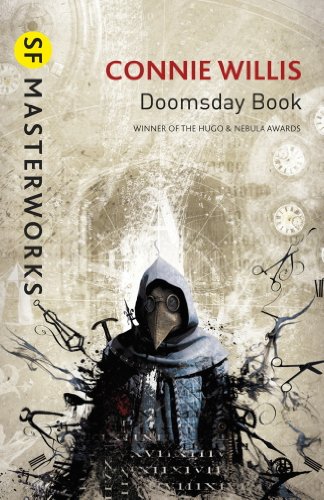
2020/031: The Doomsday Book -- Connie Willis

'In America, nobody would dream of telling you where you can or can’t go.’
And over thirty million Americans died during the Pandemic as a result of that sort of thinking, he thought. [p. 76]

After finishing Blackout / All Clear, I decided it was about time that I reread The Doomsday Book -- the first of Connie Willis' novels that I encountered, long ago and far away in the 1990s.

In some respects it has not aged well. The scenes in the fourteenth century are still excellent: but 1960s -- sorry, 2060s -- Oxford, with its lack of mobiles and email, with its mufflers and Americanisms and stubborn blinkered characters and lack of basic health and safety.... aargh. (To be fair, most of this did not bug me nearly as much on first reading.)

The premise: Kivrin is a young medievalist who persuades her supervisor, Professor Dunworthy, to send her to 1320s England. However, there are complications, and she ends up in 1348, when the countryside is ravaged by bubonic plague. Back (or forward) in 2060s Oxford, a plague -- a deadly new strain of influenza -- is ravaging Oxford, necessitating quarantine, incapacitating the one technician who might be able to bring Kivrin back, and stranding a group of bell-ringers who'd very much like to get to Norwich to ring a Traditional Peal.

The Oxford scenes are at once uncomfortably familiar -- anti-immigrant sentiment, resistance to a lockdown, people so focussed on their own concerns that the gravity of the situation barely registers -- and already alien. A lot of the Oxford half of the plot hinges, as in Blackout / All Clear, on communication issues: a key figure, needed for authorisation purposes, is uncontactable; Dunworthy is expecting several important calls, but can't stay by the phone all the time; one character's reassurance is misunderstood because he uses an Americanism. There's also a vocal minority who believe that the disease came, somehow, from the past -- that it was 'brought back' when Kivrin was sent to the fourteenth century.

But the medieval scenes (though not wholly historically accurate) are still marvellous and frightening. There is a real sense of isolation and deprivation, highlighted by what seems to be the failure of Kivrin's translation device. Willis doesn't shy from describing, in detail, the lingering death from the plague. Kivrin becomes attached to the family who take her in, especially the little girls Agnes and Rosamund: she also forms a bond with the village priest, Father Roche, who believes she is a saint. And she realises that she is stranded a very long way from home.

This was a strangely comforting read, despite the pandemic ravaging the modern world around me. Willis is generally good at characterisation (though I wasn't wholly convinced by 12-year-old Colin, or by some of the more single-minded Oxford individuals) and she knows how to pace a story. The two parallel narratives, Kivrin and Dunworthy, echo and mirror each other throughout: bells ringing, characters trying to communicate with others, over-fond mothers, revelations and reversals. Faith is all very well, but Dunworthy, I think, loses his: he thinks of an empty Heaven, and God unwilling to abandon his only son to suffering. As in Blackout / All Clear, though, love and human decency and care for others triumph over single-mindedness and stupidity.

But I'd have liked more about Kivrin, after.

Monday, March 16, 2020

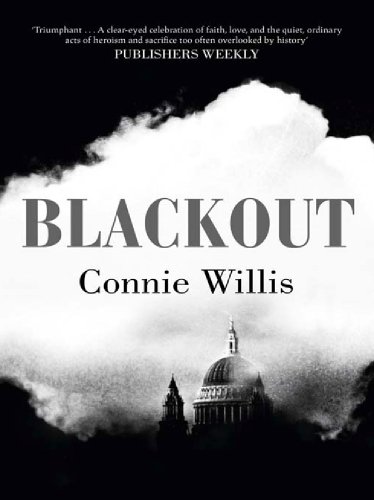
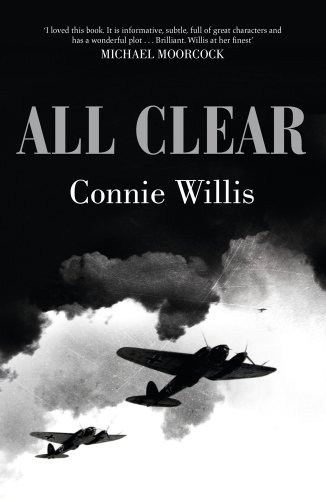
2020/029/30: Blackout and All Clear-- Connie Willis

‘Is it a comedy or a tragedy?’
He doesn’t mean the war, she thought. He’s talking about all of it – our lives and history and Shakespeare. And the continuum.
She smiled down at him. ‘A comedy, my lord.’ (All Clear, p. 734)

The premise: time-travelling historians visit London and the Home Counties in the dark days of 1940, and can't get home, because their pick-up points stop working. And nobody has come to fetch them. World War II is always a difficult assignment, because there are so many divergence points where historians just can't 'land': these, according to theory, are the points at which the presence of a time traveller could change history itself. So Polly, Eileen, and Michael are trapped in (mostly) London in the Blitz. For fourteen hundred pages.

I hadn't read this long, two-volumed novel before -- I have to be in the right mood for Connie Willis -- but it suited my appetite for cosy catastrophes, so I dived in. And it was a very enjoyable read.

Polly seeks work as a shop assistant, aiming to observe the people who shelter in tube stations: she joins an amateur dramatics group. Michael has gone to 1940 in the hope of seeing heroes in action: it's impossible to reach Dunkirk itself, but he hopes to spend a couple of days talking to the weekend sailors and retired captains who make the crossing. And Merope, known as Eileen for her sojourn in the 20th century, is observing child evacuees at a stately home in the countryside, and wondering darkly if the brattish Hodbin siblings are Hitler's secret weapon.

None of their assignments goes according to plan: and the ways in which circumstance conspires are intricately woven together. Each of them forms strong emotional (though not romantic or sexual) bonds to the 'contemps' they encounter; each is terrified at the destruction around them, and yet able to see the beauty in both firestorms and everyday bravery; each makes a lot of poorly-informed assumptions and decisions, risks death, and changes lives.

I think I was put off, when Blackout was first published, by several reviews pointing out basic errors: the Jubilee line didn't exist in 1940; you don't make a phone call from a pillar box; a phone call wouldn't cost '5p' ... I am happy to say that most, though not all, of those errors had been corrected by the time the Kindle edition was produced.

I do have some gripes, though. The characters (and not just the time travelling ones) seem incapable of getting around London except by public transport. There's a scene where they're on a train somewhere in the vicinity of Tower Hill and need to get to St Pauls, so they go to Monument and change to the Central line ... but the Central line isn't working, so they spend ages getting to, I think, Blackfriars. Instead of walking from Bank, which'd take about ten minutes.

Much of the novel's plot pivots on miscommunication, bad decisions, poor logistics, missed meetings ... I found this terribly frustrating and not a little repetitive. Worst were the scenes in 2060s Oxford, where apparently the mobile phone, email, pagers etc have been uninvented.

And, perhaps most damning of all, two of the characters appear twice, using different identities: and I couldn't tell. There was simply nothing to unify identity A and identity B.

All those gripes aside, I really did enjoy immersing myself in Willis' Blitz for a few days. There is a cosiness, and a very humane and compassionate sense of community, underlying this story. Love and beauty and art matter; sacrifices count for a great deal; tiny changes have immense effects: carry on, and don't despair.

Thursday, March 12, 2020

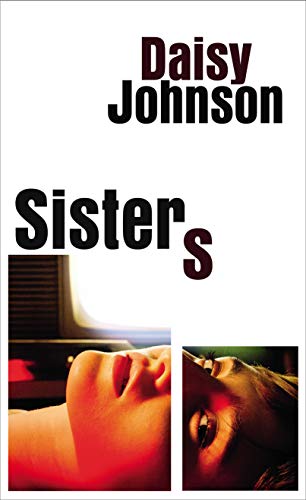
2020/028: Sisters -- Daisy Johnson

I am drunk. Yes. I think then, as I have so many times, she is the person I have always wanted to be. I am a shape cut out of the universe, tinged with ever-dying stars – and she is the creature to fill the gap I leave in the world. I remember the promise we made years ago, how we’d written it down so we wouldn’t forget... [loc. 724]

UK Publication Date now 13th August 2020, delayed from early July ... thanks to NetGalley for a free review copy in exchange for this honest review.

September and July, both around sixteen years old, are inseparable. They were born ten months apart and have been codependent ever since. Their mother Sheela, a British-Indian writer and illustrator, whose popular childrens' books are based on her daughters, feels excluded by their bond. September is the dominant one, the one who invents games ('September says lie in the road when the lights are red'), the one who demands that July shares her birthday, the one who withholds love as a form of punishment: the one whose anger makes her mother nervous. When July, the younger and less assertive of the sisters, falls prey to vicious school bullying, September seeks vengeance, with terrible consequences.

Sheela decides they need to leave Oxford and seek shelter in the house where September was born. The Settle House is an isolated place on the Yorkshire coast, intermittently let to holidaymakers by the sisters' aunt Ursa (sister of their dead father Peter), and broken into from time to time by the locals. The house is as much a character, a presence, as any of the humans who live there. There are secret passages in the walls; lightbulbs don't last; the house is full of noises, and there is a sense of busy-ness, 'a creasing in the air like the moment just after a train has passed'.

This is a claustrophobic and occasionally terrifying novel, quite different to Johnson's earlier Everything Under but sharing a sense of ominous forces just beyond the edges of perception. I reread for this review, and even knowing what was coming the lines 'this is not what happened' were thoroughly chilling, and the final few pages are harrowing. 'My sister is a black hole my sister is a bricked-up window my sister is a house on fire my sister is a car crash my sister is a long night my sister is a battle my sister is here.' [loc 1531]. That's where the horror lies, not on the beach in the dark, not in the old bird-watching hide, not in the overheated house with Sheela shutting herself away upstairs. While the 'twist', which I shan't explain or explore, may be predictable, its outcome is not.

I suspect Daisy Johnson will be an auto-buy for me in future: like Tana French, whose fiction has similarities of ambience, she combines the mundane and the strange, in excellent prose and without explication.

Sunday, March 08, 2020

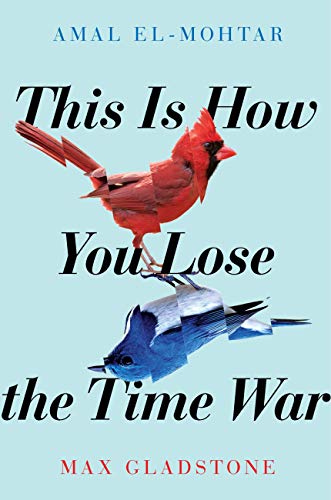
2020/027: This is How You Lose the Time War -- Amal El-Mohtar and Max Gladstone

Blue, as herself, cannot survive. Red, as herself, cannot reach her. But they have sprinkled bits of themselves through time. Ink and ingenuity, flakes of skin on paper, bits of pollen, blood, oil, down, a goose’s heart. [p. 179]

This is a difficult book to review: the prose is almost hallucinogenically vivid, the setting glittery with detail but hard to focus on, and the central love story -- of two soldiers on opposite sides of the eponymous Time War, each learning that they fit better with the other than with 'their' people -- as intricate and clever as a puzzle-box, and reliant on an innate understanding of chaotic cause-and-effect that may as well be magical.

Red represents the tech-flavoured Agency, Blue the organic growth of the Garden. They initially recognise one another as worthy opponents, and begin to correspond: but, for fear of discovery, by their own side or the other's, their letters must be encoded in the most baroque ways. Blue's first letter is marked 'burn before reading'; later communications are hidden in tree rings, in perforated bones, in a marine mammal's last, undigested meal. (If that last sentence sounds a little clunky it's because I was trying not to mention the puns: whacked seals, hoarse Trojans ...)

And someone or something is shadowing them, recovering the impenetrable remains of each letter.

Theirs is a beautiful love affair, replete with shared cultural references (Ozymandias, Chatterton, Naomi Mitchison's splendid novel Travel Light). I love the way the story flits from setting to setting, and the ways in which Red and Blue fit into each of those settings.

It's an accomplished collaboration: the two authors each wrote one character, and their styles are close and complementary enough that I didn't experience any disconnection between the two narratives. Also a very interesting read because while both protagonists -- and, I think, most of the other named characters? -- identify as female and use female pronouns, there are no particular gender markers. Indeed, both characters impersonate (?appear as, ?manifest as) males in one or more scenes. Writing Red and Blue as female is clearly a deliberate choice on the part of the authors, and I think it does change the ambience of the story: but it's hard for me to pinpoint how or why.

Luscious writing, mandatory suspension of disbelief, a reread required to reveal all the ways in which Red and Blue keep secrets from themselves and each other ... I'm glad I finally succumbed!