Monday, December 29, 2025

2025/206: The Children of God — Mary Doria Russell

What is it in humans that makes us so eager to believe ill of one another? ... What makes us so hungry for it? Failed idealism, he suspected. We disappoint ourselves and then look around for other failures to convince ourselves: it's not just me. [Prologue]

Audiobook reread, after listening to The Sparrow. It's many years since I last reread: here are my brief notes from 2007 reread. I stand by my original opinion, that this is not nearly as good or as well-structured a novel as The Sparrow. There is gorgeous prose, interesting ideas and a crowd of new characters: but there is also uneven pacing, political manoeuvring, and outright war.  There are, possibly, too many viewpoint characters, and a lack of the precise focus of the first novel. And there are several developments which felt unnecessarily cruel. ('She died last year.')

Narrated by Anna Fields, who manages the many accents and character voices -- across three species and a dozen nationalities -- admirably, with the sole exception of Northern Irish priest Sean Fein. I was especially impressed by her range of masculine voices.

I still hope for more SF from Mary Doria Russell, and I wish more of her books were available as ebooks in the UK.

Sunday, December 28, 2025

2025/205: Nonesuch — Francis Spufford

...it had to be done whole-heartedly or not at all. Not at all! voted Iris the chief clerk, Iris the careful calculator of odds, Iris the prudent investor. All in, all at once, and fuck it, voted the bad girl, and the lover, and the risk-taker, and the suburban slut not willing to be defeated by some whey-faced bitch of a fascist. [loc. 3855]

Another alternate history, in a sense, from Francis Spufford. Set in London during the Blitz, it focusses on Iris Hawkins, an ambitious young woman prevented from success in business by her gender, but determined to make the most of her natural gift for finance. She's also determined to enjoy life: she's sexually active, self-sufficient and eminently pragmatic. She hooks up with Geoff, a young and innocent BBC engineer, on a night out, and finds herself drawn into an occult underworld, an anti-fascist plot, and some unexpected statues.

On the one hand, my favourite read in December and one of my favourites of 2025: on the other, these terrible words which I was not expecting: 'To be continued'. Woe!

Thanks to Netgalley and the publishers! Proper review nearer publication, which is due 26 FEB 26.

Read an excerpt here, and listen to The Coode Street Podcast featuring Spufford.

2025/204: Crypt — Alice Roberts

In politically tense times, differences – rather than similarities – can easily be brought into sharp focus. And such differences can be exploited by any politician who ultimately cares more about their own power, or indeed some abstract idea of nationhood, than about the lives of ordinary people and the ordinary communities that they govern. [loc. 317]

Following Ancestors (which examined several prehistoric burials) and Buried (ditto, but Roman and early medieval), Crypt explores the discovery, social context and archaeological significance of a number of burials that date to between 1000 AD and about 1500 AD. There's a mass grave in Oxford: not fighters, but likely settled Danes slaughtered as a result of Æthelred the Unready's 1002 edict that “all the Danes who had sprung up in this island are to be destroyed by a most just extermination". There's a medieval hospital where 85% of the skeletons excavated showed signs of leprosy. There's Thomas Beckett, assassinated at the altar of Canterbury Cathedral and later beatified. There is the Justinian Plague, which -- contrary to usual narratives -- does seem to have reached Britain; an anchorite with syphilis; the sailors on the Mary Rose; and a cluster of skeletons in a cemetery near Runcorn, showing signs of Paget's Disease -- a disease now on the wane.

Some of the chapters interested me more than others: the chapter on Beckett, for instance, focussed mostly on the history of the assassination and subsequent relgious controversy, as -- thanks to Henry VIII's destruction of Beckett's tomb and suppression of his cult -- there were no actual remains to examine. I was fascinated, though, by the ecology of M. leprae, the mycobacterium that causes leprosy: apparently it is completely unable to survive on its own, and can't even be grown in a laboratory. The descriptions of the damage it inflicted on sufferers were horrendous, but I am thankful that it's not more infectious. Happy news: 40% fewer new cases of leprosy in 2019 than in 2014!

I found the discussion of archaeogenetics really interesting: not only the detection and evolution of various pathogens, but also the new method for detecting biological sex: 'the amelogenin gene appears on both the X and Y chromosomes, in slightly different forms on each. DNA analysis focusing on the amelogenin gene has become a standard method for determining sex in forensic cases' [loc. 1085]. And I applaud the ways in which Roberts brings past lives to life.

Saturday, December 27, 2025

2025/203: The Sparrow — Mary Doria Russell

‘At the end of his description of the first contact, in a locked file, Father Yarbrough ... wrote of you, “I believe that he was inspired by the Holy Spirit. Today I may have looked upon the face of a saint.”’
‘Stop it. Leave me something.’ [p. 298]

Audiobook reread on a lazy Boxing Day -- perhaps inspired by the excellent Jesuit priest in Snake-Eater. I first read this novel in 1997, when it was a submission for the Arthur C Clarke Award (which it won): some thoughts from an informal review back then. I hadn't reread since 2007, and was surprised at how much I remembered -- mostly about the humans, rather than the Runa and the Jana'ata.

The audiobook is splendidly narrated by David Colacci, who manages a huge range of character voices. Listening to the novel gave me a better appreciation of its structure: the pacing, the braided timelines, the suspense. And the pivotal scene, the scene where Sandoz's eager anticipation is destroyed, is incredibly powerful when experienced at speaking-pace rather than reading-pace.

I had a big argument with a well-known genre writer about this novel. He dismissed it as 'homophobic': I countered that the worst thing that happens to Sandoz is not with Hlavin Kitheri, but with Askama.

In some ways the novel is dated: AI is depicted positively, climate change is barely mentioned, and of course SETI has not picked up any songs: nor are we asteroid-mining. But the emotional and spiritual elements are timeless, precise and profoundly moving. Still one of my favourite SF novels ever, though often harrowing.

Monday, December 22, 2025

2025/202: The Riddle of the Labyrinth — Margalit Fox

The pull of an undeciphered ancient script comes not only from the fact that its discoverer cannot read it, but also from the knowledge that once, long ago, someone could. [p. 38]

Margalit Fox offers the 'first complete account' of the decipherment of Linear B, the earliest Greek script, which was first identified on tablets excavated by Arthur Evans at Knossos. Fox worked with the newly-opened archive of classicist Alice Kober's papers to uncover her role in decoding an unknown language, written in an unknown script, with unknown meaning. 

 Credit for Linear B's decipherment is generally given to gifted amateur Michael Ventris, whose debt to Kober's work -- as Fox puts it -- 'he acknowledged less conspicuously than he might have' [p. 262]. It was Kober who determined that Linear B was a syllabary script rather than an alphabet; that it was inflected; that it was possible to distinguish relationships between the characters without any knowledge of their meaning. It was also Kober who worked extensively on Arthur Evans' Scripta Minoa, at the expense of her own work and her health: it's tempting to see Evans as a dragon hoarding his treasure, not allowing anyone to publish work on, or even view original photographs of, the thousands of tablets he'd discovered.

Kober was hampered by class, gender and the need to support her widowed mother (who, in the end, outlived her). She never married, and there is no indication of any romantic relationship, though she had a close scholarly friendship with archaeologist John Franklin Daniel: when he died at the age of 38, she was devastated. Despite her gifts as a classicist and a linguist, she was only awarded the rank of full professor a few months before her death. And she was rejected by academia in favour of less-qualified men. Grr.

Fox brackets her account of Kober's life and work with sections on Evans (apparently incredibly near-sighted, a huge advantage for an archaeologist) and Ventris (who was a navigator during WWII and was known for working on Linear B on the way home from bombing raids). Fox is at pains to be fair to them, but it's clear that her sympathies are with Kober: as are mine.

A fascinating book with clear explanations of linguistic theory for the non-technical reader. And the whole story of Linear B and the tablets, baked to clay, which record slaves and stores, rations and resources, ties in very well with some of my other reading, from 1177 BC: The Year Civilisation Collapsed to The Hymn to Dionysus.

...what we have, then (and all we will ever have), are the records of the final year of each palatial center before some cataclysm—invasion, earthquake, lightning strike—and the subsequent fire reduced the Mycenaean Age to ash. [p. 272]

Saturday, December 20, 2025

2025/201: Skyward Inn — Alisa Whiteley

‘I put my hands in the mud and it said to come here. Mud, speaking to me in my head. They had a word for that when I was young: touched, they would have said. But here I am, and I’ll be touched if that is what’s next, because I felt certain it was Tom’s voice. Can you tell me—was it Tom’s voice? I suppose it couldn’t have been.’ [loc. 2155]

By the author of Three Eight One, this novel is set in the aftermath of interplanetary war. Two veterans of the war, Isley and Jem, have returned to the Western Protectorate (Devon and Cornwall: 'a small area of a small country that decided to secede from modern life, from space flight, from the Coalition and the conquering spirit of the new age') to run the Skyward Inn, née the Lamb and Flag. Jem is human, and comes from the nearby town, where her brother Dom (the Mayor) looks after her estranged son Fosse. Isley is a Qitan, from the side that lost: he's in charge of preparing the Qitan drink, 'brew', that the pub serves. It may be addictive, and it is certainly popular.

Things are changing, though. There are incomers at the deserted farm where Fosse hangs out, and they claim they can do magic. There's another stranger, a friend of Isley's, stranded and hiding in the cellar of the Skyward Inn. Outsiders threaten the precarious post-apocalyptic peace of the Protectorate, and raise issues of xenophobia, isolation, colonialism and the impossibility of communication between species -- or even between people, human people, who have every reason to yearn for mutual understanding.

I loved the wildness of the setting; was uneasy at the invasion of Fosse's private place, because it reminded me of my own childhood; and was deeply unsettled by the climax of the novel. Whiteley's prose is beautiful and her characters, though not always likeable, are solidly constructed with emotional depth and unspoken histories. I'm still not sure I liked this book but I found it fascinating and impressively understated.

2025/200: Unaccustomed Spirits — Elizabeth Pewsey

‘That’s no guitar, ignorant and misguided girl,’ said Sylvester. ‘That’s a lute. Strange tuning; it must be one of these authentic renderings.’
‘I can’t hear anything,’ said Adele.
‘Of course, the house is haunted,’ said Lily in matter-of-fact tones ...[loc. 578]

Comfort reread, which also fulfils my "reread beginning with 'U'" challenge. This is a very Christmassy romantic comedy, set in haunted Haphazard House, in Pewsey's imaginary northern county of Eyotshire. Familiar characters from the Mountjoy series (famous cellist Sylvester, his witchy housekeeper Lily, Val's son Thomas) appear, along with protagonist Cleo, her dastardly cousin Henry who wants to demolish the house but needs someone to housesit over Christmas, and Henry's Gothic housekeeper Mrs Grigson. 

Not to mention Lambert and Giles, the ghosts of the house, who (between eavesdropping on phone conversations and watching Star Trek) provide a running commmentary on Cleo, her friends and her dull fiance Perry. Giles is the lutenist, banished by Queen Elizabeth for ogling one of her favourites; Lambert the Roundhead, granted the house and the title after harrying the original occupants. 

There's some excitement in Cleo's trip to Hungary to rescue Prue, whose husband has fallen foul of the Party; there is amusement as dressmaker Adele and ghost-hunter Will negotiate a relationship; and there is unexpected romance, and Sylvester being awesome. Still a delight!

Thursday, December 18, 2025

2025/199: How to Fake It In Society — K J Charles

To marry a woman close to fifty years his senior, on her deathbed, for no better reason than money on his side and malice on hers -- it was contemptible. He'd be a laughing stock.
He'd be a rich contemptible laughing stock.
'All right,' he said. [loc. 131]

ARC provided out of the blue, waaaay before publication, with ideal timing as year-end werk-stress hit and several book-disappointments triggered a reading slump. This was a complete and utter delight, and cheered me immensely. John Julius Angerstein! Marie Antoinette! Diamonds! Painter's colours! Actors! Punctuation marks! Dashing rogues! Non-binary character! And a flawed and difficult romance that came right in the end...

Full review nearer publication date, which is 30th April 2026.

Tuesday, December 16, 2025

2025/198: Snake-Eater — T Kingfisher

Walter would . . . Her thoughts stopped there, because Walter would already have dropped dead of shock weeks ago. She was in a world where Walter no longer applied. [loc. 3355]

Selena is down on her luck when she heads, with her beloved dog Copper, to the remote desert town of Quartz Creek. She has $27 to her name, and has left behind a job in a deli and a gaslighting ex who's destroyed Selena's self-confidence. She's searching for her Aunt Amelia -- but Amelia, says the nice lady at the post office, died last year. No reason why Selena shouldn't stay in town for a couple of days, though...

The folk of Quartz Creek are odd but friendly, and Selena's new neighbour Grandma Billy is keen for Selena to move into her aunt's abandoned house. Grandma Billy is splendidly competent, despite some unsettling observations about Selena's glimpse of a man in green in her garden: a squash god, apparently, quite normal for Quartz Creek. And it turns out that Aunt Amelia had some connection with another god: a roadrunner spirit. As a Brit, I have no direct experience of roadrunners apart from the Loony Tunes cartoons. Apparently they are not at all cute, and they kill rattlesnakes. Selena is also ignorant of the species, which causes Plot.

Snake-Eater may have a setup reminiscent of The Twisted Ones (dead relative, abandoned house, faithful hound, increasing weirdness) but it's a much kinder novel, more about Selena regaining her strength and self-esteem and finding a different sort of family. It's also set in a lightly-sketched future, probably about fifty years from now: there's a moon colony, and rural depopulation means there's more space in the desert for non-human people. (That said, there's still the internet and mobile phones -- though Selena never switches on her phone in case the ex tracks her down, and she avoids the internet connection at the library because she can barely manage her own issues, never mind the world's.) And there's more humour than in Kingfisher's horror-oriented novels: I found myself laughing out loud more than once, not least at the perils of reading Clan of the Cave Bear at an impressionable age.

Love (but no romance), loyalty, an excellent Jesuit priest, and the importance of kindness to animals, plus some truly likeable characters: may we all land as softly as Selena, when we fall.

Sunday, December 14, 2025

2025/197: The Listeners — Maggie Stiefvater

Luxury felt like a different game when the people involved were officially enemies of the state. [loc. 1328]

Appalachia, 1942: the luxe Avallon hotel has been designated as an 'assembly point for Axis diplomats and their families' -- an arrangement made by the Gilfoyles. who own the hotel. June Hudson just runs it (and is conducting an ongoing clandestine affair with Gilfoyle heir Edgar: clandestine because she comes from an unsuitable, i.e. poor, background). The luxuries of the hotel, and the benefits of the mysterious 'sweetwaters' that bubble and flow beneath it, are turned to the service of Nazis and fascists, and it's up to June to keep the peace between the various Japanese and German factions, the hotel's staff, and the FBI.

June is one of the titular 'listeners', always aware of her guests' (and the staff's) emotional state, balancing the demands of the waters (which must not turn) with those of the people around her. Other listeners include Edgar Gilfoyle's younger brother Sandy, confined silently in a wheelchair by his war wounds; Hannelore, the adolescent daughter of a German cultural attache; the nameless resident of room 411, who refuses to leave when the other guests are asked to make way for the Axis diplomats. And, of course, Tucker Minnick, the FBI agent who comes from the same places as June, and shares her awareness of the waters -- which are, in a way, also listening, soaking up the emotions of the humans nearby.

It's hard to write about my reaction to this novel because I didn't really engage with it. I love Stiefvater's YA writing -- especially the Raven Cycle (starting with The Raven Boys) -- and had expected something more fantastical from The Listeners. I kept waiting for something ... something more to happen: perhaps it did, but too subtly for my increasing disengagement. As a character study of June Hudson, it's splendid: as a novel, it didn't work for me.

Saturday, December 06, 2025

2025/196: The Naughty List Manager — Remy Fable

"...Go see what this young man is really like. Then come back and tell me if he truly deserves coal in his stocking."
It was absolutely against protocol. It was wildly inefficient. It was a complete deviation from two centuries of procedure.
"I could leave tomorrow," Noel heard himself say.[loc. 61]

Short sweet Christmas m/m romance novella: Noel Frost, an elf, has been managing the Naughty List Department for over two hundred years. For the last decade, he's pulled the file of Ezra Vince, street artist and befriender of stray cats, who's been on the Naughty List for the last ten years. Noel is something of a stickler for the rules, but Mrs Claus sends him to investigate whether Ezra is actually Naughty or ... the other thing.

I was suffering from a surfeit of pre-Christmas crowds and hecticity: this was the perfect antidote. Nicely written, sweet, humorous and fun. There are more in the 'Claus Encounters' series...

Friday, December 05, 2025

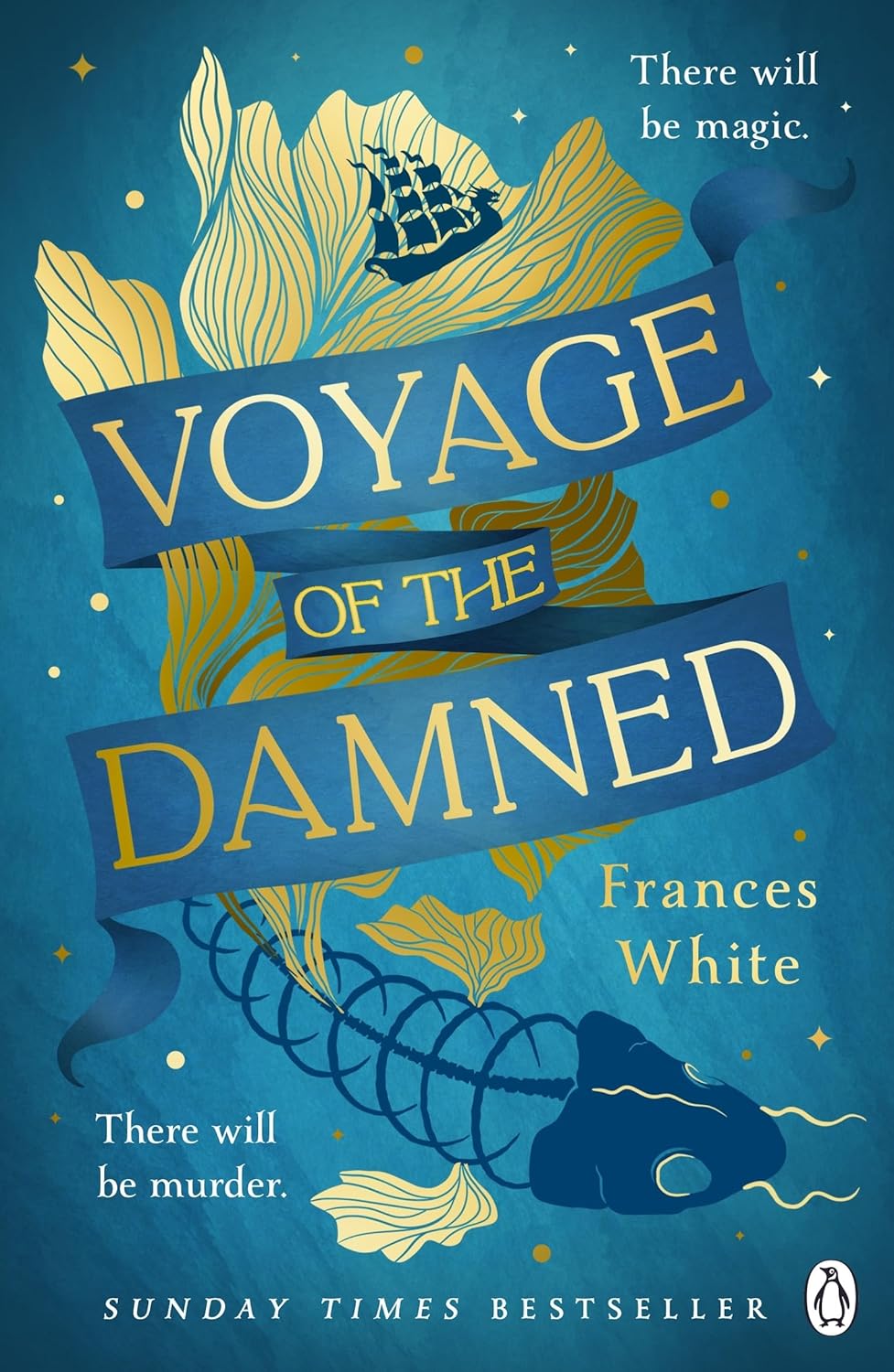
2025/195: Voyage of the Damned — Frances White

She’s cutting off the weak to save the strong. No, not even that. Cutting off the poor to save the rich. [loc. 6441]

There has been peace in Concordia for a thousand years: the twelve provinces are united against the threat of invasion, and each province has an heir who's been granted a magical gift, a Blessing, by the Goddess Herself. Voyage of the Damned begins just as Ganymedes ('Dee'), the representative of Fish province, is desperately trying to avoid embarking on the eponymous voyage -- to a sacred mountain, on the Emperor's own ship -- with the other eleven Blesseds. Dee has spent most of his time as Blessed playing the clown, alienating his peers, and overeating. Also, he has a secret which mustn't come out: he doesn't actually have a Blessing.

On board despite his best efforts, Dee comforts himself with the thought that at least he'll get to spend time with his love interest Ravi, the Crow Blessed. But on the very first night of the journey, one of the most popular of the twelve is murdered ... and she's only the first of the victims.

Aided by the six-year-old, sugar-crazed Grasshopper Blessed and the terminally-ill Bear Blessed, Dee is determined to unmask the killer -- if only to save his own life. He's not cut out to be a hero, he insists: but perhaps heroism is in the eye of the beholder.

I didn't quite get the hang of this novel. It was fun and twisty, but sometimes too silly: Dee is rather annoying at times, but more likeable as he opens up and displays his vulnerabilities: the worldbuilding is fairly basic, but there are lots of fascinating details. Not all of the characters are especially rounded, but each has secrets, flaws, allegiances and handicaps. It's a novel about outsiders -- being one, helping others -- and about self-doubt: and it's very much about class.

Despite my reservations, I did enjoy this novel, and I shall look forward to White's next book, due next year.

Tuesday, December 02, 2025

2025/194: The Year's Midnight — Rachel Neumeier

Tenai had come into Dr. Dodson's care raging with a fury so tightly contained that a casual glance might have judged her calm. She was not calm. Daniel did not need to be told this. He knew it from the first moment he saw her. [p.2]

Daniel Dodson is a gifted psychiatrist who's mourning the death of his wife, and struggling to raise their daughter Jenna. He's also fouled his professional record by whistleblowing an abusive colleague. Now he's working at a smaller institution, Lindenwood, where his first patient is a mute 'Jane Doe' who was found on the highway, threatening vehicles with a sword. She cannot be identified, and nobody can communicate with her.

Daniel persuades her to speak. Her name is Tenai, and the tale she tells is a fantastical account of another world where she made a bargain with Lord Death and avenged her family over a lifespan of centuries. Dr Dodson, eminently sensible, diagnoses her thus: "I think you encountered something in this world that you couldn’t live with, and so you invented another world to be from." He doesn't seem to notice the bursts of static that accompany her flashes of rage, or the way she only picks red flowers, from beds where no red flowers are planted. But the reader knows more than Daniel from the very first page... I'm still not sure if that's a good thing or not!

I was drawn into Tenai's story, and into her therapy, and into her growing respect and liking for Daniel Dodson. Sadly, that's only the first half of the book: the second half, though interesting -- Tenai, released from Lindenwood, becomes a martial arts instructor -- wasn't as interesting to me. I think what I liked most was the sense of worlds colliding, of Daniel's mild-mannered rationalism and Tenai's dark, epic history. She was less interesting when she'd faced the truth about her emotions.

I'd read more, though: there are another five books in the series, and from the brief excerpt included with The Year's Midnight, I believe Tenai will be going home. Or back.