Wednesday, September 29, 2021

2021/116: The Naturalist -- Andrew Mayne

I have to remind myself this isn’t some professional dispute in a journal over the results of a research paper. Two girls were murdered, and maybe many, many more. My goal is simply truth. I have to take my ego out of this. [p. 167]

There are more than enough femicides in the news, so why read fictional versions? I tend to avoid novels about serial killers who prey on young women, yet I did find The Naturalist readable, well-plotted and surprisingly sympathetic. To be fair, I made an incorrect assumption based on the sample chapters -- I thought the Big Bad would be supernatural -- and by the time I realised I was wrong, I'd been drawn into the story, and intrigued by the character of Professor Theo Cray, computational biologist and social misfit. Theo has been trained to spot patterns in chaos, and he is adept at applying the scientific method (and a comprehensive knowledge of biology, botany, ecology and geology) to the world around him. Not so adept at dealing with people ("What was I supposed to say when he mentioned her name? How was my face supposed to move? I don’t know." [p. 37]) and with some quite old-fashioned ideas, or perhaps unquestioned instincts, regarding women.

It's the usual thing: maverick lone wolf finds something that all the professionals have missed; he (or she) is mocked and ignored, but ultimately proven right, though not without idiosyncratic acts of heroism, a few broken laws, a couple of dead ends and one or more unnecessarily dead bodies. What made this murder mystery unusually interesting, for me, was Cray's use of science to unravel the case. He spots burial sites because of the mix of plants growing there; he recognises a predator's circuit in the pattern of crimes; he develops an algorithm to identify comparable murders, and observes that it's not that accurate -- it's just that there are many more murders than anyone has realised.

I found Cray annoying at times, but that was, I think, because of some aspects of his character: he doesn't score highly on empathy, in the sense of understanding how his actions might appear to others, and his attitude to women he finds attractive is, by his own admission, somewhat chauvinistic. But I liked him, and Mayne's prose, enough to acquire the next in the series.

Saturday, September 25, 2021

2021/115: What Abigail Did That Summer -- Ben Aaronovitch

We still don’t know where the talking foxes come from, what they think they’re up to, or why they’re up in my business. I gave one half a Greggs sausage roll once. Maybe they imprinted. [loc. 419]

A fun novella focussing on Abigail's adventures on Hampstead Heath: it's set in the summer of 2013, when Peter Grant is off in Herefordshire being menaced by unicorns, and though it doesn't really add anything to the main Rivers of London arc, it does establish Abigail as a competent, savvy and likeable young woman.

Teenagers are going missing, but only for a couple of nights, and without any physical or psychological damage apart from mild amnesia. Abigail is convinced the disappearances are connected. She begins to investigate, with the help of her new friend Simon and a shadowy organisation of talking foxes who are accomplished spies and detectives, and have picked up London slang from ... somewhere.

The foxes are awesome, and so is Abigail. She's a complex character with a difficult family life and enough courage and curiosity to make her a formidable wizard when she's older. And she takes a lot of weirdness in her stride, unlike Peter in the early books. This was a cheering read for a rainy Saturday, with Discworld and Hitchhiker's references and a sharp eye for London street life: I hope we'll get more Abigail from Aaronovitch.

Shout-out to Harold Postmartin's explicatory footnotes on London street slang. I was charmed.

Thursday, September 23, 2021

2021/114: Seducing the Sorcerer -- Lee Welch

...who was to say that worple horses didn’t eat pink silk eiderdowns? Whatever a worple horse was. [loc. 729]

Fenn Todd scrapes a living doing odd jobs for whoever'll employ him. He has no home, and very little hope. He still dreams of the horses he cared for on the estate where he grew up. When a loutish chap in a fancy embroidered jerkin offers him a horse of his own in exchange for digging a cesspit, of course Fenn jumps at the chance. But it's a cruel trick, because the 'horse' is a sad-looking affair of sacking and stuffing.

And there's a glowing rune on its chest, and it keeps following him.

Fenn finds himself a guest of the Court Sorcerer, Morgrim, who rumour claims is responsible for the drought that grips the country. Certainly it rains ceaselessly at Unket Tower, where Morgrim dwells. Evidence suggests that Morgrim is a black-dyed villain: but Fenn, much to his own surprise, finds the man charming, companionable and extremely attractive. Can he trust his feelings, though, in a place so beset with spells and hexes?

This is a warm-hearted romance with an ambience that reminded me of Diana Wynne Jones' works, especially Howl's Moving Castle. The world-building, though never the focus, is splendid: the rise of crystal-powered 'horseless carriages' and velocipedes; Morgrim's desire to abolish the monarchy, wholeheartedly supported by young Queen Aramella. I found Fenn's love and appreciation for horses truly moving, and I liked his distinctive narrative voice, which felt credibly rural and uneducated without making him seem unintelligent. Though at least some of Fenn and Morgrim's issues could have been resolved by better communication, neither has had much in the way of close relationships for many years: some reserve, some over-hasty assumption, is excusable. And I did like the fact that they were both in their forties, far past the first flush of youth.

Tuesday, September 21, 2021

2021/113: Mr Cadmus -- Peter Ackroyd

‘May I offer you a glass of sherry, Mr Cadmus? Or wine perhaps?’
‘We will drink our fill of golden sunshine. One of your national poets tells us this.’
‘I’m afraid I only have a Beaujolais from Tesco.' [p. 6]

Devon, 1981: two unmarried cousins, Maud Finch and Millicent Swallow, inhabit the end houses of a three-cottage terrace. The ladies are understandably alarmed when a Foreigner (easily identified by his yellow sportscar, green trousers and red sweater) moves into the middle house. However, the mysterious yet charming Mr Cadmus -- for it is he -- soon wins them over with chocolates, compliments and polite flirtation, and in turn the ladies introduce him to the social whirl of Lower Camborne. Unfortunately his arrival coincides with a string of alarming incidents, including an armed robbery at the Post Office, the abrupt departure of the vicar Anthony 'call me Tony' Beaumont, a murder or two ...

This short novel never quite gelled for me, perhaps because I was expecting something weirder. There were hints of the supernatural, and of an ambience suggestive of magic realism, but the actual story -- revenge for a crime committed during the war, tempered with a sharp satire on rural life in the early 1980s -- was depressingly mundane, and never quite resolved itself. A disappointment: I loved Ackroyd's early novels, and intend to reread them once they're available as ebooks (I have no idea why they haven't been published in this format), but this doesn't compare favourably.

Monday, September 20, 2021

2021/112: The Poppy War -- R F Kuang

"...You’ve brought down forces you don’t understand into your pathetic little material world, and your world would be infinitely more interesting if someone smashed it up for a bit.” [p. 464]

Rin is a war orphan, effectively a slave to her foster family: to avoid an arranged marriage and escape a life of poverty and oppression, she studies for the Empire's Keju test, which promises admission to the academies -- and she passes with flying colours. Her admission to the elite Sinegard academy brings its own challenges: in this respect, The Poppy War is a typical school story. Rin makes friends and enemies, clashes with teachers, discovers that she has hidden talents or gifts (in this case, shamanic powers), and is determined to use them and thus prove herself, despite her mentor warning her of the dangers.

Then it all goes grimdark, and there are some deeply unpleasant and upsettingly graphic descriptions of genocide, torture and desecration. It's easy to read Rin as monstrous, even if the reasons she has become -- or been made -- a monster are sympathetically depicted. The worldbuilding (and especially the theology) is interesting, as is Rin's character arc, but I found the increasing brutality, and the sheer misery, alienating, and I'm disinclined to read the rest of the series.

Fulfils the 'A Fantasy Novel by an Asian Author' prompt of the Reading Women Challenge 2021.

Friday, September 17, 2021

2021/111: Invisible Women -- Caroline Criado Perez

Routinely forgetting to accommodate the female body in design – whether medical, technological or architectural – has led to a world that is less hospitable and more dangerous for women to navigate. [loc. 5423]

The physical differences between men's bodies and women's bodies are not the only inequalities which Perez discusses. There are three major themes in this book: the female body, women's unpaid care burden, and male violence against women. I was most interested in the 'female body' content, as it introduced me to some fascinating data that I hadn't previously encountered. I did not know, for instance, that there is a safe, effective treatment for period pain -- something that plagued me for decades despite nurofen, codeine, mefenamic acid -- already on the market. It grants 'total pain relief over 4 consecutive hours’, with ‘no observed adverse effects’. Unfortunately it is marketed to men: it's Viagra.

I also did not know that 'cells differ according to sex irrespective of their history of exposure to sex hormones': for example, muscle-stem cells transplanted from a male donor won't regenerate in the way that cells from a female donor will. (I found this fascinating and weird: my further reading is noted at the end of this review.)

A lot of the book, with its relentless onslaught of figures, covered familiar territory, even if I wasn't aware of the specific data. As a woman at the lower end of the height curve, I am all too accustomed to a world designed for people taller, stronger and with a different distribution of fat and muscle. I have experienced sexism in every area of life, and am constantly aware of my physical vulnerability and the risk I take by being in possession of a female body in public. The only reason I don't have an unpaid care burden is because I am, in sociological parlance, 'unencumbered' by care responsibilities.

But I can still be enraged by the ways in which female experience is ignored, discounted or deprioritised. I was fascinated (and furious) by Perez' account of how female farming practices are dismissed: "Hoeing can be easily started and stopped, meaning that it can be combined with childcare. The same cannot be said for a heavy tool drawn by a powerful animal....female farmers in this area didn’t see yields as the most important thing. They cared about other factors like how much land preparation and weeding these crops required, because these are female jobs. And they cared about how long, ultimately, the crops would take to cook (another female job)." [loc 2650-2735] The perils of bias in voice recognition systems: "a woman who had bought a 2012 Ford Focus, only to find that its voice-command system only listened to her husband, even though he was in the passenger seat" [2922]. I wonder about statistics like this one: "among men and women who smoke the same number of cigarettes, women are 20–70% more likely to develop lung cancer" [3450] and how different the anti-smoking campaign might have been if the propensity had been reversed.

The book does present gender, and biological sex, as a binary. I don't think it aims to erase trans, nonbinary, intersex experience, but it certainly doesn't focus on them. Regarding 'the female body', I found it useful to mentally translate this as 'bodies assigned female at birth' (AFAB): while there are distinct differences between AFAB bodies and AMAB bodies, not all AFAB bodies belong to women, just as not all AMAB bodies belong to men.

This book made me very angry. It was refreshing, informative and infuriating. And it is extremely well referenced, for anyone wishing to read more on any of Perez' statements.

Fulfils the 'A Nonfiction Book Focused on Social Justice' prompt of the Reading Women Challenge 2021.

Thursday, September 16, 2021

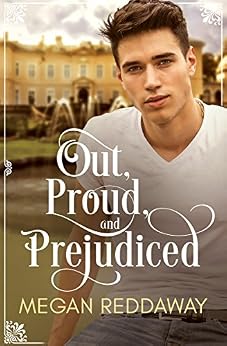
2021/110: Out, Proud and Prejudiced -- Megan Reddaway

Darius looked him up and down and said, "Just about fuckable, I suppose, but hardly up to my standards." [p. 13]

M/M modern AU of Pride and Prejudice. Bennet Rourke is a hospitality student: Darius Lanniker is a wealthy lawyer, slumming it with his friend Tim who's just bought an art gallery in Meriton. Tim falls in love with Bennet's housemate Jamie, but Bennet and Darius -- despite a frisson of sexual attraction between them, and a shared interest in rock-climbing -- do not get along. Bennet would rather hang out with Darius's stepbrother, Wyndham, and support his friends when drama strikes. Only gradually does he revisit his prejudices and assumptions, and realise that Darius is not the villain here.

This was fun, though there were a few plot threads that seemed to be left dangling (Bennet's family, for instance), and some characters who could have been more developed. I enjoyed spotting the parallels between this and Austen, and I like the way in which Reddaway kept the essential plot while giving it a thoroughly modern setting. Perhaps the enormity of Wyndham's crimes has, after all, the impact that Wickham's behaviour would have had in Austen's time -- though Wyndham is considerably more destructive to more people.